Visto n' Visa
Blog
Notícias e artigos
Destinations
Careers
Immigrants

Want to live and work in Hawaii?

Personalized immigration plan with eligible visas, costs, and next steps for your goal!

If you are not eligible, you will know exactly why and what to do to improve your approval chances.

Save up to 12 hours in meetings

No pointless assessments.

Save up to 90%

Save money on vague or unfocused consultations

Avoid Fraud and Mistakes

One mistake can cost you your visa

Total Impartiality

Zero commercial bias

Decide with peace of mind

No toxic urgency

Fast and Accurate

Answers in minutes, no guesswork

Get to know Hawaii

Tropical Pacific archipelago with a unique culture and the highest cost of living in the US.

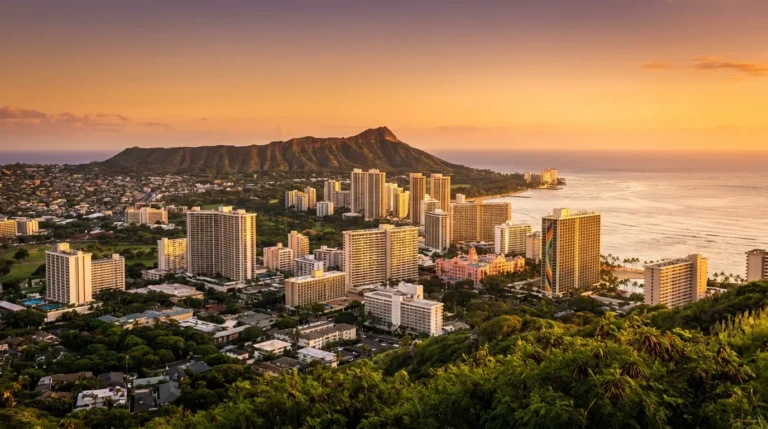
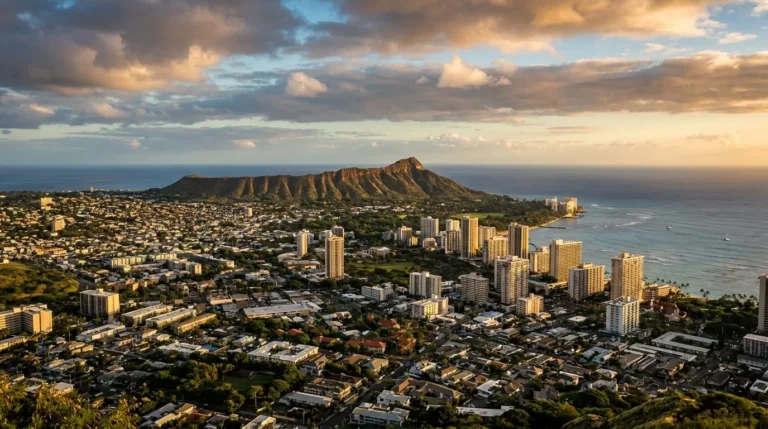
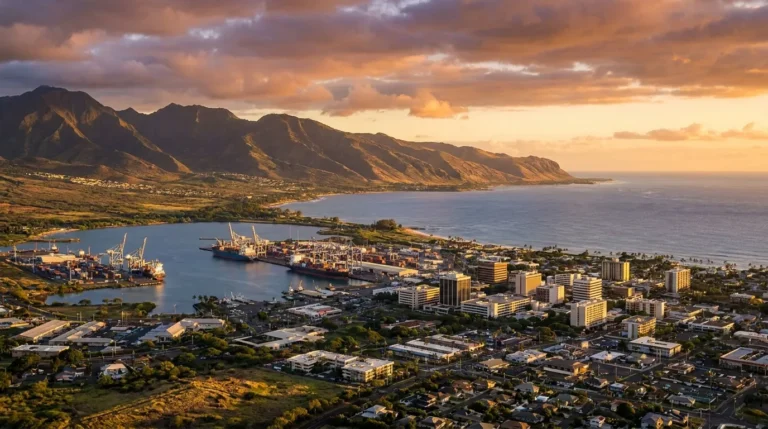
Hawaii is the most distant and unique of all US states. It is an archipelago in the middle of the Pacific Ocean, made up of eight main islands. The most inhabited are Oahu (home to Honolulu, the capital), Maui, the Big Island (Hawaii itself), Kauai, and Molokai. The distance to the mainland is significant: five to six hours by plane to California.

The capital, Honolulu, is on Oahu and concentrates about 70% of the state's population. It has a unique blend of native Hawaiian, Asian (Japanese, Filipino, Chinese, Korean), and American culture. The other islands are less urban, with economies focused on tourism, agriculture, and military bases.

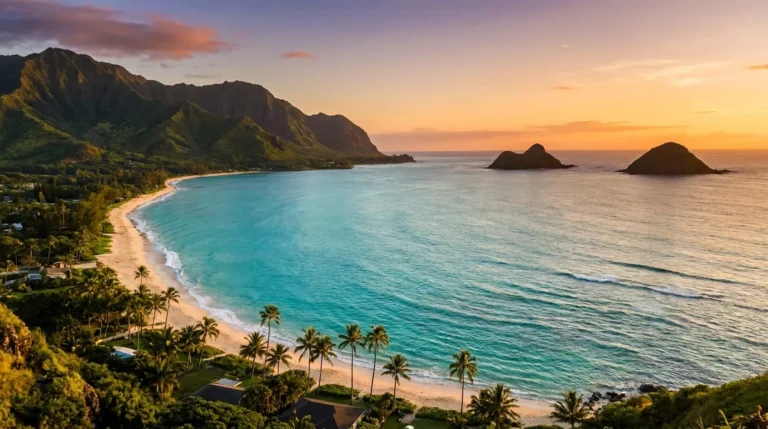
Living in Hawaii means living far from everything. Almost everything must be imported by ship, which makes prices some of the highest in the US. In return, the climate is tropical year-round, the beaches are spectacular, and there is a strong sense of community (called aloha spirit). It is not a place for those who want a fast pace, but for those seeking a different quality of life.

Population
1,440,196
Average monthly salary
62,500 USD/mo
21.0943°, -157.4983°

Featured places

Top 10 places in Hawaii

The places most sought-after by immigrants in this region.

Hawaii's demographics: the most Asian state in the US

Most of the population has Asian or Polynesian ancestry. No ethnic group forms a majority; it is the most racially mixed state in the US.

Hawaii is the only US state where non-Hispanic whites are not the majority. People of Asian descent (Japanese, Filipino, Chinese, Korean) make up about 37% of the population. Native Hawaiians and other Pacific Islanders form another significant portion. Whites from the mainland are also a substantial part, especially in newer developments.

Interethnic marriages are so common that Hawaii is considered the most racially mixed state in the US. Identifying as multiracial is normal. Native Hawaiian culture, though a demographic minority, remains present in festivals, hula dance, the Hawaiian language, and traditional practices.

The Brazilian community is small, with little organized presence. Most Latin immigrants in the state are Mexican or Central American, working in construction, agriculture, and hospitality. English dominates, but pidgin (a blend of English, Hawaiian, Japanese, and Filipino) is spoken informally among locals.

1,440,196
Population
40 yrs
Median age
86/km²
Density
$91,010
Median income
per year
Urban population92.0%
Foreign-born18.7%
Languages spoken
  • English
  • Hawaiian Pidgin (informal, among locals)
  • Hawaiian (traditional language, taught in schools)
  • Tagalog (Filipino)
  • Japanese
  • +2 more
Main religions
  • Christian (Catholic, Protestant)
  • No religion
  • Buddhism (Japanese, Chinese)
  • Traditional Hawaiian religions
  • Shinto
  • +1 more

Cost of living in Hawaii: the highest in the US

Rent, food, and gas all cost more because of the geographic isolation. Salaries do not always keep up.

Living in Hawaii is expensive. Rent for a one-bedroom apartment in Honolulu runs between $2,000 and $2,800/month in urban areas. On Maui or the Big Island, prices vary but rarely drop below $1,800 for something decent. Buying property is even harder: modest homes in Honolulu exceed $1 million.

Food is expensive because almost everything is imported by ship from the mainland. A gallon of milk (3.8 liters) can cost $8 to $10, versus $4 to $5 on the mainland. Casual restaurants charge $18 to $28. Gas is more expensive than the US average, and electricity rates are the highest in the country.

On the other hand, some services are not taxed and salaries in tourism, the military, and government are often adjusted for the cost of living. For remote workers earning mainland salaries, Hawaii can be viable. Those earning local low-wage salaries struggle significantly with the cost.

113Cost index (US = 100)13% above US average
CategorySingleCoupleFamily (2 + 2)
iHousing$1,463$1,688$2,138
iFood$428$855$1,553
iTransport$563$956$1,238
iHealthcare$315$630$1,181
iChildcare$2,048
iOther$956$1,721$2,419
Monthly total$3,725$5,850$10,577

Source: U.S. BLS Consumer Expenditure Survey 2023 + BEA Regional Price Parities 2023 · Estimates in USD, monthly.

Housing in Hawaii: extremely expensive and limited market

Land is scarce on the islands. Small homes at very high prices. Condominiums are a common option in Honolulu.

There is little available land and strict environmental laws in Hawaii, which keeps prices high. Homes in good Honolulu neighborhoods (Kahala, Manoa, Kailua) exceed $1.5 million and can reach $5 million oceanfront. Condos in Waikiki and downtown Honolulu high-rises are more accessible options, starting at $500,000 for something modest.

On the other islands (Maui, Big Island, Kauai), there is more space but prices are still high. Homes in residential areas range from $700,000 to $2 million. Tourist areas (Kihei on Maui, Princeville on Kauai) are higher. The Big Island has the most affordable options, with some volcanic areas having homes starting at $400,000.

Renting is the practical path for most newcomers. Landlords ask for proof of income, credit history, and references. Some communities have racial-cultural quota systems to preserve local character, though this does not prevent renting to foreigners. Many immigrants start in shared apartments.

Purchase price (m²)
  • Center$9,500/m²
  • Outside$6,200/m²
9.8×
Price-to-income
7.0%
Mortgage rate (20y)
Recommended neighborhoods
  • Kailua (Oahu, charm and beaches)
  • Manoa (Honolulu, near the university)
  • Hawaii Kai (Honolulu, suburban)
  • Kapolei (west Oahu, more affordable)
  • Kihei (Maui, beach)
  • +3 more

Job market in Hawaii: tourism and the military dominate

Hotels, restaurants, and tourism activities employ the most people. US military bases are the second-largest employer.

Tourism is the engine of Hawaii's economy. Hotels, restaurants, diving, surfing, helicopter tours, and luaus employ hundreds of thousands. Honolulu, Maui, and Kauai run on this. The pandemic showed how dependent the state is on the sector: when tourism stopped, the economy collapsed quickly.

The US Department of Defense has several bases in Hawaii: Pearl Harbor (Navy, on Oahu), Hickam (Air Force), and Schofield Barracks (Army). Military personnel and civilian defense workers form the second-largest economic pillar. Including families, more than 100,000 people are linked to the military.

Other sectors include tropical agriculture (pineapple, Kona coffee, macadamia), fishing, clean energy, the film industry (Jurassic Park, Lost were filmed there), and technology. Salaries in technology or the military are good, but tourism wages tend to be low. Remote work with mainland salaries has become a common solution.

$62,500
Avg net salary
per month
$29,120
Minimum wage
per month
3.0%
Unemployment
61.7%
Labor force
Dominant sectors
  • Tourism and hospitality
  • Military and defense
  • Tropical agriculture (Kona coffee, pineapple, macadamia)
  • Fishing and aquaculture
  • Renewable energy
  • +3 more
Major employers
  • US Department of Defense (multiple bases)
  • Hawaiian Airlines
  • Hilton Hotels
  • Marriott
  • Hawaiian Electric
  • +3 more

Education in Hawaii: unified state school system and few universities

The only US state with a single centralized school system. The University of Hawaii has campuses on the main islands.

Hawaii has the only unified state school system in the US: the Hawaii Department of Education administers all public schools, with no county or local district divisions. Quality varies, with schools in wealthier neighborhoods (Manoa, Kahala) receiving high ratings and others facing challenges.

Private schools are expensive but traditional and highly sought after. Punahou School (where Barack Obama studied), Iolani School, and Kamehameha Schools (oriented toward children with native Hawaiian ancestry) are the main ones. Tuition exceeds $30,000 per year. Charter schools are few but growing.

The University of Hawaii (UH) is the main university system, with the flagship campus in Manoa (Honolulu) and smaller campuses in Hilo, Maui, and other islands. UH Manoa has strong programs in Pacific studies, oceanography, astronomy (observatory on Mauna Kea), and Asian studies. Brigham Young University Hawaii is a private option.

Literacy97.0%
Tertiary education34.6%
478
PISA score (avg)
$17,500
Private school
per year
Notable universities
  • University of Hawaii at Manoa
  • University of Hawaii at Hilo
  • Brigham Young University Hawaii
  • Chaminade University of Honolulu
  • Hawaii Pacific University

Healthcare in Hawaii: broad coverage, better than the US average

Hawaii has one of the highest health insurance coverage rates in the US. State law requires employers to offer plans.

Hawaii has one of the best health insurance coverage rates in the US. Since 1974, state law has required employers to offer health plans to any employee working more than 20 hours per week. This ensures that most workers have coverage, even in tourism jobs.

The main hospitals are Queen's Medical Center (Honolulu, the state's largest), Kapiolani Medical Center for Women and Children, Kaiser Permanente Hawaii, and Maui Memorial. Hospital quality is good, but rare specialized care may require travel to the mainland, especially from the Big Island and Kauai.

Low-income families have access to state Medicaid (Med-QUEST), with more inclusive criteria than many states. Documented immigrants qualify after a waiting period. Undocumented immigrants have restricted access (emergencies, pregnancy, children). Community clinics serve patients on multiple islands.

Healthcare index78.0 / 100
  • Life expectancyyears at birth
    80.7yrs
  • Doctors per 1kpracticing physicians
    3.0
  • Health spendper capita, per year
    $9,200
  • Public systemoverall quality rating
    Good

Safety in Hawaii: one of the safest states in the US

Violent crime is rare. The most common problems are theft from tourists and car break-ins.

Hawaii consistently ranks among the safest US states. Violent crime is rare, mainly outside urban areas of Honolulu. Most communities on the islands are peaceful, with low crime and a strong sense of community.

The most common problems are car break-ins near beaches and hiking trails (leaving visible objects is an invitation for a broken window), minor theft at hotels, and scams targeting tourists. Honolulu has areas with more homeless residents (Chinatown, parts of downtown) with occasional issues.

Neighborhoods like Kahala, Manoa, Hawaii Kai, Kailua, Mililani, and Aiea are considered very safe. On Maui, Kihei and Wailea; on the Big Island, Waimea and Kona; on Kauai, Princeville. Most immigrants report no serious safety concerns. Local culture values mutual respect, which reduces tension.

2.5
Homicides per 100k
per year
Safety index
53.0
Crime index
47.0
Safer neighborhoods
  • Kahala (Honolulu)
  • Manoa (Honolulu)
  • Hawaii Kai (Honolulu)
  • Mililani (Oahu)
  • Kailua (Oahu)
  • Wailea (Maui)
  • Princeville (Kauai)
  • Waimea (Big Island)
Areas to avoid
  • Honolulu Chinatown at night
  • Wahiawa downtown
  • Kalihi
  • Pahoa isolated areas

Transportation in Hawaii: planes between islands, cars on land

No trains or ferries between islands. Short flights connect the islands. A car is necessary outside of Honolulu.

Hawaii has five commercial airports: Honolulu (HNL), the largest, on Oahu; Kahului (OGG) on Maui; Kona (KOA) on the Big Island; Lihue (LIH) on Kauai; and Hilo (ITO), also on the Big Island. Inter-island flights last 30-45 minutes and cost between $60 and $200 depending on the season. Hawaiian Airlines and Southwest dominate these routes.

Honolulu has TheBus, a bus system that covers Oahu reasonably well, and the Skyline, a recently inaugurated train connecting parts of the city. For daily life in Honolulu, it is possible to live without a car in some neighborhoods (Waikiki, downtown), but most residents have a vehicle.

On the other islands, a car is practically mandatory. Distances can be long and public transport is minimal. Renting a car at the airport upon arrival is common practice. There are small tourist ferries between some islands, but they do not serve as regular transport for residents.

1
Metro lines
9
Metro stations
28 min
Avg commute
47
Walkability
Airports
  • HNL (Daniel K. Inouye International, Honolulu)
  • OGG (Kahului, Maui)
  • KOA (Ellison Onizuka Kona International)
  • LIH (Lihue, Kauai)
  • ITO (Hilo International)
  • International airport
  • Bike infrastructure

Hawaii's climate: tropical year-round, with microclimates on each island

Warm and humid throughout the year. The windward sides of the islands receive heavy rain; the leeward sides are dry.

Hawaii has a tropical climate with little variation throughout the year. Coastal temperatures stay between 22°C and 30°C practically always. There are two subtle seasons: summer (May to October), slightly drier and warmer, and winter (November to April), with more rain and large waves on the north shore (drawing professional surfers).

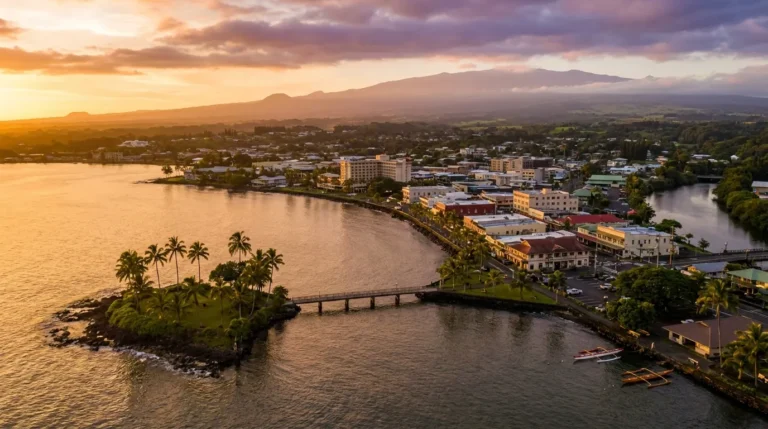
Each island has striking microclimates. The windward side (generally east and north) receives heavy rain: Hilo, on the Big Island, is one of the rainiest cities in the US. The leeward side (generally west and south) is dry and sunny: Waikiki, Kona, and Kihei have an almost desert-like climate.

There is also variation by altitude. The tops of Mauna Kea (Big Island) and Haleakala (Maui) can have snow in winter, a surprising phenomenon in the tropics. Hurricanes are rare but possible, usually weakening before arrival. Tsunamis are a risk the state takes seriously, with sirens and protocols in place.

Sunny days / year271 days
Avg high (°F)
  • 80°J
  • 80°F
  • 81°M
  • 83°A
  • 85°M
  • 87°J
  • 88°J
  • 89°A
  • 88°S
  • 87°O
  • 84°N
  • 82°D
Avg low (°F)
  • 67°J
  • 67°F
  • 68°M
  • 70°A
  • 71°M
  • 74°J
  • 75°J
  • 76°A
  • 75°S
  • 74°O
  • 72°N
  • 69°D
Rainfall (")
  • 2"J
  • 2"F
  • 2"M
  • 1"A
  • 1"M
  • 1"J
  • 1"J
  • 1"A
  • 1"S
  • 2"O
  • 2"N
  • 2"D

Hawaii's culture: aloha spirit, hula, surf, and Asian fusion

A unique blend of native Hawaiian, Asian, and American culture. Hula, ukulele, surfing, and luaus are part of the identity.

Hawaiian culture is unique in the US. It has deep Polynesian roots: hula (traditional dance), Hawaiian music, the Hawaiian language (taught in schools), and values like ohana (extended family) and aloha (a greeting that means more than hello -- it is a philosophy of respect). Festivals like the Merrie Monarch (hula, in April) keep traditions alive.

Asian influence is strong because of waves of immigration in the 19th and 20th centuries. Japanese, Filipino, Chinese, and Korean food are part of everyday life. Spam musubi (a local creation with Japanese influence), poke bowl, plate lunch, and shave ice are modern Hawaiian staples. Festivals like the Honolulu Festival celebrate this diversity.

Surfing is part of the identity. Hawaii is where modern surfing was born, and the North Shore of Oahu (Pipeline, Waimea Bay) hosts world championships from November to February. Diving, paddleboarding, and sailing are also part of daily life. The relationship with the ocean (kai) is cultural, spiritual, and practical.

90
Major museums
Notable dishes
  • Poke bowl (raw fish with rice)
  • Spam musubi (with Japanese influence)
  • Plate lunch (meat, rice, macaroni salad)
  • Loco moco (burger with egg and gravy over rice)
  • Kalua pig (traditional roasted pork)
  • +3 more
Annual events
  • Merrie Monarch Festival (Hilo, April, hula)
  • Aloha Festivals (September)
  • Honolulu Festival (March)
  • Ironman World Championship (Kona, October)
  • Pipeline Masters (North Shore Oahu, December)
  • +2 more
UNESCO sites
  • Hawaii Volcanoes National Park
  • Papahanaumokuakea

Hawaii's main economic sectors

Tourism is the engine. Military bases are the second pillar. Tropical agriculture, renewable energy, and fishing round it out.

Tourism is the largest sector of Hawaii's economy, accounting for about 20% of state GDP. More than 9 million visitors per year under normal conditions. Hotels, restaurants, tours, air transport, and activities depend on this. Small fluctuations in tourism (epidemics, recessions) affect the entire state.

The military sector is the second-largest employer. Pearl Harbor, Hickam Air Force Base, Schofield Barracks, and other facilities bring in billions in federal spending. Military families are part of the local economy. Hawaii is strategic for the US in the Pacific, ensuring continued investment.

Agriculture is specialized and export-oriented. Kona coffee, pineapple, macadamia, banana, and seafood (tuna, mahi-mahi) are recognized brands. The industry is also betting on renewable energy (solar, wind, geothermal) to reduce dependence on imported oil. Film and technology are growing in Honolulu.

  • GDPgross domestic product
    $99.0B
  • GDP per capitaoutput per resident
    $68,700
  • GDP growth (yr)economy expanding
    +2.2%
Top sectors
  • Tourism and hospitality
  • Military and defense
  • Tropical agriculture (coffee, macadamia, pineapple)
  • Fishing and aquaculture
  • Renewable energy
  • +3 more

Immigrant communities in Hawaii

About 290,000 immigrants live in the state. Filipinos are by far the largest group, followed by Japanese, Koreans, and Chinese.

Hawaii has roughly 290,000 residents born outside the United States, close to 20% of the population. Filipinos are by far the largest immigrant group, the result of decades of migration tied to sugarcane plantations and later to hotel and hospital work. They cluster in Oahu, especially in Waipahu, Kalihi, and Ewa Beach, with strong presence also in Pearl City and Hilo on the Big Island. Japanese, Koreans, and Chinese form older communities, today partly integrated but still visible in neighborhoods like Honolulu's Chinatown and Aiea. There is also a growing Marshallese, Chuukese, and Pacific Islander population from nations associated through the Compact of Free Association, living mostly in Honolulu, Waipahu, and Hilo.

The Pacific Gateway Center, the Legal Aid Society of Hawaii's immigration unit, and the Filipino Community Center in Waipahu cover most of the legal and social services. Honolulu hosts consulates-general for Japan, the Philippines, South Korea, and China, plus consular missions for the Federated States of Micronesia and the Marshall Islands, essential to the Pacific Islander communities. Filipino Catholic parishes, Japanese Buddhist temples, and Korean community centers serve as practical support hubs for newcomers.

290,000
Foreign-born residents
estimated
Top countries of origin
  • Philippines
  • Japan
  • China
  • South Korea
  • Marshall Islands
Main immigrant hubs
  • Honolulu
  • Waipahu
  • Pearl City
  • Hilo
Foreign consulates
  • Japanese Consulate General in Honolulu
  • Philippine Consulate General in Honolulu
  • South Korean Consulate General in Honolulu
  • Chinese Consulate General in Honolulu
  • Consulate of the Federated States of Micronesia in Honolulu
  • +1 more
Community organizations
  • Pacific Gateway Center
  • Legal Aid Society of Hawaii Immigration Unit
  • Filipino Community Center

Latest posts

Posts about the United States

Coverage and updates related to this destination.

Showing content from the United States, as there is no specific data for Hawaii yet.