Visto n' Visa
Blog
Notícias e artigos
Destinations
Careers
Immigrants

Want to live and work in Waipahu?

Personalized immigration plan with eligible visas, costs, and next steps for your goal!

If you are not eligible, you will know exactly why and what to do to improve your approval chances.

Save up to 12 hours in meetings

No pointless assessments.

Save up to 90%

Save money on vague or unfocused consultations

Avoid Fraud and Mistakes

One mistake can cost you your visa

Total Impartiality

Zero commercial bias

Decide with peace of mind

No toxic urgency

Fast and Accurate

Answers in minutes, no guesswork

The highest concentration of Filipinos on Oahu is in Waipahu

Filipinos form the majority of the population, with a strong presence of other Asian communities, Native Hawaiians, and a small share of non-Hispanic white residents.

Waipahu is one of the most Filipino cities in the United States. Residents of Filipino descent make up the largest share of the population, a presence visible in Catholic churches, small neighborhood markets, restaurants specializing in lechon, lumpia, and adobo, and community celebrations such as the Filipino Fiesta. Japanese, Okinawan, Chinese, and Hawaiian communities are also well represented.

Non-Hispanic white residents are a minority, which contrasts with the demographic profile of the state's more tourist-oriented areas. Military families tied to Pearl Harbor live primarily in Royal Kunia and the hillside neighborhoods. Tagalog and Ilocano appear frequently in local shops and schools alongside English and Hawaii Pidgin.

The Brazilian community is small, most visible in a few evangelical churches and gyms. Because median incomes here are lower than in Kailua or Kahala, Waipahu attracts a different immigrant profile: people at the start of their journey, working in construction, hospitality, hospitals, and airport logistics.

Languages spoken
  • English
  • Tagalog
  • Ilocano
  • Hawaii Pidgin
  • Japanese
  • +1 more
Main religions
  • Catholicism
  • Protestant Christianity
  • Mormonism
  • No religion
  • Buddhism
  • +1 more

More affordable cost of living than most of Oahu

Rent and housing in Waipahu are lower than in central Honolulu, Kailua, or Kahala. Groceries and utilities still follow the state's expensive standards.

Waipahu is one of the island's relatively affordable options. One-bedroom apartments, townhouse condos, and even small single-family homes cost less than in central Honolulu and considerably less than in areas like Kailua and Kahala. For immigrants starting out, it is one of the most logical first stops.

Grocery shopping is dominated by Don Quijote, Foodland, Times Supermarket, Sack N Save, and Costco locations in Iwilei and Hawaii Kai, each reachable by car. Filipino specialty markets carry items like banana lumpia, sinigang mix, and bagoong. Inexpensive plate-lunch spots make feeding a family affordable on a modest budget.

Electricity and gas follow the statewide pattern: expensive. Even so, the cost gap between Waipahu and more upscale neighborhoods allows families with average incomes to allocate more toward other priorities, which partly explains why many Filipino families choose to buy in Royal Kunia and Village Park.

Waipahu

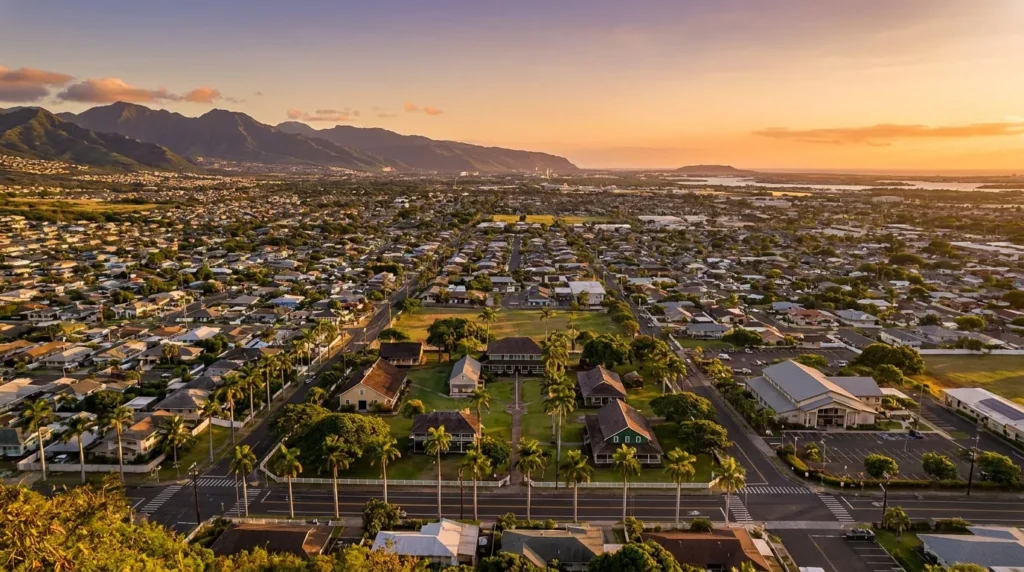
Houses, townhouses, and condos across well-defined neighborhoods in Waipahu

Residential neighborhoods such as Royal Kunia, Village Park, and Crestview offer single-family homes and townhouses. Closer to the old downtown, smaller rentals and shared housing are common.

The housing stock varies considerably. Near the old center along Farrington Highway, older houses, small apartment buildings, and modest shared units are common. Moving uphill, neighborhoods like Royal Kunia, Village Park, Crestview, and Robinson Heights offer two-story homes and gated townhouse complexes, many with pools and courts.

Filipino immigrant families in these neighborhoods have a tradition of multigenerational living, with homes serving as landing points for newly arrived relatives. Rental listings circulate heavily through word of mouth and community Facebook groups, alongside traditional real estate agents and Craigslist.

The practical approach is to rent first, learn the H-1 commute at work hours, and only then consider buying. Higher neighborhoods like Royal Kunia offer better views, good breezes, and a quieter environment, but require a car for nearly everything. Reviewing HOA rules and aesthetic guidelines before committing is advisable.

Recommended neighborhoods
  • Royal Kunia
  • Village Park
  • Crestview
  • Robinson Heights
  • Waipio Gentry
  • +1 more

Employment tied to retail, services, the military, and airport logistics

Waipahu draws workers to retail (Waikele Outlets), healthcare, construction, hospitality, and airport and port operations. Pearl Harbor is just minutes away for military-linked employment.

The local economy combines retail, anchored by Waikele Premium Outlets which draws Asian and mainland tourists, with services, transportation, construction, and light manufacturing. Pali Momi Medical Center in Aiea and Queen's Medical Center West Oahu in Ewa employ a large share of area residents in healthcare roles.

Pearl Harbor is only minutes away. For immigrants with citizenship or a green card, contracts with the DoD and with companies such as Lockheed Martin, KBR, and BAE Systems represent a real opportunity, particularly for technical profiles. Daniel K. Inouye International Airport is also a major employer in logistics and hospitality.

For recently arrived Filipino immigrants, the most common paths lead to hospitality, construction, home care, restaurants, and nursing. Programs at Honolulu Community College and Leeward Community College help workers earn certifications in a short time. Practical English skills and a strong community network speed up formal entry into the job market.

Dominant sectors
  • Retail and commerce
  • Healthcare
  • Construction
  • Logistics and transportation
  • Defense and military
  • +1 more
Major employers
  • Waikele Premium Outlets
  • Don Quijote Hawaii
  • Queen's Medical Center West Oahu (Ewa)
  • Pali Momi Medical Center (Aiea)
  • Joint Base Pearl Harbor-Hickam
  • +1 more

Community-oriented public schools and a community college nearby

The state public school system is served by schools such as Waipahu High and James Campbell High. Leeward Community College in Pearl City is only minutes away.

The main public schools serving Waipahu include Waipahu High School, Pearl City High School for some addresses, Waipahu Intermediate, August Ahrens Elementary, and Honowai Elementary. Most rank in the middle of statewide ratings, with some standout programs in technical education and the arts.

A solid network of Filipino and Catholic private schools operates in the area, including St. Joseph Catholic School in Waipahu. Families with greater resources also consider options like Iolani and Punahou in Honolulu, with their own transportation arrangements. Hawaii Technology Academy, a state charter virtual school, is another option.

The main higher education assets in the region are Leeward Community College in Pearl City and the University of Hawaii West Oahu in Kapolei, both oriented toward working adults and career-track students. For a four-year degree, UH Manoa in Honolulu remains the most common destination.

Notable universities
  • Leeward Community College (Pearl City)
  • University of Hawaii West Oahu (Kapolei)
  • University of Hawaii at Manoa
  • Hawaii Pacific University
  • Honolulu Community College
  • Brigham Young University Hawaii (Laie)

Healthcare served by nearby hospitals in Ewa, Aiea, and Honolulu

There is no major hospital within Waipahu itself, but Queen's West Oahu, Pali Momi, and Daniel K. Inouye International Airport are 10 to 25 minutes away.

The nearest hospital is Queen's Medical Center West Oahu in Ewa Beach, offering an emergency room, maternity services, and several specialties. Pali Momi Medical Center is located in Aiea, and Kaiser Permanente Moanalua is a short distance away. For complex cases, Queen's Medical Center at Punchbowl in central Honolulu is the main referral destination.

For primary care, Kaiser and HMSA clinics operate in the area, along with community health centers such as Waianae Coast Comprehensive Health Center, which also serves west-side residents, and Waikiki Health, which has partner locations. Urgent care clinics handle evenings and weekends at significantly lower cost than emergency rooms.

Filipino immigrants benefit from physicians and nurses who speak Tagalog and Ilocano, easing the integration process considerably. Mental health and dental care remain bottlenecks, with long wait lists. As throughout the state, employer-sponsored health coverage under the Hawaii Prepaid Health Care Act is the most common form of insurance.

Healthcare index68.0 / 100
  • Life expectancyyears at birth
    78.4yrs
  • Doctors per 1kpracticing physicians
    3.7
  • Health spendper capita, per year
    $13,473
  • Public systemoverall quality rating
    Good

Safe residential neighborhoods with specific areas to avoid

Waipahu has quite peaceful residential areas. Some stretches of the old downtown see higher rates of drug activity and theft. Daily life in most of the city is safe.

The safety profile in Waipahu is mixed. Residential neighborhoods such as Royal Kunia, Village Park, Crestview, and Westloch are considered safe, with consistent patrols and low rates of violent crime. Families in these areas report quiet daily life and active streets during the day.

The old downtown, along parts of Farrington Highway, has higher rates of theft, drug activity, mainly methamphetamine, and altercations. This is the area that warrants extra caution at night, though it does not reach the level of the most troubled neighborhoods on the mainland. Problems are localized and identifiable to a few specific blocks.

For women, seniors, and children, shopping at Waikele and Don Quijote, visiting residential parks, and attending schools is safe. At night, it is advisable to avoid isolated stretches near the old downtown bus station and to park in well-lit areas. A video doorbell such as Ring or Nest is standard practice for deterring package theft.

5.8
Homicides per 100k
per year
Safety index
64.0
Crime index
36.0
Safer neighborhoods
  • Royal Kunia
  • Waikele
  • Crestview
  • Robinson Heights
  • Waipio Gentry
  • Village Park
Areas to avoid
  • Older stretches of Waipahu Depot Road late at night
  • Industrial areas along Farrington Highway after business hours

H-1 and the Skyline connect Waipahu to Honolulu and Kapolei

H-1 runs through the city and links it to western and central Oahu. The Skyline rail has stations in Waipahu, greatly improving the commute to Pearl Harbor and Ala Moana.

Waipahu is bisected by H-1, the island's main freeway. Heading east, it connects to Pearl City, Honolulu, and the airport; heading west, it leads to Ewa, Kapolei, and Ko Olina. Farrington Highway is the local arterial running through the city and connecting to Waipio, Waikele, and Honokai Hale.

The most significant recent development is the Skyline elevated rail, with stations inside Waipahu at Pouhala, Hokimama, and West Loch. For the first time, it is possible to travel from Waipahu to Aloha Stadium without a car, on a predictable schedule. Future phases are expected to reach Kakaako, which could reshape the neighborhood's profile.

TheBus complements the network with routes to central Honolulu, Pearl Harbor, and Kapolei. Despite these options, most residents still rely on a car for daily errands, especially outside peak hours. Obtaining a Hawaii Driver's License in the first weeks of arrival remains a practical priority for newcomers.

1
Metro lines
3
Metro stations
35 min
Avg commute
38
Walkability
Airports
  • HNL, Daniel K. Inouye International Airport (in Honolulu, about 15 km away)
  • Bike infrastructure

What the Climate Is Like Living in Waipahu

Located on Oahu's drier west side, Waipahu sees tropical conditions with temperatures ranging from 72 to 88 degrees Fahrenheit year-round and steady trade winds providing a consistent breeze.

Waipahu's climate is tropical and stable. High temperatures range from 84 to 90 degrees Fahrenheit (29 to 32 C) between May and October, and from 77 to 82 degrees Fahrenheit (25 to 28 C) between November and April. Lows rarely fall below 66 degrees Fahrenheit (19 C), meaning heating is not needed indoors at any time of year.

The area sits on the drier side of the island, receiving less rainfall than Honolulu or eastern Oahu. Trade winds blow steadily, though the strong summer sun makes afternoon air conditioning advisable in bedrooms. Cross-ventilation handles much of the heat in well-positioned homes.

The rainy season runs from November through March, with brief showers. The dry season, April through October, is mostly sunny. The strong Filipino and broader Asian community gives the city a distinctive multicultural character.

Sunny days / year271 days
Avg high (°F)
  • 80°J
  • 79°F
  • 80°M
  • 82°A
  • 83°M
  • 85°J
  • 87°J
  • 88°A
  • 87°S
  • 86°O
  • 84°N
  • 81°D
Avg low (°F)
  • 69°J
  • 69°F
  • 69°M
  • 71°A
  • 72°M
  • 74°J
  • 75°J
  • 75°A
  • 76°S
  • 74°O
  • 73°N
  • 71°D
Rainfall (")
  • 1"J
  • 2"F
  • 2"M
  • 1"A
  • 1"M
  • 2"J
  • 1"J
  • 1"A
  • 1"S
  • 1"O
  • 1"N
  • 2"D

Living Filipino culture and plantation-era heritage in Waipahu

The city celebrates Filipino culture at events like the Filipino Fiesta, preserves the plantation era at Hawaii's Plantation Village, and features a food scene that is strongly Asian in character.

The plantation heritage is central to Waipahu's identity. Hawaii's Plantation Village is an open-air museum that reconstructs workers' homes from the sugar plantation era, representing Filipino, Japanese, Chinese, Korean, Portuguese, and Puerto Rican communities. A visit offers essential context for understanding contemporary Hawaiian society.

Filipino culture is visibly present: Catholic churches with Tagalog and Ilocano masses, school marching bands, community pageants, and events such as the Filipino Fiesta and the annual downtown parade. Restaurants like Elena's, Highway Inn, which serves traditional Hawaiian food, and markets like Tamashiro and Don Quijote serve as neighborhood gathering points.

The atmosphere is more working-class and unpretentious than in upscale neighborhoods. For Brazilian and Latin American immigrants, the area offers easy access to a diverse Asian community and a wide variety of affordable food. Cultural life does not compete with central Honolulu; those seeking major performances, museums, and concerts head to Kakaako and Waikiki.

Waipahu

Attractions and Plantation History in Waipahu, Hawaii

A former sugarcane plantation town on Oahu's south shore, home to Hawaii's Plantation Village, a strong Filipino community, and proximity to Pearl Harbor and Ko Olina.

Waipahu, on Oahu, developed as a plantation village for the Oahu Sugar Company, which closed in 1995. That era is preserved at Hawaii's Plantation Village, within Waipahu Cultural Garden Park, where restored homes of Chinese, Japanese, Filipino, Portuguese, and Korean workers document the history of multiethnic life on the plantation. The old factory whistle still sounds during museum events.

The city sits about 30 minutes from downtown Honolulu via H-1 or the Skyline rail line, Oahu's new train connecting the west side. Pearl Harbor and the USS Arizona Memorial are 15 minutes away at Pearl Harbor National Memorial. Ka Makana Ali'i Mall in Kapolei is the nearest major shopping center. Restaurants along Farrington Highway and Waipahu Depot Street serve Filipino, Vietnamese, and local plate lunch cuisine.

The nearest beach is Iroquois Point, and the Hawaiian Railway Society operates vintage train excursions from the coast to Nanakuli. Wet'n'Wild Hawaii in Kapolei and the lagoon beaches of Ko Olina round out recreational options. Trails in the Waianae Range, such as Pu'u Ma'eli'eli, are located to the west. Makaha surf breaks are about 40 minutes away.

  1. 1["Hawaii Plantation Village"
  2. 2"Waikele Premium Outlets"
  3. 3"Pearl Harbor National Memorial (nearby)"
  4. 4"Hans L Estate Heiau Complex"
  5. 5"Waipahu Cultural Garden Park"
  6. 6"Royal Kunia Country Club"
Nightlife2.0 / 10
Parks & green spaces
  • ["Waipahu Cultural Garden Park"
  • "Waikele Community Park"
  • "Hans L Estate Park"
  • "Robinson District Park"
  • "Village Park Community Park"
  • +1 more

Latest posts

Straight from the blog

There are no posts specifically about Waipahu yet. In the meantime, check out our latest posts.