Visto n' Visa
Blog
Notícias e artigos
Destinations
Careers
Immigrants

Want to live and work in Denver?

Personalized immigration plan with eligible visas, costs, and next steps for your goal!

If you are not eligible, you will know exactly why and what to do to improve your approval chances.

Save up to 12 hours in meetings

No pointless assessments.

Save up to 90%

Save money on vague or unfocused consultations

Avoid Fraud and Mistakes

One mistake can cost you your visa

Total Impartiality

Zero commercial bias

Decide with peace of mind

No toxic urgency

Fast and Accurate

Answers in minutes, no guesswork

Denver's Population: White Majority with a Strong Latino Presence

Roughly half of residents are non-Hispanic white, and nearly 30% are Hispanic or Latino, with Mexican and Central American communities established for generations.

Denver's population is predominantly non-Hispanic white, at close to 54%, with a Hispanic community exceeding 29%, primarily of Mexican origin, along with significant representation from El Salvador, Guatemala, and Honduras. Black residents account for approximately 9%, and the Asian population (Vietnamese, Korean, Filipino) is growing in neighborhoods such as Park Hill and Aurora, to the east.

English is the dominant language, though Spanish is heard on the streets, in schools, and on local radio. Neighborhoods such as Westwood and Globeville maintain a strong Latino character, with markets like El Rancho and authentic taquerias. The Brazilian community is small but present, with a few Portuguese-language evangelical churches and Facebook groups for information exchange.

The median age is around 35, younger than the national average. Denver attracts many recent graduates, childless couples, and tech professionals relocating from California and Texas. Families with children tend to move to the suburbs (Aurora, Centennial, Highlands Ranch) in search of larger homes.

Languages spoken
  • English
  • Spanish
  • Vietnamese
  • Amharic (Ethiopian community)
  • Korean
  • +2 more
Main religions
  • No religion (approximately 35%)
  • Protestant Christian
  • Roman Catholic
  • Mormon
  • Buddhist
  • +1 more

Cost of Living in Denver: Above the National Average, Below the Coasts

Rent has risen sharply over the past decade. Food, transportation, and services exceed the national average, but remain more affordable than San Francisco, Seattle, or New York.

Denver is no longer the affordable city it was 15 years ago. A one-bedroom apartment downtown (LoDo, Capitol Hill, RiNo) costs between USD 1,700 and USD 2,300 per month. In more distant neighborhoods such as Aurora, Lakewood, or Northglenn, rents drop to USD 1,300 to USD 1,700. Those looking for a house with a yard need to look at the suburbs, where rents start at USD 2,500.

Grocery shopping at chains like King Soopers, Safeway, Trader Joe's, and Sprouts is comparable to the national average. A meal at a fast-casual restaurant runs about USD 15 to USD 25 per person. Craft beer at a brewpub costs between USD 7 and USD 10. Legal cannabis costs USD 30 to USD 50 per eighth of an ounce (3.5g) at dispensaries such as Native Roots or The Green Solution.

Colorado has a state income tax of 4.4% (2024), in addition to federal taxes. Military retirement income is not taxed at the state level. Energy bills (Xcel) are higher in winter due to gas heating. Car insurance is more expensive than the national average because of hail. Individual health insurance without a subsidy runs USD 400 to USD 700 per month.

107Cost index (US = 100)7% above US average
CategorySingleCoupleFamily (2 + 2)
iHousing$1,398$1,613$2,043
iFood$408$817$1,484
iTransport$538$914$1,182
iHealthcare$301$602$1,129
iChildcare$1,957
iOther$914$1,645$2,312
Monthly total$3,559$5,591$10,107

Source: U.S. BLS Consumer Expenditure Survey 2023 + BEA Regional Price Parities 2023 · Estimates in USD, monthly.

Housing in Denver: Historic Homes Downtown, New Apartments in RiNo, Suburban on the Edges

The central area features new buildings alongside restored Victorian homes. The suburbs offer larger, newer houses with easy highway access.

The predominant housing style in Denver is the bungalow and Victorian house from the 1900s to 1920s, common in neighborhoods such as Capitol Hill, Washington Park (Wash Park), Highlands, and Park Hill. These neighborhoods have tree-lined streets and have become expensive over the past 15 years. RiNo has become the favorite of the younger generation, with lofts in converted warehouses, street murals, and breweries.

Suburbs such as Centennial, Highlands Ranch, Aurora, and Thornton offer newer homes (1990s to 2020s), with two-car garages, yards, and central air conditioning. These attract families and those needing more space at a lower cost. The downside is car dependency for nearly everything. Lakewood and Wheat Ridge are intermediate options.

To rent, landlords typically require proof of income at 3x the monthly rent, a credit score above 650, and references. Those arriving without a U.S. credit history (no SSN or ITIN) may need a co-signer or be asked to pay 2 to 3 months upfront. Popular search platforms include Zillow, Apartments.com, Trulia, and Facebook Marketplace.

Recommended neighborhoods
  • LoDo (Lower Downtown, urban, close to everything)
  • RiNo (River North, art and breweries)
  • Capitol Hill (historic, Victorian homes)
  • Washington Park (families, large park)
  • Highlands (young professionals, restaurants)
  • +3 more

Denver's Job Market: Technology, Energy, Aerospace, and Healthcare

An expanding technology hub (Google, Amazon, Salesforce). Energy (oil, gas, renewables) and aerospace are historical pillars.

Denver has established itself as one of the leading technology hubs outside the West Coast. Google opened a campus in Boulder and has offices in Denver. Amazon maintains operations in Aurora and Thornton. Salesforce, Palantir, IBM, and local startups such as Guild Education and Ibotta employ thousands. Software engineering salaries range from USD 110,000 to USD 180,000 per year.

Energy is a traditional sector: Halliburton, DCP Midstream, and various oil and gas companies operating in the Denver-Julesburg Basin. Renewable energy is also advancing, with the National Renewable Energy Laboratory (NREL) headquartered in Golden. The aerospace industry is strong: Lockheed Martin (Littleton), Ball Aerospace (Boulder), and United Launch Alliance (Centennial) operate large complexes.

Healthcare drives significant hiring: UCHealth, HealthONE, and Kaiser Permanente are the largest hospital employers. Denver International Airport (DEN) is one of the largest airports in the United States by area and employs thousands in logistics, customer service, and aviation. Colorado's minimum wage is USD 14.42 per hour in 2024, with Denver maintaining its own minimum at USD 18.29.

Dominant sectors
  • Technology and software
  • Energy (oil, gas, renewables)
  • Aerospace and defense
  • Healthcare and biotechnology
  • Logistics and aviation
  • +2 more
Major employers
  • UCHealth (healthcare)
  • Lockheed Martin (Littleton)
  • Ball Aerospace (Boulder)
  • Amazon (distribution centers)
  • Google (Boulder/Denver)
  • +3 more

Education in Denver: Public Schools of Varying Quality and Public and Private Universities

Suburban districts tend to have higher-rated schools. The city is home to the University of Denver, Metropolitan State, and the CU Anschutz Medical Campus.

Denver Public Schools (DPS) is the main district, with more than 200 schools. Quality varies significantly by neighborhood. Schools in wealthier areas (Wash Park, Cherry Creek, Park Hill) tend to be well-rated. In lower-income or recently immigrant neighborhoods, resources and outcomes are more limited. Families often choose suburban districts such as Cherry Creek School District, considered among the top in the state.

The University of Denver (DU), a private institution, is the oldest university in the Rockies and has strong programs in law, business (Daniels College), and international studies (Korbel School). Metropolitan State University of Denver serves many working-class students in the city center. The University of Colorado has a medical campus (CU Anschutz) in Aurora, one of the largest biomedical research centers in the West.

For international students, the Colorado School of Mines (in neighboring Golden) is a world reference in mining and petroleum engineering. Tuition for international students ranges from USD 30,000 to USD 60,000 per year. International students must obtain an F-1 visa and an I-20 issued by the institution before applying at a consulate.

Notable universities
  • University of Denver (DU, private)
  • University of Colorado Denver
  • CU Anschutz Medical Campus (Aurora)
  • Metropolitan State University of Denver
  • Colorado School of Mines (Golden, nearby)
  • Regis University (Jesuit)
  • Community College of Denver

Healthcare in Denver: Major Hospitals and University Medical Campus in Aurora

UCHealth, HealthONE, and Kaiser Permanente dominate. High-quality care is available, but costs are steep without health insurance.

Denver has some of the best hospitals in the western United States. University of Colorado Hospital (part of CU Anschutz, in Aurora) is a leading center for cardiology, oncology, and transplants. HealthONE operates Presbyterian/St. Luke's and Swedish Medical Center. National Jewish Health, in the city center, is a world reference for respiratory diseases.

As throughout the United States, all medical care is costly without insurance. A basic visit to a walk-in clinic costs USD 150 to USD 250. An emergency room visit without coverage can exceed USD 2,000 for the visit alone. Individual health insurance on the marketplace (healthcare.gov) costs USD 400 to USD 800 per month for an adult, with an annual deductible of USD 3,000 to USD 7,000.

For newly arrived immigrants who do not yet have coverage, community clinics such as Denver Health (public system) offer sliding-scale fees based on income. Telemedicine (Teladoc, MDLive) is an affordable alternative for minor issues. Dental and vision care are rarely covered under a main health plan and require separate coverage.

Healthcare index68.0 / 100
  • Life expectancyyears at birth
    78.4yrs
  • Doctors per 1kpracticing physicians
    3.7
  • Health spendper capita, per year
    $13,473
  • Public systemoverall quality rating
    Good

Safety in Denver: Mostly Safe, with Problem Areas Downtown and to the East

Central and residential neighborhoods are safe. Property crime has increased, and there is a concentration of unhoused individuals in parts of downtown.

Denver is considered safe throughout most of the city. Neighborhoods such as Wash Park, Cherry Creek, Highlands, Stapleton/Central Park, and Park Hill have very low crime rates. Walking at night in LoDo, RiNo, or Capitol Hill is generally fine, though the concentration of bars leads to some incidents on weekends.

Property crime (vehicle theft, smash-and-grab, catalytic converter theft) has increased significantly in recent years. The standard precaution is to leave nothing visible in a vehicle, even an empty bag. Bicycles require a sturdy U-lock, and stamping a frame identification number is helpful. Aurora (eastern suburb) has higher crime rates in some zones, though neighborhoods like Centennial and Stapleton are calm.

Downtown has a concentration of unhoused individuals, particularly near Civic Center Park and along Colfax Avenue. The fentanyl and methamphetamine crisis is visible in these areas. The police department (DPD) is more prevention-focused than aggressive in its presence. Violent crimes against strangers are rare, but avoiding Colfax further east at night is advisable.

5.8
Homicides per 100k
per year
Safety index
42.0
Crime index
58.0
Safer neighborhoods
  • Cherry Creek
  • Washington Park
  • Stapleton (Central Park)
  • Highlands
  • Hilltop
  • Lowry
Areas to avoid
  • Areas near Federal Boulevard at night
  • Five Points in late-night stretches
  • Sun Valley during off-peak hours
  • Montbello in certain sections

Transportation in Denver: RTD Rail, Walkable Core, Car-Dependent Suburbs

The light rail and A Line connect downtown, the airport, and some suburbs. Beyond those corridors, a car is practically required.

The RTD (Regional Transportation District) system operates light rail and commuter rail lines covering downtown, the airport (A Line), Aurora, Lakewood, Englewood, and parts of the metro area. A fare costs USD 3 and includes transfers. Union Station, in the city center, is the main hub, recently renovated and surrounded by restaurants.

Downtown Denver, RiNo, LoDo, and Capitol Hill are walkable. There is a bike-share program (Lyft) and reasonable bike lanes along the South Platte River and Cherry Creek Trail. Residents who live and work downtown can manage without a car. In Aurora, Centennial, or Thornton, however, having a car is practically essential.

Denver International Airport (DEN) is located about 25 miles from downtown, connected by the RTD A Line (45 minutes, USD 10.50). It is one of the largest airports in the world by area, with direct flights to Europe (Frankfurt, London, Munich), Mexico, Central America, and nearly every major U.S. city. United and Southwest are the primary carriers at the airport.

8
Metro lines
77
Metro stations
27 min
Avg commute
61
Walkability
Airports
  • DEN — Denver International Airport
  • APA — Centennial Airport (general aviation)
  • BJC — Rocky Mountain Metropolitan Airport (general aviation)
  • International airport
  • Bike infrastructure

What the Climate Is Like Living in Denver

Denver has a semi-arid high-altitude climate befitting its Mile High City designation, with hot dry summers, cold but sunny winters, and snow that typically melts quickly.

Summer is dry and hot, running from June through August. Highs typically range between 82 and 90 F (28 to 32 C), with peaks above 99 F (37 C) in July. Afternoon hailstorms are a regular occurrence and can damage vehicles and rooftops. Air conditioning is important, though the low humidity makes the heat more bearable.

Winter is cold but sunny, from December through February, with highs between 41 and 48 F (5 to 9 C) and lows between 14 and 23 F (-10 to -5 C). Snowfall is regular, with an annual accumulation around 55 inches (1.4 m), but snow tends to melt quickly. Central heating is essential.

The elevation (5,280 ft / 1,609 m) intensifies UV radiation and demands greater hydration. For residents, air conditioning, robust heating, daily sunscreen, and awareness of hailstorms in spring and early summer are important considerations.

Sunny days / year245 days
Avg high (°F)
  • 42°J
  • 41°F
  • 51°M
  • 63°A
  • 71°M
  • 83°J
  • 90°J
  • 89°A
  • 84°S
  • 66°O
  • 54°N
  • 46°D
Avg low (°F)
  • 17°J
  • 12°F
  • 22°M
  • 32°A
  • 43°M
  • 53°J
  • 61°J
  • 60°A
  • 52°S
  • 36°O
  • 27°N
  • 21°D
Rainfall (")
  • 1"J
  • 1"F
  • 2"M
  • 1"A
  • 3"M
  • 2"J
  • 1"J
  • 1"A
  • 1"S
  • 1"O
  • 1"N
  • 1"D

Culture in Denver: Beer, Cannabis, Sports, and Outdoor Life

A young culture centered on mountaineering, skiing, and cycling. More than 100 craft breweries, legal cannabis dispensaries, and a strong music scene.

Denver's identity is outdoorsy. Weekends mean hiking at Mount Falcon or Chautauqua (Boulder), cycling on the Cherry Creek Trail, or a 90-minute drive to Vail, Breckenridge, Keystone, or Aspen for skiing. Fishing, climbing, and mountain biking are also part of the lifestyle. Breweries complement the outdoor scene: many residents end a day on the trail at a local brewery.

Beer is a fixture of local culture. The Great American Beer Festival takes place every October at the Convention Center. Breweries such as Wynkoop (the city's first), Great Divide, Denver Beer Co., and Ratio are community gathering spots. Cannabis was legalized in 2014, and dispensaries like Native Roots and LivWell are as common as coffee shops. Mexican food is ubiquitous, with green chiles and rellenos serving as local staples.

Professional sports animate the city: the Broncos (NFL) at Empower Field, the Nuggets (NBA) and Avalanche (NHL) at Ball Arena, the Rockies (MLB) at Coors Field. Live music at Red Rocks Amphitheatre, a natural outdoor venue set among red sandstone formations 25 minutes from downtown, is a defining local experience.

Denver

What to See and Do Living in Denver

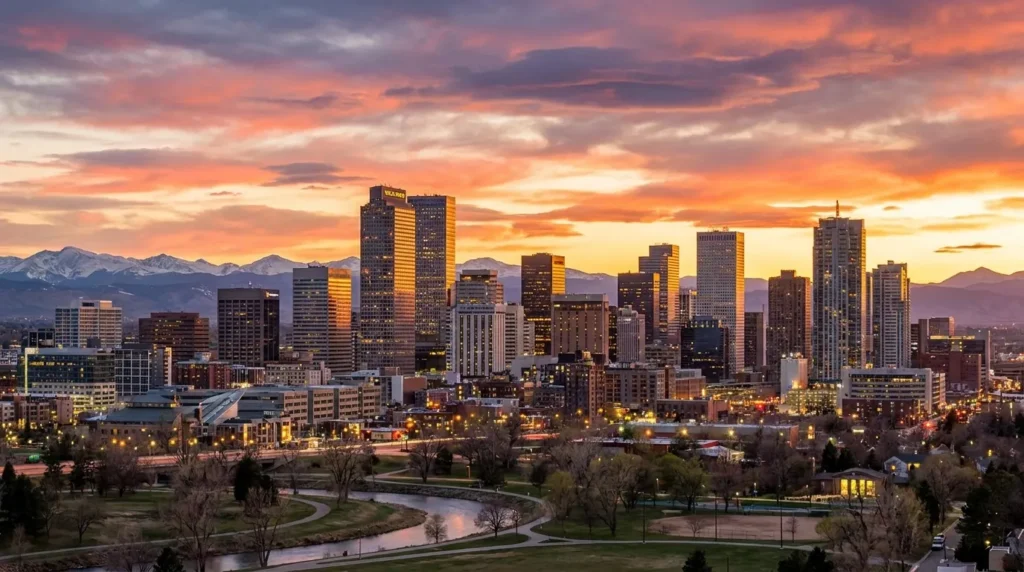
Denver combines a high-altitude urban core, Rocky Mountain parks, and a vibrant cultural scene featuring world-class museums, craft breweries, and distinct neighborhoods such as LoDo, RiNo, and Highlands.

The Denver Art Museum, with its Hamilton Building extension designed by Daniel Libeskind, and the adjacent Clyfford Still Museum anchor the city's arts scene. The Denver Museum of Nature and Science in City Park and the Denver Zoo are essential stops for families. The revitalized Union Station has become a gathering point with restaurants, the Crawford Hotel bar, and rail connections.

Neighborhoods like RiNo (River North Art District) host breweries, food halls such as Denver Central Market, and open-air murals. LoDo is home to Coors Field, where the Colorado Rockies play, along with nightlife venues. Highlands offers a refined Latin and American dining scene. Cherry Creek Shopping Center and Larimer Square are the main retail destinations.

For nature, Red Rocks Amphitheatre, 30 minutes away, is legendary for its rock formations and concerts. Washington Park and City Park serve as the city's green lungs. Rocky Mountain National Park is 90 minutes via US-36, with Estes Park as a base. The 16th Street Mall and the Cherry Creek Trail bikeway connect downtown to residential areas.

  1. 1["Denver Art Museum"
  2. 2"Red Rocks Park and Amphitheatre"
  3. 3"Denver Botanic Gardens"
  4. 4"Denver Museum of Nature and Science"
  5. 5"Union Station"
  6. 6"Larimer Square"
Nightlife8.0 / 10
Parks & green spaces
  • ["Washington Park"
  • "City Park"
  • "Cheesman Park"
  • "Sloan's Lake Park"
  • "Confluence Park"
  • +1 more

Latest posts

Posts about Colorado

Coverage and updates related to this destination.

Showing content from Colorado, as there is no specific data for Denver yet.