Visto n' Visa
Blog
Notícias e artigos
Destinations
Careers
Immigrants

Want to live and work in Spain?

Personalized immigration plan with eligible visas, costs, and next steps for your goal!

If you are not eligible, you will know exactly why and what to do to improve your approval chances.

Save up to 12 hours in meetings

No pointless assessments.

Save up to 90%

Save money on vague or unfocused consultations

Avoid Fraud and Mistakes

One mistake can cost you your visa

Total Impartiality

Zero commercial bias

Decide with peace of mind

No toxic urgency

Fast and Accurate

Answers in minutes, no guesswork

Why visit Spain

Sun, abundant food, and a relaxed pace of life in one of the eurozone's largest economies.

Spain occupies most of the Iberian Peninsula, with access to the Mediterranean and the Atlantic, as well as territories in the Canary Islands, Balearic Islands, Ceuta, and Melilla. The best-known cities are Madrid (the capital, in the center of the country), Barcelona (the capital of Catalonia, by the sea), Valencia, Seville, Bilbao, and Malaga. The country is divided into 17 autonomous communities with strong regional identities.

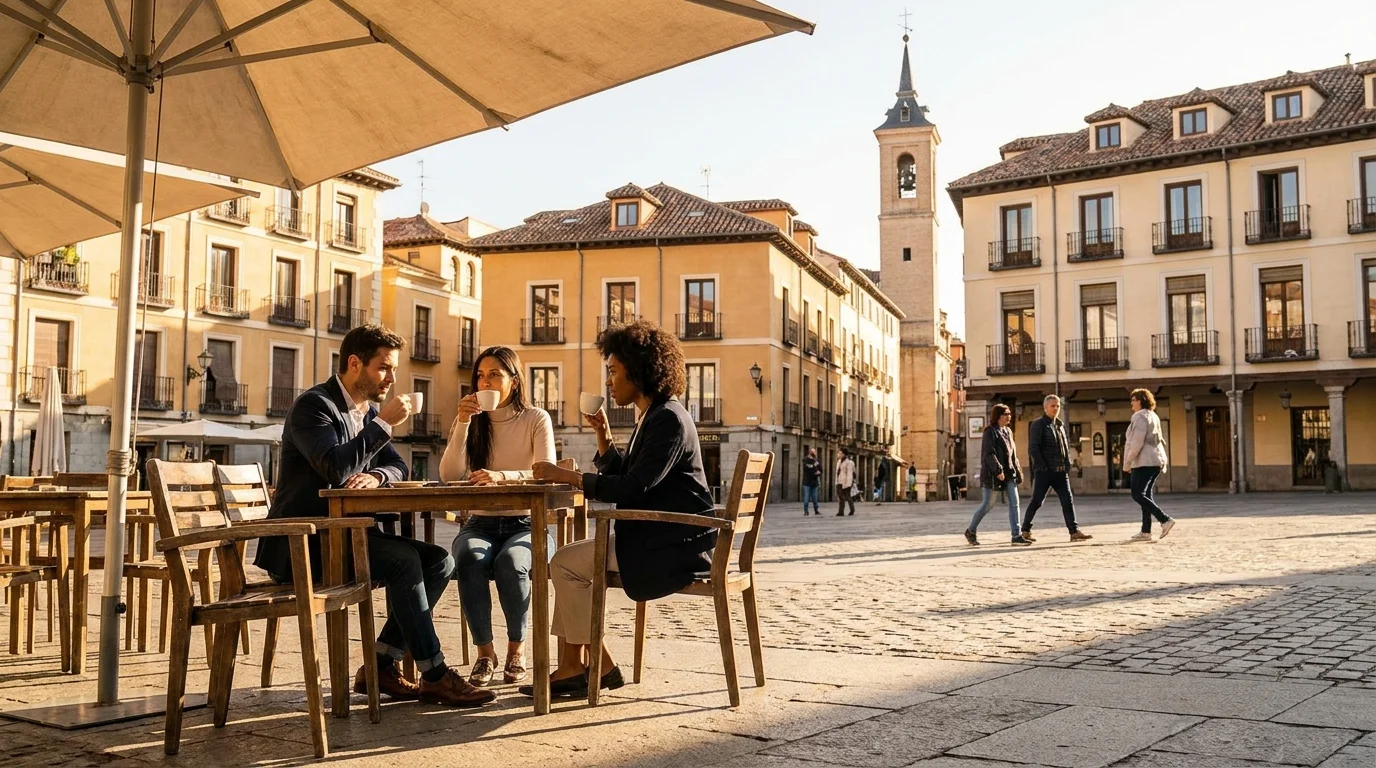
Daily life is relaxed. Lunch is an event, usually between 2 PM and 4 PM, and dinner is typically after 9 PM. The siesta has practically disappeared in major cities, but the pace remains slower than in other European countries. Tapas bars, terrazas, and markets are part of everyday life. The mild climate encourages outdoor living almost year-round.

For those thinking about moving, the country has defined pathways: a skilled work visa, a non-lucrative visa (for those living on passive income), a digital nomad visa, student visa, entrepreneur visa, and citizenship through descent. EU citizens can settle freely. The TIE (Tarjeta de Identidad de Extranjero) is the main residence document.

40.0000°, -4.0000°

Spain's demographics: around 48 million people with strong regional diversity

About 81% of the population lives in urban areas. Madrid and Barcelona concentrate a large share of recent immigrants.

Spain is the fourth most populous country in the European Union. Most people live in cities, with Madrid and Barcelona together having more than 10 million people in their metro areas. An aging population is a trend, with low birth rates partially offset by immigration. The interior of the country (known as la España vaciada) has been losing population to the coast.

The population is diverse by region. There are historically distinct communities: Catalans, Basques, Galicians, and Valencians have co-official languages and their own cultures. Recent immigration has brought Latin Americans (especially Colombians, Venezuelans, Peruvians, Ecuadorians, Brazilians, and Argentinians), Moroccans, Romanians, British, Chinese, and Ukrainians. Latinos represent an important share of migration over the past two decades.

Spanish (called castellano locally) is the national official language. Catalan, Galician, Basque (Euskera), and Aranese are co-official in their regions. English is increasingly spoken by young people and professionals, especially in Barcelona and Madrid, but proficiency levels remain lower than in Nordic countries. Learning Spanish is highly recommended for any long-term plan.

Languages spoken
  • Spanish (castellano, national official)
  • Catalan (co-official in Catalonia, Valencia, Balearic Islands)
  • Galician (co-official in Galicia)
  • Basque/Euskera (co-official in the Basque Country and Navarra)
  • English (among young people and professionals)
Main religions
  • Catholic (about 56%)
  • No religion (about 38%)
  • Others (Muslim, Evangelical, Jewish)

Cost of living in Spain: among the most affordable in Western Europe

Mid-sized cities remain very affordable. Madrid, Barcelona, and the Balearics are more expensive, but still below Paris and London. Food and wine are cheap.

Spain is among the most affordable countries in Western Europe. Rent for a one-bedroom apartment in Madrid ranges from 900 to 1,500 euros in central neighborhoods (Chamberi, Salamanca, Malasana); in Barcelona, 1,000 to 1,700 euros (Eixample, Gracia, Sant Antoni). In mid-sized cities such as Valencia, Seville, Bilbao, Malaga, and Zaragoza, rent drops to 500 to 900 euros. The interior of the country and small cities have even lower rents.

Grocery shopping for one person runs between 200 and 320 euros per month. Mercadona, Carrefour, Lidl, Dia, Alcampo, and Eroski are the most common chains. Municipal markets (La Boqueria in Barcelona, San Miguel in Madrid) carry high-quality fresh produce. Eating out is part of the culture and affordable: a menu del dia (full lunch) costs 12 to 18 euros, tapas and a drink 3 to 6 euros, dinner at a mid-range restaurant 20 to 35 euros per person. A coffee at the bar runs 1.20 to 1.80 euros.

Electricity, gas, and water run between 90 and 180 euros per month. Fiber internet (Movistar, Vodafone, Orange, MasMóvil) costs 25 to 45 euros. Public transport in Madrid (Metro Madrid) costs 22 to 60 euros per month depending on zones; Barcelona (TMB) uses the T-Usual at 22 euros per month for residents. Income tax is progressive, between 19% and 47%. Standard VAT is 21%. Andalusia, Murcia, and Galicia have a considerably lower cost of living than Madrid or the Balearics.

62Cost index (NYC = 100)38% below NYC
CategorySingleCoupleFamily (2 + 2)
iHousing$1,312$1,700$2,268
iFood$270$540$990
iTransport$180$330$390
iHealthcare$80$152$256
iChildcare$450
iOther$217$372$496
Monthly total$2,059$3,094$4,850

Labor market in Spain: tourism, automotive, services, and renewables, with the EU's highest unemployment

Tourism and services lead. Automotive, textiles, infrastructure, and renewables are strong. Unemployment remains above the European average, especially among young people.

The Spanish labor market is large (about 21 million active workers) but marked by unemployment higher than the European average (around 12%, and more than 25% among young people). Tourism is the largest sector employer: more than 80 million tourists per year sustain hotels, restaurants, retail, and transport. Madrid, Barcelona, the Balearics, the Canaries, the Costa del Sol, and the Costa Brava concentrate jobs in the sector.

The automotive industry is the second largest in Europe, with factories from SEAT (Volkswagen) in Martorell, Renault in Valladolid and Palencia, Ford in Almussafes (Valencia), Stellantis in Vigo and Zaragoza, Mercedes-Benz in Vitoria, and Iveco in Madrid. The pharmaceutical (Almirall, Grifols, Esteve, Rovi), chemical, agro-food (Pascual, Mercadona, Bimbo Iberia), and consumer goods (Inditex, owner of Zara, Massimo Dutti, Pull and Bear, Bershka) industries are strong. The financial sector has Santander, BBVA, CaixaBank, and Banco Sabadell as global giants.

Renewable energy (Iberdrola, Endesa, Acciona, Repsol in transition) is a European leader. Construction and infrastructure (Ferrovial, ACS, Acciona, Sacyr, FCC) build roads, railways, and airports worldwide. Technology is growing in Madrid, Barcelona, and Valencia. The average gross salary is about 27,000 euros per year; the national minimum wage (SMI) is 1,184 euros gross per month in 14 payments (about USD 1,300 to 1,500). Largest employers: Inditex, Santander, BBVA, Telefonica, Iberdrola, Repsol, El Corte Ingles, and Mercadona.

$1,450
Minimum wage
per month
Top national employers
  • Inditex
  • Banco Santander
  • BBVA
  • Telefonica
  • Iberdrola
  • +3 more

Education in Spain: free public schooling and internationally recognized universities

Basic education is free. Public university tuition is far lower than in the US and UK.

Basic education (primary, ESO, and bachillerato) is free in the public network. There are also concertadas (semi-public) and private schools, including international schools (British, American, German, French, Japanese) in major cities. Madrid and Barcelona have the widest selection of international schools.

The most recognized public universities include the Complutense University of Madrid, the University of Barcelona, the Autonomous University of Madrid, the Autonomous University of Barcelona, and Pompeu Fabra University. Public tuition ranges from 1,000 to 3,000 euros per year (about 10 times cheaper than in the US and UK). Private universities such as IE, IESE Business School, and ESADE have international reputations.

Several universities offer programs in English for foreign students, especially at the MBA, business master's, engineering, and medicine levels. The Erasmus+ program has brought millions of European students to Spain. EU citizens pay the same as Spaniards; students from outside the EU pay more, but still affordably by international standards. Scholarships are available through the government (MAEC-AECID) and regional programs.

Notable universities
  • Complutense University of Madrid
  • University of Barcelona (UB)
  • Autonomous University of Madrid (UAM)
  • Autonomous University of Barcelona (UAB)
  • Pompeu Fabra University (UPF)
  • IE University
  • IESE Business School
  • ESADE
  • University of Salamanca
  • University of Navarra

Healthcare in Spain: universal public system considered one of the best in the world

The Sistema Nacional de Salud (SNS) covers all registered residents. No direct charge for consultations, tests, or hospitalizations.

Spain's public healthcare system is tax-funded and considered one of the best in the world. Anyone who works formally, receives a pension, or has regularized residency (registered on the municipal census with social security or equivalent private insurance) is entitled to the Sistema Nacional de Salud (SNS). It covers consultations, tests, hospitalizations, childbirths, maternity, vaccines, and medications with a small copayment (free for pensioners).

The system works with a family doctor (medico de cabecera) as the entry point. Public hospitals such as La Paz (Madrid), Vall d'Hebron (Barcelona), and Hospital Clinic are internationally recognized. For elective procedures, waiting lists can be long, and many Spaniards have private insurance (Sanitas, Adeslas, DKV) to supplement care.

Foreigners with a residence visa need to be on the municipal register (empadronamiento) and contribute to social security or have equivalent private insurance. Retirees often take out the convenio especial with Social Security, paying monthly to gain access to the SNS. Pharmacies are easy to find (look for the green cross sign) and medications are far cheaper than in the US.

  • Public systemoverall quality rating
    Excellent

Safety in Spain: one of the safest countries in Europe

Violent crime is rare. Petty theft in tourist areas, especially in Barcelona and Madrid, is the main concern.

Spain is considered one of the safest countries in Europe, with crime rates comparable to those of Portugal and Italy. Violent crime is rare, and women walk alone at night in Madrid, Barcelona, and smaller cities without concern. Medium and small cities such as Valencia, Seville, Bilbao, and Malaga have even lower crime rates.

The most common crimes affecting foreigners are pickpocketing in tourist areas: Las Ramblas and the metro in Barcelona, Puerta del Sol and Gran Via in Madrid, and Plaza de España in Seville. Pickpockets are professional and work in groups. Basic precautions (bag worn in front, phone in a closed pocket) solve most cases. Uber, Cabify, Bolt, and FreeNow work in all major cities.

For newcomers, the adjustment is smooth. There are large communities of Latin American and other European immigrants, with active online groups. Brazilians, Colombians, Venezuelans, Argentinians, and Peruvians share tips on neighborhoods, rentals, empadronamiento, and paperwork. Interactions with police are generally procedural and in Spanish.

Safer neighborhoods
  • Salamanca, Chamberi, and Retiro (Madrid)
  • Eixample, Gracia, and Sarria-Sant Gervasi (Barcelona)
  • Valencia city center and Ruzafa
  • Triana and Los Remedios (Seville)
  • Indautxu (Bilbao)
  • Pedregalejo (Malaga)

Climate in Spain: Mediterranean on the coast, continental inland, oceanic in the north

The south and Levante have long, hot summers. The interior has cold winters. The north (Galicia, Asturias, Basque Country) is rainy and cool year-round.

Spain has great climatic diversity. The Mediterranean zone (Catalonia, Valencia, Murcia, coastal Andalusia, Balearic Islands) has long, hot summers (25 to 35°C) and mild winters (8 to 16°C). Malaga and the Costa del Sol are known for the "best climate in Europe," with an annual average above 19°C. The Canary Islands have a subtropical climate with mild temperatures throughout the year.

The interior (Madrid, Castile, Aragon, Extremadura) has a continental climate: very hot summers (reaching 40°C) and dry, and cold winters with frosts and occasional snow. "Nine months of winter and three of hell," locals joke in Madrid. The north (Galicia, Asturias, Cantabria, Basque Country) has an oceanic climate, rainy and cool year-round, with green landscapes reminiscent of Ireland.

Those coming from temperate countries tend to adapt well to the Mediterranean and southern regions. Summers can be harsh in the interior due to the dry heat. Homes typically keep shutters (persianas) closed during the day in summer to maintain temperature. Air conditioning has become more common in recent decades, especially in the south and interior. Central heating is standard in apartments.

Spanish culture: tapas, flamenco, soccer, and regional festivals with a strong personality

Each region has its own cuisine, festivals, and identity. Tapas, paella, wine, and jamon are part of the national identity.

Spanish culture is regional and diverse. Catalonia has castells (human towers) and the Diada (September 11); Andalusia has flamenco, Seville's Semana Santa, and the Feria de Abril; the Basque Country has pelota and pintxos cuisine; Galicia has its Celtic tradition and bagpipes; Madrid has the castico style and the San Isidro verbenas. Festivals such as San Fermin in Pamplona (bull run, July), Las Fallas in Valencia (March), and La Tomatina in Bunol (August) attract visitors from around the world.

Food is regional and varies enormously. Valencian paella, pulpo a la gallega in Galicia, Extremaduran jamon iberico, Andalusian gazpacho, Asturian fabada, and Basque pintxos are all examples. Tapas (small portions) and raciones accompany cerveza, wine, or vermouth in bars. Lunch is a long social event, and Sunday brunch (aperitivo) is a tradition in many regions.

Soccer is the national passion, with Real Madrid, Barcelona, Atletico de Madrid, Athletic Bilbao, and other historic clubs. Flamenco is a UNESCO Intangible Cultural Heritage. Spanish cinema (Almodovar, Bunuel) and music (from Paco de Lucia to Rosalia) are recognized worldwide. Architecture blends Romanesque, Gothic, Mudejar, Baroque, and Catalan Modernisme (Gaudi).

Notable dishes
  • Paella (Valencian, seafood, mixed)
  • Tortilla española
  • Jamon iberico and serrano
  • Gazpacho and salmorejo
  • Patatas bravas
  • +7 more
Annual events
  • San Fermin in Pamplona (July)
  • Las Fallas in Valencia (March)
  • Feria de Abril in Seville (April)
  • Semana Santa (Seville, Malaga, Valladolid)
  • La Tomatina in Bunol (August)
  • +3 more
UNESCO sites
  • Historic Center of Toledo
  • Burgos Cathedral
  • Alhambra, Generalife, and Albaicin of Granada
  • Mosque-Cathedral of Cordoba
  • Works of Gaudi in Barcelona
  • +8 more

Spain's economy: tourism, services, industry, agriculture, and renewable energy

Fourth-largest eurozone economy. Tourism, automotive, banking, renewable energy, infrastructure, and fashion are strong sectors.

Spain is the fourth-largest economy in the eurozone. Tourism is a central sector, with over 80 million visitors per year (among the most visited countries in the world). Sun, beaches, gastronomy, culture, and cities such as Barcelona, Madrid, Seville, and the Balearic Islands are the main draws. Hotels, restaurants, and vacation rentals (Airbnb, Idealista) drive the coast and major capitals.

The automotive industry is the second-largest in Europe, with factories from SEAT (Volkswagen, in Martorell), Renault (Valladolid, Palencia), Ford (Valencia), Stellantis (Vigo, Zaragoza), and Mercedes-Benz (Vitoria). The pharmaceutical industry (Almirall, Grifols, Esteve) and chemicals are also exporters. Banks such as Santander, BBVA, and CaixaBank are global giants.

Spain leads renewable energy in Europe, with a strong presence in wind power (Iberdrola, Endesa, Acciona), solar, and hydroelectric. Infrastructure companies such as Ferrovial, ACS, and Acciona build roads and railways around the world. Agriculture is Europe's largest producer of olive oil and citrus, and exports wine, jamon, fruits, and vegetables. Fashion (Inditex, owner of Zara, Pull&Bear, Massimo Dutti, Stradivarius) has become a global reference.

Top sectors
  • Tourism and hospitality
  • Automotive industry (SEAT, Renault, Ford)
  • Financial services (Santander, BBVA, CaixaBank)
  • Renewable energy (Iberdrola, Acciona)
  • Construction and infrastructure (Ferrovial, ACS)
  • +3 more

Geography of Spain: most of the Iberian Peninsula, plus the Balearics and Canary Islands

About 505,000 km2 between the mainland and the islands. The central Meseta plateau, the Pyrenees to the north, the Sierra Nevada to the south, and archipelagos in the Mediterranean and Atlantic.

Spain covers about 504,782 km2 and occupies roughly 85% of the Iberian Peninsula, plus the Balearic Islands in the Mediterranean, the Canary Islands in the Atlantic (near the African coast), and the territories of Ceuta and Melilla in northern Africa. It borders Portugal, France, Andorra, Gibraltar (United Kingdom), and Morocco (at Ceuta and Melilla). It has more than 4,964 km of coastline between the Atlantic and the Mediterranean.

The terrain is dominated by the Meseta Central, a large plateau 600 to 900 meters in altitude that occupies the interior of the Iberian Peninsula, divided by the Central System (Sierra de Gredos, Sierra de Guadarrama). The Pyrenees mark the border with France, with peaks exceeding 3,000 m (Aneto, 3,404 m). The Cantabrian Range runs along the northern coast. The Sierra Nevada in Andalusia has the highest point on the Iberian Peninsula (Mulhacen, 3,479 m). The Teide volcano in Tenerife is the absolute highest point (3,715 m).

Biomes vary by region: Mediterranean oak forest (holm oak and cork oak) in the interior and south, Atlantic forest of oak and beech in the north (Galicia, Asturias, Cantabria, Basque Country), semi-arid steppe in the Aragonese and Castilian interior, near-desert vegetation in Almeria, alpine vegetation in the Pyrenees and Sierra Nevada, and laurisilva in the Canaries. Average population density is about 95 inhabitants per km2, with a strong contrast between the Mediterranean coast and Madrid (dense) and the Castilian-Aragonese interior (the emptied Spain, with nearly deserted villages).

95/km²
Population density
Main biomes
  • Mediterranean holm oak and cork oak forest
  • Atlantic oak and beech forest (north)
  • Semi-arid steppe (Aragon, Castile)
  • Alpine vegetation (Pyrenees, Sierra Nevada)
  • Laurisilva and subtropical vegetation of the Canaries

Terrain

Most of the Iberian Peninsula, with the Meseta Central (plateau at 600-900 m) cut by mountain systems. Pyrenees to the north (Aneto 3,404 m), Sierra Nevada to the south (Mulhacen 3,479 m). Balearics in the Mediterranean, volcanic Canary Islands in the Atlantic (Teide 3,715 m, absolute highest point). Ceuta and Melilla in northern Africa.

Immigrant communities in Spain: about 18% of the population is foreign

Moroccans, Romanians, Colombians, Venezuelans, and British nationals form the largest communities. Madrid, Barcelona, and the Mediterranean coast concentrate the greatest diversity.

Spain has about 48 million inhabitants, and approximately 18% of the population is foreign (more than 8.8 million people with non-Spanish nationality, combining EU and non-EU residents). The largest communities are Moroccans (about 920,000, concentrated in Catalonia, Madrid, and Andalusia), Romanians (about 630,000, in Madrid, Castile, and Aragon), Colombians (more than 500,000, with strong recent growth), Venezuelans (about 450,000, in Madrid and Barcelona), and British nationals (about 290,000, in Alicante, Malaga, and the Balearics).

Other large communities include Ukrainians (with a surge after 2022), Italians (in Barcelona and Madrid), Peruvians, Ecuadorians, Argentinians, Chinese (in Madrid, Barcelona, and Valencia), Pakistanis, Bolivians, Hondurans, Bulgarians, and Spanish-speaking South Americans. Latin American immigration has become the majority of recent arrivals, partly due to cultural and linguistic ease. Catalonia, Madrid, the Valencian Community, Andalusia, and the Balearic Islands concentrate about 70% of all foreigners.

Formal integration requires Spanish for permanent residency and citizenship. Foreign diploma recognition goes through the Ministry of Education (homologacion) and professional associations. Citizenship requires 10 years of legal residency, with special regimes: 2 years for Ibero-Americans, Andorrans, Filipinos, Equatorial Guineans, Guineans, Portuguese, and Sephardic Jews (until 2019, with occasional renewals); 5 years for refugees; 1 year for spouses of Spanish citizens. Dual citizenship is permitted for nationals of Ibero-American countries.

Top countries of origin
  • Morocco
  • Romania
  • Colombia
  • Venezuela
  • United Kingdom
Main immigrant hubs
  • Madrid
  • Barcelona
  • Valencia
  • Malaga
  • Alicante

Integration & naturalization

Spanish required for permanent residency and citizenship. Diploma recognition via homologacion. Citizenship after 10 years of legal residency, 2 years for Ibero-Americans, Andorrans, Filipinos, Sephardic Jews, and Portuguese. Dual citizenship permitted for Ibero-American countries.

Paths to living in Spain: work, non-lucrative, digital nomad, descent

EU citizens settle freely. Non-EU nationals have the non-lucrative visa, digital nomad visa, skilled work visa, student visa, entrepreneur visa, and citizenship through descent.

For EU/EEA citizens, living in Spain is straightforward: just register as a resident. For non-EU nationals, the most common paths are the non-lucrative visa (for those living on a required minimum passive income), the digital nomad visa (created in 2023 under the Startups Law, with tax benefits), the skilled work visa, the student visa, and the entrepreneur visa.

The Golden Visa for real estate purchase (from 500,000 euros) was abolished in April 2025. Other Golden Visa modalities (investment in companies, funds, public debt) are still under discussion. Brazilians with Spanish grandparents or great-grandparents can pursue citizenship through descent, especially under the Democratic Memory Law (in force since 2022, with a deadline extended to 2025-2026), which expanded the right to descendants of exiles and those persecuted by the Franco regime. Citizenship after residency is also facilitated for Brazilians: only 2 years of legal residency are required (vs. 10 years for most foreigners).

Spain is part of the E-1 and E-2 commerce treaty with the US. This means Spaniards can open a business in the US with an E-2 (treaty investor) visa or conduct bilateral trade with an E-1 visa. It is a path used by entrepreneurs, franchisees, exporters, and professionals looking to expand in the American market.

Typical pathways from Spain to the US include the E-2 treaty (investor), EB-1 and EB-2 NIW for researchers and qualified professionals, EB-2 for permanent residency, L-1 for intracompany transfer (Santander, BBVA, Telefonica, Inditex), O-1 for exceptional talent in arts and sports, and F-1 for university students. ESTA covers short visits up to 90 days.

Latest posts

Straight from the blog

There are no posts specifically about Spain yet. In the meantime, check out our latest posts.