Visto n' Visa
Blog
Notícias e artigos
Destinations
Careers
Immigrants

Want to live and work in East Honolulu?

Personalized immigration plan with eligible visas, costs, and next steps for your goal!

If you are not eligible, you will know exactly why and what to do to improve your approval chances.

Save up to 12 hours in meetings

No pointless assessments.

Save up to 90%

Save money on vague or unfocused consultations

Avoid Fraud and Mistakes

One mistake can cost you your visa

Total Impartiality

Zero commercial bias

Decide with peace of mind

No toxic urgency

Fast and Accurate

Answers in minutes, no guesswork

Asian demographic profile, high income, and established family composition

Strong presence of Japanese and Chinese descendants, a significant proportion of non-Hispanic whites, an older population than the state average, and high household income.

East Honolulu is one of the wealthiest parts of the state. The ethnic composition reflects the classic Hawaiian profile, with a predominance of Asian descendants (especially Japanese and Chinese), non-Hispanic whites in a higher proportion than in the rest of the city, and a smaller share of Native Hawaiians and Filipinos compared to neighborhoods such as Kalihi and Waianae.

The age profile skews older. Entire neighborhoods, such as Aina Haina and Niu Valley, have a high proportion of retirees, many of whom have lived in the same home for decades. Families with young children tend to concentrate in Hawaii Kai, which has more recently built homes and a greater supply of schools and parks.

The immigrant community from Latin America is small in the area, generally linked to marriages with Americans, surf professionals, and some families who relocated after years on the mainland. English dominates, though Japanese can be heard among older residents and in some local churches and clubs.

Languages spoken
  • English
  • Japanese
  • Tagalog
  • Chinese
  • Korean
  • +1 more
Main religions
  • Protestant Christianity
  • Catholicism
  • Buddhism
  • No religion
  • Traditional Hawaiian religions
  • +1 more

High cost of living, especially for housing

Even within an already expensive city like Honolulu, East Honolulu sits above average. Homes command high prices, grocery stores skew premium, and budgeting requires planning.

For those relocating from other parts of the United States, East Honolulu often comes as a shock due to real estate prices. Homes in neighborhoods such as Kahala and parts of Hawaii Kai rank among the most expensive in the state. Rents are also high, with limited availability of smaller apartments.

The grocery landscape is dominated by Foodland Farms, Safeway, Costco (in Hawaii Kai), and Whole Foods in Kahala. To keep costs down, many residents combine large Costco runs with visits to ethnic markets in downtown Honolulu, such as Don Quijote and Marukai. Restaurants range from casual (poke shops) to expensive options catering to residents and older tourists.

Electricity and gasoline bills follow the statewide pattern: costly. The advantage lies in quality of life: quiet neighborhoods, safety, cleaner air, and easy access to the ocean and hiking trails. Those willing to live in a Hawaii Kai apartment can balance costs more effectively than those seeking a house in Kahala.

East Honolulu

Mix of large houses, coastal condominiums, and townhouses

Hawaii Kai concentrates apartments and townhouses around the marina. Kahala and Aina Haina are house-oriented neighborhoods. Kuliouou and Niu Valley have a more traditional, tree-lined character.

The market is varied within the region itself. Hawaii Kai was planned in the 1960s around canals and the marina, resulting in a good supply of townhouses and low-rise buildings, some with water views. Kahala is dominated by large homes and oceanfront mansions, with parts of the neighborhood ranking among the most expensive in the United States.

Aina Haina and Niu Valley have a more traditional character: single-story or two-story homes, medium-sized lots, tree-lined streets, and many long-established families. Kuliouou is similar, known as a quiet neighborhood favored by runners. For immigrants, starting in Hawaii Kai is more practical due to relatively lower prices and greater rental availability.

Two things deserve attention: the strict landscaping and homeowners association rules enforced particularly in Hawaii Kai, and humidity, which in some valleys can increase mold problems. As throughout Hawaii, rental agreements require proof of income and some US credit history.

Recommended neighborhoods
  • Hawaii Kai
  • Kahala
  • Aina Haina
  • Niu Valley
  • Kuliouou
  • +1 more

Job market driven by central Honolulu, with a high professional profile

Almost no one works within the area itself. Most residents commute to downtown Honolulu, Pearl Harbor, or neighborhoods such as Kakaako.

East Honolulu is distinctly an upscale bedroom community. Local jobs exist but concentrate in retail, restaurants, schools, marinas, and some clinics. Professionals such as doctors, lawyers, and executives, along with higher-ranking military personnel, typically live here and work in Honolulu, at Tripler Army Medical Center, or at Pearl Harbor.

The sectors in which these residents work include healthcare, education, finance, legal services, the military, the federal government, and upscale tourism. For immigrants with technical qualifications, it is worth looking for positions at hospitals such as Straub and Queen's, at the University of Hawaii, and at companies such as Hawaiian Electric, Hawaiian Airlines, and Bank of Hawaii.

Positions in luxury hospitality (such as the Kahala Hotel & Resort), private schools, and construction also appear frequently. For those just starting out, transportation is a factor: the commute to downtown takes time, and the cost of gasoline and parking needs to be factored into salary considerations.

Dominant sectors
  • Healthcare
  • Education
  • Retail and commerce
  • Upscale hospitality
  • Financial services
  • +1 more
Major employers
  • Kahala Hotel & Resort
  • Hawaii Kai Towne Center (retail)
  • Kaiser High School (DOE)
  • Hawaii Medical Center
  • Costco Hawaii Kai
  • +1 more

Public schools rank among the most highly rated in the state

Hawaii Kai and Aina Haina have public schools with strong reputations. Traditional private options are also available nearby. The closest university is UH Manoa.

By Hawaiian standards, the public schools in East Honolulu are considered strong. Kaiser High School in Hawaii Kai, Niu Valley Middle, Aina Haina Elementary, and Kahala Elementary appear in state rankings with above-average scores. This is often one of the primary draws for families relocating to the area.

Several traditional private schools are also located a few minutes away: Punahou, Iolani, and Mid-Pacific Institute are in other parts of the city but attract students from the east side. Star of the Sea Catholic School serves Catholic families in Waialae-Kahala. A number of charter schools round out the landscape.

For higher education, the natural path is the University of Hawaii at Manoa, approximately 25 minutes by car. Those interested in community college can look at Kapiolani Community College, near Diamond Head, which offers practical programs in hospitality, nursing, and technology.

Notable universities
  • University of Hawaii at Manoa
  • Kapiolani Community College
  • Hawaii Pacific University
  • Chaminade University of Honolulu
  • Honolulu Community College
  • Brigham Young University Hawaii (Laie)

Good local primary care, with hospitals in central Honolulu

The area has clinics and smaller outpatient centers. For inpatient care and major specialties, the principal hospitals are 15 to 30 minutes away by car, in central Honolulu.

East Honolulu has good coverage of clinics, private practices, and outpatient centers. There are Kaiser Permanente locations, a Straub Clinic and Hospital branch in Hawaii Kai, and numerous private offices in the area's shopping centers. For minor emergencies, urgent care facilities such as Adventist Health Castle Urgent Care provide adequate coverage.

For serious cases, inpatient stays, or complex surgery, patients are referred to Queen's Medical Center, Straub Medical Center, Kaiser Moanalua, and Kapiolani Medical Center for Women and Children, all located in central Honolulu. Tripler Army Medical Center serves military personnel and their families.

As throughout the state, the Hawaii Prepaid Health Care Act extends health plan access to those working at least 20 hours per week. For immigrants without formal employment, the options are Healthcare.gov or private plans such as HMSA and Kaiser. Separate dental insurance is also worth considering.

Healthcare index72.0 / 100
  • Life expectancyyears at birth
    78.4yrs
  • Doctors per 1kpracticing physicians
    3.7
  • Health spendper capita, per year
    $13,473
  • Public systemoverall quality rating
    Good

One of the safest parts of Honolulu

Crime rates in East Honolulu are among the lowest in the state. Vehicle break-ins at trail parking lots and residential burglaries are the most common incidents.

Compared to areas such as Chinatown, Kalihi, or Waianae, East Honolulu is distinctly quieter. The neighborhoods are well lit, with few through streets and low pedestrian traffic during the day. The Honolulu Police Department (HPD) covers the area with routine patrols and community teams.

The most common crime is opportunistic: vehicle break-ins at the parking lots of Sandy Beach, Hanauma Bay, Koko Head, and some trailheads. The standard advice is to leave no bags, backpacks, or wallets visible inside the vehicle. Residential burglaries also occur, but most involve unlocked doors and windows.

For women, older adults, and children, the environment is considered quite safe. Walking around Hawaii Kai Towne Center or along the marina boardwalk at night is generally peaceful. As anywhere, on isolated roads such as the stretch of Kalanianaole toward Makapuu, traveling by car with a charged phone is the sensible choice at night.

5.8
Homicides per 100k
per year
Safety index
72.0
Crime index
28.0
Safer neighborhoods
  • Hawaii Kai
  • Aina Haina
  • Niu Valley
  • Kuliouou
  • Portlock
  • Kalama Valley
Areas to avoid
  • Isolated stretches of Kalanianaole Highway after midnight
  • Deserted beach parking lots at night

Car is the norm, buses exist, and new transit options remain limited

Virtually all residents depend on a car, primarily along Kalanianaole Highway. TheBus has routes to downtown, but trips can be lengthy.

Kalanianaole Highway is the spine of the region. It connects Hawaii Kai and the eastern coastline to Waikiki and downtown Honolulu. During peak hours, it becomes congested in both directions, primarily toward downtown in the morning and eastward in the late afternoon. There are few alternative routes, which intensifies the bottleneck effect.

TheBus offers routes connecting Hawaii Kai, Kuliouou, and Aina Haina to Ala Moana and downtown. Living without a car is possible, especially in Hawaii Kai, but requires patience: trips that take 25 minutes by car can take more than twice as long by bus. The Skyline rail has not yet reached the eastern area.

Bicycling works well on the internal bike paths of Hawaii Kai and for short-distance trips. For immigrants, the practical recommendation is to consider a fuel-efficient hybrid vehicle, obtain a Hawaii Driver's License in the first few weeks, and carefully assess the commute time before committing to a rental far from the main road.

32 min
Avg commute
35
Walkability
Airports
  • HNL — Daniel K. Inouye International Airport (in Honolulu, approximately 25 km away)
  • Bike infrastructure

What the climate is like living in East Honolulu

A coastal suburb of Oahu with a stable tropical climate, temperatures ranging between 72 and 86 degrees Fahrenheit year-round, steady trade winds, and frequent light rainfall.

East Honolulu's climate is tropical and consistent throughout the year. High temperatures vary little, staying between 82 and 86 degrees Fahrenheit from May through October and between 75 and 81 degrees from November through April. Lows rarely drop below 68 degrees, meaning home heating is essentially never needed.

Humidity is high year-round, but steady trade winds move along the coast with regularity, making the heat more tolerable than in many other tropical regions. Air conditioning is common in bedrooms and offices, though many homes rely on cross-ventilation alone to stay cool.

The rainiest period runs from November through March, with short, intense showers. The dry season, from April through October, brings more sunshine and less rain, making it ideal for beach outings and outdoor activities. The climate is stable enough that seasonal adjustment is straightforward for most newcomers.

Sunny days / year271 days
Avg high (°F)
  • 78°J
  • 77°F
  • 78°M
  • 79°A
  • 80°M
  • 82°J
  • 82°J
  • 84°A
  • 84°S
  • 83°O
  • 81°N
  • 79°D
Avg low (°F)
  • 70°J
  • 70°F
  • 70°M
  • 71°A
  • 73°M
  • 74°J
  • 76°J
  • 76°A
  • 76°S
  • 75°O
  • 74°N
  • 72°D
Rainfall (")
  • 2"J
  • 3"F
  • 3"M
  • 3"A
  • 2"M
  • 3"J
  • 3"J
  • 2"A
  • 2"S
  • 2"O
  • 2"N
  • 4"D

Local culture of beaches, hiking, and family life

Cultural life is less urban and more tied to nature, outdoor sports, church, schools, and community shopping centers. For a heavier cultural scene, downtown Honolulu remains the destination.

The area has the feel of a residential neighborhood, which is reflected in local culture. There are no major museums and no nightlife scene. Activity revolves around beaches such as Sandy Beach and Hanauma Bay, trails such as Koko Head Crater, Makapuu Lighthouse, and Kuliouou Ridge, and parks oriented toward youth sports.

Dining out is an important part of the culture. Hawaii Kai Towne Center, Koko Marina Center, and the small commercial strip in Aina Haina offer poke shops, Japanese restaurants, cafes, and bakeries. Sushi and izakaya are prominent, a legacy of the historic Japanese communities. For actual nightlife, clubs, theater, and large festivals, residents head to Waikiki, Kakaako, or downtown.

Community life takes place in schools, churches, Buddhist temples, and Hawaiian outrigger canoe (paddling) clubs at the marina and in Maunalua Bay. The latter is a good entry point for local integration, and many adult immigrants discover both a sport and a circle of friendships there at the same time.

East Honolulu

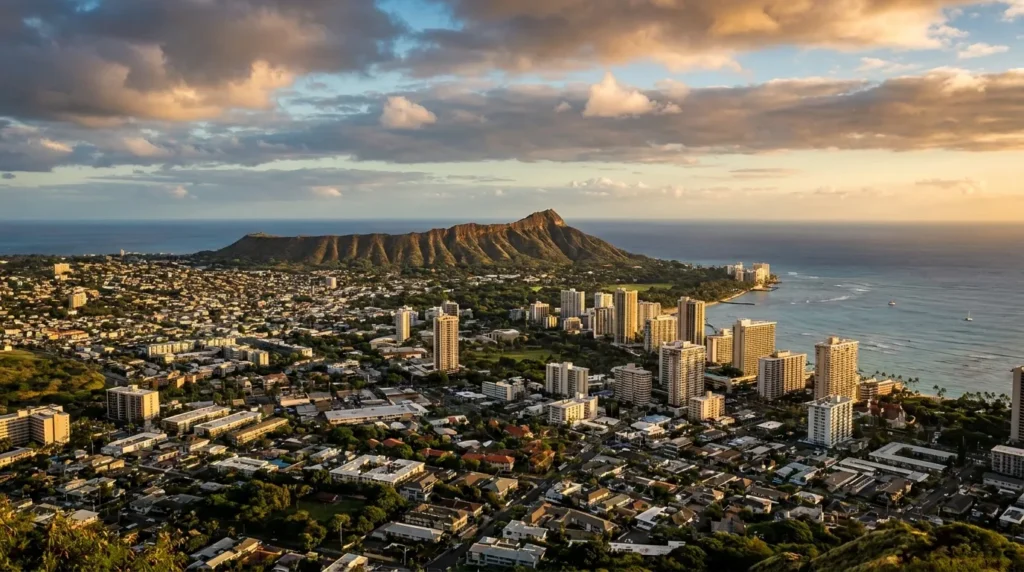
East Honolulu, residential side between Diamond Head and Hanauma Bay

A collection of suburban neighborhoods including Hawaii Kai, Aina Haina, and Kahala, East Honolulu is a quiet base for families with direct access to iconic beaches, hiking trails, and snorkeling at Hanauma Bay.

Hanauma Bay Nature Preserve, a collapsed volcanic crater transformed into a bay, is Hawaii's most famous snorkeling destination and requires advance reservations. Diamond Head State Monument sits at the western boundary, with a short trail to the summit delivering the classic view of Waikiki. Koko Head Crater Trail, with 1,048 steps built along a former military rail line, has become a popular local fitness challenge.

Sandy Beach is a body surfing spot favored by locals, while Makapuu Beach and the Makapuu Lighthouse Trail are just minutes away. Halona Blowhole Lookout, along the coastal route, is a near-mandatory stop. Kahala Mall serves everyday needs, and the Kahala Hotel & Resort hosts luxury events and a dolphin swimming program.

Hawaii Kai, designed by Henry J. Kaiser in the 1950s, is the newest neighborhood, featuring navigable canals and the Hawaii Kai Towne Center. Families make use of Koko Head District Park and Maunalua Bay Beach Park for fishing, paddling, and sailing. Downtown Honolulu is about 30 minutes away by car via Kalanianaole Highway.

  1. 1["Hanauma Bay Nature Preserve"
  2. 2"Koko Crater Trail (Stairs)"
  3. 3"Makapuu Lighthouse Trail"
  4. 4"Sandy Beach Park"
  5. 5"Halona Blowhole Lookout"
  6. 6"Koko Head Regional Park"
Nightlife3.0 / 10
Parks & green spaces
  • ["Koko Head Regional Park"
  • "Koko Crater Botanical Garden"
  • "Hanauma Bay Nature Preserve"
  • "Maunalua Bay Beach Park"
  • "Kuliouou Ridge Trail"
  • +1 more

Latest posts

Straight from the blog

There are no posts specifically about East Honolulu yet. In the meantime, check out our latest posts.