Visto n' Visa
Blog
Notícias e artigos
Destinations
Careers
Immigrants

Want to live and work in Kaneohe?

Personalized immigration plan with eligible visas, costs, and next steps for your goal!

If you are not eligible, you will know exactly why and what to do to improve your approval chances.

Save up to 12 hours in meetings

No pointless assessments.

Save up to 90%

Save money on vague or unfocused consultations

Avoid Fraud and Mistakes

One mistake can cost you your visa

Total Impartiality

Zero commercial bias

Decide with peace of mind

No toxic urgency

Fast and Accurate

Answers in minutes, no guesswork

Mixed demographics with a strong military and Hawaiian presence in Kaneohe

A blend of Asian residents (Japanese, Filipino, Chinese), Native Hawaiians, non-Hispanic whites connected to USMC, and family-oriented households with multiple generations living together.

The composition is diverse. There is a significant share of Native Hawaiians and descendants of Japanese, Filipino, and Chinese families, many of whom have lived in the area for generations. Non-Hispanic whites appear in higher proportions than in Waipahu or Kalihi, largely tied to Marine Corps Base Hawaii and professionals who relocated from the mainland.

Multigenerational households are common, particularly among Asian and Hawaiian families. Samoan and Tongan evangelical churches have a visible presence in the city, reflecting the strong Pacific Islander community. Hawaiian Pidgin is part of everyday life, especially among island natives.

The Brazilian community is small, more connected through mixed marriages, jiu-jitsu (local schools have Brazilian influence), surfing, and some remote-working families. Portuguese appears occasionally, but English is dominant, with pockets of Tagalog, Japanese, and Samoan in shops and churches.

Languages spoken
  • English
  • Hawaiian Pidgin
  • Tagalog
  • Samoan
  • Japanese
  • +1 more
Main religions
  • Catholicism
  • Protestant Christianity
  • Latter-day Saints
  • No religion
  • Buddhism
  • +1 more

Lower cost of living than Kailua and central Honolulu

Rent and home prices in Kaneohe are generally lower than in neighboring Kailua. Groceries and utilities follow the state's typically high standards.

For those seeking the windward coast of Oahu, Kaneohe tends to be the more affordable option compared to Kailua. Homes in neighborhoods such as Aikahi (which technically sits between Kailua and Kaneohe), Haiku Plantations, and Pikoiloa cost less than those near Lanikai. Rental prices follow the same proportional pattern.

The grocery market is served by Foodland, Times Supermarket, Safeway, and Costco in Iwilei (requiring a longer trip). Don Quijote in Pearl City is another budget-friendly option. Restaurants are reasonably priced, with a solid selection of poke shops, plate lunch spots, and Japanese eateries.

Electricity and gas follow the state standard: high. For military families with a housing allowance (BAH), Kaneohe is particularly attractive due to its proximity to Marine Corps Base. For civilians on median salaries, the balance between cost and quality of life is better than in Kailua and much of central Honolulu.

Homes in wooded valleys and townhouses in gated communities in Kaneohe

The city offers single-family homes in older neighborhoods, townhouses in pool communities, and a few low-rise buildings near Kamehameha Highway.

Housing supply varies by neighborhood. In areas such as Haiku Plantations, Crouching Lion, and Pikoiloa, single-story homes with wooded yards and high humidity predominate. In Hawaii Kai Heights (not to be confused with the eastern Honolulu neighborhood) and Halekauwila, townhouses and condominiums with pools and homeowners association fees are common.

For immigrants, starting with a long-term rental (12 months) in a gated condominium is generally advisable, especially when arriving with family. Neighborhoods like Pikoiloa have good schools and enough street activity to support community life. More secluded homes in the valleys (Haiku Valley, Waikalua) offer more space, but come with more mold and greater car dependency.

A few details are worth noting: the age of plumbing and roofing in older homes, lawn maintenance costs (is the HOA worthwhile?), and proximity to Marine Corps Base, which generates aircraft noise at certain hours. Homes at higher elevations benefit from better wind and cooler temperatures.

Recommended neighborhoods
  • Pikoiloa
  • Haiku Plantations
  • Crouching Lion
  • Halekauwila
  • Aikahi Park
  • +1 more

Employment tied to USMC, healthcare, and retail in Kaneohe

Marine Corps Base Hawaii, regional hospitals, and local commerce anchor the internal job market. Many residents commute to central Honolulu.

The dominant employer in the area is Marine Corps Base Hawaii (MCBH) on Mokapu Peninsula, with Marines, DoD civilians, and contracted firms. For immigrants with citizenship or a green card, it represents one of the main entry points into federal technical and administrative positions.

Healthcare is also a strong employer, particularly Adventist Health Castle in Kailua (a few minutes away), Pohai Nani (elder care), and Kaiser clinics. Education has a notable presence through Windward Community College, Hawaii Pacific University Hawaii Loa Campus, and Brigham Young University Hawaii in Laie, farther north.

Retail and services complete the picture, with Windward Mall and supermarkets absorbing a significant portion of the local workforce. Those working in central Honolulu, Tripler, or Pearl Harbor commute via Pali Highway, Likelike Highway, or H-3. Remote work is increasingly prevalent.

Dominant sectors
  • Defense and military
  • Healthcare
  • Education
  • Retail and commerce
  • Community services
  • +1 more
Major employers
  • Marine Corps Base Hawaii (MCBH)
  • Adventist Health Castle (Kailua)
  • Windward Community College
  • Hawaii Pacific University (Hawaii Loa Campus)
  • Windward Mall
  • +1 more

Decent public schools and two university campuses in Kaneohe

Castle High School, Windward Community College, and Hawaii Pacific University Hawaii Loa serve K-12 and higher education. UH Manoa is just minutes away via H-3.

The state public school system covers Kaneohe through Castle High School, Heeia Elementary, Kaneohe Elementary, Maunawili Elementary, and King Intermediate. Ratings vary, with strong music and sports programs. Some military families choose charter schools or private options in Kailua, such as Le Jardin Academy.

A key strength of Kaneohe is the presence of higher education within the area itself. Windward Community College, part of the UH system, is located in Kaneohe and offers technical and two-year programs with transfer pathways to four-year universities. Hawaii Pacific University operates its Hawaii Loa Campus within the city, with programs including nursing and marine sciences.

For adult immigrants, Windward CC is one of the state's most accessible entry points, with evening and hybrid courses, ESL student support, and scholarship options. For a more complete four-year university experience, the University of Hawaii at Manoa is roughly 25 minutes away via H-3.

Notable universities
  • Windward Community College
  • Hawaii Pacific University (Hawaii Loa Campus)
  • University of Hawaii at Manoa
  • Brigham Young University Hawaii (Laie)
  • Chaminade University of Honolulu
  • Kapiolani Community College

No major hospital of its own, but close proximity to Castle and Tripler

Kaneohe lacks a large hospital, but Adventist Health Castle in Kailua is nearby. Tripler serves military personnel and dependents; Queen's and Kaiser are in Honolulu.

Kaneohe is one of Oahu's mid-size cities without a general hospital of its own. The nearest emergency care is Adventist Health Castle in Kailua, offering an emergency room, maternity services, and multiple specialties. Kaiser and HMSA clinics operate within Kaneohe, alongside urgent care centers and private practices near Windward Mall.

For military personnel and dependents affiliated with Marine Corps Base Hawaii, Tripler Army Medical Center is the primary hospital complex, located on the other side of the island. Families often alternate between Tripler and Castle for different specialties, depending on clinical needs and Tricare coverage.

For more complex cases, Queen's Medical Center and Kaiser Permanente Moanalua in central Honolulu remain the main referral destinations. Mental health and dental services have longer wait times. As throughout the state, employer-based health coverage under the Hawaii Prepaid Health Care Act applies to most formal workers.

Healthcare index70.0 / 100
  • Life expectancyyears at birth
    78.4yrs
  • Doctors per 1kpracticing physicians
    3.7
  • Health spendper capita, per year
    $13,473
  • Public systemoverall quality rating
    Good

City considered safe, with a few localized concerns

Kaneohe has low to moderate crime rates. Vehicle break-ins at beach and trail parking lots, drug activity in isolated areas, and online fraud are the main concerns.

In terms of crime, Kaneohe is considered quite safe, especially in residential neighborhoods such as Pikoiloa, Haiku Plantations, and Aikahi. Violent crime is rare, and the Honolulu Police Department covers the entire area, with military police presence within and around Marine Corps Base.

The most common crimes are opportunistic: vehicle break-ins at bay parking lots, at trailheads such as Olomana Hike (between Kaneohe and Kailua), and near beaches, as well as package theft at homes. In more isolated valley areas, sporadic drug activity exists, though it is far removed from most residents' daily experience.

Day-to-day life is calm for women, seniors, and children. Walking at Heeia Pier, Windward Mall, and internal bike paths during daylight hours is safe. At night, avoiding isolated trails and parking lots is advisable, and well-lit vehicles are preferred. Video doorbells are standard in residential homes.

5.8
Homicides per 100k
per year
Safety index
72.0
Crime index
28.0
Safer neighborhoods
  • Hauula
  • Aikahi
  • Mahinui
  • Pikoiloa
  • Kahaluu
  • Kaalaea
Areas to avoid
  • Isolated stretches of Kamehameha Highway after midnight
  • Deserted commercial parking lots at night

Pali, Likelike, and H-3 connect Kaneohe to Honolulu

Three highways cross the Koolau Range toward central Honolulu. TheBus provides solid coverage. Cycling works on flat stretches along the bay.

The defining transportation feature of the windward coast is crossing the Koolau Range. Kaneohe is served by three highways: Pali Highway (the oldest and most scenic), Likelike Highway (more technical), and H-3 (an interstate, the fastest option). All corridors experience congestion during peak hours, but H-3 tends to be the best route for Pearl Harbor and Tripler.

TheBus operates several lines connecting Kaneohe to Ala Moana, the University of Hawaii, and downtown. Given typical commute distances, many residents prefer to drive for comfort and convenience. Parking in Kaneohe is easy, though central Honolulu parking can be costly.

The city's topography is mixed: flat sections near the bay and slopes in the valleys. For immigrants, having at least one car per adult is practically a requirement. Bicycles work well for short trips along the bay and within neighborhoods, but regular rain limits everyday use.

30 min
Avg commute
32
Walkability
Airports
  • HNL — Daniel K. Inouye International Airport (in Honolulu, about 22 km away)
  • Bike infrastructure

What the climate is like living in Kaneohe

Located on the eastern side of Oahu, Kaneohe has a humid tropical climate with stable temperatures between 22 and 30 degrees year-round and frequent short rain showers.

Kaneohe's climate is humid tropical, with more frequent rainfall than the western side of the island. High temperatures range from 28 to 30 degrees from May through October and from 24 to 27 degrees from November through April. Lows rarely drop below 19 degrees, making heating unnecessary throughout the year.

The area sits directly in front of the Ko'olau mountains, which trap moisture carried by the trade winds and trigger brief, nearly daily rain showers. The tropical vegetation is lush, and homes require attention to mold prevention along with keeping rain gear on hand.

Air conditioning is less common here than in Honolulu, as the sea breeze and rain showers keep conditions comfortable. The climate is steady and easy to adapt to, with a calm pace of life throughout the year.

Sunny days / year220 days
Avg high (°F)
  • 78°J
  • 77°F
  • 78°M
  • 79°A
  • 80°M
  • 82°J
  • 83°J
  • 84°A
  • 84°S
  • 83°O
  • 82°N
  • 79°D
Avg low (°F)
  • 69°J
  • 69°F
  • 69°M
  • 71°A
  • 72°M
  • 74°J
  • 75°J
  • 75°A
  • 75°S
  • 74°O
  • 73°N
  • 71°D
Rainfall (")
  • 3"J
  • 4"F
  • 5"M
  • 4"A
  • 4"M
  • 4"J
  • 5"J
  • 4"A
  • 4"S
  • 3"O
  • 4"N
  • 6"D

Hawaiian, military, and religious culture in Kaneohe

Cultural life centered on the bay, military events, Pacific Islander evangelical churches, and landmarks such as Heeia Pier, Heeia Fishpond, and the Byodo-In Temple.

Kaneohe's culture blends three distinct layers. The first is Hawaiian, with sites such as the Heeia Fishpond (an ancestral fish cultivation pond restored through community initiatives), Heeia Pier, and Hawaiian canoe practices on the bay. The second is Asian, symbolized by the Byodo-In Temple, a replica of a Japanese temple from Kyoto set in a green valley.

The third layer is military, with occasional open events at MCBH and a large community of Marine Corps families. Samoan, Tongan, and Filipino evangelical churches are active and organize cultural festivals throughout the year. Windward Mall is the hub for cinema, dining, and family activities.

The food scene is good and relatively affordable. He'eia Kea Pier General Store, poke restaurants, Japanese izakayas, and plate lunch spots along Kamehameha Highway cover daily needs. For a more active nightlife, the trip to central Honolulu takes 25 to 35 minutes via Likelike or H-3.

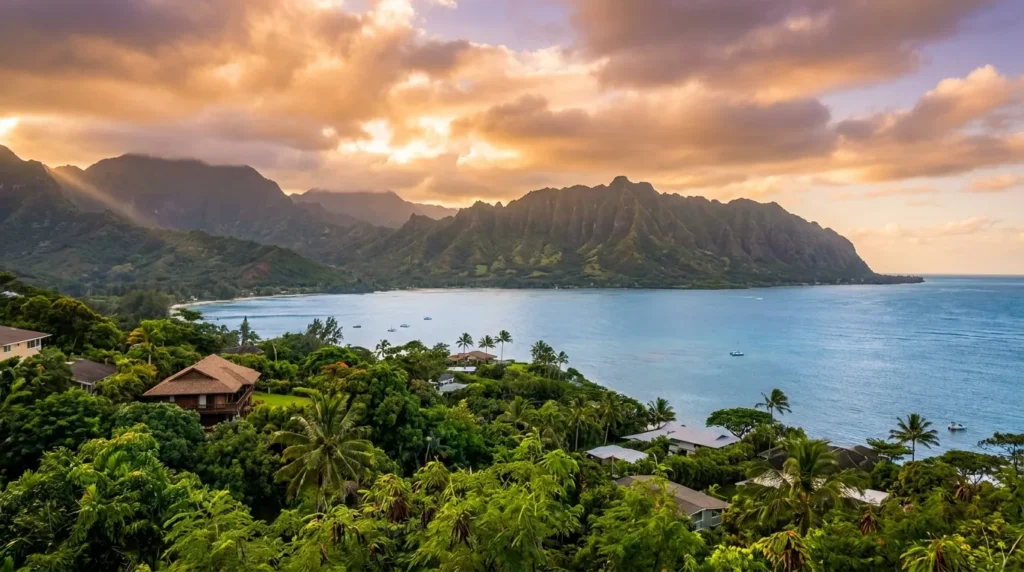
Kaneohe, Oahu's windward side with a protected bay and tropical gardens

Kaneohe sits on the eastern coast of Oahu, facing the stunning Kaneohe Bay and the Ko'olau Range. Life here blends nature, a military base, and residential neighborhoods.

Kaneohe Bay is the heart of the city, home to the Sandbar (Ahu o Laka), a shallow sandbar in the middle of the bay accessible only by boat. The Ho'omaluhia Botanical Garden, maintained by the Honolulu Botanical Gardens, spans 162 hectares at the foot of the Ko'olau mountains and draws families and anglers alike. The Byodo-In Temple, a replica of a 900-year-old Japanese temple, is located in the Valley of the Temples Memorial Park.

He'eia State Park and He'eia Pier offer panoramic views and serve as departure points for boat tours. Senator Fong's Plantation and Gardens, though closed for renovations at times, remains a historical landmark. For diving and snorkeling, areas near Coconut Island (Moku o Lo'e) are popular, though the island itself is a research reserve of the Hawaii Institute of Marine Biology.

Marine Corps Base Hawaii at Mokapu includes Klipper Beach, accessible to military personnel and dependents. For outdoor pursuits, the Likeke Falls Trail and the Maunawili Falls Trail, both nearby, are popular hikes. Kualoa Ranch, a few miles away, offers film location tours (Jurassic Park, Lost) and adventure activities. Beaches such as Kailua Beach and Lanikai are about 15 minutes away.

  1. 1["Ho'omaluhia Botanical Garden"
  2. 2"Byodo-In Temple"
  3. 3"Kualoa Regional Park (nearby)"
  4. 4"He'eia State Park"
  5. 5"Kaneohe Sandbar (Ahu O Laka)"
  6. 6"Valley of the Temples Memorial Park"
Nightlife2.0 / 10
Parks & green spaces
  • ["Ho'omaluhia Botanical Garden"
  • "He'eia State Park"
  • "Kaneohe District Park"
  • "Pohai Nani Park"
  • "Bayview Park"
  • +1 more

Latest posts

Straight from the blog

There are no posts specifically about Kaneohe yet. In the meantime, check out our latest posts.