Visto n' Visa
Blog
Notícias e artigos
Destinations
Careers
Immigrants

Want to live and work in Mililani Town?

Personalized immigration plan with eligible visas, costs, and next steps for your goal!

If you are not eligible, you will know exactly why and what to do to improve your approval chances.

Save up to 12 hours in meetings

No pointless assessments.

Save up to 90%

Save money on vague or unfocused consultations

Avoid Fraud and Mistakes

One mistake can cost you your visa

Total Impartiality

Zero commercial bias

Decide with peace of mind

No toxic urgency

Fast and Accurate

Answers in minutes, no guesswork

A mixed, Asian, and military demographic in Mililani Town

Strong Japanese, Filipino, and Chinese presence. Military families connected to Schofield Barracks and Wheeler Army Airfield, along with a significant share of non-Hispanic white residents.

The ethnic composition of Mililani Town is one of the most diverse on Oahu, with a strong Asian presence (Japanese, Filipino, Chinese, Korean) and a significant proportion of non-Hispanic white residents. Part of this stems from the proximity of Schofield Barracks to the north and Wheeler Army Airfield, which bring many military families to the area.

The median age is well-balanced, with a good number of families with young children as well as retirees. There is a long-established Japanese community, rooted for generations, with active Buddhist temples and Obon festivals. Catholic, Protestant, and Latter-day Saint congregations round out the religious landscape, with a notable presence of Filipino and Hawaiian families.

The Brazilian community is small. There are families connected through marriages with military personnel, international schools, and some remote work networks. English is dominant, with Tagalog, Japanese, and Hawaiian Pidgin appearing in commerce and schools. For immigrants seeking a quiet, organized community, Mililani tends to be a good fit.

Languages spoken
  • English
  • Tagalog
  • Japanese
  • Hawaiian Pidgin
  • Korean
  • +1 more
Main religions
  • Protestant Christianity
  • Catholicism
  • Buddhism
  • Latter-day Saints
  • No religion
  • +1 more

A more balanced cost of living within Oahu

Rents and home prices are lower than in central Honolulu, Kailua, and Kahala. Groceries and utilities follow the state's high standard, but there are good discount retail options.

Mililani Town offers one of the best combinations of home size and price within Oahu, without reaching the isolation of inland towns. Three-bedroom townhouse rentals and condo homes cost less than in central Honolulu, Kailua, or Aiea, though still above the US national average.

Grocery options are strong in the city: Foodland, Safeway, Don Quijote, Times Supermarket, and Costco in Iwilei and Kapolei. There are restaurants for every budget, with a strong selection of Asian food, plate lunches, and American chains (Olive Garden, Texas Roadhouse). For immigrants who cook at home, it is possible to manage a tighter budget better than in many Honolulu neighborhoods.

Electricity and gas follow the state standard, with slightly lower air conditioning costs than coastal neighborhoods due to the cooler climate. HOA fees vary considerably across recreation centers: some charge small monthly dues, others higher ones, and this variable should factor into any rental or purchase decision.

Mililani Town

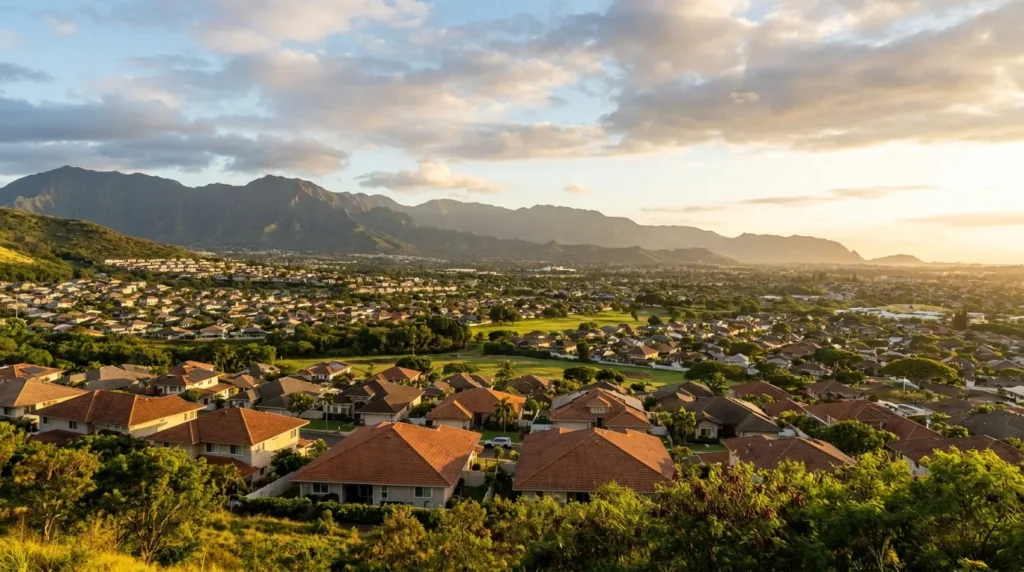
Homes and townhouses in organized recreation centers across Mililani

The city is divided into seven recreation centers, each with a pool, park, and courts. Single-story and two-story homes predominate, with townhouses in dedicated subdivisions.

The most distinctive feature of the real estate market here is the recreation center system. Mililani Town was planned around seven recreational centers, each with a pool, tennis courts, party facilities, and a park. Residents pay monthly dues to the Mililani Town Association and have free use of all the centers.

Mililani Mauka, the newer section of the city (1990s onward), sits at higher elevation with an even cooler climate, larger homes, and more modern townhouses. Traditional Mililani Town has homes from the 1960s and 1970s, generally well-maintained with tree-lined yards.

For immigrants, the recommendation is to rent first for six months to a year, learn the H-2 commute during work hours, and choose a neighborhood based on the children's school, the surrounding area, and the HOA fee. Homes in Mililani Mauka tend to have higher HOA fees but offer newer facilities. Be sure to review the subdivision's aesthetic covenants as well.

Recommended neighborhoods
  • Mililani Mauka
  • Mililani Town Center
  • Launani Valley
  • Waipio Acres (adjacent)
  • Melemanu
  • +1 more

Work tied to the military, technology, healthcare, and retail

Schofield Barracks and Wheeler Army Airfield are major employers to the north. Mililani Tech Park, healthcare, and retail also play key roles. Commuting to Honolulu is common.

Mililani's job market has a diversified profile. A few minutes to the north are Schofield Barracks, Wheeler Army Airfield, and Helemano Military Reservation, which employ soldiers, DoD civilians, and contracted companies. For immigrants with citizenship or a green card and technical training, this is an important point of entry.

Mililani Technology Park is a distinguishing feature: it concentrates IT, defense, and biotechnology companies such as Referentia Systems, Verizon, Hawaiian Telcom, and several software firms. This is rare among Oahu suburbs. Wahiawa General Hospital, Castle Medical (in Kailua), and Pali Momi also employ healthcare professionals.

Retail is strong at Mililani Town Center and Mililani Marketplace. For newly arrived immigrants, healthcare, retail, hospitality (with a commute to Honolulu/Waikiki), and construction tend to be the most common entry points. Remote work for mainland companies is increasingly common among residents.

Dominant sectors
  • Defense and military
  • Information technology
  • Healthcare
  • Retail and commerce
  • Education
  • +1 more
Major employers
  • Schofield Barracks (US Army)
  • Wheeler Army Airfield
  • Mililani Technology Park
  • Wahiawa General Hospital
  • Mililani Town Center (retail)
  • +1 more

Mililani has some of the best public schools on Oahu

Mililani High, Mililani Middle, and several elementary schools rank among the top in the state. Leeward Community College is just a few minutes away in Pearl City.

Mililani's public schools are one of the main draws for immigrant families. Mililani High School, Mililani Middle School, Mililani Mauka Elementary, Mililani Ike Elementary, Kipapa Elementary, and several others appear in state rankings with above-average ratings. Music programs, AP courses, robotics, and sports are strong.

There are private and charter options in the area, such as Hawaii Technology Academy (a statewide virtual charter with a campus in Waipahu) and several Catholic and Protestant schools. For families with more resources, Punahou and Iolani in Honolulu remain in the conversation, with private transportation. For military families, DoDEA schools are available at Schofield Barracks.

For higher education, the closest and most practical option is Leeward Community College in Pearl City, just minutes away via H-2. For four-year colleges, the University of Hawaii at Manoa and the University of Hawaii West Oahu are the most common destinations. Military personnel and dependents also have access to online programs through partner universities.

Notable universities
  • Leeward Community College (Pearl City)
  • University of Hawaii West Oahu (Kapolei)
  • University of Hawaii at Manoa
  • Hawaii Pacific University
  • Chaminade University of Honolulu
  • Brigham Young University Hawaii (Laie)

Wahiawa General nearby, with a broad network in Pearl City and Honolulu

Wahiawa General Hospital is just minutes away. Pali Momi (Aiea), Tripler (military), and Queen's (Honolulu) cover more complex cases.

The closest hospital is Wahiawa General Hospital, in Wahiawa to the north of Mililani. It has an emergency room, maternity ward, and various specialties. For more complex cases, Pali Momi Medical Center in Aiea and Kaiser Permanente Moanalua in Honolulu are the most common destinations. Military personnel and dependents use Tripler Army Medical Center.

In Mililani there are Kaiser and HMSA clinics, urgent care centers such as Adventist Health Castle Urgent Care, and dozens of private practices near Mililani Town Center and Mililani Marketplace. Dental and ophthalmological care is also available, with reasonable wait times. For Asian immigrants, there are physicians and nurses who speak Tagalog and Japanese.

As throughout the state, the Hawaii Prepaid Health Care Act requires employers to offer health insurance to employees working 20 or more hours per week. For self-employed immigrants, plans such as HMSA, Kaiser, and UHA cover the area. Mental health care and dental coverage generally require additional coverage or out-of-pocket payment.

Healthcare index70.0 / 100
  • Life expectancyyears at birth
    78.4yrs
  • Doctors per 1kpracticing physicians
    3.7
  • Health spendper capita, per year
    $13,473
  • Public systemoverall quality rating
    Good

One of the safest cities on Oahu

Mililani Town appears on rankings of the safest cities in the United States, with low violent crime rates and active patrols on main roads.

Mililani Town is one of the safest cities on Oahu and in the United States. It frequently appears on national lists of the safest communities, especially for families with children. The planned community profile, with an active HOA and Honolulu Police Department patrols, helps keep crime rates low.

The most common crimes are opportunistic: car break-ins in shopping center parking lots, porch package theft, and online fraud. Violent crime is rare. Standard suburban precautions apply: a video doorbell (Ring, Nest), not leaving valuables visible in the car, keeping doors locked, and using exterior lighting.

For women, seniors, and children, walking within the recreation centers, parks, and shopping centers is safe. At night, interior streets are quiet, with a good number of residents walking or jogging. Nearby trails, such as Manana Trail and trails in the Schofield area, are best explored in a group and during daylight hours.

5.8
Homicides per 100k
per year
Safety index
78.0
Crime index
22.0
Safer neighborhoods
  • Mililani Mauka
  • Mililani Town Center
  • Launani Valley
  • Patio Homes
  • Mililani West
  • Wahiawa Heights (vicinity)
Areas to avoid
  • Isolated stretches of Kamehameha Highway near Wahiawa after midnight
  • Deserted commercial parking lots at night

H-2 and H-1 connect Mililani to Pearl Harbor and Honolulu

H-2 runs through Mililani and connects to H-1. Traffic is heavy during peak hours. TheBus provides good coverage. Cycling works well within the city.

H-2 is the city's main highway, connecting Mililani to Pearl City and H-1. Heading north it leads to Wahiawa and Haleiwa; heading south it leads to Pearl Harbor, the airport, and Honolulu. During peak hours, especially in the morning heading south, traffic is heavy. Some residents leave home early to avoid congestion.

TheBus operates several lines connecting Mililani to Ala Moana, downtown, and the University of Hawaii. Most residents drive, but the bus is a viable option for those working regular hours. The Skyline rail does not yet reach Mililani; the nearest stations are in Pearl City and at Aloha Stadium.

Within the city, bike lanes and flat streets make cycling practical for short trips. For immigrants, having at least one car per adult is essentially standard. Obtaining a Hawaii Driver's License is a priority, and considering hybrid or electric vehicles makes sense given local gas prices.

1
Metro lines
1
Metro stations
35 min
Avg commute
30
Walkability
Airports
  • HNL — Daniel K. Inouye International Airport (in Honolulu, approximately 25 km away)
  • Bike infrastructure

What the climate is like in Mililani Town

A planned community in central Oahu with a milder tropical climate due to its elevation, with temperatures ranging between 65°F and 86°F throughout the year.

Mililani Town has a tropical climate, though its higher elevation relative to the coast moderates the heat somewhat. High temperatures range between 82 and 86°F from May through October and between 75 and 81°F from November through April. Lows can drop to around 65°F on cool winter nights.

The area sits in the center of the island, between two mountain ranges, receiving moderate rainfall year-round. The trade winds move steadily through the region and make the heat far more comfortable than in Honolulu. Air conditioning is rarely needed in homes.

The rainy season runs from November through March, with short showers. The dry season, from April through October, is sunny. The mild, consistent temperatures and steady breezes make outdoor activities practical in every month of the year.

Sunny days / year250 days
Avg high (°F)
  • 79°J
  • 78°F
  • 78°M
  • 80°A
  • 82°M
  • 84°J
  • 85°J
  • 86°A
  • 86°S
  • 85°O
  • 83°N
  • 80°D
Avg low (°F)
  • 65°J
  • 65°F
  • 65°M
  • 67°A
  • 68°M
  • 70°J
  • 71°J
  • 72°A
  • 72°S
  • 70°O
  • 69°N
  • 67°D
Rainfall (")
  • 1"J
  • 2"F
  • 3"M
  • 2"A
  • 2"M
  • 2"J
  • 1"J
  • 1"A
  • 1"S
  • 2"O
  • 1"N
  • 3"D

Community, military, and family culture in Mililani Town

Cultural life revolves around parks, churches, schools, sports leagues, and Mililani Town Association events. For nightlife, everyone heads to central Honolulu.

Cultural life in Mililani has a distinctly community-oriented profile. The recreation centers function as small clubs, hosting parties, swimming lessons, and sports leagues. Catholic churches, Protestant congregations, Latter-day Saint wards, and Buddhist temples hold festivals and events throughout the year. School events and youth leagues (basketball, football, taekwondo) fill the weekends.

Mililani Town Center concentrates retail, restaurants, and a movie theater. There is a strong selection of Asian food (Japanese, Korean, Filipino, Chinese), plate lunches, and American chains. Markets like Don Quijote and Foodland carry products typical of many communities. For real nightlife, clubs, museums, concerts, and more upscale dining, residents head to central Honolulu, Kakaako, and Waikiki, 25 to 45 minutes away.

The surrounding nature is a distinct advantage. Trails like Manana Trail, parks like Wahiawa Botanical Garden, and the North Shore (about an hour away) are all accessible. For immigrants, the most common paths to integration are through church, children's schools, and the community sports leagues of the Mililani Town Association.

Mililani Town

Attractions in Mililani Town, planned community in central Oahu

A master-planned community on the central plateau of Oahu, with seven community pools maintained by the Mililani Town Association. Recreation blends beach access, hiking trails, Hawaiian agriculture, and proximity to Honolulu and the North Shore.

The Mililani Town Association maintains seven recreation centers with pools, courts, and event halls, available exclusively to residents, which strongly defines the local lifestyle. Mililani District Park, with baseball and softball fields, and Mililani Mauka District Park round out the sports facilities. Mililani Town Center serves as the neighborhood hub for shopping and dining.

Mililani is surrounded by accessible nature. Wahiawa Botanical Garden and Kukaniloko Birthstones State Monument, a sacred Hawaiian site where high-ranking chiefs were born, are just minutes away. Schofield Barracks and Wheeler Army Airfield are in the vicinity. Within half an hour lies the North Shore (Waimea Bay, Sunset Beach, Haleiwa), and another twenty minutes brings visitors to Dole Plantation with its pineapple maze.

Honolulu, with Waikiki, Diamond Head, Iolani Palace, and Bishop Museum, is about forty minutes via H-2 and H-1, longer during rush hour. Pearl Harbor National Memorial is roughly halfway. For broader natural experiences, Kaena Point on the northwest tip and Ka'ena Point State Park make excellent weekend excursions, with Pacific Ocean views and humpback whales visible in winter.

  1. 1["Mililani District Park"
  2. 2"Mililani Town Center"
  3. 3"Mililani Golf Club"
  4. 4"Wahiawa Botanical Garden (nearby)"
  5. 5"Kukaniloko Birth Stones State Historic Site (nearby)"
  6. 6"Dole Plantation (nearby)"
Nightlife2.0 / 10
Parks & green spaces
  • ["Mililani District Park"
  • "Mililani Mauka District Park"
  • "Patsy T. Mink Central Oahu Regional Park (nearby)"
  • "Launani Valley Park"
  • "Wahiawa Botanical Garden (nearby)"
  • +1 more

Latest posts

Straight from the blog

There are no posts specifically about Mililani Town yet. In the meantime, check out our latest posts.