Visto n' Visa
Blog
Notícias e artigos
Destinations
Careers
Immigrants

Want to live and work in Honolulu?

Personalized immigration plan with eligible visas, costs, and next steps for your goal!

If you are not eligible, you will know exactly why and what to do to improve your approval chances.

Save up to 12 hours in meetings

No pointless assessments.

Save up to 90%

Save money on vague or unfocused consultations

Avoid Fraud and Mistakes

One mistake can cost you your visa

Total Impartiality

Zero commercial bias

Decide with peace of mind

No toxic urgency

Fast and Accurate

Answers in minutes, no guesswork

Honolulu is one of the most Asian cities in the United States

Descendants of Japanese, Filipino, Chinese, and Native Hawaiian heritage predominate. Non-Hispanic whites are a minority, and the ethnic mix is a defining part of the city's identity.

Honolulu is one of the few large cities in the United States where non-Hispanic whites are a minority. The majority of the population is of Asian ancestry, with strong representation from Japanese, Filipino, and Chinese descendants, alongside Native Hawaiians and other Pacific Islanders. Interethnic marriages have been common for decades, and the term 'hapa' describes those of mixed heritage.

English is the primary language, spoken universally, but Hawaiian Pidgin appears in everyday life, especially among local families. Filipino Catholic churches, Japanese Buddhist temples, Korean evangelical churches, and Shinto shrines share space with traditional Hawaiian churches.

Brazilians and Latinos form a small but growing group, partly linked to work in tourism, jiu-jitsu, surfing, and construction. There is an active Brazilian community in gyms and select churches. A Brazilian neighborhood grocery, as found in Boston or Orlando, is not to be expected here.

Languages spoken
  • English
  • Hawaiian Pidgin
  • Tagalog
  • Japanese
  • Chinese
  • +1 more
Main religions
  • Catholicism
  • Protestant Christianity
  • Buddhism
  • No religion
  • Hinduism
  • +1 more

Honolulu is one of the most expensive cities in the United States

The cost of living exceeds cities like San Francisco and New York in several categories. Rent, food, and electricity are the most significant budget pressures.

Nearly everything in Hawaii arrives by ship or plane, and that shows in prices. Groceries are noticeably more expensive than on the mainland. Chains like Foodland, Times Supermarket, and Don Quijote help, but even staples like milk, eggs, and fruit cost more than in any average American city.

Rent is the most sensitive item. Small apartments in Waikiki and Kakaako cost what an entire house costs in other parts of the country. Electricity bills are high because Hawaii generates power primarily from imported oil, and air conditioning during the warmer months adds significantly. Gasoline is also more expensive.

A state income tax exists and is progressive. In return, property tax is not a heavy burden for renters, and residents (kama'aina) receive discounts on admissions, transportation, and some services. Those relocating should plan on at least six months of financial reserves to get established.

130Cost index (US = 100)30% above US average
CategorySingleCoupleFamily (2 + 2)
iHousing$1,682$1,941$2,459
iFood$492$983$1,786
iTransport$647$1,099$1,424
iHealthcare$362$725$1,358
iChildcare$2,355
iOther$1,099$1,979$2,782
Monthly total$4,282$6,727$12,164

Source: U.S. BLS Consumer Expenditure Survey 2023 + BEA Regional Price Parities 2023 · Estimates in USD, monthly.

Tight, expensive, and highly vertical housing market

Condos dominate in neighborhoods like Waikiki, Kakaako, and Ala Moana. Houses are concentrated in Manoa, Kaimuki, Kahala, and the hillside areas. All in high demand.

Honolulu is a condo city. In Waikiki, Ala Moana, and Kakaako, high-rise towers predominate, many geared toward the tourism market, with more recent restrictions on short-term rentals. Kakaako has become the new neighborhood, full of modern buildings and restaurants, with good access to the beach and downtown.

Houses are found in neighborhoods like Manoa (wetter, close to the university), Kaimuki (family-oriented, with a solid commercial strip), Kahala (upscale, near the ocean), Aiea, Salt Lake, and Pearl City. Waitlists for well-located properties are long, and competition from military personnel and Asian investors keeps prices elevated.

For newcomers, the recommendation is to join community groups on Facebook, use Craigslist with caution, and prioritize contracts through licensed brokers. Inspection for the classic Hawaii issue, mold, is essential. No lease should be signed without visiting the unit in person, even if that delays the move-in date.

Recommended neighborhoods
  • Kakaako
  • Ala Moana
  • Manoa
  • Kaimuki
  • Kahala
  • +2 more

Job market centered on tourism, the military, and government

Tourism, defense, healthcare, and the public sector sustain the economy. Technology remains a small scene. Salaries are solid in military and medical fields, moderate in hospitality.

Honolulu's economy rests on three pillars: tourism (hotels, restaurants, retail, events), federal and state government, and the military complex (Joint Base Pearl Harbor-Hickam, Schofield Barracks). Healthcare and education complete the picture, with Queen's Medical Center, Kaiser Permanente, and the University of Hawaii as major employers.

Healthcare professionals (nurses, technicians, therapists) are in high demand with decent salaries. Technology is still a small scene, concentrated in Kakaako and a handful of startups focused on ocean research and clean energy. Hospitality employs large numbers but pays at median levels. Construction and services tend to absorb a significant amount of Latino labor.

For recent arrivals, worthwhile avenues include DoD contractor networks, tourism chains (Hilton, Marriott, Hyatt), Hawaiian Airlines, and the state's Workforce Development division. Seasonal tourism jobs serve as entry points, but the goal should be moving toward more stable sectors over time.

Dominant sectors
  • Tourism and hospitality
  • Defense and military
  • Healthcare
  • Government
  • Education
  • +1 more
Major employers
  • Queen's Health Systems
  • Hawaiian Airlines
  • Kaiser Permanente Hawaii
  • Hawaii Pacific Health
  • University of Hawaii at Manoa
  • +1 more

Middling public schools and a major state university

The public system is unified and statewide, with uneven quality. Private schools like Punahou and Iolani are long-established traditions. The University of Hawaii is the primary academic center.

Hawaii is the only state where the public school system is managed entirely by the state government rather than local districts. Quality varies considerably by neighborhood, and many local families opt for private schools. Punahou (where Barack Obama attended), Iolani, Mid-Pacific Institute, and Kamehameha (restricted to children of Hawaiian ancestry) are the established references.

For newcomers, this means that choosing a neighborhood involves checking the public school assignment for a given address and considering charter schools as an option. Strong public schools exist in Manoa, Kahala, and Mililani, for example, but research is required.

In higher education, the University of Hawaii at Manoa is the flagship, with strong programs in oceanography, volcanology, Asian studies, and tropical medicine. Hawaii Pacific University in downtown Honolulu, Chaminade University, Kapiolani Community College, and Honolulu Community College also serve those looking to start with a lighter course load.

Notable universities
  • University of Hawaii at Manoa
  • Hawaii Pacific University
  • Chaminade University of Honolulu
  • Kapiolani Community College
  • Honolulu Community College
  • Brigham Young University Hawaii (Laie)

Strong hospital network and near-universal coverage for workers

Hawaii has a longstanding state law requiring employers to provide health insurance to employees working 20 or more hours per week, which significantly improves access.

Honolulu's hospital network is strong by American standards. Queen's Medical Center, Kaiser Permanente Moanalua, Straub Medical Center, Pali Momi, and Kapiolani Medical Center for Women and Children cover general practice, emergency care, maternity services, and specialties. For highly complex cases, some patients still travel to Los Angeles or Seattle.

The key differentiator is the Hawaii Prepaid Health Care Act, a state law requiring employers to offer health coverage to employees working 20 or more hours per week. In practice, this broadens access and pushes the uninsured rate lower compared to other states.

For newcomers, the most common path is enrolling in an employer-sponsored plan (HMSA, Kaiser Permanente, UHA). Without that option, community clinics such as the Waianae Coast Comprehensive Health Center and the Kalihi-Palama Health Center provide care on a sliding-fee basis. Dental and vision coverage is rarely included in basic plans.

Healthcare index73.0 / 100
  • Life expectancyyears at birth
    78.4yrs
  • Doctors per 1kpracticing physicians
    3.7
  • Health spendper capita, per year
    $13,473
  • Public systemoverall quality rating
    Good

Safer than major mainland cities, but with specific concerns

Honolulu has lower violence rates than mainland metros, but beach theft, car break-ins, and tourist-targeted fraud warrant attention.

Compared to cities like Atlanta, Houston, or Los Angeles, Honolulu is noticeably calmer. Violent crime is relatively low, partly due to the island's geographic isolation. Fights and serious crimes are concentrated in specific pockets of Chinatown, Kalihi, and Waianae, away from tourist areas and upscale residential neighborhoods.

The most common problem is petty theft. In Waikiki, on beaches, and at tourist spots like Diamond Head, extra attention to bags and phones is warranted. Car break-ins to steal visible items are frequent at trailheads and beach parking lots, so the local advice is simple: leave nothing in the car, not even anything that resembles a valuable item.

The homeless population is visible in some areas, especially near downtown and in parks. This is generally more of a social issue than a safety concern, and confrontations are rare. For those walking at night in Waikiki, Ala Moana, and Kakaako, the environment is considered reasonably safe, with good foot traffic and lighting.

5.8
Homicides per 100k
per year
Safety index
60.0
Crime index
40.0
Safer neighborhoods
  • Kahala
  • Hawaii Kai
  • Manoa
  • Kaimuki
  • Diamond Head
  • Aina Haina
Areas to avoid
  • Chinatown late at night
  • Areas near Iwilei at night
  • Isolated stretches of Waikiki late at night
  • Sand Island industrial areas

Famous traffic, a reliable bus network, and a new rail line in operation

The H-1 is the main artery, with heavy congestion. TheBus covers most of the city. Skyline, the new urban rail, connects west Oahu to downtown Honolulu.

Despite being an island, Honolulu has serious traffic. The H-1 is the main artery and becomes congested during peak hours, with heavy flow between Pearl City, Aiea, and downtown. Parking in downtown and Waikiki is expensive and limited. Living close to work saves considerable time and money.

TheBus is one of the best municipal transit networks in the United States, reaching nearly the entire island at an affordable price. Skyline, the newly inaugurated elevated rail system, connects areas like East Kapolei to Aloha Stadium and continues to expand toward Ala Moana and Kakaako, aiming to reduce a significant portion of west-side congestion.

For newcomers, logistics depend on the neighborhood. Those living in Waikiki, Ala Moana, or Kakaako can manage without a car using the bus, bicycle (Biki), and walking. In more distant neighborhoods, a car remains nearly indispensable, and building parking may carry a separate charge on top of rent.

1
Metro lines
9
Metro stations
27 min
Avg commute
64
Walkability
Airports
  • HNL — Daniel K. Inouye International Airport
  • International airport
  • Bike infrastructure

What the Climate Is Like Living in Honolulu

Hawaii's capital enjoys a stable tropical climate year-round, with temperatures between 72 and 88 degrees Fahrenheit, steady trade winds, and brief, refreshing rain showers.

Honolulu's climate is tropical and remarkably consistent. High temperatures range from 85 to 88 degrees Fahrenheit between May and October, and from 77 to 82 degrees between November and April. Lows rarely drop below 68 degrees, eliminating any need for home heating throughout the year.

Humidity is high, but the trade winds blow nearly continuously, making the heat quite manageable. Air conditioning is common in bedrooms and offices, though many residences rely on cross-ventilation and ceiling fans for effective cooling.

The rainy season runs from November through March, bringing short, intense showers followed quickly by sunshine. The dry season, from April through October, is sunny and ideal for beach activities and outdoor recreation. At 271 sunny days per year, the city offers one of the most reliably pleasant climates in the United States.

Sunny days / year271 days
Avg high (°F)
  • 78°J
  • 77°F
  • 77°M
  • 79°A
  • 81°M
  • 83°J
  • 84°J
  • 85°A
  • 85°S
  • 83°O
  • 82°N
  • 79°D
Avg low (°F)
  • 69°J
  • 68°F
  • 69°M
  • 70°A
  • 71°M
  • 73°J
  • 74°J
  • 75°A
  • 75°S
  • 73°O
  • 72°N
  • 70°D
Rainfall (")
  • 1"J
  • 2"F
  • 2"M
  • 2"A
  • 1"M
  • 1"J
  • 1"J
  • 1"A
  • 1"S
  • 1"O
  • 1"N
  • 3"D

Hawaiian, Japanese, and Filipino cultures blended into everyday life

Hula, surfing, Asian festivals, and multicultural cuisine define daily life. Local pride runs deep, and respect for the Hawaiian people is a central part of community life.

Hawaii has its own distinct culture, not simply a version of mainland beach life. Hula is a serious art form, tied to the history of the archipelago, with schools (halau) throughout the city. Surfing is part of many local residents' lives, and beaches like Ala Moana Beach Park, Sandy Beach, and Waikiki serve as both recreation and community gathering points.

The cuisine is among the most interesting in the country. Plate lunch, poke, saimin, Portuguese malasada, Korean food, and Japanese izakayas coexist with Filipino barbecue and food hall stalls like those at the KCC Farmers Market. The Bishop Museum and the Honolulu Museum of Art offer context for those seeking to understand the history of the archipelago.

There is growing tension around 'mainlanders' arriving from the continental US due to rising housing costs and gentrification. For newcomers, the path is straightforward: learn the basic pronunciation of Hawaiian words, respect the aina (land), remove shoes when entering a home, and treat local residents as citizens of their place, not as tourist attractions.

Honolulu

Honolulu Attractions: Waikiki, Pearl Harbor, and Hawaiian Heritage

Honolulu brings together Waikiki, Diamond Head, Pearl Harbor National Memorial, and the Bishop Museum in an island capital where Hawaiian, Asian-Pacific, and American cultures converge.

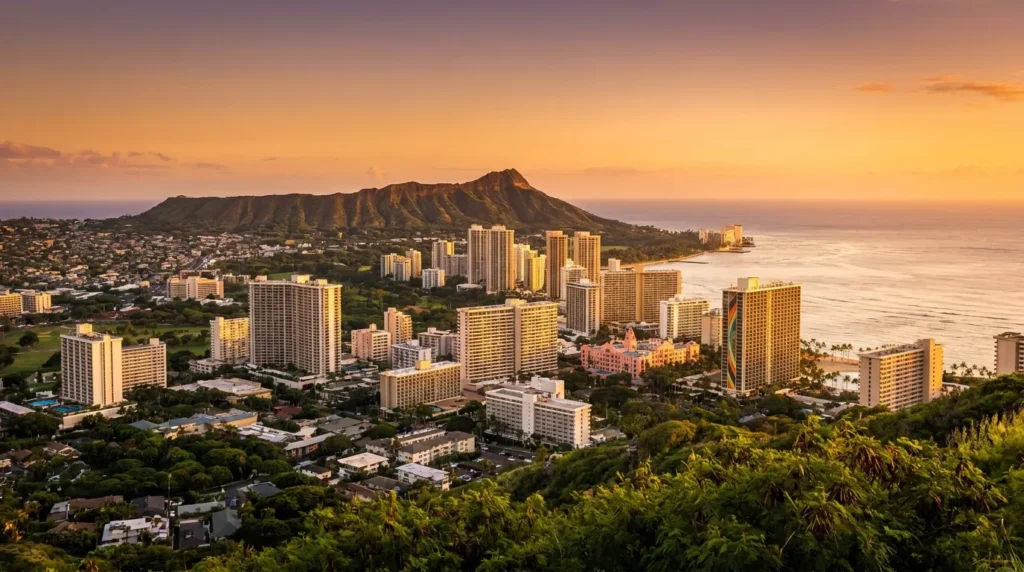
Waikiki Beach is the city's defining landmark, with Diamond Head State Monument anchoring the horizon and Kalakaua Avenue lined with shops, art deco hotels, and the historic Royal Hawaiian. Iolani Palace, the only royal palace on American soil, and the Bishop Museum in Kalihi document the history of the Hawaiian Kingdom and the Polynesian diaspora. The Honolulu Museum of Art holds a world-class Japanese art collection.

Pearl Harbor National Memorial, encompassing the USS Arizona Memorial, USS Missouri Battleship, and USS Bowfin Submarine, is essential for understanding modern Pacific history. The Polynesian Cultural Center in Laie offers a complementary experience on the other side of the island. For nature, Hanauma Bay Nature Preserve is renowned for snorkeling, while the Lanikai Pillbox trail and Manoa Falls round out the outdoor itinerary.

Honolulu's Chinatown blends fish markets, galleries, and award-winning cocktail bars; Kakaako has become a hub for murals, food trucks, and craft breweries; and the Aloha Tower with Kewalo Basin marks the historic harbor. Waimea Valley, Foster Botanical Garden, and Lyon Arboretum provide botanical escapes, and the Honolulu Festival each March celebrates Pacific traditions.

  1. 1["Waikiki Beach"
  2. 2"Diamond Head State Monument"
  3. 3"Pearl Harbor National Memorial (USS Arizona)"
  4. 4"Iolani Palace"
  5. 5"Bishop Museum"
  6. 6"Honolulu Museum of Art"
Nightlife7.0 / 10
Parks & green spaces
  • ["Kapiolani Regional Park"
  • "Ala Moana Regional Park"
  • "Manoa Falls Trail"
  • "Diamond Head State Monument"
  • "Foster Botanical Garden"
  • +1 more

Latest posts

Straight from the blog

There are no posts specifically about Honolulu yet. In the meantime, check out our latest posts.