Visto n' Visa
Blog
Notícias e artigos
Destinations
Careers
Immigrants

Want to live and work in Kahului?

Personalized immigration plan with eligible visas, costs, and next steps for your goal!

If you are not eligible, you will know exactly why and what to do to improve your approval chances.

Save up to 12 hours in meetings

No pointless assessments.

Save up to 90%

Save money on vague or unfocused consultations

Avoid Fraud and Mistakes

One mistake can cost you your visa

Total Impartiality

Zero commercial bias

Decide with peace of mind

No toxic urgency

Fast and Accurate

Answers in minutes, no guesswork

Kahului's population: Asian, Hawaiian, and Pacific mix

Predominantly Asian and Pacific city. Filipinos form the largest group, followed by Native Hawaiians, Japanese, and whites. The Hispanic community is growing.

Kahului has an ethnic profile quite different from the American mainland. Filipinos are the largest group, with a strong presence in hospitality, agriculture, and nursing. Native Hawaiians and other Pacific Islanders (Samoans, Tongans, Micronesians) also make up a significant portion. Japanese form a historic community, descendants of sugarcane plantation workers from the 19th and 20th centuries. Whites (haoles) are a minority.

The Hispanic community has grown over the past decade, with Mexicans, Salvadorans, and Guatemalans working in construction, agriculture, and restaurants. Brazilians are very few. There are also Koreans, Vietnamese, Chinese, and a small historic Portuguese community, descendants of Azoreans and Madeirans who came to work alongside the Japanese on the plantations in the 19th century.

Religious life reflects this blend. Large Catholic churches such as Maria Lanakila and Christ the King serve Filipinos and Hispanics. Buddhist temples such as Maui Hongwanji and Jodo Mission serve the Japanese community. Local Protestant churches and a few small Brazilian Pentecostal congregations are also present. Traditional Hawaiian ceremonies still play a role in cultural life. English is the official language, but Hawaiian Pidgin (Hawaiian Creole English) is spoken in everyday life.

Languages spoken
  • English
  • Hawaiian Pidgin (Hawaiian Creole English)
  • Tagalog and Ilocano (Filipino)
  • Japanese
  • Spanish
  • +2 more
Main religions
  • Catholic Christian
  • Buddhist (Japanese)
  • Protestant Christian
  • Traditional Hawaiian religion
  • No religion
  • +1 more

Cost of living in Kahului: high, but lower than the rest of Maui

Hawaii is expensive. Everything that does not grow on the island arrives by ship or plane. Rent is a burden, and so are groceries. Wages do not always keep up with costs.

Living in Kahului is expensive even by American standards. A one-bedroom apartment rents for between USD 1,800 and USD 2,500 per month. A three-bedroom house starts at USD 3,000 and up. Buying is practically out of reach for newcomers: a modest home exceeds USD 800,000. As a result, many people share housing, live in ohanas (accessory dwelling units attached to a main house), or in trailers near the beach.

Food is expensive. A gallon of milk at Foodland, Safeway, or Times Supermarket costs USD 7 to USD 9. Bread, eggs, and fruits (except for local bananas, pineapples, and mangoes) are costly. Costco in Kahului is a lifeline for those who cook at home, offering wholesale prices. A plate lunch, the local staple of rice, macaroni salad, and a protein, costs USD 12 to USD 18 at places like Da Kitchen and Tin Roof Maui.

Hawaii charges a General Excise Tax of 4.712% in Maui (replacing sales tax), applied to nearly everything, including rent and services. State income tax reaches 11% in the higher brackets. Gasoline is the most expensive in the US, generally USD 1 to USD 2 above the national average. The electricity bill is very high due to generation from imported diesel oil. Even so, Kahului is more affordable than Wailea, Kihei, or Lahaina.

Kahului

Housing in Kahului: condos, ohanas, and simple residential neighborhoods

Tight and expensive market. Maui Lani, Dream City, and old Kahului are options. Ohanas (accessory units) and shared housing are common practice among newcomers.

Kahului has residential neighborhoods without tourist appeal, with three- to four-bedroom houses, double garages, and small yards. Dream City and Old Kahului are the traditional neighborhoods, with homes from the 1960s and 1970s. Maui Lani, on the city's edge, is newer and planned, with houses and townhouses aimed at young families. Wailuku Heights, in the neighboring city, suits those seeking mountain views.

Simpler condominiums such as Wailuku Towers, Kehalani, and Iao Parkside offer one or two bedrooms at relatively accessible prices. Many new residents start in an ohana (a backyard unit attached to the main house) for USD 1,500 to USD 2,000. Listings circulate on Craigslist, in the Maui News newspaper, in Facebook groups such as Maui Rentals, and through word of mouth. Sites like Zillow have limited coverage of the local market.

A note of caution: not every rental is legal. Many ohanas and shared units are unregistered. Landlords generally require an application, proof of income (2.5 to 3 times the rent), references, and a deposit. Immigrants without an American credit history may need to pay several months upfront. The market moves quickly: units listed today are gone within two days.

Recommended neighborhoods
  • Dream City (traditional, 1960s-1970s homes)
  • Old Kahului (central, near commerce)
  • Maui Lani (new, young families)
  • Kehalani (condominiums, mid-range price)
  • Sand Hills (quiet residential)
  • +2 more

Job market in Kahului: tourism, healthcare, retail, and construction

Hospitality employs many people. Maui Memorial is a major healthcare employer. Construction and retail absorb immigrant labor. Wages are relatively low.

Tourism is Maui's engine, and even Kahului (which is not a tourist destination itself) employs people who work at resorts in Wailea, Kaanapali, and Lahaina. Hotel housekeeping, front desk, kitchen, maintenance, and landscaping are common roles. Hawaii's minimum wage is USD 14 per hour, rising gradually, but the cost of living pulls upward. In hospitality, tips significantly supplement income.

Maui Memorial Medical Center is the main hospital and the island's largest healthcare employer. Hawaii Health Systems, Kaiser Permanente Maui, and private clinics also hire. Nurses, technicians, and physicians are in demand, with a chronic shortage of professionals. For those with credentials from another country, there is a lengthy validation process through the Hawaii Medical Board.

Retail employs workers at the Queen Ka'ahumanu Center, Costco, Target, Walmart, Home Depot, Lowe's, and Foodland. Construction firms (Goodfellow Bros, Maui Master Builders) absorb carpenters, electricians, and laborers. Kahului Airport (OGG) and Hawaiian Airlines hire for ground operations, maintenance, and customer service. Agriculture remains present, though sugarcane production ended in 2016 with the closure of HC&S.

Dominant sectors
  • Tourism and hospitality
  • Healthcare
  • Retail and commerce
  • Construction
  • Aviation and logistics (airport and port)
  • +2 more
Major employers
  • Maui Memorial Medical Center
  • County of Maui
  • Hawaiian Airlines (OGG operations)
  • Costco Kahului
  • Kaiser Permanente Maui
  • +3 more

Education in Kahului: state public schools and UH Maui College

Hawaii has a unified state school system. Private schools are few and competitive. UH Maui College offers bachelor's degrees and technical programs.

Hawaii has a unified state school system: all public schools are managed by the Hawaii Department of Education. In Kahului, Maui High School is the largest, serving neighborhoods such as Dream City and Maui Lani. Maui Waena Intermediate, Pomaikai Elementary, and Kahului Elementary cover lower grades. Quality varies, with some strong schools and others facing overcrowding and funding challenges.

Elite private schools include Seabury Hall (in Olinda, on the mountain), Maui Preparatory Academy (in Napili), and Saint Anthony School (Catholic, in Wailuku). Charter schools such as Kihei Charter School are also available. Hawaiian language immersion programs exist at some schools. Private school costs range from USD 15,000 to USD 30,000 per year, depending on the level.

The University of Hawaii Maui College, in Kahului, offers technical programs and some bachelor's degrees, primarily in nursing, business administration, and hospitality. It is the main gateway to higher education in Maui. Those seeking a larger bachelor's program go to the University of Hawaii at Manoa, on Oahu. Tuition for Hawaii residents is significantly lower than for out-of-state students.

Notable universities
  • University of Hawaii Maui College (Kahului)
  • University of Hawaii at Manoa (Oahu, main campus)
  • Hawaii Pacific University (Oahu, private)
  • Brigham Young University-Hawaii (Oahu)

Healthcare in Kahului: Maui Memorial is the island's central hospital

Maui Memorial Medical Center is the main hospital. Complex cases are transferred to Honolulu. Kaiser Permanente serves its members. Costs are high.

Maui Memorial Medical Center, in Wailuku (adjacent to Kahului), is the island's only acute care hospital, with approximately 220 beds, a 24-hour emergency room, ICU, maternity ward, and oncology. For highly complex procedures (advanced cardiac surgery, transplants, major trauma), patients are transferred by air to Honolulu, usually to Queen's Medical Center or Kapi'olani Medical Center.

Kaiser Permanente operates a clinic in Kihei (about 20 minutes away) and serves its members. Hawaii Pacific Health also has a presence. Community clinics such as Maui Medical Group, Malama I Ke Ola Health Center, and Hana Health (on the isolated east coast) provide primary care, with a sliding-scale fee for low-income patients. Private specialist practices are also available.

Hawaii has coverage through the Pre-Paid Health Care Act, which requires employers to offer health plans to employees working more than 20 hours per week. As a result, many hospitality workers already have coverage. QUEST (Hawaii's Medicaid program) covers low-income residents. Telemedicine is widely used due to the island geography. Medications are available at Walgreens, Longs Drugs (a local chain), and Walmart. Prescriptions from foreign countries rarely transfer directly; revalidation with an American physician is required.

Healthcare index66.0 / 100
  • Life expectancyyears at birth
    78.4yrs
  • Doctors per 1kpracticing physicians
    3.7
  • Health spendper capita, per year
    $13,473
  • Public systemoverall quality rating
    Fair

Safety in Kahului: quiet city, but attention to natural hazards

Violent crime is low. Car break-ins and bicycle theft occur. Tsunami, earthquake, and hurricane are real risks. Volcanic eruption is closely monitored.

Kahului is a quiet city compared to mid-sized American cities. Violent crime is rare. The most common incidents are break-ins of cars parked at beaches or trailheads (tourists leave bags visible and thieves take advantage), bicycle theft, and burglaries of homes without alarms. The Maui Police Department maintains a solid presence. Areas such as Happy Valley in Wailuku have a somewhat rougher reputation.

Drugs, particularly methamphetamine (ice), are a recognized social problem in some parts of the island. Homelessness has also grown, with encampments in parks and on beaches. Even so, walking at night in downtown Kahului or Wailuku is generally safe. The aloha spirit, the local ethos of respect and friendliness, still prevails in everyday interactions.

The real risk is meteorological and geological. Hawaii is in a tsunami zone: test sirens sound on the first business day of every month. Hurricanes pass through the region in summer and fall (June through November). Volcanic earthquakes are common, generally minor. Eruptions of Mauna Loa or Kilauea are monitored by the USGS. Wildfire is also a risk, as the 2023 Lahaina disaster made clear. Having an emergency kit and evacuation route in mind is advisable.

5.8
Homicides per 100k
per year
Safety index
68.0
Crime index
32.0
Safer neighborhoods
  • Maui Lani
  • Kahului Industrial Park residential edge
  • Sandhills
  • Dream City
  • Old Kahului
  • Wailuku Heights (nearby)
Areas to avoid
  • Industrial port area at night
  • Deserted commercial parking lots during nighttime hours

Transportation in Kahului: car essential, limited bus service, OGG airport

Without a car, life in Maui is difficult. Maui Bus covers basic routes. OGG connects to the mainland and other islands. Island traffic exists, especially near the airport.

Kahului was designed for the car. Most residents own at least one vehicle. Distances are manageable, but hotel or tourist beach parking can charge fees. Used cars in Maui cost more than on the mainland because shipping a vehicle by sea (Pasha Hawaii) is expensive. Buying locally at Maui Toyota, Cutter Maui, or through word of mouth is common practice.

Maui Bus operates basic routes connecting Kahului to Wailuku, Kihei, Lahaina, Paia, and Haiku, with a USD 2 fare. Many routes run less than once an hour and do not operate late at night. Uber and Lyft are available, especially during business hours, but long-distance rides are costly. Cycling works within Kahului and Wailuku, but the trade winds are strong.

Kahului International Airport (OGG) is Hawaii's second busiest, with flights to Honolulu, Los Angeles, San Francisco, Seattle, Phoenix, Dallas, and some seasonal international connections. Travel to Brazil requires a connection via LAX or SFO. Hawaiian Airlines, Southwest, Alaska, United, American, and Delta operate here. The Port of Kahului receives cargo ships and occasional cruise vessels.

22 min
Avg commute
36
Walkability
Airports
  • OGG — Kahului Airport
  • International airport
  • Bike infrastructure

What the Climate Is Like in Kahului

A port city on the island of Maui with a dry tropical climate, stable temperatures ranging from 66 to 88 degrees Fahrenheit year-round, and consistent trade winds.

Kahului's climate is tropical but drier than the eastern side of the islands. High temperatures range from 84 to 90°F (29 to 32°C) from May through October, and from 77 to 82°F (25 to 28°C) from November through April. Lows rarely drop below 66°F (19°C), making heating entirely unnecessary.

The area receives less rainfall than the western side of Maui, and the trade winds blow with near-constant strength, keeping the heat from feeling oppressive. Air conditioning is useful in bedrooms during summer, but many homes manage well with cross-ventilation alone.

The rainy season runs from November through March, with brief passing showers. The dry season, from April through October, is sunny and ideal for beach activities. Residents generally find the climate comfortable and easy to adapt to, with warm conditions throughout the year.

Sunny days / year271 days
Avg high (°F)
  • 80°J
  • 79°F
  • 80°M
  • 81°A
  • 82°M
  • 84°J
  • 85°J
  • 86°A
  • 86°S
  • 85°O
  • 83°N
  • 81°D
Avg low (°F)
  • 66°J
  • 66°F
  • 67°M
  • 68°A
  • 70°M
  • 71°J
  • 72°J
  • 73°A
  • 73°S
  • 72°O
  • 70°N
  • 68°D
Rainfall (")
  • 1"J
  • 2"F
  • 2"M
  • 2"A
  • 1"M
  • 0"J
  • 0"J
  • 0"A
  • 0"S
  • 1"O
  • 1"N
  • 2"D

Culture in Kahului: hula, surf, plate lunch, and multiethnic festivals

Unique cultural blend. Hula and Hawaiian chant are alive. Filipino, Japanese, and Portuguese festivals. Local food fuses Pacific and Asian influences. Strong local music scene.

Traditional Hawaiian culture remains strong even in Kahului. Hula, chant, lei (flower garlands), ukulele, and traditional martial arts appear in schools, festivals, and ceremonies. The Maui Arts and Cultural Center (MACC), downtown, is the main venue for concerts, plays, exhibitions, and the Maui Film Festival. The Bailey House Museum in Wailuku documents local history from pre-contact times.

Cultural festivals mark the calendar. The Maui Matsuri celebrates Japanese culture with taiko, bon dance, and food. The Maui Filipino Fiesta and the Barrio Fiesta highlight the strong Filipino presence. The Portuguese Holy Spirit celebration in Wailuku keeps the Azorean tradition alive. Farmers markets (Upcountry Farmer's Market, Maui Mall Market) sell tropical fruits, 100% Maui coffee, and flowers.

Local food is pure Hawaii. Plate lunch (white rice, macaroni salad, and a protein such as kalua pig, mochiko chicken, or loco moco) is the staple. Spam musubi, poke, Portuguese malasada, Chinese manapua, and Filipino adobo are found everywhere. Tin Roof Maui, Da Kitchen, Sam Sato's (saimin), and Tasty Crust are classics. Surfing at Hookipa, Honolua Bay, or Jaws (Peahi) is part of the local lifestyle.

Kahului

What to See and Do While Living in Kahului

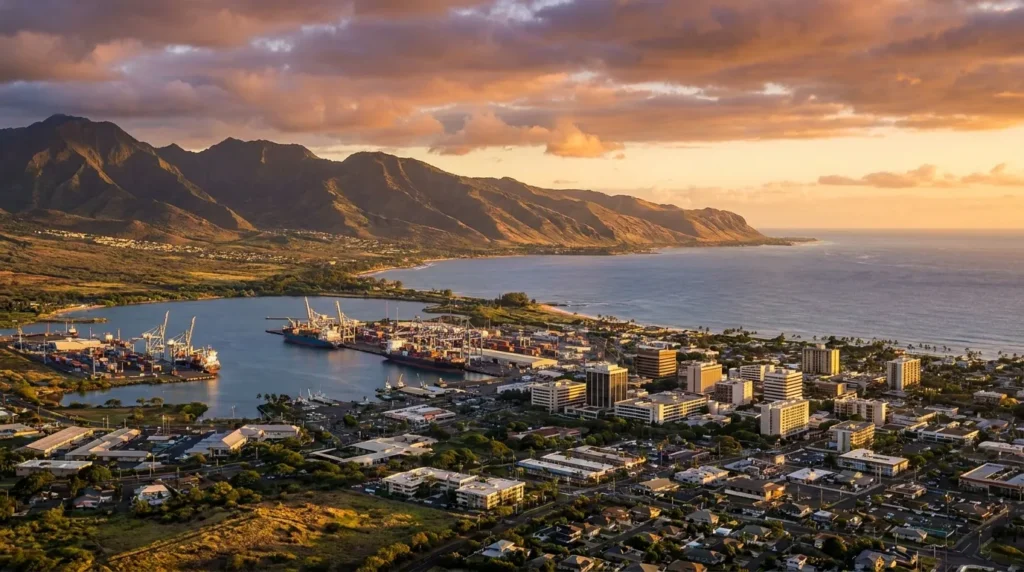
Kahului is Maui's commercial and port hub, home to the main airport, shopping centers, schools, and direct access to Iao Valley, Haleakala, and the North and West Shore beaches.

Kahului concentrates the island's practical infrastructure: Kahului Airport (OGG), Costco, Target, and the Queen Kaahumanu Center, the main shopping mall. The Maui Arts and Cultural Center (the MACC), at the Castle Theater, hosts concerts, ballet performances, and film screenings. Maui Mall and Maui Marketplace round out the daily retail options.

Kanaha Beach Park is a world-renowned windsurfing and kitesurfing destination, with reliable trade winds for most of the year. Kanaha Pond State Wildlife Sanctuary, adjacent to the airport, protects native Hawaiian birds including the ae'o (Hawaiian stilt). Iao Valley State Monument, 10 minutes away in Wailuku, features the iconic Iao Needle and short trails through the rainforest.

The University of Hawaii Maui College is located in Kahului and serves as a regional educational center. Haleakala National Park, famous for its summit sunrise at 10,023 feet (3,055 meters), is about an hour away. The Road to Hana, with waterfalls and Waianapanapa Black Sand Beach, begins along Hana Highway departing from Kahului. Beaches such as Baby Beach and Hookipa are just minutes away.

  1. 1["Maui Arts and Cultural Center"
  2. 2"Maui Nui Botanical Gardens"
  3. 3"Kanaha Beach Park"
  4. 4"Kanaha Pond State Wildlife Sanctuary"
  5. 5"Queen Kaahumanu Center"
  6. 6"Alexander and Baldwin Sugar Museum (nearby)"
Nightlife3.0 / 10
Parks & green spaces
  • ["Kanaha Beach Park"
  • "Kanaha Pond State Wildlife Sanctuary"
  • "Maui Nui Botanical Gardens"
  • "Keopuolani Park"
  • "Hookipa Beach Park (nearby)"
  • +1 more

Latest posts

Straight from the blog

There are no posts specifically about Kahului yet. In the meantime, check out our latest posts.