Visto n' Visa
Blog
Notícias e artigos
Destinations
Careers
Immigrants

Want to live and work in Hilo?

Personalized immigration plan with eligible visas, costs, and next steps for your goal!

If you are not eligible, you will know exactly why and what to do to improve your approval chances.

Save up to 12 hours in meetings

No pointless assessments.

Save up to 90%

Save money on vague or unfocused consultations

Avoid Fraud and Mistakes

One mistake can cost you your visa

Total Impartiality

Zero commercial bias

Decide with peace of mind

No toxic urgency

Fast and Accurate

Answers in minutes, no guesswork

Asian, Hawaiian, and Portuguese ancestry strongly present in Hilo

A city with strong Japanese and Filipino ancestry, a significant share of Native Hawaiians, and a Portuguese tradition rooted in immigration from Madeira and the Azores in the 19th century.

Hilo tells a demographic story different from Honolulu. It shares the same Asian foundation, but with a different distribution: many descendants of Japanese and Filipino immigrants, a larger share of Native Hawaiians, and a historic Portuguese community that arrived from Madeira and the Azores to work in the sugarcane fields starting in the 19th century.

Non-Hispanic whites are a notable presence, partly tied to the university, tourism, and professionals who relocated from the mainland. Population aging is more pronounced than in Honolulu, partly because local young people migrate to Oahu or the mainland in search of work.

The Brazilian community is small and scattered. Portuguese appears more as a surname than as a spoken language, a legacy of earlier waves of immigration. Those who speak Portuguese in Hilo today are usually connected to recently arrived families, mixed marriages, or tourism and service work. English dominates, with Pidgin heard in everyday interactions.

Languages spoken
  • English
  • Hawaiian Pidgin
  • Tagalog
  • Japanese
  • Hawaiian
  • +1 more
Main religions
  • Catholicism
  • Protestant Christianity
  • Buddhism
  • Traditional Hawaiian religions
  • No religion
  • +1 more

Cost of living lower than Honolulu, but still high

Housing is noticeably more affordable than on Oahu, but food, fuel, and electricity remain more expensive than on the US mainland due to shipping costs.

Hilo is one of the most accessible options within Hawaii, especially compared to Honolulu. Homes and rents cost significantly less than on Oahu, and there is proportionally more supply relative to demand. For a couple relocating from the mainland, it is possible to live on a tighter budget than in Kona or Maui.

The sensitive point remains everything else: groceries, gasoline, electricity. All logistics on the Big Island depend on ports and the same cost increases that affect the entire state. KTA Super Stores, Sack N Save, Foodland, and Walmart are the main chains. Those who cook at home and use farmers markets such as the Hilo Farmers Market can keep spending under control.

Hawaii's state income tax still applies. The advantage is that salary and overall cost tend to move together, so the balance is often positive for those with stable remote income. Those who depend on in-person employment need to assess whether the local market offers the position they are looking for.

Hilo

Traditional wooden homes and more affordable rentals

Hilo is dominated by single-story plantation-style homes with metal roofs and porches. Apartments exist but in smaller numbers, mainly near the university.

The dominant building style is the Hawaiian plantation house: wood construction, metal roof pitched for heavy rain, porch, and louvered windows for ventilation. Neighborhoods such as Waiakea Uka, Wainaku, Pukihae, and Kaumana feature many homes of this type. Newer houses appear in subdivisions like Waiakea Villas and in the areas surrounding Banyan Drive.

Apartments and townhouses are concentrated near the university (UH Hilo) and in a few small buildings close to the bay. Rental supply turns over regularly, and the market is less competitive than on Oahu, but it requires patience given the small size of the city. Many rentals are arranged informally through word of mouth and local groups.

For newly arrived immigrants, the most sensible approach is to rent first for six months to a year, get to know the neighborhoods, and only then consider buying. One local factor deserves attention: the rain. Homes in valleys or at lower elevations can develop mold and water intrusion, and neighborhoods like Kaumana tend to cool off at night due to the modest elevation.

Recommended neighborhoods
  • Waiakea Uka
  • Wainaku
  • Kaumana
  • Keaukaha
  • Hilo Bay (downtown)
  • +1 more

Smaller job market tied to the public sector and university

Hilo employs many in education, healthcare, government, regional tourism, and construction. Salaries are lower than in Honolulu, and skilled tech opportunities are scarce.

The city's economy rests on three main pillars: the public sector (county government, schools, state agencies), higher education (University of Hawaii at Hilo, Hawaii Community College), and healthcare (Hilo Medical Center). Regional tourism, retail, and construction round out the picture.

There are interesting niches connected to Mauna Kea observatories, environmental management, and agriculture (coffee, macadamia, tropical flowers). For IT, biotechnology, and finance professionals, the local scene is limited. Remote work for mainland companies has become a common path for those who want to live here without giving up salaries comparable to Oahu or California.

For immigrants, it is worth focusing on healthcare (nursing, therapy, technician roles), education, maintenance, and services. Hawaii Community College offers short practical programs that help entry into fields such as healthcare assistance, construction, and tourism. Those who arrive without a local network should expect it to take longer to secure a first formal position.

Dominant sectors
  • Education
  • Healthcare
  • Government
  • Regional tourism
  • Tropical agriculture
  • +1 more
Major employers
  • Hilo Medical Center
  • University of Hawaii at Hilo
  • Hawaii County Government
  • Hawaii Department of Education
  • KTA Super Stores
  • +1 more

State public university and community-oriented schools

Hilo is the only city in Hawaii outside Honolulu with a four-year state university. The public school system is statewide, with quality that varies by neighborhood.

The University of Hawaii at Hilo (UH Hilo) is one of the city's distinguishing features. It offers programs in astronomy (with a direct connection to Mauna Kea), tropical agriculture, marine science, Hawaiian language and culture, and pharmacy, through the Daniel K. Inouye College of Pharmacy. Hawaii Community College, on the same campus, serves technical and two-year programs.

Elementary and secondary education is statewide, as throughout Hawaii. Hilo High, Waiakea High, Hilo Intermediate, and several elementary schools serve the urban area. Quality varies: families with more resources often consider private schools such as Hawaii Preparatory Academy (in Waimea) or St. Joseph School in Hilo.

There is also the option of Hawaiian-language immersion schools, part of the language revitalization movement. For immigrants with young children, it is a viable choice, though it requires family engagement to support the learning and associated cultural content.

Notable universities
  • University of Hawaii at Hilo
  • Hawaii Community College
  • Daniel K. Inouye College of Pharmacy (UH Hilo)
  • University of Hawaii at Manoa (Oahu)
  • Hawaii Pacific University (Oahu)
  • Brigham Young University Hawaii (Laie)

Regional hospital covers basic needs; complex cases go to Oahu

Hilo Medical Center is the island's main hospital. For high-complexity care, patients fly to Honolulu. Outpatient services are reasonable, but wait times can be long for some specialties.

Hilo Medical Center is the island's reference hospital, with an emergency department, maternity ward, ICU, and several specialties. It serves as a regional hub, receiving patients from Puna, Hamakua, and even from Kona in specific cases. There are also private urgent care clinics and community health centers such as Bay Clinic, which provides care on a sliding-scale basis.

For highly complex cases (transplants, advanced oncology, rarer cardiac surgeries), patients are typically transferred to Honolulu, particularly to Queen's Medical Center and Kapiolani. This means that families on the Big Island may, in some cases, need to travel between islands for extended treatment.

The supply of specialist physicians (cardiologists, neurologists, endocrinologists) is smaller than on Oahu, and wait lists can be long. Mental health, in particular, is one of the most underserved areas on the island. For immigrants, it is essential to secure health coverage through employment (Hawaii Prepaid Health Care Act) or to enroll with HMSA or Kaiser from the start.

Healthcare index64.0 / 100
  • Life expectancyyears at birth
    78.4yrs
  • Doctors per 1kpracticing physicians
    3.7
  • Health spendper capita, per year
    $13,473
  • Public systemoverall quality rating
    Fair

A quiet city with isolated issues in specific areas

Hilo has crime rates below the national average. Car theft, drugs (methamphetamine), and break-ins at isolated homes are the main concerns.

Compared to mid-sized cities on the mainland, Hilo is quiet. Violent crime is low, and most of the day passes without incident in residential areas and around the university. The Hawaii County Police covers the entire island and maintains a visible presence downtown and along the Bayfront.

The problems that do arise are more specific: vehicle break-ins at tourist parking areas, drug activity (methamphetamine is a chronic issue on the Big Island, especially in rural areas), and occasional altercations near Banyan Drive and in more isolated neighborhoods such as Puna. Homelessness is also visible at several points downtown.

For women, elderly residents, and children, daily life is safe. Walking near Liliuokalani Park, at the farmers market, and through residential neighborhoods during daylight is comfortable. At night, avoiding isolated trails, dark streets along the Bayfront, and long unlit roads in the island's interior are standard precautions.

5.8
Homicides per 100k
per year
Safety index
62.0
Crime index
38.0
Safer neighborhoods
  • Waiakea
  • Kaumana
  • Hilo Bayfront
  • Pana ewa
  • Ainaola
  • Keaukaha
Areas to avoid
  • Isolated stretches of Banyan Drive late at night
  • Industrial areas near the port after business hours

A car is practically essential in Hilo

The public bus system (Hele-On) covers the island in a limited way, with few scheduled runs. Most residents depend on a car for both work and errands.

Hilo is a spread-out city, with neighborhoods extending up the slopes of Mauna Loa and Mauna Kea. The Bayfront and Kanoelehua Avenue (Highway 11) concentrate most commercial and service activity. The main urban exits are Highway 11 toward Volcano and Kona, and Highway 19 toward the northern coast (Honokaa, Waimea).

The Hele-On Bus is the county transit system. It covers routes between Hilo, Kona, Pahoa, and other towns, and fares are low, but frequency is limited and schedules are sparse. It works for those with predictable routines. For daily life, especially with children, getting around without a car is very difficult.

Hilo International Airport (ITO) serves flights to Honolulu and some connections to the mainland. To reach the Big Island from abroad, the most common route is through Honolulu. Cycling works well on flat stretches near the bay, but constant rain limits its practical use for daily commuting.

18 min
Avg commute
38
Walkability
Airports
  • ITO — Hilo International Airport
  • International airport
  • Bike infrastructure

What the climate is like living in Hilo

A coastal city on the eastern side of Hawaii, considered the rainiest in the United States, with stable temperatures between 66 and 82 degrees Fahrenheit year-round.

Hilo has a tropical rainforest climate, with rainfall distributed throughout the year. It is the rainiest city in the United States, receiving over 118 inches of precipitation annually across all months. High temperatures range from 79 to 82 degrees Fahrenheit in summer and from 73 to 79 degrees in winter, consistently accompanied by high humidity.

Lows rarely drop below 64 degrees Fahrenheit, making heating unnecessary. Air conditioning is less common here than in other tropical cities, as the constant rain and ocean breeze keep conditions relatively comfortable. Cross-ventilation is the standard approach in local homes.

The combination of rainfall and tropical vegetation makes Hilo one of the greenest cities in the country, though residents keep an eye out for mold, take care of footwear, and carry rain gear at all times. The climate pattern is similar to other wet tropical regions, with consistent warmth and moisture throughout the year.

Sunny days / year152 days
Avg high (°F)
  • 78°J
  • 76°F
  • 77°M
  • 77°A
  • 79°M
  • 80°J
  • 81°J
  • 82°A
  • 82°S
  • 82°O
  • 80°N
  • 78°D
Avg low (°F)
  • 67°J
  • 66°F
  • 67°M
  • 68°A
  • 69°M
  • 70°J
  • 71°J
  • 71°A
  • 71°S
  • 71°O
  • 70°N
  • 68°D
Rainfall (")
  • 7"J
  • 11"F
  • 13"M
  • 10"A
  • 7"M
  • 6"J
  • 7"J
  • 6"A
  • 5"S
  • 6"O
  • 10"N
  • 9"D

Deep Hawaiian culture and multicultural tradition in Hilo

Home of the Merrie Monarch Festival, the world's premier hula event. The city has a strong presence of Japanese, Filipino, Portuguese, and Hawaiian culture in everyday life.

Hilo is a cultural reference point for the state. It is home to the Merrie Monarch Festival, the most important hula event in the world, held every April after Easter, filling the city with halau (hula schools) and visitors. Even outside that period, there are community events such as First Friday Hilo and celebrations at Liliuokalani Park, a Japanese garden created more than a century ago.

The city has notable museums: Lyman Museum (geology and multicultural history of Hawaii), Pacific Tsunami Museum (memory of the 1946 tsunami), and the Imiloa Astronomy Center, connected to the Mauna Kea observatories. The food scene is strong: poke, plate lunch, home-style Japanese food, Portuguese sweet bread, and filled mochi.

The pace is much slower than in Honolulu. People greet each other on the street, drivers yield, and the nightlife is minimal. For those coming from a large city, it is an adjustment. In return, the sense of community is strong, and immigrants who get involved in hula, paddling, church, or volunteer work tend to integrate quickly.

Hilo

Hilo, the rainy capital of the Big Island — volcanoes, gardens, and Hawaiian culture

A port city on the eastern coast of Hawaii's Big Island and county seat, with a humid climate, botanical gardens, proximity to Volcanoes National Park, and a living Hawaiian culture.

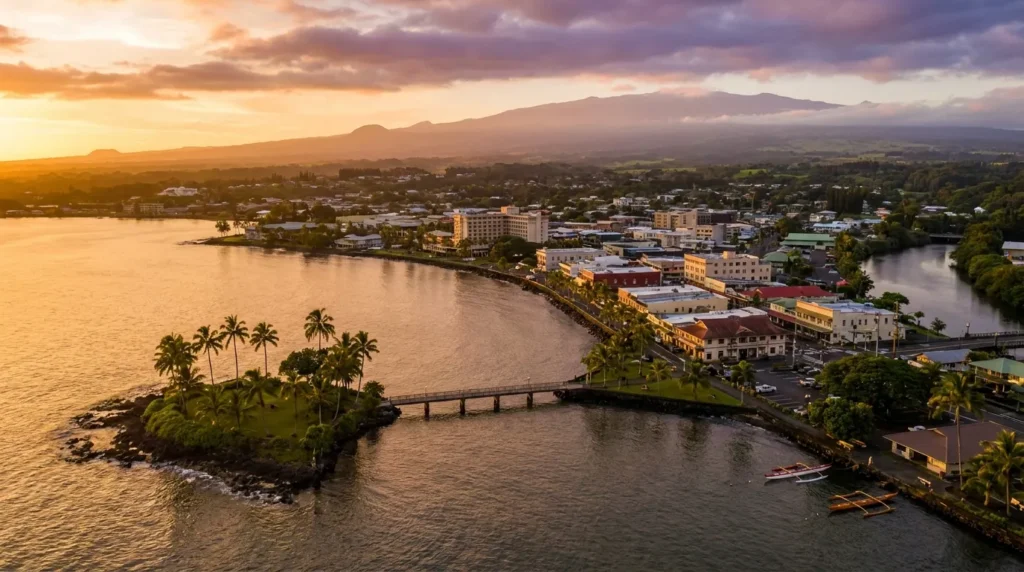
Hilo is the largest city on the island of Hawaii, known as the Big Island. Located on the eastern coast facing the Pacific, it is one of the rainiest cities in the United States, with dense tropical vegetation. Downtown, centered around Kamehameha Avenue and Keawe Street, preserves low-rise early-20th-century buildings along with reconstruction following the 1946 and 1960 tsunamis. Residential neighborhoods such as Kaumana, Waiakea, and Wainaku spread across the hillsides.

Hawaii Volcanoes National Park, home to Kilauea and Mauna Loa volcanoes, lies roughly 45 minutes from the city center. Mauna Kea, with astronomical observatories at its summit, is visible from the city on clear days. Within Hilo, Liliuokalani Park and Gardens, featuring a lagoon and a bridge to Coconut Island, is the standard late-afternoon destination. Rainbow Falls and Boiling Pots, along the Wailuku River, are just minutes from downtown.

The Merrie Monarch Festival in April is the world's largest hula competition and draws visitors from across the islands. The Hilo Farmers Market, at the corner of Mamo and Kamehameha, is the heart of local commerce, offering Hawaiian produce, Asian ingredients, and fresh poke. For swimming, Richardson Ocean Park, with its black sand beach, and Carlsmith Beach Park attract families and sea turtles alike.

  1. 1["Hawaii Volcanoes National Park (nearby)"
  2. 2"Rainbow Falls (Waianuenue)"
  3. 3"Liliuokalani Gardens"
  4. 4"Imiloa Astronomy Center"
  5. 5"Pacific Tsunami Museum"
  6. 6"Akaka Falls State Park"
Nightlife3.0 / 10
Parks & green spaces
  • ["Liliuokalani Gardens"
  • "Hilo Tropical Botanical Garden"
  • "Wailoa River State Recreation Area"
  • "Kalakaua Park"
  • "Onekahakaha Beach Park"
  • +1 more

Latest posts

Straight from the blog

There are no posts specifically about Hilo yet. In the meantime, check out our latest posts.