Visto n' Visa
Blog
Notícias e artigos
Destinations
Careers
Immigrants

Want to live and work in North Carolina?

Personalized immigration plan with eligible visas, costs, and next steps for your goal!

If you are not eligible, you will know exactly why and what to do to improve your approval chances.

Save up to 12 hours in meetings

No pointless assessments.

Save up to 90%

Save money on vague or unfocused consultations

Avoid Fraud and Mistakes

One mistake can cost you your visa

Total Impartiality

Zero commercial bias

Decide with peace of mind

No toxic urgency

Fast and Accurate

Answers in minutes, no guesswork

All about North Carolina

Technology, finance, top universities, and a mild climate. The modern American South.

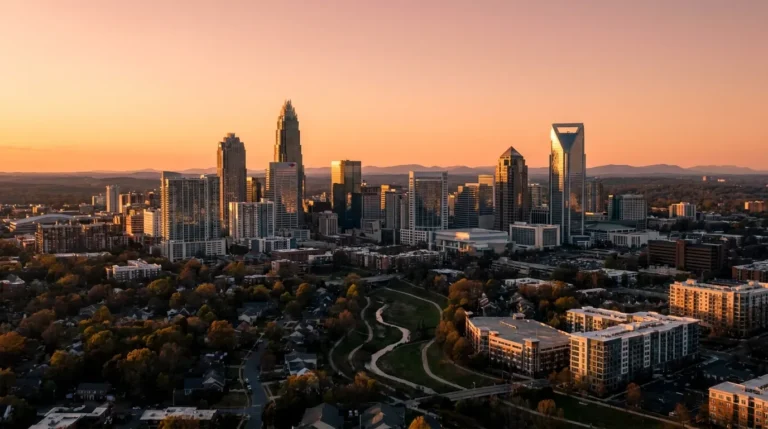
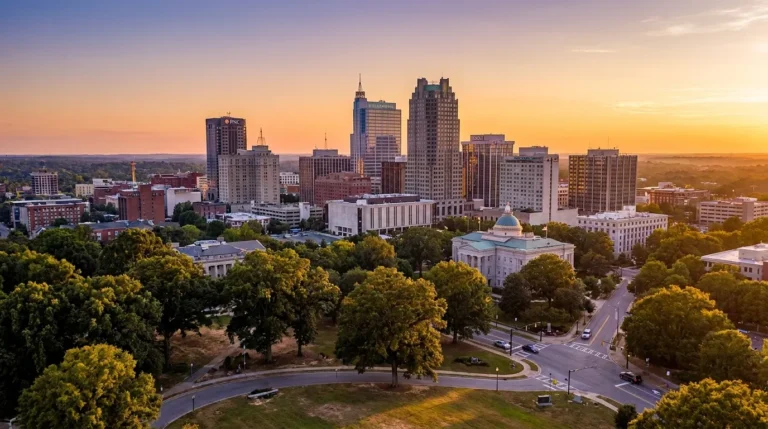
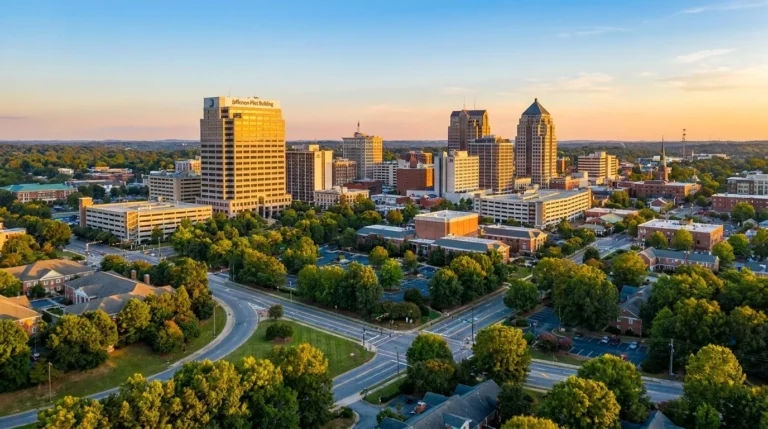
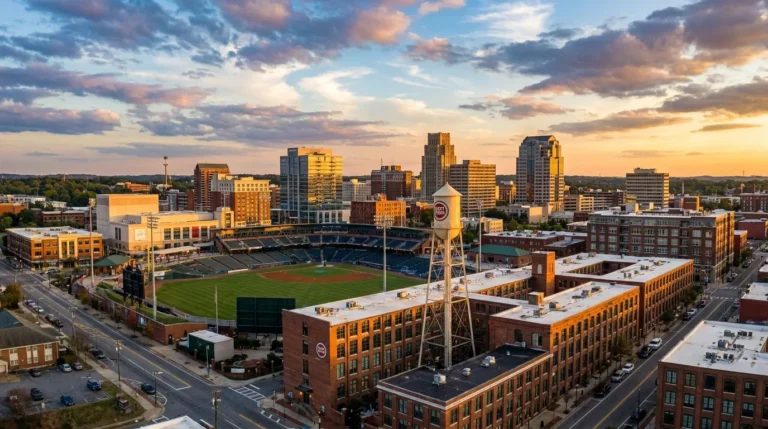
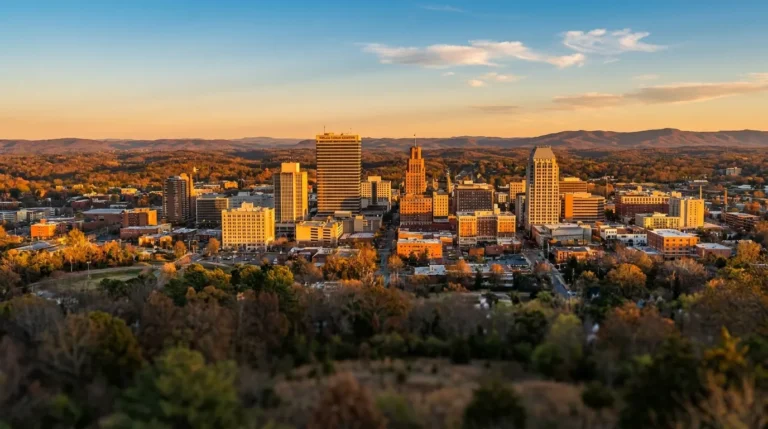
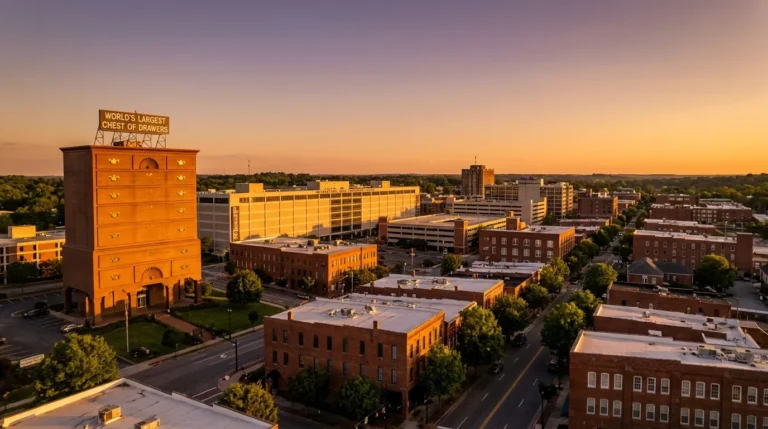
North Carolina is located in the South, between Virginia, Georgia, Tennessee, and South Carolina. The main cities are Charlotte (the largest, a banking hub), Raleigh (the capital, part of the Research Triangle), Durham, Chapel Hill, Greensboro, Winston-Salem, and Asheville (in the mountains).

It is one of the fastest-growing states in the US, drawing people from New York, California, Florida, and Brazil. Research Triangle Park, between Raleigh, Durham, and Chapel Hill, is one of the world's largest research parks, home to IBM, Cisco, Google, Biogen, and hundreds of startups. Charlotte is the second-largest banking center in the US, after New York.

The climate is mild: warm summers, gentle winters, and four well-marked seasons. There are beaches to the east (Outer Banks, Wilmington) and mountains to the west (Blue Ridge, Asheville). The Brazilian community has grown considerably in Charlotte and the Triangle. The Hispanic community is large, with Mexican and Central American neighborhoods in Charlotte, Durham, and Greensboro.

Population
10,698,973
Average monthly salary
58,000 USD/mo
35.6301°, -79.8064°

Featured places

Top 10 places in North Carolina

The places most sought-after by immigrants in this region.

North Carolina demographics: white, African American, and growing Hispanic and Asian populations

About two-thirds white and one-fifth African American. Hispanic and Asian communities are growing rapidly in metropolitan areas.

North Carolina has a majority white population (about 60%), with a strong African American presence (about 22%), a legacy of the South's agricultural history. Cities like Charlotte, Durham, and Greensboro have African American neighborhoods with vibrant cultural life, historic churches, and historically Black universities (HBCUs).

The Hispanic community grew from less than 2% in 1990 to about 10% today, mainly Mexicans, Salvadorans, and Hondurans. They work in construction, agriculture, restaurants, and manufacturing. Cities like Charlotte (East Charlotte), Durham, and Raleigh have Hispanic neighborhoods with grocery stores, churches, and bilingual schools.

There is an active Brazilian community in Charlotte and the Research Triangle, linked to finance, technology, medicine, and construction. Brazilian evangelical churches, restaurants, and grocery stores exist. Indians and Chinese have grown with the Research Triangle Park. There is also a Vietnamese community in Charlotte and refugees of various origins (Hmong, Sudanese, Syrian) in Greensboro.

10,698,973
Population
39 yrs
Median age
77/km²
Density
$66,200
Median income
per year
Urban population66.1%
Foreign-born8.4%
Languages spoken
  • English
  • Spanish
  • Portuguese (in Brazilian communities)
  • Vietnamese
  • Mandarin Chinese
  • +2 more
Main religions
  • Christian (Baptist, Methodist, Presbyterian)
  • Catholic (among Hispanics)
  • No religion (growing in urban areas)
  • Hinduism and Buddhism (in the Triangle)
  • Mormon (LDS)

Cost of living in North Carolina: moderate, with differences between cities

Cheaper than the Northeast or California, but rising in large cities. Small cities and rural areas are still very affordable.

Cost of living varies by city. Charlotte and Raleigh have risen considerably in recent years. A one-bedroom apartment in Charlotte runs around $1,500 to $2,000/month. In Raleigh, $1,300 to $1,800. Durham and Chapel Hill are in the same range. Greensboro, Winston-Salem, and Asheville are cheaper.

Supermarkets like Harris Teeter, Food Lion, Publix, Aldi, and Wegmans compete on price. A meal at a casual restaurant costs $12 to $18. Electricity is reasonable; natural gas is common in urban areas. Gas prices and sales taxes are moderate.

The state income tax is flat at 4.5%. Those earning in dollars can live well on $70,000 to $100,000 as a family. Buying a home is feasible in many cities, though Charlotte and Raleigh have risen considerably. The state is generally considered good value for money.

97Cost index (US = 100)3% below US average
CategorySingleCoupleFamily (2 + 2)
iHousing$1,258$1,452$1,839
iFood$368$736$1,336
iTransport$484$823$1,065
iHealthcare$271$542$1,016
iChildcare$1,762
iOther$823$1,481$2,081
Monthly total$3,204$5,034$9,099

Source: U.S. BLS Consumer Expenditure Survey 2023 + BEA Regional Price Parities 2023 · Estimates in USD, monthly.

Housing in North Carolina: large homes in developments, a rising market

Buying a home is still viable, though prices have risen. Suburban neighborhoods with good schools are sought by families.

In Charlotte, homes in good neighborhoods (Ballantyne, SouthPark, Dilworth, Myers Park) run from $500,000 to $1.2 million. More affordable neighborhoods (NoDa, Plaza Midwood, University area) range from $350,000 to $500,000. In Raleigh and Cary, good neighborhoods are $450,000 to $800,000. Durham and Chapel Hill are similar.

For renting, standard requirements apply: proof of income (3x the rent), credit history, and references. In fast-growing cities like Charlotte and Raleigh, competition for properties is intense, and those arriving from out of state often rent first and buy later at their leisure.

Recommended neighborhoods in Charlotte: Ballantyne, SouthPark, Davidson, Cornelius. In Raleigh: Cary, Apex, Holly Springs, North Hills. In Durham: Hope Valley, Forest Hills. In Asheville: Biltmore Forest, North Asheville. Greensboro has good options at Irving Park and Lake Jeanette. Always check the school district on GreatSchools before signing a lease.

Purchase price (m²)
  • Center$2,900/m²
  • Outside$1,850/m²
4.8×
Price-to-income
7.0%
Mortgage rate (20y)
Recommended neighborhoods
  • Ballantyne (Charlotte, top schools)
  • SouthPark (Charlotte)
  • Davidson (Charlotte, suburban)
  • Cary (Raleigh, top schools and Brazilians)
  • Apex (Raleigh, families)
  • +4 more

Job market in North Carolina: banking, technology, biotech, and universities

Charlotte is a banking hub (Bank of America, Wells Fargo). Research Triangle is a tech and biotech hub. Asheville has tourism. Greensboro has industry.

Charlotte is the second-largest banking center in the US, headquarters of Bank of America and the largest Wells Fargo operation. Together with Truist, Ally Bank, and fintechs, the financial sector employs tens of thousands. Analysts, programmers, managers, and operators earn well.

Research Triangle Park (RTP), between Raleigh, Durham, and Chapel Hill, is home to IBM, Cisco, Google, Lenovo, Biogen, GSK, Pfizer, and hundreds of startups. There is a concentration of jobs in technology, biotech, pharma, and academic research (Duke, UNC, NC State have thousands of researchers).

Greensboro and Winston-Salem have heavy industry (Honda Aircraft, Volvo Trucks, Krispy Kreme, Hanesbrands). Asheville lives on tourism and craft beer. Wilmington has a port, pharmaceutical industry, and film production (Screen Gems Studios). Tech salaries in Raleigh average $100,000 to $140,000 per year.

$58,000
Avg net salary
per month
$15,080
Minimum wage
per month
3.6%
Unemployment
61.0%
Labor force
Dominant sectors
  • Financial services and banking
  • Technology and software
  • Biotech and pharmaceuticals
  • Universities and research
  • Automotive and aerospace industry
  • +3 more
Major employers
  • Bank of America (Charlotte)
  • Wells Fargo (Charlotte)
  • Truist Financial
  • Duke University Health System
  • UNC Health
  • +5 more

Education in North Carolina: elite universities and well-rated suburban schools

Duke, UNC, and NC State are the academic pillars. Public schools in districts like Cary, Chapel Hill, and Davidson are excellent.

Children are entitled to free public school. The best school districts in the state are in Chapel Hill-Carrboro, Cary, Apex, Davidson, and Wake Forest (near Raleigh). In Charlotte, neighborhoods like Ballantyne and Providence have top schools. The Wake County Public School System (Raleigh) is large and well regarded.

Duke University in Durham is one of the best private universities in the US, strong in medicine, law, business, and public policy. UNC-Chapel Hill (public, founded in 1789) is one of the oldest and most respected, with traditions in medicine, law, and journalism. NC State (Raleigh) is strong in engineering, agriculture, and design. Wake Forest (Winston-Salem) is a prestigious private university.

There are also several HBCUs like North Carolina A&T (Greensboro), NC Central (Durham), and Shaw (Raleigh). In-state tuition at public universities runs around $9,000 to $12,000 per year. Private schools like Duke exceed $65,000, with generous scholarships for low-income students.

Literacy97.0%
Tertiary education33.4%
478
PISA score (avg)
$12,500
Private school
per year
Notable universities
  • Duke University (Durham, private)
  • University of North Carolina at Chapel Hill
  • North Carolina State University (Raleigh)
  • Wake Forest University (Winston-Salem)
  • UNC Charlotte
  • Davidson College
  • Elon University
  • North Carolina A&T State University (Greensboro)

Healthcare in North Carolina: Duke and UNC among the best in the US

Duke Health and UNC Health are national references. Atrium Health dominates Charlotte. Rural areas and mountains have more limited access.

North Carolina has some of the best hospitals in the country. Duke University Hospital (Durham) and UNC Medical Center (Chapel Hill) appear in national rankings, especially in transplants, cardiology, oncology, and neurology. Atrium Health (Charlotte), Novant Health (multiple cities), and Cone Health (Greensboro) operate large regional networks.

As in all of the US, there is no universal public system. Employer-sponsored insurance is the standard. The state had not fully expanded Medicaid under the ACA until recently, though expansion was approved in 2023 and implemented in 2024. Low-income families now have more coverage.

Documented immigrants with a green card or legal work authorization access employer plans or Healthcare.gov with subsidies. Community clinics (FQHCs) serve patients regardless of documentation on a sliding fee scale. Private hospital charges can be very high, with ER visits exceeding $2,000 without insurance. Urgent care ($100-200) is an alternative for non-emergency cases.

Healthcare index68.0 / 100
  • Life expectancyyears at birth
    77.6yrs
  • Doctors per 1kpracticing physicians
    2.6
  • Health spendper capita, per year
    $9,600
  • Public systemoverall quality rating
    Good

Safety in North Carolina: suburbs and mid-sized cities are safe

Cary, Apex, Holly Springs, and Davidson rank among the safest cities in the US. Central Charlotte, parts of Durham, and Greensboro have higher rates.

North Carolina has uneven safety. Suburbs around Raleigh (Cary, Apex, Holly Springs, Morrisville) regularly rank among the safest cities in the US. Davidson, near Charlotte, is another standout. In general, family neighborhoods with good schools are very safe.

In Charlotte, areas like East Charlotte, West Boulevard, and some parts of downtown have higher rates of robbery and violence. Neighborhoods like Ballantyne, Myers Park, SouthPark, and Dilworth are peaceful. In Durham, areas near the old downtown have more incidents; Hope Valley and Forest Hills are safe. Greensboro has a similar pattern.

For immigrants, the general rule applies: live in a recommended neighborhood, check the public school rating, and avoid known problem areas at night. Violent crime is less common than car theft and break-ins. Asheville and smaller mountain cities are very peaceful, with tourist theft being more common than violent crime.

7.5
Homicides per 100k
per year
Safety index
53.0
Crime index
47.0
Safer neighborhoods
  • Cary (Raleigh)
  • Apex and Holly Springs (Raleigh)
  • Davidson (Charlotte)
  • Wake Forest (Raleigh)
  • Ballantyne (Charlotte)
  • Chapel Hill
  • Morrisville (RTP)
  • Asheville (Biltmore Forest)
Areas to avoid
  • Charlotte east (Eastland)
  • Fayetteville downtown at night
  • Greensboro east
  • Durham isolated neighborhoods

Transportation in North Carolina: cars dominate, Charlotte has light rail

A car is essential. Charlotte has a light rail (Lynx Blue Line). Charlotte and Raleigh-Durham airports have international flights.

North Carolina is a car state. Most cities are designed for motor vehicle travel. Charlotte has a light rail system (Lynx Blue Line) connecting the south to downtown and the University area, useful for commuters and students. In Raleigh and Durham, there are buses (GoRaleigh, GoDurham) and the GoTriangle between cities, but ridership is limited.

Major interstates are I-77 (north-south, Charlotte), I-85 (crossing the state), I-95 (east-west in the east), I-40 (cutting through Raleigh-Durham to Asheville), and I-26 (Asheville to the southeast). Traffic in Charlotte and Raleigh builds during rush hour but is manageable.

Charlotte Douglas International Airport (CLT) is an American Airlines hub and one of the busiest in the US. International flights to Europe, Latin America, and the Caribbean are frequent. Raleigh-Durham International (RDU) also has international flights to London, Paris, and multiple US capitals. Greensboro (GSO) and Asheville (AVL) handle regional flights.

1
Metro lines
26
Metro stations
25 min
Avg commute
32
Walkability
Airports
  • CLT (Charlotte Douglas International)
  • RDU (Raleigh-Durham International)
  • GSO (Piedmont Triad International, Greensboro)
  • AVL (Asheville Regional)
  • ILM (Wilmington International)
  • +1 more
  • International airport
  • Bike infrastructure

North Carolina's climate: humid subtropical, four seasons, and snow in the mountains

Hot, humid summers and mild winters in low-lying areas. Mountains to the west get winter snow. Hurricane risk in the east.

North Carolina has a humid subtropical climate (Koppen Cfa) in most of the state. Summer is hot and humid (June to September), with highs around 30-33°C and occasional heat waves. Winter is mild in low-lying areas (Charlotte, Raleigh, Wilmington), with January lows around 0-3°C and a few light snowfalls per year.

In the western mountains (Asheville, Boone, Blowing Rock), the climate is cooler. Summer has pleasant days (highs near 25°C); winter is cold with significant snowfall. Boone and Beech Mountain have modest ski resorts. Areas like the Blue Ridge Parkway attract tourists in autumn for the fall foliage.

On the coast (Outer Banks, Wilmington), the climate is milder year-round, but there is hurricane risk from June to November. Hurricane Florence (2018) and Helene (2024, which devastated Asheville in the mountains) showed that storms can affect multiple regions. Spring and autumn are the most pleasant seasons across the state.

Sunny days / year213 days
Avg high (°F)
  • 52°J
  • 57°F
  • 64°M
  • 73°A
  • 80°M
  • 87°J
  • 90°J
  • 89°A
  • 83°S
  • 73°O
  • 63°N
  • 55°D
Avg low (°F)
  • 32°J
  • 35°F
  • 41°M
  • 49°A
  • 58°M
  • 66°J
  • 70°J
  • 69°A
  • 63°S
  • 50°O
  • 40°N
  • 35°D
Rainfall (")
  • 3"J
  • 3"F
  • 4"M
  • 4"A
  • 3"M
  • 4"J
  • 4"J
  • 4"A
  • 4"S
  • 3"O
  • 3"N
  • 4"D

North Carolina's culture: college basketball, barbecue, music, and growing diversity

College basketball is a religion. Regional barbecue styles (Eastern and Western) are a serious matter. Large cities attract cosmopolitan culture.

College basketball is almost a religion. The rivalry between Duke (Blue Devils) and UNC (Tar Heels) is one of the greatest in American sports. Games at Cameron Indoor Stadium (Duke) and the Dean Smith Center (UNC) are landmark events. NC State also has a strong tradition. The Charlotte Hornets (NBA) and Carolina Panthers (NFL) draw large crowds.

The cuisine features the famous North Carolina barbecue, with two schools: Eastern (whole hog, vinegar-based sauce) and Western (pork shoulder, ketchup-based sauce). It is a religion unto itself. Calabash-style seafood (shrimp, fish, hush puppies) is a coastal highlight. Charlotte and Raleigh have modern food scenes with award-winning restaurants.

Asheville is a hub for craft beer (with more breweries per capita than many cities), folk and bluegrass music, and art. The Festival of the Arts and Mountain Heritage Festival draw tourists. Wilmington has a beach culture and film production. The urban diversity of Charlotte and the Triangle brings Hispanic, Asian, African, and Brazilian festivals (Festa Junina, Carnaval) to the calendar.

320
Major museums
Notable dishes
  • North Carolina barbecue (Eastern and Western)
  • Carolina pulled pork sandwich
  • Calabash-style seafood
  • Cheerwine (regional soft drink)
  • Sweet tea
  • +4 more
Annual events
  • College basketball March Madness final (March)
  • Duke vs. UNC basketball (February and March)
  • Lexington Barbecue Festival (October)
  • Festival of the Arts (Asheville)
  • Wide Open Bluegrass (Raleigh, September and October)
  • +3 more

North Carolina's main economic sectors

Banking, technology, biotech, universities, automotive industry, and agriculture sustain the economy. Financial services are the standout.

Financial services and banking are the standout. Charlotte is the second-largest banking center in the US, headquartering Bank of America, a major Wells Fargo operation, and Truist (formed from the merger of BB&T and SunTrust). Together with fintechs, the sector employs tens of thousands and attracts talent from across the country.

Technology and biotech are strong in Research Triangle Park. IBM, Cisco, Lenovo, Google, Biogen, GSK, and Pfizer have major operations. Universities (Duke, UNC, NC State) generate research, startups, and human capital. The Triangle is one of the leading innovation ecosystems in the US outside of California and Boston.

The automotive and aerospace industry is growing with Honda Aircraft (Greensboro), Volvo Trucks, Toyota Battery Plant (Liberty), and suppliers. Agriculture is important: North Carolina is a major producer of tobacco, sweet potatoes, pork, and poultry. Tourism, with mountains, beaches, and historic cities (New Bern, Wilmington), generates billions.

  • GDPgross domestic product
    $730.0B
  • GDP per capitaoutput per resident
    $68,300
  • GDP growth (yr)economy expanding
    +2.6%
Top sectors
  • Financial services and banking
  • Technology and software
  • Biotech and pharmaceuticals
  • Universities and research
  • Automotive and aerospace industry
  • +3 more

Immigrant communities in North Carolina

About 850,000 immigrants live in North Carolina, with Mexicans in Charlotte and Raleigh, Indians in Cary and RTP, and Hondurans growing rapidly.

North Carolina has around 850,000 residents born outside the country, close to 8% of the population, and has been one of the fastest-growing immigrant states over the last three decades. Mexicans form the largest group, concentrated in Charlotte (especially on the east side and around Eastland), Raleigh, Durham, Greensboro, and Winston-Salem. Hondurans and Guatemalans have grown quickly, tied to construction and agricultural processing in the east of the state. Indians concentrate in Cary, Morrisville, and the Research Triangle Park, tied to tech, biotech, and Duke and UNC. Vietnamese have a strong presence in Charlotte, with a community established since the 1970s. Chinese, Koreans, Salvadorans, and Burmese and Somali refugees round out the picture, with Greensboro as a resettlement hub.

Raleigh hosts the consulate-general of Mexico, and Charlotte has a Mexican consulate and an India consulate office. The Latin American Coalition, in Charlotte, offers immigration legal services, English classes, and community organizing. El Pueblo, in Raleigh, works on Latino civil rights. The NC Justice Center Immigrant Rights Program runs statewide advocacy. Catholic Charities of the Dioceses of Charlotte and Raleigh provide immigration assistance. Church World Service has an office in Greensboro for refugee resettlement.

850,000
Foreign-born residents
estimated
Top countries of origin
  • Mexico
  • India
  • Honduras
  • El Salvador
  • China
Main immigrant hubs
  • Charlotte
  • Raleigh
  • Durham
  • Greensboro
  • Cary
Foreign consulates
  • Mexican Consulate General in Raleigh
  • Mexican Consulate in Charlotte
  • Indian Consulate in Atlanta (jurisdiction includes North Carolina)
Community organizations
  • Latin American Coalition (Charlotte)
  • El Pueblo (Raleigh)
  • NC Justice Center Immigrant Rights Program
  • Catholic Charities of the Diocese of Charlotte
  • Church World Service Greensboro

Latest posts

Posts about North Carolina

Coverage and updates related to this destination.