Visto n' Visa
Blog
Notícias e artigos
Destinations
Careers
Immigrants

Want to live and work in Fayetteville?

Personalized immigration plan with eligible visas, costs, and next steps for your goal!

If you are not eligible, you will know exactly why and what to do to improve your approval chances.

Save up to 12 hours in meetings

No pointless assessments.

Save up to 90%

Save money on vague or unfocused consultations

Avoid Fraud and Mistakes

One mistake can cost you your visa

Total Impartiality

Zero commercial bias

Decide with peace of mind

No toxic urgency

Fast and Accurate

Answers in minutes, no guesswork

Unusual diversity shaped by military service and international marriages

Approximately 210,000 residents, with strong ethnic diversity: African Americans, non-Hispanic whites, Hispanics, Asians, and a mix created by the international marriages of military personnel.

Fayetteville has approximately 210,000 residents, with one of the most diverse demographic compositions in the rural American South, largely because of the military installation. African Americans form the largest ethnic group, with non-Hispanic whites as the second. Hispanics and Asians have a significant presence, both with growing populations.

The Asian community is notable: Filipinos, Koreans, Vietnamese, Thai, and Japanese form visible communities, many originating from marriages with military personnel stationed in Asia. A German community has also been established for decades. The Hispanic community is primarily Mexican, Puerto Rican, and Dominican. A small Brazilian community exists, without a well-defined gathering point of its own.

The age profile is young, partly due to the military presence. Military families arrive, stay three to five years, and are reassigned. Religiously, Protestantism predominates (Baptist, Methodist, African American churches), alongside Catholics (with a strong Hispanic and Filipino presence), Pentecostals, Presbyterians, and Latter-day Saints. There are also mosques, a synagogue, a Korean church, and Buddhist temples.

Languages spoken
  • English
  • Spanish
  • Tagalog (Filipino)
  • Korean
  • Vietnamese
  • +2 more
Main religions
  • Protestantism (Baptist, Methodist)
  • Catholicism
  • African American churches
  • Pentecostalism
  • Buddhism
  • +2 more

Among the lowest costs of living for large cities in North Carolina

Housing, food, and services are well below the national average. Military salaries include a housing allowance (BAH) that helps sustain the market. For civilians, wages tend to be modest.

The cost of living in Fayetteville is among the lowest for large cities in the state and across the American Southeast. Housing is particularly affordable, with modest rents and home prices well below the national average. Military demand (backed by the Basic Allowance for Housing, or BAH) sustains an active rental market, especially in apartment complexes near the base.

Groceries, restaurants, and services follow standard American patterns at reasonable prices. Chains such as Food Lion, Walmart Supercenter, ALDI, and Harris Teeter compete on price. Asian restaurants (Filipino, Korean, Vietnamese, Thai) are abundant and affordable, thanks to the established communities. Military bases also operate commissaries with even lower prices for military families.

Sales tax in Cumberland County is around 7%. North Carolina levies a flat-rate state income tax. Civilian wages in Fayetteville are modest: healthcare, base-related services, and retail dominate employment, without the aggressive technology or biotech salary packages found in Raleigh. For immigrants, the equation is low cost paired with comparably lower wages.

100Cost index (US = 100)same as US average
CategorySingleCoupleFamily (2 + 2)
iHousing$1,296$1,496$1,894
iFood$379$758$1,376
iTransport$499$848$1,097
iHealthcare$279$558$1,046
iChildcare$1,815
iOther$848$1,525$2,143
Monthly total$3,301$5,185$9,371

Source: U.S. BLS Consumer Expenditure Survey 2023 + BEA Regional Price Parities 2023 · Estimates in USD, monthly.

A dynamic market tied to the base, with affordable homes and rentals

Haymount features historic homes. Vanstory Hills attracts officers. Neighborhoods near Fort Liberty have an active rental market for military families. Suburbs like Hope Mills offer affordable new construction.

Fayetteville's real estate market is strongly tied to the military cycle. Families arrive and depart every few years, keeping the rental market consistently active. For those seeking historic neighborhoods with character, Haymount is the traditional upscale district, with older homes on tree-lined streets close to downtown. Vanstory Hills attracts military officers and well-established civilian professionals.

Neighborhoods such as Cliffdale, near Reilly Road and Cliffdale Road, offer a large supply of rental housing for military families due to their proximity to Fort Liberty. Suburbs like Hope Mills, to the south, provide affordable new homes in planned communities with decent schools. Spring Lake, north of the base, is another option for lower-ranking military personnel.

Newcomers often begin by renting in apartment complexes along Cliffdale, Skibo Road, or near Raeford Road. Entry is easier than in competitive markets, and landlords tend to offer flexible lease terms given the transient military clientele. Buying a home in Fayetteville is especially accessible compared to markets like Charlotte or Raleigh.

Recommended neighborhoods
  • Haymount
  • Vanstory Hills
  • Cliffdale
  • Hope Mills
  • Westwood
  • +3 more

An economy deeply tied to Fort Liberty and the federal government

Fort Liberty (Fort Bragg) is by far the largest employer. Cape Fear Valley Health, local and state government, retail, and construction follow in the hierarchy.

Fayetteville's labor market is dominated by the federal government. Fort Liberty (formerly Fort Bragg) is the largest employer, with approximately 50,000 active-duty military personnel, 8,000 reservists, and more than 13,000 federal civilian employees and contractors. This includes soldiers, officers, mechanics, medical staff, instructors, and administrative workers. Military spending permeates virtually the entire local economy.

Beyond the base, the second-largest employer is the Cape Fear Valley Health System, with a regional hospital, clinics, and specialized centers. Cumberland County Schools, local and state government, retail (Walmart, Target, Macy's), chain restaurants, and construction companies round out the list. Automotive and pharmaceutical industries operate at a smaller scale.

For qualified immigrants, opportunities exist in military contracting (with possible visa sponsorship for specific specialties), in medicine and nursing at Cape Fear, and in engineering for defense firms. For operational work, construction, hospitality, restaurants, cleaning services, and retail absorb labor, with a strong presence from the Hispanic and Filipino communities.

Dominant sectors
  • Military and defense
  • Healthcare
  • Federal and state government
  • Public education
  • Retail
  • +1 more
Major employers
  • Fort Liberty (US Army)
  • Cape Fear Valley Health System
  • Cumberland County Schools
  • Walmart Distribution Center
  • Goodyear Tire & Rubber Company
  • +1 more

Methodist University, Fayetteville State, and Fayetteville Tech serve the city

Methodist University is private. Fayetteville State University is a public HBCU. Fayetteville Technical Community College is one of the largest community colleges in the state, with a strong ESL program.

Fayetteville's higher education ecosystem is modest compared to Raleigh or Charlotte, but it meets local needs. Methodist University is a private liberal arts institution with approximately 2,000 students, known for its PGA Golf Management program, nursing, and law school (Methodist Law School). Fayetteville State University is a public HBCU (historically Black university) with approximately 7,000 students, with strengths in education, criminal justice, and business.

Fayetteville Technical Community College (FTCC) is one of the largest community colleges in the state, with approximately 30,000 students enrolled in credit and continuing education courses. It offers two-year degrees, technical certificates, ESL (English as a Second Language), and courses tailored to military personnel and veterans. For immigrants, it is the most accessible entry point into American higher education.

K-12 public schools fall under Cumberland County Schools, with quality varying by neighborhood. Schools in Haymount, Vanstory Hills, and Linden Oaks have stronger reputations. Charter schools, private schools, and specialized schools for military children are also available. Military families may additionally access the Department of Defense Education Activity (DoDEA) for schools on bases worldwide, maintaining continuity when reassigned.

Notable universities
  • Fayetteville State University
  • Methodist University
  • Fayetteville Technical Community College
  • Campbell University Law School (nearby)

Cape Fear Valley Health and Womack Army Medical Center serve the region

Cape Fear Valley Medical Center is the civilian reference hospital. Womack Army Medical Center serves military personnel and dependents on base. Complex cases are referred to Chapel Hill or Durham.

Fayetteville's healthcare system is divided between the civilian and military sides. On the civilian side, Cape Fear Valley Health System is the largest provider, with Cape Fear Valley Medical Center as its flagship: emergency services, maternity, a cancer center, and numerous specialties. The network also includes satellite hospitals in Hope Mills, Bladen County, and Harnett County.

On the military side, Womack Army Medical Center, located within Fort Liberty, serves active-duty personnel, dependents, and retirees through TRICARE. It is one of the largest military hospitals in the United States, with emergency services, maternity, and multiple specialties. Highly complex cases (transplants, rare surgeries) are typically referred to Duke (Durham), UNC (Chapel Hill), or Walter Reed (Washington, D.C.).

For immigrants, health insurance is essential. Employers often offer coverage as a benefit, and the Affordable Care Act marketplace is an alternative for the self-employed. Community clinics serve uninsured patients, and the strong Hispanic and Filipino presence ensures care in Spanish, Tagalog, and other languages at many practices. Marriage to military personnel provides access to TRICARE, a robust federal health plan.

Healthcare index62.0 / 100
  • Life expectancyyears at birth
    78.4yrs
  • Doctors per 1kpracticing physicians
    3.7
  • Health spendper capita, per year
    $13,473
  • Public systemoverall quality rating
    Fair

Safety varies considerably by neighborhood, with residential areas that are quite quiet

Fayetteville has above-average crime rates in some national statistics, but this is heavily concentrated in specific areas. Haymount, Vanstory Hills, and Hope Mills are considered safe.

Safety in Fayetteville is a nuanced topic. The city appears on some national lists with above-average crime rates, but the reality is strongly concentrated by neighborhood. Certain areas have elevated crime, while others are as quiet as any American suburb. Neighborhoods such as Haymount, Vanstory Hills, Linden Oaks, Hope Mills, and King's Grant are considered very safe.

Lower-income areas, particularly parts of downtown and the eastern side of the city, show significantly higher rates of violent crime. As with any mid-size American city with socioeconomic diversity, researching a neighborhood before signing a lease is standard practice: visiting at different times of day, speaking with residents, and consulting the city's crime maps all support an informed decision.

Policing is carried out by the Fayetteville Police Department, with a strong Military Police presence in areas near Fort Liberty. Standard precautions apply as in any mid-size city: keeping valuables out of sight in vehicles, securing the home, and installing basic cameras. Xenophobic incidents are rare, and the city's military diversity creates a relatively welcoming environment for those arriving from abroad.

5.8
Homicides per 100k
per year
Safety index
40.0
Crime index
60.0
Safer neighborhoods
  • Haymount
  • Vanstory Hills
  • Kings Grant
  • Westover
  • Jack Britt area
  • Gates Four
Areas to avoid
  • Sections of Murchison Road at night
  • Parts of Bragg Boulevard during off hours
  • Areas near Bonnie Doone late at night

A car-dependent city with a regional airport and Amtrak connections to the East Coast

Fayetteville is car-dependent, like virtually every city in the American South. FAST operates bus service. Regional airport FAY offers flights to Atlanta and Charlotte. Amtrak connects to Washington and New York.

Fayetteville is a car-dependent city. The main routes are Interstate 95 (north-south, connecting Miami to New York) and I-295 (an expanding beltway), along with the All American Freeway, which leads directly to Fort Liberty, and Bragg Boulevard. Traffic is increasing as the city grows but remains manageable outside base shift-change hours.

Public transit is operated by the Fayetteville Area System of Transit (FAST), with buses covering most of the city. There is no light rail or subway. For those living or working along major corridors, the bus is a viable option; for most areas, a car is practically required. Cycling is rarely used for commuting and is more common for recreation in specific parks.

Fayetteville Regional Airport (FAY) is a small facility with direct flights primarily to Atlanta (Delta) and Charlotte (American). For a wider range of destinations, many residents drive to Raleigh-Durham (RDU), about 90 minutes away. The city also has an Amtrak station, served by the Silver Star and Silver Meteor lines, connecting Fayetteville to Washington, D.C., New York, Charleston, Savannah, and Miami.

22 min
Avg commute
28
Walkability
Airports
  • FAY — Fayetteville Regional Airport
  • Bike infrastructure

What the climate is like living in Fayetteville

Fayetteville has a humid subtropical climate, with long, hot, and very muggy summers, short and mild winters, and consistent rainfall throughout the year.

Summers are long and notably humid, with highs between 31 and 34 degrees Celsius from June through September and nights that rarely drop below 23 degrees. The heat index typically runs several degrees above the thermometer reading.

Winters are short and mild, with highs between 13 and 15 degrees and lows near freezing. Snow is rare, and most winters pass with only a few light frosts.

Residents prioritize efficient air conditioning, a dehumidifier for the humid months, and minimal cold-weather clothing. Spring is brief but spectacular, marked by intense blooming.

Sunny days / year215 days
Avg high (°F)
  • 72°J
  • 76°F
  • 80°M
  • 83°A
  • 93°M
  • 96°J
  • 98°J
  • 98°A
  • 95°S
  • 88°O
  • 80°N
  • 73°D
Avg low (°F)
  • 22°J
  • 23°F
  • 25°M
  • 34°A
  • 43°M
  • 57°J
  • 66°J
  • 64°A
  • 52°S
  • 41°O
  • 25°N
  • 23°D
Rainfall (")
  • 4"J
  • 4"F
  • 3"M
  • 4"A
  • 3"M
  • 5"J
  • 6"J
  • 6"A
  • 4"S
  • 2"O
  • 3"N
  • 5"D

A strong military culture blended with Southern tradition and international cuisine

The Airborne & Special Operations Museum honors military history. Cape Fear Botanical Garden and international markets represent the civilian side. Multicultural festivals reflect the city's diversity.

Fayetteville's culture is deeply shaped by its military presence. The Airborne & Special Operations Museum, located downtown, chronicles the history of airborne troops and U.S. Army Special Forces. Parachute ceremonies by the 82nd Airborne, military parades, and events such as All American Week anchor the calendar. The city holds a deep pride in its military identity.

Beyond the military, Cape Fear Botanical Garden is a landscape landmark with 80 acres of gardens and trails. Fascinate-U Children's Museum, the Arts Council of Fayetteville, and Crown Theatre host performances, ballet, and theater productions. The historic downtown area around the Market House (a historically significant and contested building due to its ties to slavery) is undergoing revitalization.

The dining scene reflects military diversity: Filipino, Korean, Vietnamese, Thai, and Mexican restaurants are abundant and authentic, often run by families who originally came from those regions through military marriages. Traditional Carolina barbecue and classic Southern cooking round out the options. Annual events such as the International Folk Festival celebrate the cultural mix.

Fayetteville

Attractions in Fayetteville, home of Fort Liberty in North Carolina

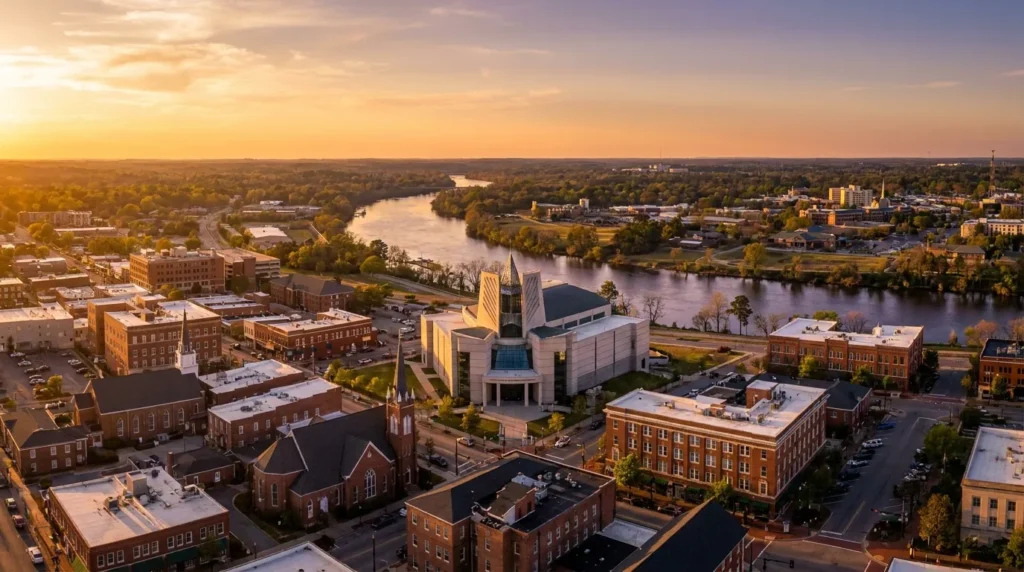
Fayetteville is a military city defined by Fort Liberty (formerly Fort Bragg), with the Airborne and Special Operations Museum, a revitalized historic downtown, and the Cape Fear River as anchors of daily life.

The historic core runs through downtown around Hay Street and Person Street, revitalized over the past two decades with restaurants, breweries, and the Cool Spring Downtown District. The Market House, at the center, marks the city's central point. The Airborne and Special Operations Museum, free and operated by the Army, chronicles the history of American paratroopers and special forces, featuring a simulator and immersive exhibits.

Fort Liberty (formerly Fort Bragg), the most populous military installation in the United States, defines the city's economy and demographics. Pope Army Airfield, the JFK Special Warfare Museum (limited civilian access), and the Iron Mike Statue are located on base. For civilians, the Crown Complex hosts Marksmen (ECHL hockey) games and concerts. The Cape Fear Botanical Garden, spanning 32 hectares along the river, maintains trails across multiple themed sections.

For nature and family activities, the Cape Fear River Trail connects several points throughout the city and sees daily use. Lake Rim Park and Mazarick Park provide access to urban lakes. Festival Park, in the city center, hosts the Dogwood Festival in April and the International Folk Festival in September, reflecting the area's international military presence. Methodist University and Fayetteville State University contribute athletic and cultural programming.

  1. 1["Airborne and Special Operations Museum"
  2. 2"Cape Fear Botanical Garden"
  3. 3"Museum of the Cape Fear (Fayetteville History Museum)"
  4. 4"Crown Complex"
  5. 5"Cape Fear Regional Theatre"
  6. 6"Segra Stadium (Fayetteville Woodpeckers)"
Nightlife4.0 / 10
Parks & green spaces
  • ["Cape Fear Botanical Garden"
  • "Arnette Park"
  • "Mazarick Park"
  • "Lake Rim Park"
  • "Clark Park Nature Center"
  • +1 more

Latest posts

Posts about North Carolina

Coverage and updates related to this destination.

Showing content from North Carolina, as there is no specific data for Fayetteville yet.