Visto n' Visa
Blog
Notícias e artigos
Destinations
Careers
Immigrants

Want to live and work in Charlotte?

Personalized immigration plan with eligible visas, costs, and next steps for your goal!

If you are not eligible, you will know exactly why and what to do to improve your approval chances.

Save up to 12 hours in meetings

No pointless assessments.

Save up to 90%

Save money on vague or unfocused consultations

Avoid Fraud and Mistakes

One mistake can cost you your visa

Total Impartiality

Zero commercial bias

Decide with peace of mind

No toxic urgency

Fast and Accurate

Answers in minutes, no guesswork

A diverse city with strong growth among Latino and African communities

Just over 880,000 residents, with a historic African American base and significant growth among Hispanic and African immigrants. Cosmopolitan by the standards of the American South.

Charlotte has approximately 882,000 residents, with more than 2.8 million in the greater metropolitan area. Its ethnic composition is among the most diverse in the Southeast: non-Hispanic white, African American, and Hispanic residents form the three largest groups, with a growing presence of Asians (especially Indian and Vietnamese) and sub-Saharan Africans.

The Hispanic community is primarily Mexican, Salvadoran, and Honduran, concentrated along corridors such as Central Avenue and South Boulevard. There is also a growing Brazilian community, with churches, markets, and restaurants, particularly in the Pineville and Matthews areas. Vietnamese, Ethiopian, and Bosnian communities are also well established.

The median age is young, reflecting the steady arrival of professionals in the financial and technology sectors. Christianity is predominant, with a strong Baptist, Methodist, Catholic, and Pentecostal presence. There are also mosques, Hindu temples, and an organized Jewish community with several synagogues.

Languages spoken
  • English
  • Spanish
  • Vietnamese
  • Portuguese
  • Arabic
  • +1 more
Main religions
  • Protestantism (Baptist, Methodist)
  • Catholicism
  • Pentecostal churches
  • Islam
  • Hinduism
  • +1 more

Cost of living higher than the North Carolina average, but below major metro areas

Charlotte is more expensive than other cities in the state, but still affordable compared to New York, San Francisco, or Boston. Housing and rent have risen considerably over the past five years.

The cost of living in Charlotte is above the North Carolina average, but remains well below markets such as New York, Boston, Seattle, or the Bay Area. This has attracted skilled professionals who can earn competitive salaries while paying considerably less in rent or mortgage.

Housing is the largest expense, with rents rising sharply since 2020, especially in areas like South End, Plaza Midwood, and NoDa. In more distant neighborhoods (University City, Steele Creek, Matthews), prices remain more accessible. Groceries and restaurants follow average American standards; traditional Southern food tends to be affordable.

The sales tax in Mecklenburg County is around 7.25%. North Carolina charges a flat-rate state income tax. Electric bills are higher in summer due to air conditioning, and water bills tend to be reasonable. A car is practically a necessity, so gasoline and insurance are part of the budget.

97Cost index (US = 100)3% below US average
CategorySingleCoupleFamily (2 + 2)
iHousing$1,258$1,452$1,839
iFood$368$736$1,336
iTransport$484$823$1,065
iHealthcare$271$542$1,016
iChildcare$1,762
iOther$823$1,481$2,081
Monthly total$3,204$5,034$9,099

Source: U.S. BLS Consumer Expenditure Survey 2023 + BEA Regional Price Parities 2023 · Estimates in USD, monthly.

A heated real estate market with neighborhoods for every profile

Charlotte offers everything from historic homes in Dilworth to new buildings in South End. Rents are high, especially near uptown. More distant neighborhoods offer more space for less money.

Charlotte's real estate market is dynamic, with neighborhoods suited to very different profiles. For those working downtown (uptown), the most sought-after areas are South End (new apartments, urban living), Plaza Midwood (eclectic, restaurants), NoDa (arts district), and Dilworth (historic homes from the 1900s).

Families with children often look to Ballantyne, Myers Park (expensive and established), SouthPark, Matthews, and Mint Hill, all with well-rated schools. Those seeking new homes with larger lots look to Steele Creek, Huntersville, Cornelius, and Lake Norman. University City suits those working on the UNC Charlotte campus or at companies like TIAA.

Newly arrived immigrants typically start by renting in large apartment complexes in South End or University City, where entry is easier without a U.S. credit history. Some landlords accept a co-signer or a larger security deposit. Purchasing a home normally requires a solid credit score and documented U.S. employment history, so the typical path is to rent for one or two years first.

Recommended neighborhoods
  • South End
  • Plaza Midwood
  • NoDa
  • Dilworth
  • Myers Park
  • +4 more

Strong market in finance, energy, technology, and logistics

Bank of America and Wells Fargo lead the financial sector. Duke Energy dominates energy. Honeywell, Lowe's, and Truist Financial round out the list. Technology is growing fast.

Charlotte is the second-largest banking center in the United States. Bank of America has its global headquarters here, and Wells Fargo maintains one of its largest regional operations. Truist Financial (formed by the merger of BB&T and SunTrust) is also headquartered in the city. This financial core employs tens of thousands in uptown and SouthPark.

Beyond finance, the economy relies on energy (Duke Energy is headquartered here), technology (Honeywell relocated its global headquarters to Charlotte in 2019), retail (Lowe's is headquartered in Mooresville, within the metro area), logistics (FedEx, UPS, and American Airlines with a hub at CLT airport), and healthcare (Atrium Health, Novant Health). The automotive industry also has a presence, with several plants in the region.

For qualified immigrants, Charlotte is one of the most active destinations for positions in banking, fintech, consulting, and energy. Visa sponsorship is common among large employers. For operational roles, construction, hospitality, and logistics at the airport absorb significant labor. Immigrants find niches in construction, cleaning services, restaurants, and logistics companies.

Dominant sectors
  • Banking and finance
  • Energy
  • Technology
  • Logistics and aviation
  • Healthcare
  • +2 more
Major employers
  • Bank of America
  • Wells Fargo
  • Truist Financial
  • Duke Energy
  • Honeywell
  • +4 more

Public and private universities serve more than 100,000 students in the region

UNC Charlotte is the main public university. Davidson, Queens University, and Johnson & Wales round out the scene, with a strong presence of accessible community colleges for immigrants.

Charlotte's educational system is broad. Public K-12 schools fall under Charlotte-Mecklenburg Schools (CMS), with more than 140,000 students. Quality varies considerably by neighborhood: schools in Myers Park, Ballantyne, and Matthews have strong reputations, while others face greater challenges. There are also good charter schools and dozens of private schools.

In higher education, the largest institution is the University of North Carolina at Charlotte (UNC Charlotte), a public university with approximately 30,000 students and strong programs in engineering, computer science, business, and nursing. Davidson College, a few miles away, is one of the most prestigious liberal arts colleges in the country. Queens University of Charlotte and Johnson & Wales round out the private landscape.

For immigrants, Central Piedmont Community College (CPCC) is a key resource: it offers technical courses, certificates, ESL (English as a Second Language), and two-year degree programs at low cost, with pathways that transfer to UNC Charlotte. Programs for validating foreign credentials and professional training are also available.

Notable universities
  • University of North Carolina at Charlotte (UNC Charlotte)
  • Davidson College
  • Queens University of Charlotte
  • Johnson & Wales University
  • Central Piedmont Community College
  • Wingate University

Two major health systems dominate the region: Atrium and Novant

Atrium Health (with Carolinas Medical Center) and Novant Health are the pillars of care. Emergency rooms, specialists, and research centers are well distributed across the city.

Charlotte's healthcare system revolves around two major providers: Atrium Health, with Carolinas Medical Center (CMC) in the center of the city, and Novant Health, with Presbyterian Medical Center in Elizabeth. Both have satellite hospitals throughout the metropolitan area, including Atrium Health Pineville, Novant Huntersville, and Atrium Health Mercy.

Specialties such as oncology, cardiology, transplantation, and neuroscience are well covered, with specialized institutes such as the Levine Cancer Institute (Atrium) and the Heart and Vascular Institute (Novant). Levine Children's Hospital serves as the pediatric reference for the entire state. Emergency care functions well, with reasonable wait times outside peak periods.

For immigrants, health insurance is essential. Large employers offer coverage as a benefit, and the Affordable Care Act marketplace is the alternative for self-employed individuals or those between jobs. Several community clinics serve uninsured patients, such as C.W. Williams Community Health Center. Physicians and dentists serving patients in Portuguese, Spanish, and other languages are available throughout the city.

Healthcare index68.0 / 100
  • Life expectancyyears at birth
    78.4yrs
  • Doctors per 1kpracticing physicians
    3.7
  • Health spendper capita, per year
    $13,473
  • Public systemoverall quality rating
    Good

Safety varies widely by neighborhood, typical of a large American city

Charlotte has very safe areas and areas with elevated crime rates. Southern and northern neighborhoods (Ballantyne, Davidson, Lake Norman) are calmer. Downtown and the east side require more attention.

Safety in Charlotte follows the pattern of large American cities: it varies widely by neighborhood. Areas such as Myers Park, Ballantyne, SouthPark, Dilworth, Davidson, and Lake Norman are considered very safe, with low crime rates and active policing. Most crimes in these neighborhoods involve theft from vehicles or small package thefts.

Areas such as parts of east Charlotte (sections of Central Avenue, Eastland), parts of the west side, and some northern corridors still face elevated rates of violent crime. Visiting is safe during the day in almost any area, but those planning to move should research neighborhoods carefully, speak with residents, consult databases such as CMPD Crime Mapping, and consider nighttime commute routes.

Policing is carried out by the Charlotte-Mecklenburg Police Department (CMPD). Standard precautions for a large city are advisable: avoid leaving valuables visible in a car, install basic home cameras, choose well-lit nighttime routes, and use reputable ride-share services rather than street taxis. Racially or xenophobically motivated crimes are rare but do occur, particularly during periods of political tension.

5.8
Homicides per 100k
per year
Safety index
45.0
Crime index
55.0
Safer neighborhoods
  • Myers Park
  • Dilworth
  • SouthPark
  • Ballantyne
  • Eastover
  • Uptown (during the day and events)
Areas to avoid
  • Sections of Beatties Ford Road at night
  • Parts of West Boulevard
  • Hidden Valley during late hours
  • Sugar Creek during late hours

Car-dependent, but the LYNX Blue Line offers an alternative along the central corridor

Charlotte is a car-oriented city with heavy traffic during peak hours. The LYNX light rail Blue Line connects uptown to the south. Charlotte Douglas is one of the largest airports in the U.S.

Charlotte is a car-dependent city like nearly every American metropolis outside the Northeast. The main routes are interstates I-77 (north-south), I-85 (northeast-southwest), and I-485 (the beltway). Traffic during peak hours, especially on I-77 and Independence Boulevard, is heavy and requires patience.

Public transit is operated by CATS (Charlotte Area Transit System) and includes buses and the LYNX Blue Line, a light rail that runs from the northern end (UNC Charlotte) to the southern end (I-485/South Boulevard), passing through uptown and South End. It does not cover the entire city, but is useful for those who live or work near the line. Expansion plans exist for Belmont and the west side.

Charlotte Douglas International Airport (CLT) is one of the busiest hubs in the country, operated by American Airlines, with direct flights to Europe, Central America, South America, the Caribbean, and hundreds of U.S. cities. Direct flights to South America are available in some periods, though connections through Miami or Atlanta are also common.

1
Metro lines
26
Metro stations
27 min
Avg commute
26
Walkability
Airports
  • CLT — Charlotte Douglas International Airport
  • International airport
  • Bike infrastructure

What the Climate Is Like Living in Charlotte

Charlotte has a humid subtropical climate, with long, hot, and muggy summers, short mild winters, and frequent storms during the warmer months.

Summers are long, hot, and humid, with highs between 86 and 99 degrees Fahrenheit from June through September and nights that barely drop below 72 degrees. Late-afternoon thunderstorms are common and the humidity is noticeable.

Winters are short and mild, with highs between 50 and 55 degrees and lows near freezing. Light snowfall occurs in some years but the city rarely comes to a standstill.

Residents need reliable air conditioning (essential), an umbrella on hand year-round, and only a modest winter wardrobe. Spring is brief but vibrant, with heavy blooming in March and April.

Sunny days / year218 days
Avg high (°F)
  • 70°J
  • 74°F
  • 78°M
  • 83°A
  • 91°M
  • 95°J
  • 99°J
  • 99°A
  • 97°S
  • 89°O
  • 80°N
  • 72°D
Avg low (°F)
  • 22°J
  • 24°F
  • 24°M
  • 32°A
  • 42°M
  • 55°J
  • 64°J
  • 62°A
  • 51°S
  • 40°O
  • 25°N
  • 22°D
Rainfall (")
  • 5"J
  • 4"F
  • 4"M
  • 4"A
  • 4"M
  • 4"J
  • 4"J
  • 4"A
  • 3"S
  • 2"O
  • 3"N
  • 5"D

A NASCAR city, home of the Panthers, and a rising cultural scene

Charlotte blends Southern sports traditions, modern museums, craft breweries in South End and NoDa, and a booming culinary scene featuring cuisines from around the world.

Charlotte has a strong identity rooted in sports and Southern American culture. The Carolina Panthers (NFL) and the Charlotte Hornets (NBA) draw large crowds, and the NASCAR Hall of Fame in uptown reflects the importance of racing to the region. The city also has Charlotte FC in Major League Soccer, with a rapidly growing fan base.

The cultural scene includes museums such as the Mint Museum, the Bechtler Museum of Modern Art, and the Levine Museum of the New South, all in uptown. The Blumenthal Performing Arts center presents Broadway shows, opera, and concerts. NoDa is the most bohemian neighborhood, with galleries and live music. South End and Plaza Midwood concentrate craft breweries such as NoDa Brewing, Wooden Robot, and Sycamore Brewing.

The food scene is varied: Carolina-style barbecue (pork with vinegar or mustard sauce), classic Southern cooking, and a new wave of chefs bringing Mexican, Vietnamese, Ethiopian, Indian, and other international influences. Markets such as 7th Street Public Market and Optimist Hall bring together diverse options. Festivals like the Carolina Renaissance Festival and the Yiasou Greek Festival animate the calendar.

Charlotte

Charlotte, the South's Banking Capital

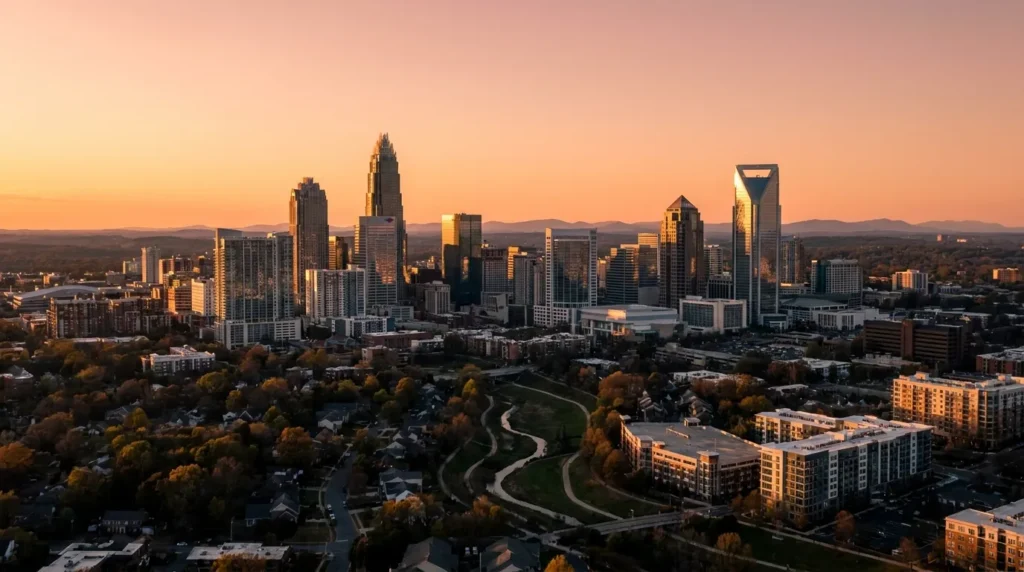
Charlotte combines an impressive financial skyline, modern museums, professional sports, and easy access to the Blue Ridge Mountains and the Carolina coast.

The downtown area, known as Uptown, concentrates the NASCAR Hall of Fame, the Levine Museum of the New South, the Mint Museum Uptown, the Bechtler Museum of Modern Art, and the Harvey B. Gantt Center for African-American Arts + Culture, all within a few blocks of each other. Bank of America Stadium hosts the NFL's Carolina Panthers, and Spectrum Center is home to the NBA's Charlotte Hornets.

The U.S. National Whitewater Center, on the west side of the city, is a one-of-a-kind outdoor sports complex in the U.S., featuring rafting, climbing, and cycling. Discovery Place, an interactive science museum, and Carowinds, an amusement park on the South Carolina border, draw families. NoDa, the arts district, and South End, with its breweries and Light Rail corridor, concentrate the city's nightlife.

Asheville and the Blue Ridge Mountains are reachable in about an hour and a half. Wrightsville Beach and Myrtle Beach are three to four hours away. Charlotte Motor Speedway in Concord hosts traditional NASCAR races.

  1. 1["NASCAR Hall of Fame"
  2. 2"Discovery Place Science"
  3. 3"Mint Museum (Uptown and Randolph)"
  4. 4"Bechtler Museum of Modern Art"
  5. 5"Levine Museum of the New South"
  6. 6"U.S. National Whitewater Center"
Nightlife7.0 / 10
Parks & green spaces
  • ["Freedom Park"
  • "Romare Bearden Park"
  • "Little Sugar Creek Greenway"
  • "McDowell Nature Preserve"
  • "Reedy Creek Nature Center and Preserve"
  • +1 more

Latest posts

Posts about North Carolina

Coverage and updates related to this destination.

Showing content from North Carolina, as there is no specific data for Charlotte yet.