Visto n' Visa
Blog
Notícias e artigos
Destinations
Careers
Immigrants

Want to live and work in Cary?

Personalized immigration plan with eligible visas, costs, and next steps for your goal!

If you are not eligible, you will know exactly why and what to do to improve your approval chances.

Save up to 12 hours in meetings

No pointless assessments.

Save up to 90%

Save money on vague or unfocused consultations

Avoid Fraud and Mistakes

One mistake can cost you your visa

Total Impartiality

Zero commercial bias

Decide with peace of mind

No toxic urgency

Fast and Accurate

Answers in minutes, no guesswork

One of the most Asian cities in the United States outside the West Coast

Approximately 177,000 residents, with an Asian population share among the highest in the country, including Indian, Chinese, and Korean communities. Highly educated population with strong median income.

Cary has one of the most distinctive demographic compositions in the American Southeast. Non-Hispanic whites form the largest share, but what sets the city apart is its proportion of Asian residents, one of the highest in the United States outside the West Coast. Indians form the largest Asian subcommunity, followed by Chinese and Koreans, with a significant presence of Vietnamese, Japanese, and Filipino residents.

African Americans and Hispanics have a smaller presence than in other Triangle cities, reflecting the higher socioeconomic profile and elevated cost of housing. The Brazilian community is small but present, partly due to IT professionals who relocated to RTP companies. There is also a European community, including British, German, and French residents, linked to multinational corporations.

Educational attainment is very high, with the proportion of adults holding a college degree among the highest in the state. Median household income is also among the highest. Religious diversity is notable: Protestants, Catholics, Hindus (with temples such as the Hindu Society of North Carolina), Muslims (Islamic Association of Raleigh), Jews, Buddhists, and a growing share of people with no declared religion.

Languages spoken
  • English
  • Hindi
  • Mandarin Chinese
  • Telugu
  • Tamil
  • +2 more
Main religions
  • Protestantism
  • Hinduism
  • Catholicism
  • Islam
  • Buddhism
  • +2 more

One of the highest costs of living in North Carolina, though still reasonable nationally

Cary is more expensive than neighboring cities like Raleigh or Durham, but remains well below markets such as Boston or the Bay Area. Housing is the primary driver of the higher cost.

The cost of living in Cary ranks among the highest in North Carolina. In absolute terms, however, it remains significantly below markets such as Boston, San Francisco, New York, or Seattle. This continues to attract technology and biotech professionals who can maintain competitive salaries while paying more accessible housing costs and lower state taxes.

Housing is the main driver of the elevated cost. Rents in newer apartment complexes and homes in well-regarded neighborhoods have risen considerably in recent years. Buying a home in Cary requires a substantial budget, especially in neighborhoods such as Preston, MacGregor Downs, or Lochmere. Newer planned suburbs like Amberly and Cary Park carry high prices due to their included amenities.

Groceries, restaurants, and services follow average American standards, with a tendency to run slightly above average due to the higher socioeconomic profile. Specialty markets include Patel Brothers (Indian), Grand Asia Market (general Asian), and H Mart (Korean). Sales tax is 7.25%. Electricity costs weigh on summer budgets, but overall the equation represents solid value for high earners.

97Cost index (US = 100)3% below US average
CategorySingleCoupleFamily (2 + 2)
iHousing$1,258$1,452$1,839
iFood$368$736$1,336
iTransport$484$823$1,065
iHealthcare$271$542$1,016
iChildcare$1,762
iOther$823$1,481$2,081
Monthly total$3,204$5,034$9,099

Source: U.S. BLS Consumer Expenditure Survey 2023 + BEA Regional Price Parities 2023 · Estimates in USD, monthly.

Planned suburbs, modern homes, and excellent amenities throughout every neighborhood

Preston, MacGregor Downs, and Lochmere are traditional upscale neighborhoods. Amberly and Cary Park are newer planned communities. Rents are high but new apartment options are abundant.

Cary's real estate market is defined by planned neighborhoods featuring landscaping, internal parks, community pools, and strict building codes. Traditional upper-class neighborhoods include Preston (home to Prestonwood Country Club), MacGregor Downs (with a lake and club), Lochmere, and Kildaire Farms, all offering spacious homes on tree-lined streets.

Newer planned communities such as Amberly, Cary Park, Carpenter Village, and Stonewater offer modern homes with community pools, bike paths, and even small internal commercial centers. For families with children, all of these neighborhoods have access to well-rated schools within the Wake County Public School System. Those seeking a walkable downtown experience choose Downtown Cary, with newer homes and ground-floor apartments.

Rents are high but there is good supply in newer complexes along Cary Parkway, NW Maynard Road, and Walnut Street. Newly arrived immigrants often start in these complexes, where entry is easier without a US credit history. Buying a home in Cary typically requires one to two years of local residency to build a credit history, and competition in desirable neighborhoods is strong.

Recommended neighborhoods
  • Preston
  • MacGregor Downs
  • Lochmere
  • Kildaire Farms
  • Amberly
  • +3 more

Technology, biotech, and finance driven by proximity to RTP

SAS Institute (headquartered in Cary), Epic Games, MetLife, Verizon, Fidelity, and dozens of RTP companies employ local residents. The healthcare sector is also strong, with WakeMed Cary.

Cary's labor market is tightly integrated with that of the Research Triangle. The largest employer headquartered in the city is SAS Institute, a global leader in analytical software, with one of the most acclaimed corporate campuses in the United States. Epic Games, creator of Fortnite and Unreal Engine, is also headquartered in Cary. MetLife maintains a large operation in the city, as do Verizon, Fidelity, and Deutsche Bank.

For those working in RTP itself, the commute is 10 to 20 minutes: IBM, Cisco, Lenovo, GSK, Biogen, and dozens of other companies are located within the park. WakeMed Cary Hospital is the main local healthcare center. Retail, restaurants, and construction also employ a significant number of workers, though at a smaller scale than technology and biotech.

For qualified immigrants, Cary is one of the most active markets in the country for H-1B visa sponsorship, particularly in IT, data science, software engineering, and biotech. Professionals from Brazil, India, and China find open doors at SAS, Epic Games, and the multinationals within RTP. For operational roles, construction, landscaping, restaurants, and services absorb workers, primarily from the Hispanic community.

Dominant sectors
  • Information technology
  • Biotechnology and pharmaceuticals
  • Finance and insurance
  • Healthcare
  • Software and gaming
  • +1 more
Major employers
  • SAS Institute
  • Epic Games
  • MetLife
  • Verizon
  • Fidelity Investments
  • +3 more

Public schools among the best in the state, with universities nearby

Wake County Public School System has several Cary schools ranked among the state's best. There is no university within Cary, but NC State, Duke, and UNC are 15 to 40 minutes away.

Education is one of the primary reasons families choose Cary. The Wake County Public School System has several Cary schools consistently ranked among the best in the state, including Green Hope High School, Panther Creek High School, and Cary High School. Elementary and middle schools in planned neighborhoods are typically well-rated and supported by highly engaged parents.

There are also elite private schools such as Cary Christian School, Cary Academy, and Ravenscroft (in nearby Raleigh). Charter schools and magnet schools with specific themes, including languages, science, and the arts, round out the landscape. For Asian families, weekend schools teaching heritage languages and cultures, including Chinese, Hindi, and Korean, are widely available.

Cary has no university of its own, but the neighboring options are excellent: NC State University in Raleigh (15 minutes), Duke University in Durham (25 minutes), UNC in Chapel Hill (40 minutes), Meredith College, Peace University, and Saint Augustine's University. For technical training and certifications, Wake Technical Community College has a campus in Cary offering ESL and practical courses for immigrants.

Notable universities
  • NC State University (in Raleigh)
  • Duke University (in Durham)
  • University of North Carolina at Chapel Hill
  • Meredith College
  • Wake Technical Community College (campus in Cary)

WakeMed Cary is the local hospital, with Duke and UNC Hospitals nearby

WakeMed Cary Hospital covers local care. Duke University Hospital (Durham), UNC Hospitals (Chapel Hill), and UNC Rex (Raleigh) are 20 to 40 minutes away for complex cases.

Cary's healthcare system is excellent, benefiting from proximity to some of the best medical institutions in the country. WakeMed Cary Hospital is the local hospital, part of the WakeMed Health system, with an emergency department, maternity services, and multiple specialties. It addresses the vast majority of the city's healthcare needs.

For more complex cases, patients have easy access to Duke University Hospital in Durham (25 minutes), a national reference in transplant, oncology, and cardiology; UNC Hospitals in Chapel Hill (40 minutes); and UNC Rex Healthcare in Raleigh (20 minutes). This means that even rare conditions have access to top-tier specialists within a short distance.

Health insurance is essential for immigrants. Large employers such as SAS, Epic Games, and MetLife offer robust coverage. Self-employed individuals can purchase plans through the Affordable Care Act marketplace. Several Indian, Chinese, and Korean physicians practice in the area and see patients in their native languages. Brazilian professionals can find Portuguese-speaking providers within the Duke or UNC network. Mental health services also have good coverage, with multiple therapists offering sessions in languages other than English.

Healthcare index72.0 / 100
  • Life expectancyyears at birth
    78.4yrs
  • Doctors per 1kpracticing physicians
    3.7
  • Health spendper capita, per year
    $13,473
  • Public systemoverall quality rating
    Good

One of the safest large cities in the United States

Cary consistently appears on national lists of the safest cities with more than 100,000 residents. Violent crime is rare. Petty theft is the main everyday concern.

Cary is consistently ranked as one of the safest large cities in the United States. Violent crime is rare, and most incidents involve theft of items from vehicles, minor package theft from front porches, and infrequent home burglaries. The city invests heavily in policing, public lighting, and security technology.

Virtually all neighborhoods are considered safe, including areas such as Preston, MacGregor Downs, Lochmere, Amberly, Cary Park, and Downtown Cary. Families move around at night without concern, children ride bikes in the neighborhood, and garage doors are left open on clear days. This is frequently cited by residents as one of the city's main draws.

Policing is handled by the Cary Police Department, with fast response times and a generally positive relationship with the community. Standard American precautions apply for immigrants: avoid leaving valuables visible in vehicles and consider installing basic security cameras. Xenophobic incidents are extremely rare, and the city's strong Asian presence and general diversity create a welcoming environment for newcomers.

5.8
Homicides per 100k
per year
Safety index
82.0
Crime index
18.0
Safer neighborhoods
  • Preston
  • MacGregor Downs
  • Lochmere
  • Amberly
  • Stonewater
  • Carpenter Village
Areas to avoid
  • Isolated areas along US-1 at night
  • Empty commercial strips after business hours

A car-dependent city with proximity to RDU and the region's best cycling infrastructure

Cary is a car-dependent city, but it has one of the best cycling and sidewalk networks in the state. GoCary operates local bus routes. RDU airport is 15 minutes away. Amtrak stops in the city.

Cary is car-dependent like most of the American South, but stands out for having one of the best cycling and pedestrian infrastructure networks in North Carolina. The main routes are Interstate 40 (east-west), I-440, and US-1, all providing quick access to Raleigh, Durham, and RTP. Traffic is reasonable most of the time, with slowdowns during peak hours.

Public transit is operated by GoCary (formerly C-Tran), with bus routes within the city and connections to GoTriangle, which links Cary to Raleigh, Durham, Chapel Hill, and RTP. There is no light rail, though a long-discussed project remains under consideration. Cycling is more prevalent in Cary than in other cities in the region, thanks to the American Tobacco Trail and additional bike paths.

Raleigh-Durham International Airport (RDU) is about 15 minutes from Cary, with direct flights to London, Paris, Cancun, and numerous US cities. Connections through Miami, Atlanta, or Newark are the standard option for travelers heading to Brazil. Cary has its own Amtrak station, with the Carolinian and Piedmont lines connecting Charlotte, Raleigh, Greensboro, Washington, and New York.

24 min
Avg commute
30
Walkability
Airports
  • RDU — Raleigh-Durham International Airport (nearby)
  • Bike infrastructure

What the Climate Is Like Living in Cary

Cary has a humid subtropical climate, with long, hot, and muggy summers, short and mild winters, and rainfall distributed throughout the year.

Summers are long, hot, and humid, with highs between 86 and 99 degrees Fahrenheit from June through September, and nights that rarely drop below 72 degrees. Brief afternoon thunderstorms are common in July and August.

Winters are short and mild, with highs between 50 and 57 degrees Fahrenheit and lows that rarely fall below freezing. Light snowfall occurs in some years but does not last long.

Residents need efficient air conditioning (an essential), an umbrella, and lightweight clothing. Heating is necessary for only a few months, and spring with cherry blossoms is one of the best seasons of the year.

Sunny days / year213 days
Avg high (°F)
  • 69°J
  • 73°F
  • 79°M
  • 84°A
  • 91°M
  • 94°J
  • 100°J
  • 98°A
  • 97°S
  • 88°O
  • 79°N
  • 70°D
Avg low (°F)
  • 21°J
  • 22°F
  • 24°M
  • 31°A
  • 42°M
  • 53°J
  • 63°J
  • 61°A
  • 50°S
  • 39°O
  • 24°N
  • 21°D
Rainfall (")
  • 4"J
  • 4"F
  • 3"M
  • 4"A
  • 3"M
  • 5"J
  • 5"J
  • 5"A
  • 4"S
  • 3"O
  • 4"N
  • 4"D

Organized suburban culture with a strong Asian presence and diverse dining

Koka Booth Amphitheatre hosts outdoor concerts. Lazy Daze Festival and Diwali Cary animate the calendar. Indian, Chinese, Korean, and Thai restaurants are abundant and authentic.

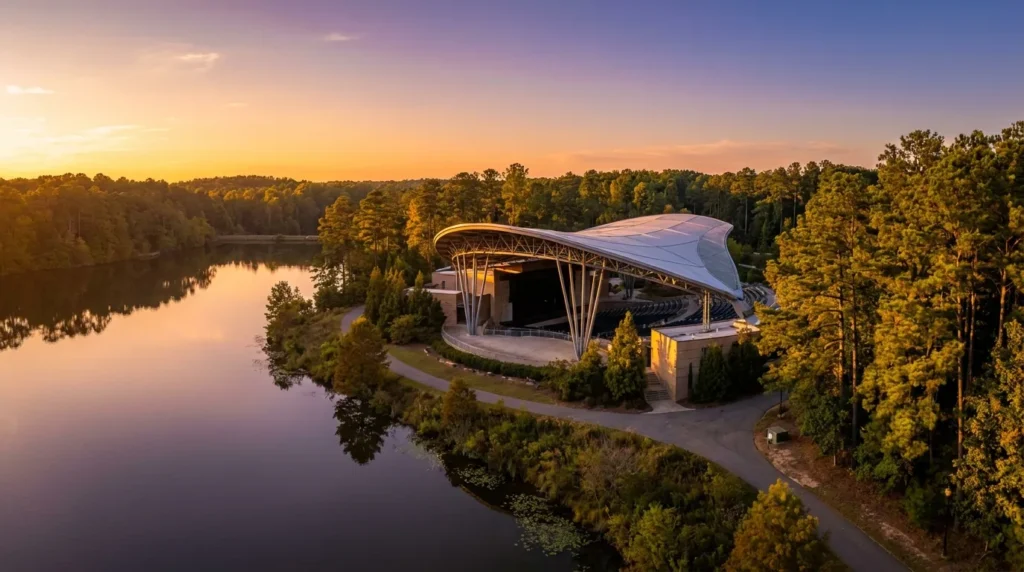
Cary's culture is organized and family-oriented, reflecting its profile as a premium suburb. Koka Booth Amphitheatre, set alongside a lake, hosts outdoor concerts during spring and summer, including performances by the North Carolina Symphony. The Cary Arts Center and the Page-Walker Arts & History Center maintain an active cultural scene with exhibitions, classes, and performances.

Festivals such as the annual Lazy Daze Arts & Crafts Festival draw tens of thousands of visitors in August. Diwali Cary, the Hindu festival of lights, is one of the largest in the American Southeast, reflecting the city's large Indian community. Spring Daze, the Cary Diwali Mela, and Holi bring Asian traditions to the calendar throughout the year. The USA Baseball Training Complex in Cary hosts national tournaments and training events.

The dining scene is internationally diverse for a city of its size. Indian restaurants such as Saffron, Cool Breeze, and Chai Pani; authentic Chinese options at Chatham Square; Korean spots like Mama Suzy; Vietnamese, Thai, Japanese (with several well-regarded sushi restaurants), and Mexican establishments fill out the menu. Small Brazilian bakeries and restaurants in Cary and Morrisville serve the local Lusophone community.

Cary

What to Do in Cary Day to Day

Cary is a planned city in the Research Triangle of North Carolina, with a strong cultural calendar, well-maintained parks, and proximity to Raleigh and Durham. Its attractions blend sports, music, and nature.

Koka Booth Amphitheatre at Symphony Lake hosts North Carolina Symphony concerts and the Movies by Moonlight series in summer. WakeMed Soccer Park is home to the North Carolina Courage and North Carolina FC, and the USA Baseball National Training Complex serves as a base for collegiate national teams. The Cary Arts Center brings together exhibitions, classes, and the Cary Players community theater group.

Downtown Cary Park, opened in 2023, has become the new heart of the city, featuring lawns, food trucks, and weekly programming. Surrounding it are the Page Walker Arts and History Center, the Cary Theater, and Academy Street, lined with Asian and Indian restaurants and independent cafes that reflect the character of the local population.

For nature within the city, Hemlock Bluffs Nature Preserve protects a rare hemlock population in the Piedmont, and Bond Park offers a lake, trails, and boat rentals. Fred G. Bond Metro Park and the White Oak Creek Greenway are part of a 80-mile greenway network connecting Cary to Raleigh, Apex, and Morrisville.

  1. 1["Koka Booth Amphitheatre"
  2. 2"Cary Arts Center"
  3. 3"Sertoma Amphitheatre"
  4. 4"Page-Walker Arts and History Center"
  5. 5"USA Baseball National Training Complex"
  6. 6"WakeMed Soccer Park"
Nightlife5.0 / 10
Parks & green spaces
  • ["Fred G. Bond Metro Park"
  • "Hemlock Bluffs Nature Preserve"
  • "Black Creek Greenway"
  • "Sertoma Amphitheatre at Bond Park"
  • "Lake Crabtree County Park"
  • +1 more

Latest posts

Posts about North Carolina

Coverage and updates related to this destination.

Showing content from North Carolina, as there is no specific data for Cary yet.