Visto n' Visa
Blog
Notícias e artigos
Destinations
Careers
Immigrants

Want to live and work in Greensboro?

Personalized immigration plan with eligible visas, costs, and next steps for your goal!

If you are not eligible, you will know exactly why and what to do to improve your approval chances.

Save up to 12 hours in meetings

No pointless assessments.

Save up to 90%

Save money on vague or unfocused consultations

Avoid Fraud and Mistakes

One mistake can cost you your visa

Total Impartiality

Zero commercial bias

Decide with peace of mind

No toxic urgency

Fast and Accurate

Answers in minutes, no guesswork

Multiethnic city, with a strong African-American and refugee presence

Around 300,000 residents. African Americans form a significant portion. Greensboro is one of the main refugee resettlement destinations in the United States, with diverse communities.

Greensboro has around 299,000 residents, with a notably diverse ethnic composition. Non-Hispanic whites and African Americans form the two largest groups, in relatively balanced proportions. The Hispanic community has grown since the 2000s, with Mexicans, Salvadorans, and Cubans.

A distinctive feature is the refugee resettlement program. Greensboro has received refugees for decades from Vietnam, Laos, Cambodia, Bosnia, Sudan, Somalia, Ethiopia, Eritrea, Iraq, Syria, Myanmar (Burma), and more recently Congo and Afghanistan. Neighborhoods such as the east side of the city have markets, mosques, Ethiopian churches, and restaurants that reflect this diversity.

The median age is young, partly due to the universities. There are around 60,000 college students in the city. Religiously, Christianity predominates (Baptist, Methodist, Catholic), but there are established mosques, Hindu temples, Buddhist temples, and various ethnic churches. The socioeconomic profile is mixed, with strong middle-class areas and significant low-income zones.

Languages spoken
  • English
  • Spanish
  • Vietnamese
  • Arabic
  • Swahili
  • +2 more
Main religions
  • Protestantism (Baptist, Methodist)
  • Catholicism
  • Islam
  • Pentecostal churches
  • Hinduism
  • +1 more

One of the lowest costs of living among large cities in the Southeast

Greensboro has housing, food, and services well below the national average. Modest rents and relatively affordable homes explain part of the recent population growth.

The cost of living in Greensboro is among the lowest for cities of its size in the American Southeast. Housing, in particular, falls well below the national average and below Charlotte and Raleigh. This attracts families and professionals who want space without committing most of their income to rent or a mortgage.

Standard apartment rent is affordable, and home prices remain reasonable in several neighborhoods. Grocery shopping follows American standards, with chains such as Harris Teeter, Food Lion, Lidl, ALDI, and Publix competing on price. Restaurants offer good variety at moderate costs.

Sales tax in Guilford County is around 6.75%. North Carolina charges a flat-rate state income tax. Electricity bills weigh in during summer (air conditioning runs almost continuously in July and August), but overall utilities are manageable. For immigrants coming from expensive markets, Greensboro can be an affordable entry point to the American market.

100Cost index (US = 100)same as US average
CategorySingleCoupleFamily (2 + 2)
iHousing$1,296$1,496$1,894
iFood$379$758$1,376
iTransport$499$848$1,097
iHealthcare$279$558$1,046
iChildcare$1,815
iOther$848$1,525$2,143
Monthly total$3,301$5,185$9,371

Source: U.S. BLS Consumer Expenditure Survey 2023 + BEA Regional Price Parities 2023 · Estimates in USD, monthly.

Charming historic neighborhoods alongside accessible planned suburbs

Fisher Park and Sunset Hills have historic homes. Irving Park is the traditional upper-class neighborhood. Suburbs such as Summerfield and Stokesdale offer new homes with large lots.

Greensboro's real estate market is calm compared to Charlotte or Raleigh, with homes still at accessible prices. For those seeking centrally located neighborhoods with character, Fisher Park and Sunset Hills offer historic homes from the 1900s and 1920s, with large trees and quiet streets. Irving Park, to the north, is the traditional upper-class neighborhood, with spacious homes on large lots.

Other urban options include Lindley Park, Westerwood, and College Hill, the latter close to UNCG. For young families with children, Adams Farm, New Garden, and neighborhoods around Battleground Avenue offer newer homes, well-rated schools, and quiet streets. Those wanting more space move to Summerfield and Stokesdale, in the neighboring county.

Rent is affordable in apartment complexes on High Point Road, Wendover Avenue, and Lawndale Drive. Recently arrived immigrants often start in these complexes, where entry is easier for those who do not yet have an American credit history. Buying a home in Greensboro tends to be simpler and less expensive than in the larger neighboring cities.

Recommended neighborhoods
  • Fisher Park
  • Sunset Hills
  • Irving Park
  • Lindley Park
  • Adams Farm
  • +3 more

Logistics, manufacturing, healthcare, and higher education drive the economy

Cone Health, Honda Aircraft, FedEx, Volvo Trucks, UNCG, and Toyota Battery Manufacturing are major employers. The traditional textile industry was replaced by logistics and aviation.

Greensboro's labor market was historically tied to textiles and tobacco. Over recent decades it transformed with the arrival of heavy logistics (FedEx has one of the world's largest cargo hubs at PTI airport), aeronautical manufacturing (Honda Aircraft Company, maker of the HondaJet), automotive manufacturing (Volvo Trucks), and the newly arrived Toyota Battery Manufacturing, with a battery plant for electric vehicles.

Cone Health is the largest healthcare employer in the area, with hospitals in Greensboro and neighboring cities. UNCG (University of North Carolina at Greensboro) and North Carolina A&T State University employ thousands in higher education and research. Lincoln Financial Group, Procter & Gamble, and Mack Trucks also have a significant presence.

For qualified immigrants, there are opportunities in engineering (aeronautical, automotive), healthcare, higher education, and logistics. Visa sponsorship is less common than in Raleigh or Charlotte, but it exists at large companies. For operational work, factories, logistics warehouses, construction, and hospitality absorb significant labor, especially from the Hispanic and refugee communities.

Dominant sectors
  • Logistics and transportation
  • Aeronautical manufacturing
  • Automotive manufacturing
  • Healthcare
  • Higher education
  • +2 more
Major employers
  • Cone Health
  • FedEx Express (PTI hub)
  • Honda Aircraft Company
  • Volvo Trucks
  • Toyota Battery Manufacturing NC
  • +3 more

Seven universities and several colleges for a city of its size

UNCG, NC A&T, Guilford College, Bennett College, Greensboro College, Elon University Law, and Guilford Technical Community College form a robust university ecosystem.

Greensboro has an impressive concentration of higher education institutions for a city of its size. The University of North Carolina at Greensboro (UNCG) is the largest, a public university with around 18,000 students and a tradition in education, nursing, music, and psychology. North Carolina A&T State University is the largest historically Black university (HBCU) in the United States, with around 13,000 students and strong programs in engineering and agriculture.

Other institutions include Guilford College (Quaker, liberal arts), Bennett College (HBCU for women), Greensboro College, Elon University School of Law (downtown), and High Point University in the neighboring city. For technical education, certificates, ESL, and two-year degrees at low cost, Guilford Technical Community College is a key resource.

Public K-12 schools fall under Guilford County Schools, the third largest district in North Carolina. Quality varies considerably: schools in neighborhoods such as Adams Farm, New Garden, and Northern Guilford have a good reputation, while others face challenges. There are also private schools, charter schools, and magnet programs with specific subjects.

Notable universities
  • University of North Carolina at Greensboro (UNCG)
  • North Carolina A&T State University
  • Guilford College
  • Bennett College
  • Greensboro College
  • Elon University School of Law
  • Guilford Technical Community College

Cone Health dominates the scene, with several hospitals and clinics throughout the city

Cone Health is the region's largest healthcare provider, with Moses H. Cone Memorial Hospital as its flagship. Wesley Long Hospital, Women's Hospital, and community clinics complete the network.

Greensboro's healthcare system revolves around Cone Health, a nonprofit network that operates several hospitals in the region, including Moses H. Cone Memorial Hospital (a teaching hospital and the main trauma center), Wesley Long Hospital, and Women's Hospital, specializing in women's health and maternity. Cone Health also has hospitals in Burlington and Reidsville.

Primary care is offered at dozens of Cone Health clinics and independent providers. For highly complex cases (transplants, rare surgeries), patients are often referred to Duke Hospital in Durham (about one hour away), UNC Hospitals in Chapel Hill, or Wake Forest Baptist Medical Center in Winston-Salem (about 30 minutes away). The region has good specialist coverage.

For immigrants, health insurance is essential. Large companies offer coverage as a benefit. Self-employed individuals purchase through the Affordable Care Act marketplace. Community clinics such as Mustard Seed and HealthServe serve uninsured patients. Due to the refugee resettlement program, health services with translation in Arabic, Swahili, Vietnamese, and other languages are available.

Healthcare index65.0 / 100
  • Life expectancyyears at birth
    78.4yrs
  • Doctors per 1kpracticing physicians
    3.7
  • Health spendper capita, per year
    $13,473
  • Public systemoverall quality rating
    Good

Safety varies by neighborhood, with very quiet residential areas

Greensboro has crime rates slightly above the national average, but neighborhoods such as Irving Park, Adams Farm, and New Garden are very safe. Downtown and the east side require more attention.

Safety in Greensboro follows the pattern of midsize American cities: it varies greatly by neighborhood. Areas such as Irving Park, Fisher Park, Sunset Hills, Adams Farm, New Garden, and Summerfield are considered very safe, with low crime rates and active policing. Most crimes in these neighborhoods involve theft from vehicles or minor property offenses.

Some parts of the east side of the city and lower-income areas have higher rates of violent crime. As with any large American city, researching a neighborhood before signing a lease is worthwhile: visiting during the day and at night, talking to residents, and consulting the city's crime maps help in making an informed decision.

Policing is handled by the Greensboro Police Department. Standard precautions apply for immigrants: do not leave valuables visible in the car, lock the house securely, install basic cameras, and choose well-lit routes at night. Xenophobic crimes are rare, and the established refugee community presence creates a relatively welcoming environment for newcomers.

5.8
Homicides per 100k
per year
Safety index
44.0
Crime index
56.0
Safer neighborhoods
  • Irving Park
  • Sunset Hills
  • Fisher Park
  • Lindley Park
  • New Garden / Northwest Greensboro
  • Adams Farm
Areas to avoid
  • Stretches of East Bessemer Avenue at night
  • Parts of Phillips Avenue late at night
  • Areas near Randleman Road at isolated hours

Car-dependent city, with Piedmont Triad International Airport and Amtrak

Car travel is the dominant standard. GTA operates buses within the city. PTI airport serves the region, and Amtrak connects Greensboro to Charlotte, Raleigh, and the East Coast.

Greensboro is a car-dependent city like most of the American South. The main routes are interstates I-40, I-85, I-840 (inner loop), and I-73, all intersecting in or near the city. Traffic is far lighter than in Charlotte or Raleigh, and commute times within the city rarely exceed 20 to 25 minutes.

Public transportation is operated by the Greensboro Transit Authority (GTA), with buses covering most of the city. There is no light rail or subway. For those who live or work on main corridors, the bus is viable; for everyone else, a car is practically mandatory. Cycling is growing, with bike lanes in some central neighborhoods.

Piedmont Triad International Airport (PTI) serves the entire Triad region, with direct flights to major American cities and some international destinations via connections. It is also home to FedEx's cargo hub. Greensboro also has an Amtrak station, with the Carolinian and Piedmont lines connecting to Charlotte, Raleigh, and continuing to New York and Washington, D.C.

21 min
Avg commute
32
Walkability
Airports
  • GSO — Piedmont Triad International Airport
  • International airport
  • Bike infrastructure

What the climate is like living in Greensboro

Greensboro has a humid subtropical climate, with hot and muggy summers, mild winters with occasional frost, and four distinct, moderate seasons.

Summers are hot and humid, with highs between 30 and 33 degrees Celsius from June through September and nights that rarely drop below 21 degrees. Brief thunderstorms offer temporary relief from the heat, though humidity remains a constant presence.

Winters are short and mild, with highs between 10 and 13 degrees and lows around freezing. Snow may appear in small amounts one or two days per year, more as a novelty than a concern.

Residents need efficient air conditioning, an umbrella, and a few light winter layers. Autumn, with its yellow and red foliage, is one of the most visually striking seasons of the year.

Sunny days / year213 days
Avg high (°F)
  • 66°J
  • 72°F
  • 76°M
  • 80°A
  • 86°M
  • 91°J
  • 96°J
  • 95°A
  • 94°S
  • 86°O
  • 76°N
  • 68°D
Avg low (°F)
  • 20°J
  • 22°F
  • 24°M
  • 30°A
  • 40°M
  • 52°J
  • 62°J
  • 61°A
  • 48°S
  • 38°O
  • 24°N
  • 19°D
Rainfall (")
  • 4"J
  • 5"F
  • 3"M
  • 4"A
  • 4"M
  • 4"J
  • 5"J
  • 5"A
  • 4"S
  • 3"O
  • 3"N
  • 4"D

Civil rights movement history, indie scene, and international cuisine

The city where the sit-in protest was born in 1960. The International Civil Rights Center & Museum, ethnic festivals, and craft breweries define the culture. College sports carry significant weight.

Greensboro holds significant historical weight in the civil rights movement. It was here, in February 1960, that four NC A&T students launched the famous sit-in at the segregated Woolworth lunch counter, an event that helped accelerate the fight for equality in the United States. The International Civil Rights Center & Museum, in the original Woolworth building, is a must-see for anyone wanting to understand this chapter of history.

The cultural scene includes the Greensboro Children's Museum, the Greensboro Science Center (zoo, aquarium, and planetarium), and the Weatherspoon Art Museum at UNCG. The Tanger Center for the Performing Arts hosts Broadway tours, ballet, and concerts. LeBauer Park, downtown, is a frequent venue for festivals such as the September Folk Festival and the National Folk Festival.

The dining scene is increasingly international, with Ethiopian, Vietnamese, Eritrean, Syrian, and Bosnian refugees opening restaurants in neighborhoods such as Adams Farm and the High Point Road corridor. There is also Carolina-style barbecue (pork), breweries such as Joymongers and Pig Pounder, and international markets such as Super G Mart. College sports (NC A&T Aggies, UNCG Spartans) animate the calendar.

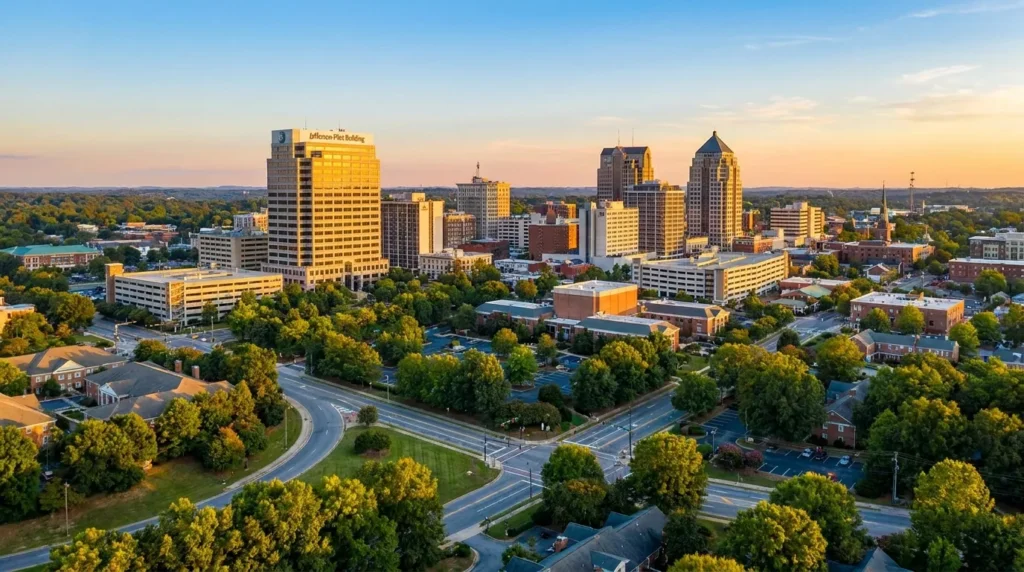
Greensboro

Greensboro, the Triad's hub and landmark of the civil rights movement

At the heart of the Piedmont Triad alongside Winston-Salem and High Point, Greensboro is home to the International Civil Rights Center & Museum at the historic 1960 sit-in lunch counter and five universities.

The International Civil Rights Center & Museum, housed in the former Woolworth's on Elm Street, preserves the lunch counter where the Greensboro Four launched the 1960 sit-in that helped ignite the civil rights movement. The Greensboro History Museum complements it with the city's story from the Battle of Guilford Courthouse onward.

The Greensboro Science Center, featuring an aquarium, a zoo, and a Sky Wild ropes course, ranks among North Carolina's most complete family attractions. LeBauer Park and Center City Park, both downtown, host free events throughout the year. The Tanger Family Bicentennial Garden spans more than 7 acres as a free urban botanical garden.

For sports, Greensboro Coliseum hosts ACC basketball and major concerts. The Greensboro Grasshoppers (Minor League Baseball) play at First National Bank Field. Winston-Salem and the Old Salem Museum are 30 minutes away, and Pilot Mountain State Park, about an hour out, offers the classic view of its hat-shaped summit.

  1. 1["International Civil Rights Center and Museum"
  2. 2"Greensboro Science Center"
  3. 3"Weatherspoon Art Museum"
  4. 4"Greensboro History Museum"
  5. 5"Bog Garden at Benjamin Park"
  6. 6"Tanger Family Bicentennial Garden"
Nightlife5.0 / 10
Parks & green spaces
  • ["Greensboro Arboretum"
  • "Bog Garden"
  • "Country Park"
  • "Lake Brandt and Lake Townsend trails"
  • "Hagan-Stone Park"
  • +1 more

Latest posts

Posts about North Carolina

Coverage and updates related to this destination.

Showing content from North Carolina, as there is no specific data for Greensboro yet.