Visto n' Visa
Blog
Notícias e artigos
Destinations
Careers
Immigrants

Want to live and work in Raleigh?

Personalized immigration plan with eligible visas, costs, and next steps for your goal!

If you are not eligible, you will know exactly why and what to do to improve your approval chances.

Save up to 12 hours in meetings

No pointless assessments.

Save up to 90%

Save money on vague or unfocused consultations

Avoid Fraud and Mistakes

One mistake can cost you your visa

Total Impartiality

Zero commercial bias

Decide with peace of mind

No toxic urgency

Fast and Accurate

Answers in minutes, no guesswork

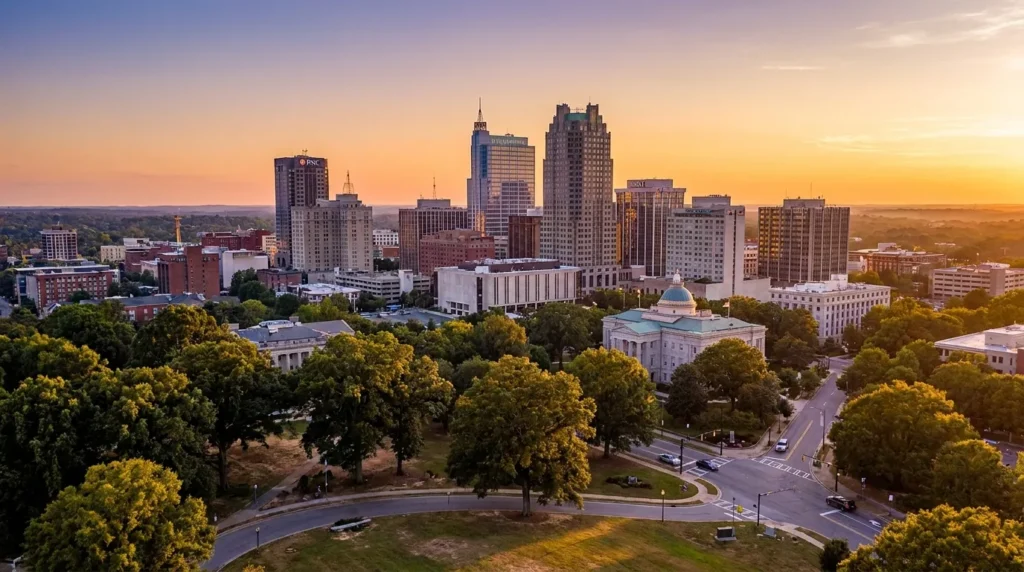
Young, educated, and increasingly multinational city

Approximately 470,000 residents, with a highly educated profile and growing immigrant populations from India, China, Latin America, and Europe. Religious diversity is also expanding with new communities.

Raleigh has approximately 470,000 inhabitants, with a strong presence of college-educated professionals. The ethnic composition includes non-Hispanic whites (the majority), African Americans (the second-largest community), Hispanics, and a growing share of Asians. The metropolitan area is one of the fastest-growing in the United States in absolute terms.

The Hispanic community is primarily Mexican, Salvadoran, and Venezuelan. The Brazilian community exists but is smaller than in Orlando or Boston, concentrated in Cary, Apex, and Morrisville. Indian immigrants number in the tens of thousands, with a strong presence in technology and medicine; Chinese, Korean, and Vietnamese communities are also well established, particularly in Cary.

The age profile is young, with a median in the low 30s, reflecting the influence of universities and the technology and science job market. Religious composition is diverse: Protestants (Baptists, Methodists, Presbyterians), Catholics, Mormons, Hindus, Muslims, and a growing share of those with no declared religious affiliation.

Languages spoken
  • English
  • Spanish
  • Hindi
  • Mandarin Chinese
  • Vietnamese
  • +1 more
Main religions
  • Protestantism (Baptist, Methodist)
  • Catholicism
  • Hinduism
  • Islam
  • Judaism
  • +2 more

Cost of living still attractive, though rising with the influx of new residents

Raleigh is more affordable than Boston, San Francisco, or New York, but population growth has pushed up rents and home prices. Technology salaries offset costs well.

The cost of living in Raleigh exceeds the national average but remains well below that of technology hubs on the East and West Coasts. This explains the significant influx of people from Boston, New York, and the Bay Area in recent years. Salaries in technology, science, and medicine are competitive and generally allow for a comfortable standard of living.

Housing costs have risen sharply since 2020. Rents for new apartments downtown or in North Hills are approaching levels seen in larger cities. In more outlying neighborhoods such as Knightdale or Garner, the price per square foot is still reasonable. Purchasing a home requires patience, with strong competition in desirable neighborhoods.

Groceries, restaurants, services, and transportation follow typical American averages. The sales tax in Raleigh is 7.25%. North Carolina levies a flat state income tax of around 4.5%. Electricity bills increase significantly in summer, with air conditioning running almost continuously in July and August. A car remains practically essential outside the central area.

97Cost index (US = 100)3% below US average
CategorySingleCoupleFamily (2 + 2)
iHousing$1,258$1,452$1,839
iFood$368$736$1,336
iTransport$484$823$1,065
iHealthcare$271$542$1,016
iChildcare$1,762
iOther$823$1,481$2,081
Monthly total$3,204$5,034$9,099

Source: U.S. BLS Consumer Expenditure Survey 2023 + BEA Regional Price Parities 2023 · Estimates in USD, monthly.

Active market with strong demand in central neighborhoods and planned suburbs

Neighborhoods such as North Hills, Five Points, and Cameron Park are in high demand. Families target Cary, Apex, and Wake Forest. Renting in new apartment complexes is the common entry point for immigrants.

Raleigh's real estate market is one of the most dynamic in the American Southeast. Those working downtown or nearby find historic appeal in neighborhoods such as Five Points, Mordecai, Cameron Park, and Boylan Heights, with homes from the 1920s and 1940s. North Hills, farther north, has become an urban hub with new buildings, restaurants, and offices.

Families with children typically look toward Cary (separate from Raleigh but fully integrated into the metro), Apex, Wake Forest, Holly Springs, and Morrisville. All offer well-rated schools, planned neighborhoods, parks, and modern infrastructure. Those seeking proximity to NC State can find more affordable rents along Hillsborough Street and the surrounding southern neighborhoods.

Newly arrived immigrants almost always begin by renting in apartment complexes such as those in North Hills, Brier Creek, or Crabtree Valley, where the process is more accessible to those who do not yet have a U.S. credit history. An additional security deposit or a co-signer are common alternatives. Purchasing a home typically follows one to two years of living and working locally.

Recommended neighborhoods
  • Five Points
  • North Hills
  • Cameron Park
  • Mordecai
  • Cary
  • +4 more

Technology, biotech, higher education, and state government anchor the economy

SAS Institute, Red Hat, Cisco, IBM, and pharmaceutical laboratories lead the private sector. NC State, state government, and hospitals form the other pillar of skilled employment.

Raleigh's labor market is one of the strongest in the country, with historically low unemployment rates. Research Triangle Park (RTP), located between Raleigh, Durham, and Morrisville, hosts hundreds of technology, biotechnology, and pharmaceutical companies. SAS Institute (analytical software), Red Hat (open source), and Cisco maintain large operations there. IBM has a longstanding presence as well.

In the pharmaceutical and biotech sector, GSK, Biogen, Lilly, and Fujifilm Diosynth employ thousands in the region. The North Carolina state government is a major employer, as is NC State University, with approximately 36,000 students and thousands of staff. Hospitals such as WakeMed and UNC Rex Healthcare are also important pillars.

For qualified immigrants, H-1B visa sponsorship is common in technology, biotech, and pharmaceuticals. IT professionals, engineers, data scientists, and nurses have found opportunities in the area. For operational roles, construction, hospitality, restaurants, and services absorb significant labor, particularly within the Hispanic community.

Dominant sectors
  • Information technology
  • Biotechnology and pharmaceuticals
  • Higher education
  • State government
  • Healthcare
  • +2 more
Major employers
  • SAS Institute
  • Red Hat (IBM)
  • Cisco
  • IBM
  • GSK
  • +5 more

Top research universities in and around the city

NC State University anchors the city. Duke (Durham) and UNC (Chapel Hill) are 30 minutes away. Wake Tech serves technical education. Public school quality varies considerably by suburb.

Raleigh sits at the center of one of the strongest university clusters in the United States. North Carolina State University (NC State) is the largest, a public institution with approximately 36,000 students and strong traditions in engineering, agriculture, design, and computer science. Duke University in Durham and the University of North Carolina at Chapel Hill complete the trio.

Other notable institutions include Shaw University (a historically Black university founded in 1865), Meredith College (women's), William Peace University, and Saint Augustine's University. For technical training, certificates, ESL, and two-year degrees, Wake Technical Community College is the primary resource, with low tuition and practical programs.

K-12 public schools fall under the Wake County Public School System, one of the largest in the country. Quality varies considerably: schools in Cary, Apex, Wake Forest, and North Raleigh have strong reputations, while others face challenges. The system uses a magnet school model in an effort to balance diversity and academic performance. Charter schools and several private institutions are also available.

Notable universities
  • North Carolina State University (NC State)
  • Duke University (in Durham)
  • University of North Carolina at Chapel Hill
  • Meredith College
  • Shaw University
  • Saint Augustine's University
  • Wake Technical Community College

WakeMed and UNC Rex lead local care, with Duke close by

WakeMed Health & Hospitals and UNC Rex Healthcare cover most care in Raleigh. Duke Hospital in Durham complements them, serving as a national reference in several specialties.

Raleigh's healthcare system is strong, benefiting from proximity to medical research universities. WakeMed Health & Hospitals is the largest local provider, with facilities in downtown, Cary, Garner, and North Raleigh, and is a regional reference for trauma and maternity care. UNC Rex Healthcare is the other major pillar, with locations in Raleigh and Holly Springs.

Duke University Hospital in Durham (about 30 minutes away) and UNC Hospitals in Chapel Hill (about 45 minutes away) offer high-level care in oncology, cardiology, neurosurgery, and transplant medicine. Complex cases are often referred to these centers. The Triangle Veterans Affairs Medical Center in Durham serves American veterans.

Health insurance is essential for immigrants. Large employers such as SAS, Red Hat, and Cisco provide robust coverage. Self-employed individuals can purchase plans through the Affordable Care Act marketplace or private insurers. Community clinics such as Open Door Clinic and Advance Community Health serve uninsured patients. Multilingual medical care is available in the area, with a range of physicians serving various language communities.

Healthcare index72.0 / 100
  • Life expectancyyears at birth
    78.4yrs
  • Doctors per 1kpracticing physicians
    3.7
  • Health spendper capita, per year
    $13,473
  • Public systemoverall quality rating
    Good

City considered relatively safe, with very quiet neighborhoods

Raleigh has crime rates below the average for large American cities. Most offenses involve property crime. Areas such as North Raleigh, Cary, Apex, and North Hills are considered very safe.

Raleigh frequently appears in national rankings of the safest cities in the United States with populations above 400,000. Violent crime rates are moderate, and most incidents involve car break-ins, minor theft, and property crime. There are more sensitive areas in the eastern and southeastern parts of the city, but even these have crime rates below the American urban average.

Neighborhoods such as North Hills, Cameron Park, Five Points, Brier Creek, Cary, Apex, and Wake Forest are considered very safe, with families out at night and children riding bikes through the neighborhood. Policing is handled by the Raleigh Police Department, with reasonable response times and a generally positive relationship with the community.

Standard precautions apply, as in any American city: avoid leaving valuables visible in a car, lock homes and bicycles securely, and remain attentive in poorly lit areas at night. Xenophobic incidents are rare, and the city is considered welcoming to immigrants, a status reinforced by the city government's welcoming city designation in recent years.

5.8
Homicides per 100k
per year
Safety index
62.0
Crime index
38.0
Safer neighborhoods
  • North Hills
  • Cameron Village (Village District)
  • Five Points
  • ITB (Inside the Beltline) residential areas
  • Brier Creek
  • Cary-adjacent (West Raleigh)
Areas to avoid
  • Parts of Southeast Raleigh at night
  • Stretches of New Bern Avenue after dark
  • Isolated areas near Capital Boulevard late at night

Car travel is standard, with GoRaleigh, GoTriangle, and RDU as complements

There is no subway. GoRaleigh buses serve the city and GoTriangle connects the Triangle. Raleigh-Durham Airport (RDU) offers nonstop flights to Europe, Latin America, and several U.S. cities.

Raleigh is a car-dependent city, as is most of the American South. The main routes include Interstates I-40 (east-west), I-440 (inner beltline), and I-540 (outer beltline, still expanding), along with US-1. Traffic has worsened in recent years with population growth, particularly on I-440 and the RTP access roads during peak hours.

Public transportation is operated by GoRaleigh (city buses) and GoTriangle (connections between Raleigh, Durham, Chapel Hill, and Cary). A bus rapid transit (BRT) project is under construction on several corridors, and there has long been debate about light rail in the Triangle, though no final decision has been reached. For those whose commute aligns with bus routes, it is a viable option; for most others, a car is practically required.

Raleigh-Durham International Airport (RDU) is a mid-sized airport with nonstop flights to London, Paris, Cancun, and several American cities. Connections through Miami, Atlanta, or Newark are typical for travelers heading to South America. American, Delta, United, Southwest, JetBlue, and other carriers operate at RDU, with competitive fares due to the range of airlines present.

24 min
Avg commute
30
Walkability
Airports
  • RDU — Raleigh-Durham International Airport
  • International airport
  • Bike infrastructure

What the climate is like living in Raleigh

Raleigh has a humid subtropical climate with long, hot, and muggy summers, short mild winters, and four well-defined seasons.

Summers are long and humid, with highs between 86 and 91 degrees Fahrenheit (30-33 C) from June through September, and nighttime lows rarely dropping below 72 F (22 C). Afternoon thunderstorms are a routine occurrence in July and August.

Winters are short and mild, with highs in the low 50s F (11-14 C) and lows near freezing. Snow may appear one or two days in some years, but prolonged cold is uncommon.

Residents rely on efficient air conditioning, keep an umbrella on hand, and need only a modest winter wardrobe. Spring, marked by cherry blossoms, and the golden autumn are widely considered the best seasons of the year.

Sunny days / year213 days
Avg high (°F)
  • 69°J
  • 73°F
  • 79°M
  • 84°A
  • 91°M
  • 94°J
  • 100°J
  • 98°A
  • 97°S
  • 88°O
  • 79°N
  • 70°D
Avg low (°F)
  • 21°J
  • 22°F
  • 24°M
  • 31°A
  • 42°M
  • 53°J
  • 63°J
  • 61°A
  • 50°S
  • 39°O
  • 24°N
  • 21°D
Rainfall (")
  • 4"J
  • 4"F
  • 3"M
  • 4"A
  • 3"M
  • 5"J
  • 5"J
  • 5"A
  • 4"S
  • 3"O
  • 4"N
  • 4"D

Active cultural life, with free museums, festivals, and a rising food scene

Free art and science museums, the Hopscotch music festival, college and professional sports, and a rapidly growing food scene define Raleigh's cultural identity.

Raleigh has a surprisingly rich cultural scene for its size. The North Carolina Museum of Art, the NC Museum of Natural Sciences (the largest natural history museum in the Southeast), and the NC Museum of History are all free. Pullen Park, founded in 1887, is one of the oldest parks in the United States, featuring a historic carousel and a children's train.

The cultural calendar includes the Hopscotch Music Festival (indie and rock in September), the IBMA World of Bluegrass, and Brewgaloo, North Carolina's largest craft beer festival. The Carolina Hurricanes (NHL) play at PNC Arena, and NC State's college sports, particularly basketball, generate significant statewide excitement. Duke and UNC stadiums are about 30 minutes away for ACC fans.

The restaurant scene has expanded rapidly over the past decade. Glenwood South, Five Points, Hillsborough Street, North Hills, and the Warehouse District offer modern Southern, Mexican, Vietnamese, Indian, Italian, and Brazilian cuisine. The Videri Chocolate Factory in downtown has become a local landmark. Brazilian bakeries, churrascarias, and small markets can be found in Cary and Morrisville.

Raleigh

Raleigh attractions, free museums, and the Research Triangle

Raleigh is the capital of North Carolina and the anchor city of the Research Triangle, offering free downtown museums, North Carolina State University, and easy access to the neighboring Durham-Chapel Hill corridor.

The cultural core surrounds the State Capitol and Bicentennial Plaza, home to several free state museums: the North Carolina Museum of Natural Sciences, the North Carolina Museum of History, and Marbles Kids Museum for families. Nearby, the North Carolina Museum of Art holds a notable Auguste Rodin collection and a Park-Wide Trail linking outdoor sculptures. Pullen Park, adjacent to NC State, features the historic Pullen Park Carousel dating to 1900.

Glenwood South, the Warehouse District, and Moore Square concentrate bars, restaurants, and the Lincoln Theatre. Red Hat Amphitheater and PNC Arena host major concerts and the Carolina Hurricanes (NHL). The larger Walnut Creek Amphitheatre draws national touring acts each summer. The North Carolina State Fair, held in October at the State Fairgrounds, attracts more than one million visitors annually.

For outdoor recreation, the 5,500-acre William B. Umstead State Park straddles Raleigh, Cary, and Durham, offering mountain biking and paddling. Falls Lake State Recreation Area to the north provides a beach and camping. The Capital Area Greenway System spans more than 100 connected miles of trail, including the 28-mile Neuse River Greenway running east through the city. Durham and Chapel Hill are roughly 30 minutes away.

  1. 1["North Carolina Museum of Art"
  2. 2"North Carolina Museum of Natural Sciences"
  3. 3"North Carolina Museum of History"
  4. 4"Marbles Kids Museum"
  5. 5"North Carolina State Capitol"
  6. 6"Pullen Park"
Nightlife6.0 / 10
Parks & green spaces
  • ["William B. Umstead State Park"
  • "Pullen Park"
  • "Dorothea Dix Park"
  • "Lake Johnson Park"
  • "Neuse River Greenway Trail"
  • +1 more

Latest posts

Posts about North Carolina

Coverage and updates related to this destination.

Showing content from North Carolina, as there is no specific data for Raleigh yet.