Visto n' Visa
Blog
Notícias e artigos
Destinations
Careers
Immigrants

Want to live and work in Wilmington?

Personalized immigration plan with eligible visas, costs, and next steps for your goal!

If you are not eligible, you will know exactly why and what to do to improve your approval chances.

Save up to 12 hours in meetings

No pointless assessments.

Save up to 90%

Save money on vague or unfocused consultations

Avoid Fraud and Mistakes

One mistake can cost you your visa

Total Impartiality

Zero commercial bias

Decide with peace of mind

No toxic urgency

Fast and Accurate

Answers in minutes, no guesswork

Predominantly white city with a historically significant African American community

Around 118,000 residents. Non-Hispanic whites make up the largest share, with a historically significant African American community. Hispanic and Asian populations are smaller than in nearby cities.

Wilmington has approximately 118,000 inhabitants, with an ethnic composition less diverse than the Research Triangle or Charlotte. Non-Hispanic whites make up the largest portion, with African Americans as the second-largest community, a historically strong presence in the city dating back to the colonial period. Hispanic and Asian populations are modest, both growing slowly.

The Hispanic community is primarily Mexican and Central American, concentrated in certain neighborhoods in the north and center of the city. Asians form a small community, mainly Vietnamese and Filipino. Other immigrant communities are minimal, with no established gathering point. The city also has a seasonal presence of students from UNC Wilmington (approximately 18,000), which influences cultural life.

The age profile is mixed: young students, mid-career professionals working in healthcare, education, and tourism, and retirees drawn by proximity to the beach. Religiously, Protestantism predominates (Baptist, Methodist, Episcopal, Presbyterian), alongside Catholics, Pentecostals, and small communities of other faiths. The city's Episcopal heritage is visible in historic churches such as St. James in the downtown district.

Languages spoken
  • English
  • Spanish
  • Vietnamese
  • Tagalog (Filipino)
Main religions
  • Protestantism (Baptist, Methodist, Episcopal)
  • Catholicism
  • Pentecostalism
  • No religion

Moderate cost of living, with housing prices rising due to coastal appeal

Wilmington's cost of living is close to the national average. Housing has climbed significantly with the influx of new residents leaving expensive cities. Rent can be inflated by tourist-season demand.

The cost of living in Wilmington sits near the national average, with an upward trend. Housing has been the main driver, with prices rising considerably over the past five years due to a combination of migration (from New York, New Jersey, and California) and limited housing supply in a city spatially constrained between the river and the ocean.

Renting near the downtown or the beach can cost significantly more than in Charlotte or Raleigh. Historic downtown homes carry premium prices for their charm and location. In more outlying neighborhoods such as Monkey Junction and the area around Cape Fear Community College, values remain more accessible. Short-term rentals (Airbnb, VRBO) compete with long-term residential leases near the beach.

Groceries, restaurants, and services follow standard American averages. Sales tax in New Hanover County is around 7%. Electric bills run high in summer due to air conditioning, but are generally manageable. Property insurance can be more expensive than in inland cities, reflecting hurricane risk along the Atlantic coast.

97Cost index (US = 100)3% below US average
CategorySingleCoupleFamily (2 + 2)
iHousing$1,258$1,452$1,839
iFood$368$736$1,336
iTransport$484$823$1,065
iHealthcare$271$542$1,016
iChildcare$1,762
iOther$823$1,481$2,081
Monthly total$3,204$5,034$9,099

Source: U.S. BLS Consumer Expenditure Survey 2023 + BEA Regional Price Parities 2023 · Estimates in USD, monthly.

Charming historic core, beaches nearby, and expanding new suburbs

The historic downtown features homes from the 1800s. Wrightsville Beach is the premier address. Suburbs such as Landfall and Monkey Junction attract families. Long-term rentals are under pressure from short-term tourist demand.

Wilmington's real estate market centers on four profiles. The Historic Downtown features homes from the 1800s and early 1900s, charming and set along cobblestone streets with views of the Cape Fear River. Neighborhoods such as Forest Hills and Carolina Place offer older homes in quiet areas close to the center. Wrightsville Beach, on a nearby barrier island, is the most sought-after address, with expensive beachfront properties.

For families with children, suburbs such as Landfall (with a country club), Monkey Junction, Porters Neck, and Ogden offer newer homes in planned neighborhoods with solid schools. Carolina Beach and Kure Beach, further south, attract retirees and professionals willing to commute farther in exchange for living directly on the beach.

Rent is high near the downtown and beach areas, but more accessible in neighborhoods along Market Street and Independence Boulevard. Newly arrived immigrants often start in apartment complexes near UNC Wilmington or along Carolina Beach Road. Short-term rentals (Airbnb) put upward pressure on long-term leasing, especially in neighborhoods closest to the shore.

Recommended neighborhoods
  • Historic Downtown
  • Forest Hills
  • Landfall
  • Monkey Junction
  • Porters Neck
  • +3 more

Healthcare, higher education, the film industry, and tourism anchor the economy

New Hanover Regional Medical Center (Novant) and UNC Wilmington are the largest employers. PPD (pharmaceutical), Live Oak Bank, GE Hitachi, and the film industry round out the landscape.

Wilmington's job market is more limited than the Research Triangle or Charlotte, but has solid sectors. New Hanover Regional Medical Center (now part of Novant Health) is the largest employer, operating an emergency department, maternity ward, and multiple specialty services. UNC Wilmington (UNCW) is the second largest, with around 18,000 students and thousands of employees.

PPD, a multinational pharmaceutical company specializing in clinical trials, is headquartered in Wilmington and is a major employer of scientists and technicians. Live Oak Bank, a fintech-focused bank also headquartered in the city, has expanded considerably. GE Hitachi Nuclear Energy maintains a significant operation. The film industry, centered on the EUE/Screen Gems studios, employs hundreds across productions, from technical roles to logistical support.

Tourism is an important but seasonal sector: hotels, restaurants, and beach operators hire heavily in summer. For skilled immigrants, opportunities exist at PPD, Novant Health, UNCW, and Live Oak Bank. Visa sponsorship is available but less common than in Raleigh or Charlotte. For operational and trade roles, construction, hospitality, restaurants, and services absorb workers, with a Hispanic community already present in those sectors.

Dominant sectors
  • Healthcare
  • Higher education
  • Pharmaceutical and biotech
  • Film industry
  • Tourism
  • +2 more
Major employers
  • Novant Health New Hanover Regional Medical Center
  • UNC Wilmington
  • PPD (Thermo Fisher)
  • Live Oak Bank
  • GE Hitachi Nuclear Energy
  • +2 more

UNC Wilmington anchors university life, complemented by Cape Fear Community College

UNC Wilmington (UNCW) has around 18,000 students. Cape Fear Community College offers technical programs, ESL, and two-year associate degrees at low cost, making it a practical option for immigrants.

The University of North Carolina at Wilmington (UNCW) is the center of the city's university life. A public institution with approximately 18,000 students, it is well regarded for programs in marine biology (a natural advantage given its proximity to the ocean), nursing, business administration, and education. The campus has a reputation for being attractive and well maintained. UNCW Athletics (the Seahawks) generates city-wide interest in collegiate sports, particularly basketball.

Cape Fear Community College is a key resource for immigrants and local students alike. It offers two-year associate degrees at low cost, technical certificates in fields such as welding, marine technology, and health sciences, and ESL (English as a Second Language) courses. Credits are transferable to UNCW and other state universities. The college has campuses downtown and in other parts of the region.

Public K-12 schools fall under New Hanover County Schools, with quality varying by neighborhood. Schools in Landfall, Porters Neck, and parts of Wrightsville Beach are well rated. Private options include Cape Fear Academy and several charter schools. Access to the beach, fishing, and coastal activities is part of the everyday school and family experience in the area.

Notable universities
  • University of North Carolina at Wilmington (UNCW)
  • Cape Fear Community College

Novant Health New Hanover Regional covers nearly all care needs in the region

Novant Health New Hanover Regional Medical Center is the primary hospital. Complex cases may be referred to Duke (Durham), UNC (Chapel Hill), or MUSC in Charleston, South Carolina.

Wilmington's healthcare system revolves around Novant Health New Hanover Regional Medical Center, formerly owned by New Hanover County and acquired by Novant Health in 2021. It is the largest hospital in southeastern North Carolina, with an emergency department, trauma center, maternity services, oncology, and multiple specialties, serving the entire coastal southeast region of the state.

The network also includes Pender Memorial Hospital in Burgaw and numerous Novant Health clinics throughout the area. For highly complex cases (transplants, rare neurosurgery, pediatric oncology), patients are referred to Duke University Hospital in Durham (approximately 2 hours away) or the Medical University of South Carolina (MUSC) in Charleston (about 3 hours). Wilmington Health, an independent medical group, also has a broad presence in the area.

For immigrants, health insurance is essential. Large employers such as Novant, UNCW, PPD, and Live Oak Bank offer robust coverage. Self-employed individuals can purchase plans through the Affordable Care Act marketplace. Community clinics provide care for uninsured patients. Spanish-language services are available at many practices; other languages are typically served through telephone interpretation.

Healthcare index65.0 / 100
  • Life expectancyyears at birth
    78.4yrs
  • Doctors per 1kpracticing physicians
    3.7
  • Health spendper capita, per year
    $13,473
  • Public systemoverall quality rating
    Good

Reasonable safety overall, with very quiet neighborhoods and some more sensitive areas

Wilmington's crime rates are near the national average. Neighborhoods such as Landfall, Forest Hills, and Wrightsville Beach are very safe. Some areas in the northern part of the city have higher crime indices.

Safety in Wilmington is close to the national average, with significant variation by neighborhood. Areas such as Landfall, Forest Hills, Wrightsville Beach, Carolina Place, Porters Neck, and most of the southern part of the city are considered very safe, with low crime rates and active policing. Incidents in these neighborhoods tend to be vehicle break-ins or package theft.

Some areas in northern Wilmington and parts of the downtown core have higher violent crime rates than the city average. As with any mid-sized American city, researching a specific neighborhood before signing a lease is worthwhile: visiting at different times of day, speaking with residents, and consulting the city's crime mapping tools all support an informed decision.

Policing is handled by the Wilmington Police Department, with reasonable response times. Wrightsville Beach and Carolina Beach have their own police departments. Standard precautions apply: avoid leaving valuables visible in vehicles, secure the home, and stay alert in poorly lit areas at night. It is also worth noting that hurricanes are a real safety risk during season (June through November); evacuation plans are a standard part of coastal life in the area.

5.8
Homicides per 100k
per year
Safety index
50.0
Crime index
50.0
Safer neighborhoods
  • Historic Downtown (riverfront)
  • Forest Hills
  • Landfall
  • Wrightsville Beach area
  • Mayfaire
  • Carolina Place
Areas to avoid
  • Sections of western Market Street late at night
  • Parts of Castle Hayne Road during isolated hours
  • Areas near Northside late at night

A car-dependent city with regional airport ILM and no Amtrak service

Wilmington is a car-dependent city. Wave Transit operates bus routes. Wilmington International Airport (ILM) offers flights to several American cities. There is no Amtrak station; the nearest is in Wilson, about two hours away.

Wilmington is a car-dependent city, as is the case for nearly every American city outside the Northeast. The main routes are I-40 (which terminates in Wilmington), US-17 (Market Street, running through the city), and US-74/76. Traffic has increased with population growth, particularly on the bridges crossing the Cape Fear River, but remains manageable.

Public transportation is operated by Wave Transit, which runs bus routes within the city. There is no light rail or metro system. For those living and working along main corridors, the bus is functional; for most other situations, a car is essentially required. Cycling has grown, with bike lanes on some stretches and the Cross-City Trail connecting parts of the city. Wrightsville Beach is walkable and bikeable within the island itself.

Wilmington International Airport (ILM) is a regional facility offering direct flights to Atlanta (Delta), Charlotte (American), Philadelphia, New York LaGuardia, Washington Dulles, and select seasonal destinations. For more varied or international itineraries, many residents drive to Raleigh-Durham (RDU, about 2 hours) or Charlotte (CLT, about 3 hours). There is no Amtrak station in Wilmington; the nearest stop is in Wilson, approximately 2 hours by car.

20 min
Avg commute
36
Walkability
Airports
  • ILM — Wilmington International Airport
  • International airport
  • Bike infrastructure

What the climate is like living in Wilmington

Wilmington has a humid subtropical coastal climate, with long, hot, and muggy summers, mild winters, and hurricane risk from June through November.

Summers are long, hot, and very humid, with highs between 86 and 93 degrees Fahrenheit and nights that rarely drop below 73. The ocean breeze offers some relief, but a heavy, sticky feeling persists throughout the season.

Winters are mild due to the proximity of the ocean, with highs between 55 and 61 degrees and lows that rarely reach freezing. Snow is virtually nonexistent.

Residents need a strong air conditioning system, a dehumidifier, a hurricane season plan (June through November), and little in the way of cold-weather clothing. Salt air requires extra attention to vehicles and metal structures.

Sunny days / year220 days
Avg high (°F)
  • 71°J
  • 72°F
  • 75°M
  • 80°A
  • 89°M
  • 91°J
  • 93°J
  • 94°A
  • 90°S
  • 84°O
  • 77°N
  • 72°D
Avg low (°F)
  • 28°J
  • 31°F
  • 33°M
  • 42°A
  • 50°M
  • 63°J
  • 71°J
  • 70°A
  • 59°S
  • 49°O
  • 36°N
  • 30°D
Rainfall (")
  • 3"J
  • 4"F
  • 3"M
  • 3"A
  • 3"M
  • 6"J
  • 6"J
  • 7"A
  • 6"S
  • 2"O
  • 4"N
  • 4"D

Coastal culture, film heritage, and preserved colonial history

Well-preserved historic downtown, live performances at Thalian Hall, beach festivals, and the USS North Carolina as a naval museum. Aquariums, gardens, and coastal state parks round out the cultural offerings.

Wilmington's culture blends colonial history, coastal living, and a film industry identity. The historic downtown is one of the largest and best-preserved in the American Southeast, with homes and buildings dating to the late 18th and early 19th centuries. Thalian Hall, a theater built in 1858, still operates and hosts regular performances. The Bellamy Mansion Museum and the Burgwin-Wright House document the history of the pre-Civil War period.

The film industry earned the city the informal nickname "Hollywood East." The EUE/Screen Gems studios, located south of the city, have at times ranked among the largest studio facilities outside California. Wilmington has appeared as a filming location for movies such as Iron Man 3 and series including Dawson's Creek, One Tree Hill, Sleepy Hollow, and Outer Banks. Fans still take tours visiting well-known filming locations.

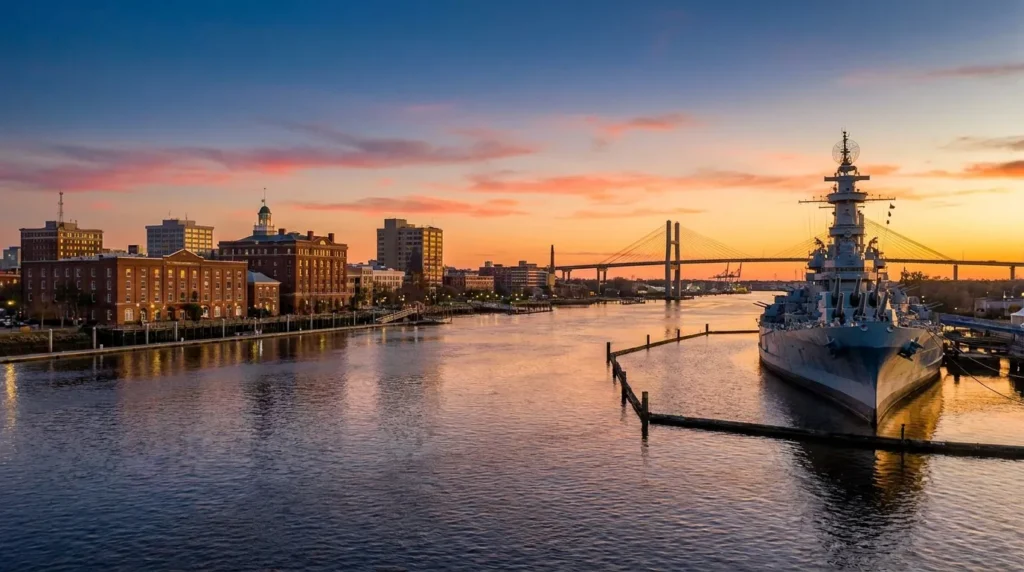
The Battleship USS North Carolina, anchored in the Cape Fear River, serves as a visitable naval museum. The Cape Fear Museum, the North Carolina Aquarium at Fort Fisher, and Airlie Gardens fill out the cultural and tourist calendar. Festivals such as the Azalea Festival in April draw tens of thousands of visitors. The dining scene is anchored by local seafood (shrimp, oysters, fish), Carolina-style barbecue, and a newer wave of chefs bringing contemporary cuisine to the area.

Wilmington

Wilmington, NC: historic port, film industry, and coastal beaches

Wilmington combines a historic downtown along the Cape Fear River, an active film production industry, and celebrated beaches like Wrightsville and Carolina Beach just minutes away.

Downtown Wilmington features the nearly 2-mile Riverwalk along the Cape Fear River, lined with restaurants, bars, and the historic Cotton Exchange. The USS North Carolina Battleship Memorial, moored in the river, is the city's most visited landmark. The Bellamy Mansion Museum and Burgwin-Wright House preserve 19th-century Southern architecture. The Cameron Art Museum maintains a collection focused on North Carolina art.

Thalian Hall, a historic theater dating to 1858, hosts the Thalian Association and the Opera House Theatre Company. The local film industry, known as Wilmywood, has produced series such as Dawson's Creek and One Tree Hill, with EUE/Screen Gems studios still in operation. The Cape Fear Museum of History and Science documents regional history. UNC Wilmington contributes a student community and the Cultural Arts Building.

The beaches are the city's main draw. Wrightsville Beach is a landmark destination for surfing, sailing, and waterfront dining. Carolina Beach and Kure Beach, to the south, offer a boardwalk and the Fort Fisher State Historic Site. Airlie Gardens features century-old live oaks and the Bottle Chapel created by artist Minnie Evans. Halyburton Park and Greenfield Lake Park are urban green spaces with trails and the well-known Greenfield Lake Amphitheater.

  1. 1["Battleship North Carolina"
  2. 2"Cape Fear Museum of History and Science"
  3. 3"Airlie Gardens"
  4. 4"Bellamy Mansion Museum"
  5. 5"Wrightsville Beach"
  6. 6"Cameron Art Museum"
Nightlife6.0 / 10
Parks & green spaces
  • ["Airlie Gardens"
  • "Greenfield Lake Park"
  • "Halyburton Park"
  • "Hugh MacRae Park"
  • "Carolina Beach State Park"
  • +1 more

Latest posts

Posts about North Carolina

Coverage and updates related to this destination.

Showing content from North Carolina, as there is no specific data for Wilmington yet.