Visto n' Visa
Blog
Notícias e artigos
Destinations
Careers
Immigrants

Want to live and work in Durham?

Personalized immigration plan with eligible visas, costs, and next steps for your goal!

If you are not eligible, you will know exactly why and what to do to improve your approval chances.

Save up to 12 hours in meetings

No pointless assessments.

Save up to 90%

Save money on vague or unfocused consultations

Avoid Fraud and Mistakes

One mistake can cost you your visa

Total Impartiality

Zero commercial bias

Decide with peace of mind

No toxic urgency

Fast and Accurate

Answers in minutes, no guesswork

A diverse city, with strong African American, Hispanic, and Asian composition

Approximately 289,000 residents. A significant mix of African Americans, non-Hispanic whites, Hispanics, and Asians. An international university community adds a cosmopolitan layer.

Durham has approximately 289,000 residents, with one of the most diverse demographic compositions in the American Southeast. African Americans, non-Hispanic whites, and Hispanics form the three main ethnic groups, with African Americans historically representing the largest share. Asians, particularly Indians and Chinese, have grown in number alongside the expansion of Research Triangle Park.

The Hispanic community is primarily Mexican, Salvadoran, and Cuban, concentrated along corridors such as Roxboro Road and Holloway Street. There is a small but present Brazilian community, spread between Durham and Cary, with Portuguese-language evangelical churches and some specialty markets. Duke University attracts students and researchers from around the world, adding a constant cosmopolitan layer.

The age profile is young, with averages influenced by the university population. The religious composition is diverse: Protestants (Baptist, Methodist, Presbyterian), Catholics, traditional African American churches (AME, AMEZ), Hindus, Muslims, and one of the largest Jewish communities in the Carolinas. Those with no declared religion are also a growing share, particularly among young professionals.

Languages spoken
  • English
  • Spanish
  • Hindi
  • Mandarin Chinese
  • Portuguese
  • +2 more
Main religions
  • Protestantism (Baptist, Methodist, Presbyterian)
  • Catholicism
  • African American churches (AME, AMEZ)
  • Hinduism
  • Islam
  • +2 more

Less expensive than Raleigh, but rising with the influx of skilled professionals

Durham's cost of living is above the national average, but below Raleigh and well below Boston or the Bay Area. Rent and home prices have risen over the past five years. Salaries in biotech offset the increase.

The cost of living in Durham is above the national average, but has remained somewhat below Raleigh and well below traditional technology and biotech hubs such as Boston, San Diego, or the Bay Area. This has attracted a significant influx of skilled professionals in recent years, particularly in biotechnology, healthcare, and computer science.

Housing costs have risen considerably since 2018. Neighborhoods close to downtown and Duke (Trinity Park, Old North Durham, Watts Hospital-Hillandale) have become substantially more expensive. In areas such as South Durham, Hope Valley, and more outlying neighborhoods, the price per square foot remains reasonable. Rent for a new apartment downtown is among the highest in the Triangle.

Groceries, restaurants, and services follow standard American averages, with a tendency to run above average due to the university clientele and well-paid professionals. Sales tax is around 7.5%. Electricity costs are noticeable in summer. North Carolina levies a flat-rate state income tax. A car is practically essential outside of downtown.

95Cost index (US = 100)5% below US average
CategorySingleCoupleFamily (2 + 2)
iHousing$1,233$1,423$1,802
iFood$361$721$1,309
iTransport$474$807$1,044
iHealthcare$266$531$996
iChildcare$1,727
iOther$807$1,451$2,039
Monthly total$3,141$4,933$8,917

Source: U.S. BLS Consumer Expenditure Survey 2023 + BEA Regional Price Parities 2023 · Estimates in USD, monthly.

Charming historic neighborhoods and strong downtown revitalization

Trinity Park, Watts Hospital-Hillandale, and Old North Durham feature historic homes. Hope Valley is the traditional upper-class neighborhood. New downtown buildings attract young professionals.

Durham's real estate market is dynamic, with historic homes in the center and urban expansion to the south and west. Those seeking charm and proximity to Duke will find that Trinity Park, Watts Hospital-Hillandale, and Old North Durham offer homes from the 1920s and 1940s, with front porches, mature trees, and walkable streets. Cleveland-Holloway is the neighborhood undergoing the fastest transition.

Hope Valley, to the south, is the traditional upper-class neighborhood, with spacious homes on large lots and a country club. South Durham offers newer and more affordable homes, close to RTP. Neighborhoods such as Brightleaf at the Park, Hope Valley Farms, and Woodcroft serve young families with children. Downtown, new buildings at the American Tobacco Campus and West Village attract young professionals.

Newly arrived immigrants typically start by renting in new apartment complexes downtown or near RTP, where entry is easier without a U.S. credit history. After a year or two of residency, purchasing becomes feasible, though competition in desirable neighborhoods is strong. Access to RTP via I-40 or NC-147 is a key factor in neighborhood selection.

Recommended neighborhoods
  • Trinity Park
  • Watts Hospital-Hillandale
  • Old North Durham
  • Hope Valley
  • American Tobacco Campus
  • +3 more

Biotech, pharmaceuticals, technology, and Duke dominate skilled employment

Duke University and Duke Health are the largest employers. Cisco, IBM, Lenovo, Cree, and dozens of biotech companies fill Research Triangle Park, at the city's edge.

Durham's labor market is one of the most sophisticated in the United States for a city of its size. Duke University and Duke University Health System together are the largest employer, with more than 40,000 employees. Physicians, researchers, nurses, technicians, professors, and administrators form a vast ecosystem centered on the campus.

Research Triangle Park (RTP), part of which lies in Durham and part in Raleigh and Morrisville, is the largest research park in the United States, with more than 300 companies and approximately 60,000 jobs. IBM, Cisco, Lenovo, Cree (Wolfspeed), Fidelity, GSK, Biogen, and dozens of other pharmaceutical and technology companies operate there. The biotech industry is particularly strong.

For skilled immigrants, Durham is one of the most active markets in the country for H-1B and L-1 visa sponsorship, particularly for scientists, engineers, and researchers. Professionals in biotech, IT, medicine, and academia find strong demand. For operational roles, construction, hospitality, restaurants, and cleaning services absorb significant labor, particularly within the Hispanic community.

Dominant sectors
  • Biotechnology and pharmaceuticals
  • Higher education
  • Healthcare
  • Information technology
  • Scientific research
  • +1 more
Major employers
  • Duke University
  • Duke University Health System
  • IBM
  • Cisco
  • Lenovo
  • +5 more

Duke University is the cornerstone, with North Carolina Central University alongside

Duke is one of the most prestigious universities in the United States. North Carolina Central University (HBCU) and Durham Technical Community College complement the higher education ecosystem.

Durham is, above all, the city of Duke University. Founded in 1838 and named in honor of the James B. Duke family (of tobacco), it is one of the most highly ranked research universities in the world, with strengths in medicine, law, business, engineering, and public policy. It enrolls approximately 17,000 students and offers competitive scholarships for international students.

North Carolina Central University (NCCU) is the city's other public university, an HBCU (historically Black college or university) with approximately 8,000 students, with strong programs in law, biomedical sciences, and computer science. For technical training, certificates, ESL, and affordable two-year degrees, Durham Technical Community College is a key resource for immigrants.

Public K-12 schools fall under Durham Public Schools, with quality varying by neighborhood. Charter schools (independent public schools), private schools such as Durham Academy and Carolina Friends School, and magnet schools with specific themes (arts, sciences, languages) are also available. The North Carolina School of Science and Mathematics, a residential public school, attracts top students from across the state.

Notable universities
  • Duke University
  • North Carolina Central University (NCCU)
  • Durham Technical Community College
  • North Carolina School of Science and Mathematics

Duke Health is one of the best medical networks in the United States

Duke University Hospital is a national reference in transplant, oncology, cardiology, and neuroscience. Duke Regional, Durham VA Medical Center, and community clinics complete the network.

Durham's healthcare system is exceptional for a city of its size. Duke University Hospital is consistently ranked among the best hospitals in the United States, serving as a national reference in organ transplantation, oncology (Duke Cancer Institute), cardiology, neurosurgery, and pediatric care. Patients travel from across the country and internationally for treatment.

The Duke Health network also includes Duke Regional Hospital, focused on community care, dozens of Duke Primary Care clinics throughout the region, and specialized centers. The Durham VA Health Care System serves American veterans. WakeMed Apex and UNC Hospitals (in Chapel Hill) are also accessible within a short drive.

For immigrants, health insurance is essential. Duke offers robust coverage for its employees. Large RTP companies also provide competitive benefits. Self-employed individuals purchase coverage through the Affordable Care Act marketplace. Community clinics such as Lincoln Community Health Center serve uninsured patients. Medical professionals speaking multiple languages are well represented within the Duke network.

Healthcare index75.0 / 100
  • Life expectancyyears at birth
    78.4yrs
  • Doctors per 1kpracticing physicians
    3.7
  • Health spendper capita, per year
    $13,473
  • Public systemoverall quality rating
    Good

Safety varies greatly by neighborhood, with residential areas generally very safe

Durham has a historical reputation as less safe than Raleigh or Cary, but the reality is highly localized. Neighborhoods such as Hope Valley, Trinity Park, and Woodcroft are considered very safe.

Durham has historically carried a reputation for being less safe than Raleigh or Cary, but the reality is considerably more nuanced and strongly dependent on the specific neighborhood. Violent crime rates have improved in recent years, though they remain somewhat above the average for cities of comparable size. Most crimes in residential neighborhoods involve theft from vehicles or minor package theft.

Neighborhoods such as Hope Valley, Trinity Park, Watts Hospital-Hillandale, Forest Hills, Woodcroft, and most of South Durham are considered very safe, with families out at night and children riding bikes in the neighborhood. Certain stretches of the east side and north-central areas have higher rates and warrant careful research before signing a lease.

Policing is handled by the Durham Police Department, with reasonable response times in residential areas. Standard precautions for a mid-sized American city apply: avoid leaving valuables visible in a parked car, lock doors securely, consider simple security cameras, and choose well-lit routes at night. Xenophobic incidents are rare, and the city has a reputation for being welcoming to immigrants, with several established support organizations.

5.8
Homicides per 100k
per year
Safety index
42.0
Crime index
58.0
Safer neighborhoods
  • Trinity Park
  • Forest Hills
  • Hope Valley
  • Watts-Hillandale
  • Duke Forest (residential)
  • Woodcroft
Areas to avoid
  • Stretches of East Main Street late at night
  • Parts of Fayetteville Street during isolated hours
  • Areas near NC-55 east at night

Car-dependent, with GoDurham, Amtrak, and RDU as complements

Durham is a car-oriented city, but is served by GoDurham bus service, GoTriangle connections to Raleigh and Chapel Hill, an Amtrak station, and RDU airport 20 minutes away. Traffic remains lighter than in comparable cities.

Durham is a car-oriented city, with traffic that remains manageable compared to Charlotte and Raleigh. The main routes are interstates I-85 (north-south), I-40 (east-west), I-540 (outer beltway, still expanding), and NC-147 (Durham Freeway), which cuts through the city and provides direct access to RTP. Peak-hour congestion has been increasing, but rarely exceeds 30 minutes for a typical commute.

Public transit is operated by GoDurham (buses within the city), with integration into GoTriangle, which connects Durham to Raleigh, Chapel Hill, Cary, and RTP. For those working along major corridors, transit is a viable option; for most other destinations, a car remains necessary. A long-discussed light rail project for the Triangle has yet to be completed. Cycling has grown, with bike lanes in some central neighborhoods.

Raleigh-Durham International Airport (RDU) is approximately 20 minutes from downtown Durham, with nonstop flights to London, Paris, Cancún, and numerous U.S. cities. Durham also has an Amtrak station, with the Carolinian and Piedmont lines connecting Charlotte, Greensboro, Raleigh, Washington, and New York.

23 min
Avg commute
38
Walkability
Airports
  • RDU — Raleigh-Durham International Airport
  • International airport
  • Bike infrastructure

What the Climate Is Like Living in Durham

Durham has a humid subtropical climate with long, hot, and muggy summers, short and mild winters, and four well-defined but moderate seasons.

Summers are long and humid, with highs between 86 and 91 degrees Fahrenheit (30 to 33 Celsius) from June through September, and nights that rarely drop below 72 F (22 C). Late-afternoon thunderstorms ease the heat but return moisture to the air.

Winters are short and mild, with highs between 52 and 57 F (11 to 14 C) and lows near freezing. Snowfall occurs in small amounts some years, and morning frost is more common.

Residents rely on strong air conditioning, keep an umbrella on hand, and need only a limited winter wardrobe. Spring blooms and golden autumn are the seasons most appreciated by locals.

Sunny days / year215 days
Avg high (°F)
  • 69°J
  • 73°F
  • 79°M
  • 84°A
  • 91°M
  • 94°J
  • 100°J
  • 98°A
  • 97°S
  • 88°O
  • 79°N
  • 70°D
Avg low (°F)
  • 21°J
  • 22°F
  • 24°M
  • 31°A
  • 42°M
  • 53°J
  • 63°J
  • 61°A
  • 50°S
  • 39°O
  • 24°N
  • 21°D
Rainfall (")
  • 4"J
  • 4"F
  • 3"M
  • 4"A
  • 3"M
  • 5"J
  • 5"J
  • 5"A
  • 4"S
  • 3"O
  • 4"N
  • 4"D

A city recognized for its dining scene, Duke basketball, and the arts

Durham consistently appears on national lists of the best small cities for food. Duke sports anchor the calendar. The American Tobacco Campus, Carolina Theatre, and DPAC are the cultural hubs.

Durham has a national reputation as one of the best small cities in the United States for dining. Restaurants such as Mateo, Mother & Sons, Pizzeria Toro, M Sushi, and Nana's, along with the legendary Magnolia Grill (now closed, but a foundational influence), placed the city on the culinary map. Ninth Street and the American Tobacco Campus concentrate strong options, with Mexican, Indian, Vietnamese, Italian, contemporary Southern, and Brazilian cuisines all represented.

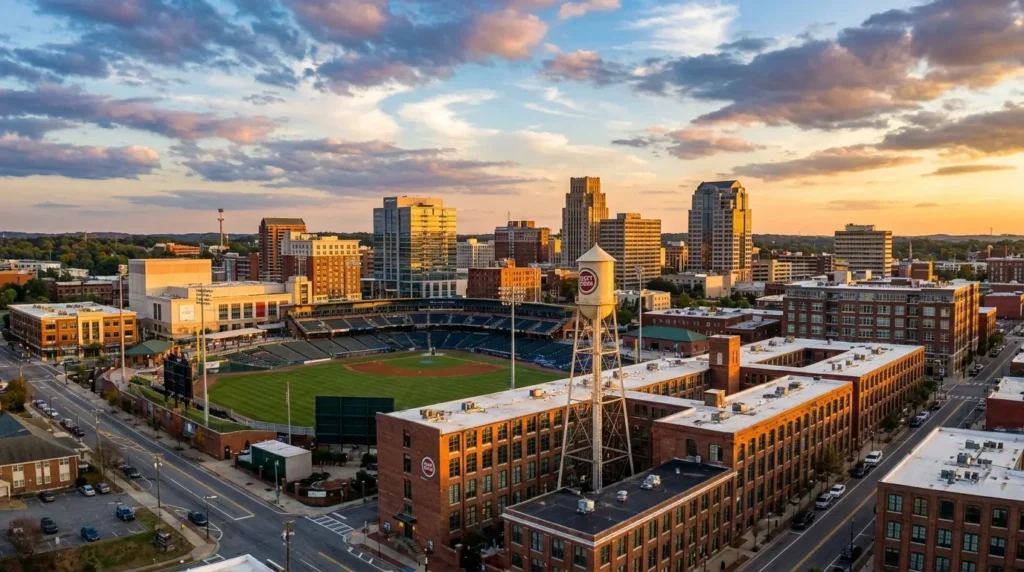
The sports calendar is anchored by Duke men's basketball (the Cameron Crazies, with games at Cameron Indoor Stadium offering a singular experience), and by North Carolina Central University basketball. The Durham Bulls (AAA baseball, affiliated with the Tampa Bay Rays) play at Durham Bulls Athletic Park in the heart of downtown. Games have become an accessible family tradition.

The cultural scene includes the Durham Performing Arts Center (DPAC), one of the busiest theaters in the Southeast, hosting Broadway shows, comedians, and concerts. The restored Carolina Theatre is home to the Full Frame Documentary Film Festival each year. The Nasher Museum of Art at Duke, the 21c Museum Hotel, and galleries in the Brightleaf District round out the offerings.

Durham

Durham, Duke University, American Tobacco Campus, and the Food Scene

A North Carolina city in the Research Triangle, home to Duke University, with former tobacco factories converted into creative districts, an active cultural scene, and neighboring communities including Chapel Hill and Raleigh.

Durham sits in the Research Triangle in central North Carolina, alongside Raleigh and Chapel Hill. The city grew in the 19th century around the Duke family's tobacco industry, followed by railroads. The American Tobacco Campus, a former factory now repurposed, operates today as a mixed-use district with offices, restaurants, Durham Bulls Athletic Park, and the Durham Performing Arts Center. Neighborhoods such as Old North Durham, Trinity Park, and Brightleaf anchor the city's historic life.

Duke University occupies two main campuses, West and East. The Sarah P. Duke Gardens, the Nasher Museum of Art, and the Gothic-style Duke Chapel are central landmarks. The Duke Lemur Center, the only university sanctuary for strepsirrhine primates outside Madagascar, offers guided tours. North Carolina Central University, a historically Black institution, is also in Durham and adds further depth to the academic scene.

Durham's food scene ranks among the strongest in the South. Restaurants such as Mateo, Mother and Sons, Pizzeria Toro, and M Sushi have earned national recognition. The Durham Farmers' Market on Foster Street and Eno River State Park along the Eno River round out the weekly routine. The DPAC and the Carolina Theatre anchor arts and live music programming.

  1. 1["Duke University Campus and Duke Chapel"
  2. 2"Sarah P. Duke Gardens"
  3. 3"Nasher Museum of Art"
  4. 4"Museum of Life and Science"
  5. 5"American Tobacco Historic District"
  6. 6"Durham Performing Arts Center (DPAC)"
Nightlife6.0 / 10
Parks & green spaces
  • ["Sarah P. Duke Gardens"
  • "Eno River State Park"
  • "American Tobacco Trail"
  • "Duke Forest"
  • "West Point on the Eno"
  • +1 more

Latest posts

Posts about North Carolina

Coverage and updates related to this destination.

Showing content from North Carolina, as there is no specific data for Durham yet.