Visto n' Visa
Blog
Notícias e artigos
Destinations
Careers
Immigrants

Want to live and work in Arizona?

Personalized immigration plan with eligible visas, costs, and next steps for your goal!

If you are not eligible, you will know exactly why and what to do to improve your approval chances.

Save up to 12 hours in meetings

No pointless assessments.

Save up to 90%

Save money on vague or unfocused consultations

Avoid Fraud and Mistakes

One mistake can cost you your visa

Total Impartiality

Zero commercial bias

Decide with peace of mind

No toxic urgency

Fast and Accurate

Answers in minutes, no guesswork

All about Arizona

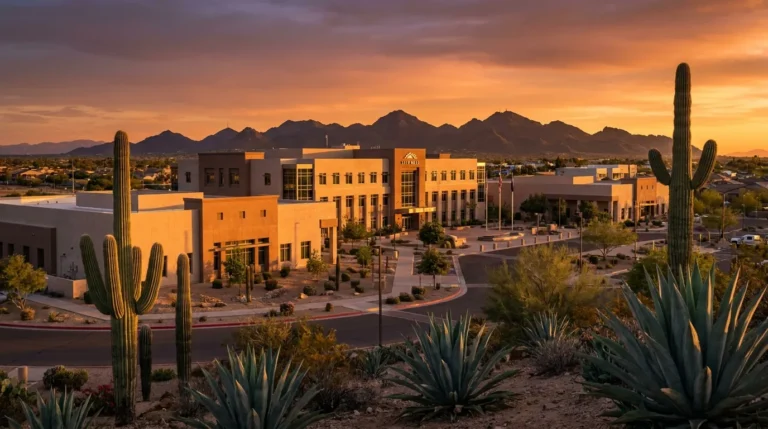
Sun, desert, and opportunity. Rapid growth and a strong Hispanic influence.

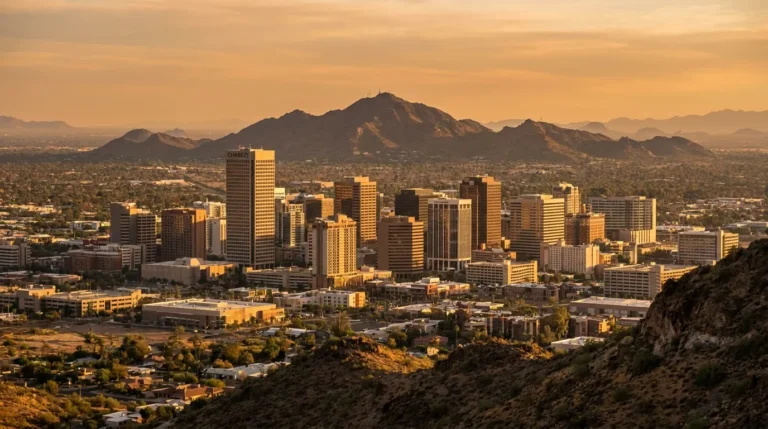
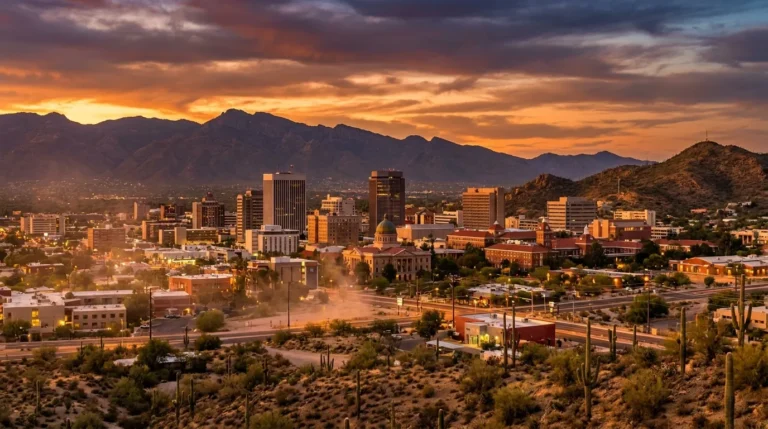
Arizona is located in the southwestern US, bordering Mexico. The main cities are Phoenix (the largest, state capital, and the country's fifth-biggest urban center), Tucson (the second city, more affordable and university-oriented), Mesa, Scottsdale, Tempe, and Flagstaff (in the north, with a mountain climate).

It is a fast-growing state. People move to Phoenix from California, New York, and Chicago in search of a lower cost of living, larger homes, and warm weather. The economy has diversified: technology, semiconductors (Intel, TSMC), tourism, aerospace, and healthcare drive employment.

The Hispanic presence is strong, especially Mexican, rooted in centuries of history. Food, music, festivals, and the local way of life reflect this blend. For immigrants, Arizona offers a balance of reasonable costs, predictable climate (despite extreme summer heat), and proximity to California, Mexico, and the Grand Canyon.

Population
7,359,197
Average monthly salary
58,500 USD/mo
33.7298°, -111.4312°

Featured places

Top 10 places in Arizona

The places most sought-after by immigrants in this region.

Arizona's demographics: white and Hispanic populations share the state

Nearly one-third of the population is Hispanic, mostly of Mexican descent. Large Native American communities also live on reservations.

Arizona has one of the highest proportions of Hispanic residents of any US state, a legacy of the region's Mexican history (Arizona was part of Mexico until 1848). Non-Hispanic whites are the majority, but Latin presence is strong in neighborhoods, schools, commerce, and festivals.

The state also has large Native nations. The Navajo Nation is the largest in the US and stretches across northeastern Arizona (and into New Mexico and Utah). There are also the Hopi, Apache, Tohono O'odham, and Pima. Some reservations operate casinos, cultural centers, and their own enterprises.

Brazilians are few, concentrated in Phoenix and Scottsdale, linked to technology companies, medicine, and university studies. Asian communities (Vietnamese, Chinese, Indian) are growing in Phoenix and Mesa. Spanish is the second most spoken language in the state, present in schools and public services.

7,359,197
Population
39 yrs
Median age
25/km²
Density
$72,580
Median income
per year
Urban population89.0%
Foreign-born13.4%
Languages spoken
  • English
  • Spanish
  • Navajo (on the reservation)
  • Vietnamese
  • Mandarin Chinese
  • +1 more
Main religions
  • Christian (Catholic, Mormon, evangelical)
  • Catholic (among Hispanics)
  • Mormon (LDS, mainly in Mesa)
  • No religion
  • Native spiritual traditions

Cost of living in Arizona: moderate, cheaper than California, with high electricity bills in summer

Reasonable rent and food. The electricity bill spikes in summer because of air conditioning. No costly heating needed.

In Phoenix, a one-bedroom apartment rents for between $1,300 and $1,800/month in average neighborhoods. Scottsdale is more expensive ($1,700 to $2,500). Tucson is one of the most affordable options ($900 to $1,300). Smaller cities in the state have even lower rents.

Supermarkets like Fry's, Safeway, and WinCo are competitive on price, and there is a lot of locally grown produce. A meal at a casual restaurant costs $12 to $20. The big typical Arizona expense is the electric bill in summer. Keeping air conditioning on from June to September can cost $250 to $500/month in an average home.

The state income tax is low (2.5% flat). No tax on basic groceries purchased at supermarkets. Gas is cheaper than in California. Overall, it is a state where a middle-class salary goes a long way.

100Cost index (US = 100)same as US average
CategorySingleCoupleFamily (2 + 2)
iHousing$1,304$1,505$1,906
iFood$381$762$1,384
iTransport$502$853$1,103
iHealthcare$281$562$1,053
iChildcare$1,825
iOther$853$1,535$2,156
Monthly total$3,321$5,217$9,427

Source: U.S. BLS Consumer Expenditure Survey 2023 + BEA Regional Price Parities 2023 · Estimates in USD, monthly.

Housing in Arizona: modern homes in developments, tile roofs, and pools

A rising market with lots of new construction on the outskirts of cities. Homes with pools are standard, and HOA-managed planned communities are common.

Phoenix and its surroundings have grown explosively. There are many new developments with single-story (ranch-style) or two-story homes, typically with a small backyard, pool, and tile roof. Buying a home in Phoenix costs around $400,000 to $600,000 in decent neighborhoods; in Scottsdale, that rises to $700,000 to $1.5 million. Tucson has more affordable homes, in the $280,000 to $450,000 range.

For renting, standard American requirements apply: proof of income, credit history, and references. Those who arrive without a credit score can offer 2 or 3 months upfront or get a cosigner. Many properties have an HOA (homeowners association fee) covering common areas, street landscaping, and sometimes a shared pool.

Recommended neighborhoods in Phoenix: Ahwatukee, Chandler, Gilbert, Tempe (near ASU), Scottsdale. In Tucson, Oro Valley and Catalina Foothills are highly rated. For those who prefer mild weather, Flagstaff and Sedona are cooler and pricier options in the north of the state.

Purchase price (m²)
  • Center$3,200/m²
  • Outside$2,100/m²
5.3×
Price-to-income
7.0%
Mortgage rate (20y)
Recommended neighborhoods
  • Chandler (Phoenix, top schools)
  • Gilbert (Phoenix, families)
  • Tempe (near ASU)
  • Scottsdale (luxury and tourism)
  • Ahwatukee (south Phoenix)
  • +3 more

Job market in Arizona: semiconductors, aerospace, healthcare, and tourism

Phoenix has become a semiconductor hub with Intel, TSMC, and their suppliers. Healthcare, finance, aerospace, and winter tourism also drive the economy.

Arizona is experiencing an advanced manufacturing boom. TSMC, the Taiwanese chip giant, built a factory in Phoenix with a multi-billion-dollar investment. Intel maintains a large operation in Chandler. Together with suppliers and equipment companies, these investments have created thousands of jobs in engineering, factory operations, and construction.

The aerospace sector is traditional, with Raytheon (Tucson), Honeywell Aerospace (Phoenix), and strong military bases. Healthcare is growing with Mayo Clinic (Scottsdale), Banner Health, and Dignity Health, all major employers. There is also a strong presence of financial companies (American Express, Discover, USAA).

Tourism is enormous, especially in winter, when retirees and tourists from cold states temporarily relocate to Phoenix and Scottsdale. Resorts, golf, and spas generate seasonal jobs. Agriculture in the south of the state (cotton, lettuce, cattle) employs many immigrants. Technology salaries average $90,000 to $130,000 per year.

$58,500
Avg net salary
per month
$30,264
Minimum wage
per month
3.5%
Unemployment
61.2%
Labor force
Dominant sectors
  • Semiconductors and electronics
  • Aerospace and defense
  • Healthcare
  • Tourism and hospitality
  • Financial services
  • +3 more
Major employers
  • Intel (Chandler)
  • TSMC (Phoenix)
  • Honeywell Aerospace (Phoenix)
  • Raytheon (Tucson)
  • Mayo Clinic (Scottsdale)
  • +5 more

Education in Arizona: variable public schools, prestigious public universities

Free public schooling, best in suburban districts. ASU in Tempe is one of the best-known public universities in the US.

Children are entitled to free public school. School quality varies widely: districts like Chandler, Gilbert, Scottsdale, and Catalina Foothills (Tucson) receive high ratings. Arizona also has a strong charter school system (publicly funded but independently managed) that many families prefer.

The University of Arizona (UA) in Tucson is strong in astronomy, space science, anthropology, and medicine. Arizona State University (ASU) in Tempe is one of the largest US universities by enrollment, known for innovation, journalism, business, and engineering. Northern Arizona University (NAU) in Flagstaff is smaller and more focused on education and health.

In-state tuition at public universities runs around $12,000 to $14,000 per year. International students pay more. ASU has robust online programs that accept students from anywhere. For children, schools in good neighborhoods often include Spanish as part of the curriculum.

Literacy96.0%
Tertiary education31.5%
478
PISA score (avg)
$11,500
Private school
per year
Notable universities
  • Arizona State University (ASU, Tempe)
  • University of Arizona (UA, Tucson)
  • Northern Arizona University (Flagstaff)
  • Embry-Riddle Aeronautical University (Prescott)
  • Grand Canyon University (Phoenix, private)
  • Arizona College (multiple campuses)

Healthcare in Arizona: recognized hospitals, with Mayo Clinic in Scottsdale

Phoenix and Scottsdale have high-quality hospitals. Rural areas and Native American reservations face access difficulties.

Arizona has top-tier hospitals. Mayo Clinic in Scottsdale is one of the most respected medical centers in the US. Banner Health, HonorHealth, and Dignity Health operate large networks in Phoenix and Tucson. The University of Arizona Medical Center is a reference for transplants and research.

Those with formal employment receive a plan through their employer. For low-income residents, there is AHCCCS, Arizona's version of Medicaid, with broad coverage for children and families. Documented immigrants gain access after a waiting period. There are also many plans on Healthcare.gov with subsidies.

In rural areas and on reservations, access is more limited. Indian Health Service serves Native communities but with wait times. Community clinics (FQHCs) serve patients regardless of documentation on a sliding fee scale. Without insurance, an ER visit can cost $1,500 to $5,000. Urgent care ($100-200) is an alternative for non-emergency cases.

Healthcare index65.0 / 100
  • Life expectancyyears at birth
    76.3yrs
  • Doctors per 1kpracticing physicians
    2.5
  • Health spendper capita, per year
    $8,900
  • Public systemoverall quality rating
    Fair

Safety in Arizona: suburban neighborhoods are safe, urban centers have more incidents

Chandler, Gilbert, and Scottsdale rank among the safest cities in the US. Central Phoenix neighborhoods and border areas have higher rates.

Arizona has very uneven safety. Cities like Gilbert, Chandler, Scottsdale, and Oro Valley regularly rank among the safest in the US, with crime rates below the national average. Planned suburbs with strong HOAs and easy police access are sought out by families.

In central Phoenix, especially neighborhoods near downtown and the south side of the city, rates of theft, car theft, and drug sales are higher. Tucson has problem areas near the center and to the south. Near the Mexican border, cartel activity concentrates in some areas, though cities like Nogales are generally safe for residents.

For immigrants, standard advice applies: live in a neighborhood with good schools (usually a sign of safety), lock your car and keep nothing visible, and take care on desert trails on very hot days. Extreme heat is a real risk, with annual deaths from dehydration and heat exposure.

7.5
Homicides per 100k
per year
Safety index
48.0
Crime index
52.0
Safer neighborhoods
  • Gilbert
  • Chandler
  • Scottsdale
  • Oro Valley (Tucson)
  • Ahwatukee (south Phoenix)
  • Goodyear
  • Queen Creek
  • Flagstaff
Areas to avoid
  • South Phoenix (Maryvale)
  • South Tucson
  • Yuma outskirts
  • Apache Junction isolated areas

Transportation in Arizona: a car is essential, with some light rail in Phoenix

Phoenix has the Valley Metro light rail, but most people depend on cars. Distances between cities are large. Phoenix's airport is one of the biggest in the West.

Arizona is a car state. Phoenix has a light rail (Valley Metro Rail) connecting downtown to Tempe and Mesa, useful for ASU students and downtown workers, but the network is short. Most people drive every day. Tucson has buses (Sun Tran) and a short streetcar, but also depends on cars.

Distances within the state are large. Phoenix to Tucson is 2 hours; Phoenix to Flagstaff is about 2.5 hours. Interstates I-10 (east-west) and I-17 (north-south) are the main corridors. Phoenix rush-hour traffic is heavy but nothing compared to Los Angeles or Atlanta.

Phoenix Sky Harbor International Airport (PHX) is one of the largest in the western US, with direct flights to Europe, Latin America, and dozens of US cities. Tucson (TUS) handles regional flights. Uber and Lyft are ubiquitous in the large cities. Biking is manageable in cooler months.

1
Metro lines
35
Metro stations
26 min
Avg commute
41
Walkability
Airports
  • PHX (Phoenix Sky Harbor International)
  • TUS (Tucson International)
  • AZA (Phoenix-Mesa Gateway)
  • FLG (Flagstaff Pulliam)
  • PRC (Prescott Regional)
  • International airport
  • Bike infrastructure

Arizona's climate: hot desert in the south, high altitude in the north with snow

Phoenix and Tucson have scorching summers (100°F+) and mild winters. Flagstaff, to the north, has snowy winters. Little rain all year.

Arizona is climatically divided. In the south (Phoenix, Tucson, Yuma), the climate is desert (Koppen BWh): very hot summers with highs frequently above 40°C and warm nights, and mild winters with highs around 18-22°C. There is almost no rain from October to July, except for the monsoon between July and September, which brings strong, short storms.

In the center and north, elevation changes everything. Flagstaff, at 2,100 meters, has cold, snowy winters with lows below zero and plenty of snow. Summers are cool and pleasant. Sedona, at 1,300 meters, has an intermediate climate. Many Phoenix residents have a summer home in Flagstaff or Prescott to escape the heat.

Extreme summer heat is a serious concern. There can be days with 45°C or more. Staying hydrated, having functioning air conditioning, and being careful with children, the elderly, and animals in cars are essential. Hiking in the desert at midday in July can be fatal. On the other hand, Phoenix winters are among the most pleasant in the US, attracting tourists from cold states.

Sunny days / year286 days
Avg high (°F)
  • 68°J
  • 71°F
  • 78°M
  • 85°A
  • 94°M
  • 104°J
  • 107°J
  • 105°A
  • 100°S
  • 89°O
  • 76°N
  • 66°D
Avg low (°F)
  • 46°J
  • 49°F
  • 55°M
  • 61°A
  • 69°M
  • 79°J
  • 85°J
  • 84°A
  • 78°S
  • 66°O
  • 54°N
  • 45°D
Rainfall (")
  • 1"J
  • 1"F
  • 1"M
  • 0"A
  • 0"M
  • 0"J
  • 1"J
  • 1"A
  • 1"S
  • 1"O
  • 1"N
  • 1"D

Arizona's culture: a blend of cowboy, Mexican, Native American, and modern

Latino festivals, rodeos, Native art, golf, and Mexican-American cuisine define the state. The Grand Canyon and Sedona attract visitors from around the world.

Arizona's culture has several layers. The Hispanic heritage is strong: food (tacos, Sonoran-style burritos, chimichangas invented in Tucson), festivals (Cinco de Mayo, Dia de los Muertos), and colonial mission architecture are everywhere. Mexican-American culture shapes daily life.

Native American culture is alive, especially in the Navajo Nation, on the Hopi mesas, and in the Tohono O'odham Nation. There are craft markets, festivals with traditional dances, and museums like the Heard Museum in Phoenix. Old West cowboy culture still exists at annual rodeos (Tucson Rodeo, Prescott Frontier Days).

Natural tourism is enormous. The Grand Canyon in the north draws millions of visitors per year. Sedona, with its red rock formations, attracts spiritual retreats and photography. Antelope Canyon, Monument Valley, and Saguaro National Park are other highlights. For residents, there is nightlife in Scottsdale, sporting events (Diamondbacks in baseball, Cardinals in football, Suns in basketball), and year-round festivals.

200
Major museums
Notable dishes
  • Sonoran hot dog (a Tucson Mexican-style hot dog)
  • Chimichanga (fried burrito, invented in Tucson)
  • Carne asada tacos
  • Frybread (Native American fried bread)
  • Mesquite-grilled BBQ
  • +3 more
Annual events
  • Tucson Rodeo (February)
  • Phoenix Open (golf, February)
  • Baseball Spring Training (Cactus League, February and March)
  • Arizona State Fair (Phoenix, October and November)
  • Sedona International Film Festival (February and March)
  • +2 more
UNESCO sites
  • Grand Canyon National Park

Arizona's main economic sectors

Semiconductors, aerospace, tourism, healthcare, and construction sustain the economy. Copper mining and agriculture in the south are also relevant.

Semiconductors and electronics have become the state's flagship. TSMC invested over $40 billion in its Phoenix factory, and Intel expanded operations in Chandler. This cluster creates jobs for engineers, technicians, and factory operators, and has attracted dozens of suppliers.

Aerospace and defense are traditional. Raytheon in Tucson, Honeywell in Phoenix, Lockheed Martin, and Boeing have operations in the state. Military bases (Luke Air Force Base, Davis-Monthan, Yuma Marine Corps) inject billions into the local economy. The healthcare industry is also strong, driven by Mayo Clinic, Banner, and HonorHealth.

Tourism generates billions. The Grand Canyon, Sedona, Scottsdale, and golf courses draw visitors year-round. Copper mining makes Arizona the largest US producer. Agriculture in the south (lettuce, cotton, cattle) supplies the country, especially in winter. Construction continues to grow, with Phoenix constantly expanding.

  • GDPgross domestic product
    $489.0B
  • GDP per capitaoutput per resident
    $66,400
  • GDP growth (yr)economy expanding
    +3.2%
Top sectors
  • Semiconductors and electronics
  • Aerospace and defense
  • Healthcare and biomedicine
  • Tourism and hospitality
  • Copper mining
  • +3 more

Immigrant communities in Arizona

Around 900,000 immigrants live in Arizona, with deep Mexican roots in Phoenix and Tucson and a fast-growing Indian and refugee presence in metro Phoenix.

Arizona is home to roughly 900,000 foreign-born residents, a little over 12% of the state population. The Mexican community is by far the largest and oldest, shaped by generations of border life and farm work, and anchors neighborhoods like Maryvale and South Phoenix in the capital and the South Side of Tucson. Other Latin American groups, including Guatemalans, Salvadorans and Hondurans, cluster in the same corridors and rely on Spanish-language Catholic and evangelical parishes. Outside that core, Phoenix has a rapidly growing Indian community in Chandler and Gilbert, tied to the semiconductor and tech industries, plus smaller Filipino and Vietnamese populations. The metro also resettles refugee families from Afghanistan, Syria, the Democratic Republic of Congo and Myanmar, spread across Alhambra, Glendale and west Phoenix.

The support network is dense along the Phoenix-Tucson axis. The Consulate-General of Mexico in Phoenix is one of the busiest in the United States, and Tucson and Nogales each host their own Mexican consulate; Phoenix also hosts consulates of Guatemala, El Salvador, Honduras and Canada. Nonprofits such as Promise Arizona, the Florence Immigrant & Refugee Rights Project, Refugee Focus and the International Rescue Committee Phoenix office provide free legal advice, deportation defense, English classes and reception services for families released from the border. State universities run immigration law clinics, and there is a thick layer of bilingual parishes, Hindu temples in Chandler and mosques in Tempe and Tucson.

900,000
Foreign-born residents
estimated
Top countries of origin
  • Mexico
  • India
  • Philippines
  • China
  • Vietnam
Main immigrant hubs
  • Phoenix
  • Tucson
  • Mesa
  • Chandler
  • Glendale
  • Gilbert
Foreign consulates
  • Mexican Consulate General in Phoenix
  • Mexican Consulate in Tucson
  • Mexican Consulate in Nogales
  • Guatemalan Consulate General in Phoenix
  • El Salvador Consulate in Phoenix
Community organizations
  • Promise Arizona
  • Florence Immigrant & Refugee Rights Project
  • Refugee Focus
  • International Rescue Committee Phoenix

Latest posts

Posts about Arizona

Coverage and updates related to this destination.