Visto n' Visa
Blog
Notícias e artigos
Destinations
Careers
Immigrants

Want to live and work in Tucson?

Personalized immigration plan with eligible visas, costs, and next steps for your goal!

If you are not eligible, you will know exactly why and what to do to improve your approval chances.

Save up to 12 hours in meetings

No pointless assessments.

Save up to 90%

Save money on vague or unfocused consultations

Avoid Fraud and Mistakes

One mistake can cost you your visa

Total Impartiality

Zero commercial bias

Decide with peace of mind

No toxic urgency

Fast and Accurate

Answers in minutes, no guesswork

Tucson population: majority non-white, with a strong Mexican and Native American presence

About 44% of the population is Hispanic, predominantly of Mexican origin. The Tohono O'odham and Pascua Yaqui Native nations have a significant presence.

Tucson is a border city in a cultural sense. Around 44% of residents are Hispanic, with deep Mexican roots spanning multiple generations. Spanish coexists with English in daily life, on radio stations, in markets, and at community celebrations. Neighborhoods such as South Tucson (an incorporated municipality within the city limits) and Barrio Viejo concentrate more traditional Mexican culture.

There is a notable Native American population. The Tohono O'odham and Pascua Yaqui nations have reservations nearby, and their cultural influence is visible in markets, museums, and events. Non-Hispanic white residents make up roughly 45% of the population, with smaller African American, Asian (Vietnamese, Chinese), and Middle Eastern communities.

The university presence keeps the city's median age lower than elsewhere in Arizona. An active LGBTQ+ community is centered around Fourth Avenue and the Sam Hughes neighborhood. The Brazilian community is small, connected mainly to students and researchers at the University of Arizona.

Languages spoken
  • English
  • Spanish (strong Mexican heritage)
  • Tohono O'odham
  • Yaqui
  • Vietnamese
  • +3 more
Main religions
  • Christian (Catholic, predominant among Latinos)
  • Christian (Protestant and Evangelical)
  • No religion
  • Jewish
  • Indigenous traditions
  • +1 more

Cost of living in Tucson: cheaper than Phoenix and far cheaper than California

Rent remains accessible by American standards, restaurants are affordable, but summer electricity bills are significant due to air conditioning demands.

Tucson is one of the most affordable large cities in the American West. A one-bedroom apartment near the University of Arizona or in central neighborhoods such as Sam Hughes or El Encanto runs between USD 1,000 and USD 1,400 per month. In outlying areas like Marana or Vail, three-bedroom houses range from USD 1,600 to USD 2,200.

Grocery shopping at chains such as Fry's, Safeway, Walmart, and Sprouts is reasonable. For lower prices, Food City and Ranch Market serve the Latino community. A meal at a popular Mexican restaurant (BK Tacos, El Charro, Mi Nidito) runs between USD 12 and USD 18 per person. Beers at a local bar cost USD 5 to USD 8.

The summer electricity bill is the main pain point. From June through September, air conditioning runs all day, and the Tucson Electric Power bill can reach USD 250 to USD 300. Gas prices are lower than in California, car insurance ranks among the lowest in the country, and Arizona has a relatively low state income tax.

92Cost index (US = 100)8% below US average
CategorySingleCoupleFamily (2 + 2)
iHousing$1,200$1,385$1,754
iFood$351$701$1,273
iTransport$462$785$1,015
iHealthcare$259$517$969
iChildcare$1,679
iOther$785$1,412$1,984
Monthly total$3,057$4,800$8,674

Source: U.S. BLS Consumer Expenditure Survey 2023 + BEA Regional Price Parities 2023 · Estimates in USD, monthly.

Housing in Tucson: adobe neighborhoods, historic districts, and newer suburbs

The city blends older adobe neighborhoods with expanding subdivisions on its outskirts. Those looking for lower prices head to areas such as Marana and Vail.

Traditional Tucson architecture is adobe, with thick walls designed to withstand the heat. Barrio Viejo, Armory Park, and Sam Hughes preserve that character. Neighborhoods such as El Encanto and Catalina Foothills feature larger homes with views of the Santa Catalina Mountains. Downtown is low-rise and largely horizontal.

For young families, growing suburbs such as Marana (north), Oro Valley, Vail (southeast), and Sahuarita (south) offer new homes in planned communities with well-regarded schools and lower prices than Phoenix. University of Arizona students cluster near campus in the West University and Fourth Avenue areas, in older buildings with per-room rental arrangements.

Landlords typically require proof of income, a credit check, and a deposit of roughly one month's rent. Without a U.S. credit history, paying several months upfront or securing a co-signer is common. Popular platforms include Zillow, Apartments.com, Trulia, and Facebook Marketplace. Rentals generally include a refrigerator and stove but are otherwise unfurnished.

Recommended neighborhoods
  • Sam Hughes (near UA, charm, older homes)
  • Catalina Foothills (upscale, mountain views)
  • Oro Valley (family suburb, golf)
  • Marana (new homes, better prices)
  • Vail (southeast, well-rated schools)
  • +2 more

Tucson job market: university, defense, mining, and optics

The University of Arizona, Davis-Monthan Air Force Base, Raytheon, and a specialized optics industry are the main employers. Salaries are lower than in Phoenix.

The University of Arizona is the city's largest employer, with thousands of faculty, researchers, and staff. The institution has particular strength in astronomy, earth sciences, optics, medicine, and arid agriculture. Davis-Monthan Air Force Base, on the east side, employs both military personnel and civilians and is home to the famous Boneyard, a storage facility for retired military aircraft.

Tucson is a global hub for optics and photonics. Companies such as Edmund Optics and II-VI, along with dozens of specialized small and medium-sized firms, have grown out of the university's research ecosystem. Raytheon Missiles and Defense is the largest private employer, with approximately 13,000 workers in the southern part of the city producing missiles and defense systems.

The region also supports copper mining at nearby operations run by Asarco and Freeport-McMoRan. Healthcare employs a large workforce at Banner University Medical Center and Tucson Medical Center. Engineering salaries range from USD 70,000 to USD 130,000, below Phoenix levels. The state minimum wage was approximately USD 14.35 per hour as of 2024.

Dominant sectors
  • Higher education and research
  • Defense and aerospace
  • Optics and photonics
  • Healthcare
  • Copper mining
  • +2 more
Major employers
  • University of Arizona
  • Raytheon Missiles & Defense
  • Davis-Monthan Air Force Base
  • Banner University Medical Center
  • Tucson Medical Center
  • +3 more

Education in Tucson: a strong research university and varied school districts

The University of Arizona holds R1 (very high research activity) status. Public school quality varies by district, with strong charter schools and magnet programs available.

The University of Arizona (UA) is a top-tier public research university with around 50,000 students. It has particular strength in astronomy (managing telescopes at Mount Lemmon and Kitt Peak), optics, medicine, arid agriculture, and earth sciences. Undergraduate tuition for international students is approximately USD 40,000 per year.

For primary and secondary education, the city is served by several districts. Tucson Unified School District (TUSD) is the largest, with variable quality across schools. Catalina Foothills, Vail, and Marana districts consistently rank among the best. BASIS Tucson (charter) has a strong academic reputation. University High School is a high-performing magnet program within TUSD.

Pima Community College serves as a bridge to the university, offering technical training and English-language courses. Northern Arizona University also operates a Tucson campus for specific programs. International students require an F-1 study visa and may pursue internships through CPT/OPT after graduation. The UA Center for English as a Second Language is a regional reference point.

Notable universities
  • University of Arizona (UA)
  • Pima Community College
  • Northern Arizona University (Tucson campus)
  • Brookline College
  • Pima Medical Institute
  • Carrington College (Tucson)

Healthcare in Tucson: a strong university hospital and a distributed private network

Banner University Medical Center serves as the UA teaching hospital. Tucson Medical Center and Carondelet round out the offerings. Standard American model applies.

Tucson has a solid hospital network for a city of its size. Banner University Medical Center is a teaching hospital affiliated with the University of Arizona, serving as a regional reference for trauma, transplant, and oncology. Tucson Medical Center (TMC), on the east side, is a well-established private hospital with a strong emergency department. Carondelet Health Network operates St. Joseph's and St. Mary's.

For pediatric care, Banner Children's at Diamond Children's Medical Center is the main facility. Walk-in clinics (NextCare, FastMed, BannerHealth Urgent Care) are available throughout the city for minor issues. Telemedicine has expanded considerably. For lower-income residents, community health centers such as El Rio Health accept uninsured patients on an income-based sliding scale.

As elsewhere in the United States, the system relies on private insurance, typically provided through an employer. An uninsured emergency room visit costs at least USD 1,500. Lower-income residents may qualify for AHCCCS, Arizona's Medicaid program. Prescription discount programs such as GoodRx help reduce costs at CVS, Walgreens, and Walmart pharmacies.

Healthcare index60.0 / 100
  • Life expectancyyears at birth
    78.4yrs
  • Doctors per 1kpracticing physicians
    3.7
  • Health spendper capita, per year
    $13,473
  • Public systemoverall quality rating
    Fair

Safety in Tucson: a mid-sized city with above-average crime rates

Neighborhoods such as Catalina Foothills and Oro Valley are considered safe. The south and west sides have higher rates of theft and robbery. Vehicle theft warrants attention.

Tucson's crime rate is somewhat above the national average, primarily in property crime and vehicle theft. Catalina Foothills, Oro Valley, and Vail are considered very safe. Sam Hughes and neighborhoods near the university are generally calm day-to-day, with ordinary caution advised at night given the student activity.

Parts of the south and west sides, including areas of South Tucson and neighborhoods near I-10 and I-19, have higher rates of theft and drug-related activity. Catalytic converter theft from SUVs has increased in recent years. Residential break-ins tend to occur when homes are left vacant; Ring cameras and alarm systems are common precautions.

Law enforcement is provided by the Tucson Police Department and the Pima County Sheriff's Office. Emergency calls go to 911. Proximity to the border does not translate into danger within the city: the majority of cartel-related violence occurs on the Mexican side. Tucson itself has a relatively calm atmosphere, particularly during daytime hours.

5.8
Homicides per 100k
per year
Safety index
45.0
Crime index
55.0
Safer neighborhoods
  • Sam Hughes
  • Catalina Foothills
  • Oro Valley (neighboring city)
  • Sabino Canyon area
  • Civano
  • Dunbar/Spring
Areas to avoid
  • Stretches of South 6th Avenue late at night
  • Western areas of Speedway after dark
  • Isolated parking lots near I-10
  • Industrial areas south of 22nd Street

Transportation in Tucson: a car-dependent city with the Sun Link streetcar and Sun Tran buses downtown

A car is practically required outside the university area. The Sun Link streetcar connects UA, downtown, and Mercado, and the city has relatively good bike infrastructure.

Tucson was built around the car, like nearly every city in the American West. Wide boulevards, a limited freeway network (I-10 and I-19), and low density make a personal vehicle essentially necessary. Traffic is manageable, without the congestion typical of Phoenix or Los Angeles.

The Sun Link streetcar runs 4 miles connecting the University of Arizona to downtown and the Mercado San Agustín. It is useful for students, downtown residents, and visitors, but its route is limited. Sun Tran buses cover the rest of the city with reasonable frequency on major corridors. A direct bus route serves the airport.

Tucson International Airport (TUS) is smaller than Phoenix but offers nonstop flights to several U.S. cities (Dallas, Denver, Los Angeles, Chicago) and service to Hermosillo, Mexico. Travelers needing international connections use Phoenix Sky Harbor, roughly two hours away by car. Tucson has a comparatively strong cycling infrastructure for an American city of its size.

1
Metro lines
23
Metro stations
23 min
Avg commute
43
Walkability
Airports
  • TUS — Tucson International Airport
  • International airport
  • Bike infrastructure

What the climate is like living in Tucson

Tucson has a hot Sonoran desert climate, with long, hot summers that are somewhat less extreme than Phoenix, short mild winters, and two distinct rainy seasons.

Summer runs long and hot from May through September. Daytime highs typically range from 95°F to 104°F (35°C to 40°C), with peaks above 108°F (42°C). The elevation of about 2,390 feet (728 m) offers slight relief compared to Phoenix, but the monsoon season from July through September brings violent thunderstorms, lightning, and haboobs. Air conditioning is essential, and energy bills run high through the summer months.

Winter is short and pleasant, from December through February, with highs between 64°F and 70°F (18°C to 21°C) and lows between 39°F and 46°F (4°C to 8°C). Brief frosts occur on cold desert mornings, and snow is rare, appearing only during stronger weather systems. This is the preferred season for snowbirds.

Annual rainfall averages around 12 inches (300 mm), concentrated in two peaks: the summer monsoon and winter cold fronts. For residents, reliable air conditioning, consistent hydration, strong sun protection, and awareness of flash flooding in dry arroyos are essential year-round considerations.

Sunny days / year286 days
Avg high (°F)
  • 65°J
  • 68°F
  • 75°M
  • 86°A
  • 93°M
  • 101°J
  • 101°J
  • 99°A
  • 96°S
  • 87°O
  • 77°N
  • 66°D
Avg low (°F)
  • 41°J
  • 42°F
  • 48°M
  • 56°A
  • 64°M
  • 73°J
  • 79°J
  • 77°A
  • 72°S
  • 60°O
  • 51°N
  • 43°D
Rainfall (")
  • 1"J
  • 2"F
  • 1"M
  • 0"A
  • 0"M
  • 0"J
  • 2"J
  • 2"A
  • 2"S
  • 0"O
  • 1"N
  • 2"D

Culture in Tucson: Sonoran gastronomy, Mexican art, and dark skies

A UNESCO Creative City of Gastronomy, Tucson has a strong indie arts scene and signature events such as the Tucson Folk Festival and the All Souls Procession.

Tucson is the first UNESCO Creative City of Gastronomy in the United States. Sonoran cuisine, rooted in more than 4,000 years of agricultural tradition in the region, is showcased at restaurants such as El Charro Cafe (which claims to have invented the chimichanga), Mi Nidito, Cafe Poca Cosa, and BK Tacos. The Sonoran hot dog is a classic street food staple.

Mexican heritage blends with Native American and Anglo influences throughout the city. The All Souls Procession, held in November, is a parade inspired by Día de los Muertos that draws tens of thousands of participants. Other notable events include the Tucson Folk Festival, Cyclovia, Tucson Meet Yourself (celebrating global food traditions), and the Gem Show, the largest mineral and fossil fair in the world.

The city has a vibrant indie music scene and a nightlife concentrated along Fourth Avenue and Downtown. The University of Arizona supports repertory cinema, theater, and public lectures. For astronomy, Kitt Peak National Observatory and the Mount Lemmon SkyCenter take advantage of clear skies protected by local lighting ordinances.

Tucson

Sonoran Desert city: saguaro cacti, deep Mexican roots, and a UNESCO gastronomy designation

Arizona's second-largest city, surrounded by Saguaro National Park, shaped by strong Mexican heritage, university life, and a UNESCO City of Gastronomy title held since 2015.

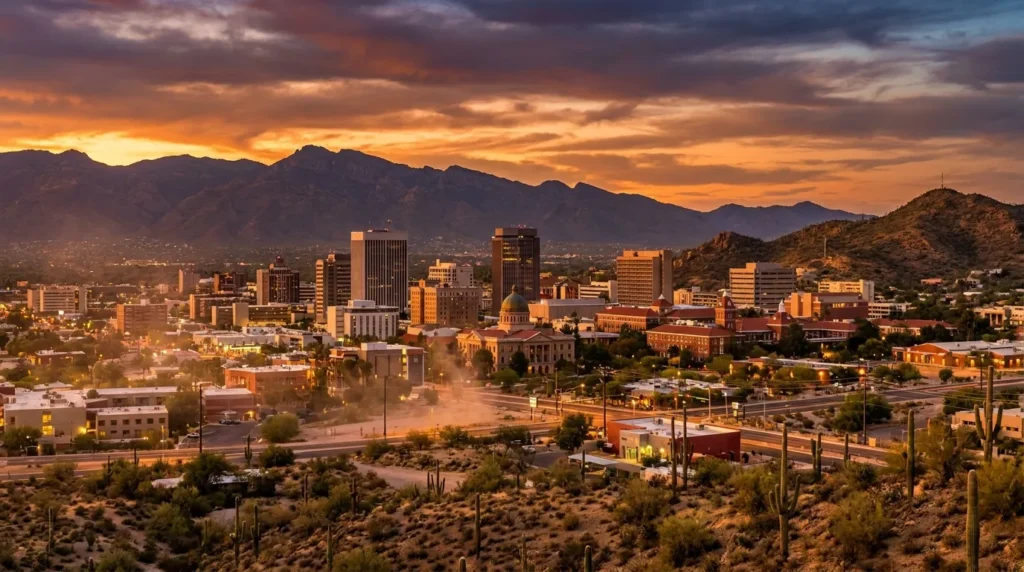
Tucson is a Southwest city with a sharply defined character: Sonoran Desert on all sides, mountains in every direction, and Mexican roots woven into daily life. Saguaro National Park, split into east and west districts, shelters the towering cactus forests familiar from countless films. The Arizona-Sonora Desert Museum, to the west, blends zoo, aquarium, botanical garden, and natural history museum into a single visit.

The historic core includes Old Town Artisans, the 18th-century Mission San Xavier del Bac south of downtown, and the Barrio Viejo neighborhood, with its colorful adobe homes and acclaimed restaurants such as El Charro Cafe. The University of Arizona, centrally located, brings student energy and cultural venues including the Center for Creative Photography, home to an Ansel Adams collection.

Tucson was named a UNESCO City of Gastronomy in 2015 in recognition of its desert cuisine, a layered tradition drawing on Tohono O'odham, Spanish, Mexican, and American ranch cooking. For outdoor pursuits, Sabino Canyon, Mount Lemmon (snow-capped in winter), and Catalina State Park all sit within 40 minutes of downtown. The All Souls Procession each November ranks among the most striking festivals in the country.

  1. 1["Saguaro National Park (East and West)"
  2. 2"Mission San Xavier del Bac"
  3. 3"Arizona-Sonora Desert Museum"
  4. 4"Pima Air & Space Museum"
  5. 5"Old Tucson Studios"
  6. 6"Sabino Canyon"
Nightlife6.0 / 10
Parks & green spaces
  • ["Saguaro National Park"
  • "Sabino Canyon Recreation Area"
  • "Tucson Botanical Gardens"
  • "Reid Park"
  • "Tumamoc Hill"
  • +1 more

Latest posts

Posts about Arizona

Coverage and updates related to this destination.

Showing content from Arizona, as there is no specific data for Tucson yet.