Visto n' Visa
Blog
Notícias e artigos
Destinations
Careers
Immigrants

Want to live and work in Peoria?

Personalized immigration plan with eligible visas, costs, and next steps for your goal!

If you are not eligible, you will know exactly why and what to do to improve your approval chances.

Save up to 12 hours in meetings

No pointless assessments.

Save up to 90%

Save money on vague or unfocused consultations

Avoid Fraud and Mistakes

One mistake can cost you your visa

Total Impartiality

Zero commercial bias

Decide with peace of mind

No toxic urgency

Fast and Accurate

Answers in minutes, no guesswork

Peoria's population: majority white with a growing Hispanic share and many retirees in the west

Approximately 70% non-Hispanic white, 19% Hispanic. The city borders Sun City and Sun City West, enormous 55+ communities that heavily shape the regional profile.

Peoria has a whiter demographic profile than most other Valley cities. About 70% of residents are non-Hispanic white, 19% Hispanic (primarily Mexican), and around 3% Asian. The city borders Sun City and Sun City West, two of the largest age-restricted communities in the country for residents 55 and older. Parts of Peoria also include 55+ subdivisions such as Westbrook Village and Trilogy.

The southern portion of the city has a more Hispanic and working-class character. Northern Peoria, with newer master-planned communities like Vistancia, Sonoran Mountain Ranch, and Blackstone, attracts upper-middle-class young families, many relocating from California. Median household income is higher than in Phoenix or Glendale but lower than in Scottsdale or Chandler.

A small Brazilian community exists, tied primarily to professionals working on the west side and near Luke Air Force Base. A significant Canadian snowbird population (spending winters here and returning to Canada in summer) is present, especially around Sun City West. English dominates, with Spanish as the second most common language.

Languages spoken
  • English
  • Spanish
  • French (Canadian snowbirds)
  • Tagalog (Filipino)
  • Vietnamese
  • +1 more
Main religions
  • Christian (Protestant and Catholic)
  • Mormon (LDS)
  • Unaffiliated
  • Christian (Evangelical)
  • Jewish

Cost of living in Peoria: still accessible, especially in the north

Rents and home prices are lower than in Scottsdale, Chandler, or Gilbert. Northern Peoria's newer subdivisions offer a solid price-to-quality ratio.

Peoria ranks among the more affordable large cities on the west side of the Valley. A one-bedroom apartment typically runs between USD 1,200 and USD 1,600 per month. A three-bedroom rental house ranges from USD 1,800 to USD 2,500. Purchasing a home in new northern developments (Vistancia, Trilogy) ranges from USD 400,000 to USD 700,000; in older, more central neighborhoods, prices fall between USD 280,000 and USD 450,000.

Grocery shopping at Fry's, Safeway, Walmart, Sprouts, and Albertsons is reasonably priced. Costco and Sam's Club are also available. A meal at a casual restaurant runs USD 13 to USD 20 per person. The P83 Entertainment District offers pricier options with chains like Yard House and Kabuki. Food trucks appear in parks on weekends.

Summer electricity bills are a significant expense: constant air conditioning drives monthly bills to USD 250 to USD 350 through APS or SRP. Gasoline and car insurance are cheaper than in California. Arizona imposes a moderate state income tax. Social Security retirement benefits are not taxed at the state level, a factor that draws retirees to the area.

100Cost index (US = 100)same as US average
CategorySingleCoupleFamily (2 + 2)
iHousing$1,304$1,505$1,906
iFood$381$762$1,384
iTransport$502$853$1,103
iHealthcare$281$562$1,053
iChildcare$1,825
iOther$853$1,535$2,156
Monthly total$3,321$5,217$9,427

Source: U.S. BLS Consumer Expenditure Survey 2023 + BEA Regional Price Parities 2023 · Estimates in USD, monthly.

Housing in Peoria: new subdivisions in the north, 1980s-90s homes in the south

The city offers a broad range of options. The south has older homes at lower price points. The north features planned communities like Vistancia with new construction and amenities.

Peoria is expanding aggressively to the north. Vistancia, in the far northeast, is a large master-planned community with more than 6,000 homes, multiple community pools, schools, and the Blackstone Country Club. Trilogy at Vistancia is the 55+ subdivision within the same master plan. Sonoran Mountain Ranch features homes set among saguaro cacti with views toward the White Tank Mountains.

Central and southern Peoria contain established neighborhoods from the 1970s through the 1990s, with simpler and more affordable homes. Areas near the P83 Entertainment District and the Peoria Sports Complex include newer apartments and condominiums. Westbrook Village is a 55+ community on Peoria's west side, with a clubhouse, golf, and activities for retirees.

Standard rental requirements apply: proof of income at 3x the monthly rent, a credit check, and a deposit of roughly one month's rent. Foreign nationals may need to pay additional months upfront. Prospective buyers are advised to visit the area during summer before closing on a property, especially in the far northern subdivisions, where heat can be more intense. Listings can be found on Zillow, Realtor.com, and Apartments.com.

Recommended neighborhoods
  • Vistancia (large, new community, good schools)
  • Trilogy at Vistancia (55+, golf)
  • Sonoran Mountain Ranch (desert views, family-oriented)
  • P83 District (walkable, near the stadium)
  • Westbrook Village (55+, west side, golf)
  • +2 more

Peoria's job market: healthcare, retail, education, and construction

HonorHealth and Banner hospitals, Peoria Unified School District, retail around P83, and residential construction are the primary employers. Many residents commute out.

Employment within Peoria concentrates in healthcare, education, and retail. HonorHealth Deer Valley Medical Center and Banner Boswell Medical Center (located in adjacent Sun City) are major employers. Peoria Unified School District operates more than 30 schools and employs thousands of teachers and administrative staff.

Residential construction is booming due to the new northern subdivisions. Demand is strong for masons, electricians, plumbers, and general contractors. The P83 Entertainment District and the nearby Arrowhead Towne Center in Glendale employ large numbers of retail, restaurant, and hospitality workers. The Peoria Sports Complex generates economic activity during spring training in February and March.

For technology or engineering positions, many Peoria residents commute to Glendale (Luke Air Force Base), Phoenix, or Chandler (Intel). Arizona's minimum wage was around USD 14.35 per hour as of 2024. Healthcare and education salaries track the state average. The city is actively working to attract additional high-tech employers.

Dominant sectors
  • Healthcare
  • K-12 Education
  • Retail and shopping centers
  • Residential construction
  • Hospitality
  • +2 more
Major employers
  • Peoria Unified School District
  • HonorHealth Deer Valley
  • Banner Boswell Medical Center (adjacent)
  • City of Peoria
  • Luke Air Force Base (Glendale, neighboring)
  • +2 more

Education in Peoria: Peoria Unified is a large and well-regarded district

Peoria Unified School District has well-rated schools, particularly in the north. Strong charter school options and Glendale Community College are nearby.

Peoria Unified School District (PUSD) is one of the largest and most well-regarded public districts in Arizona. Schools such as Liberty High School (in Vistancia), Sunrise Mountain High School, and Centennial High School (which has a strong football program) carry solid reputations. Neighboring Deer Valley Unified School District also serves portions of Peoria.

Popular charter schools (tuition-free, with selective enrollment) include BASIS Peoria, considered one of the top high schools in the United States, and Great Hearts Academies. Private options include Northwest Christian School. Families in Vistancia and other northern master-planned communities have access to newer, well-rated schools within their own developments.

Glendale Community College is close by, and Estrella Mountain Community College in Avondale also serves the area with technical and vocational programs. For public university options, Arizona State University has a campus in Glendale (West Campus) just minutes from Peoria, offering programs in education, business, and social sciences. ASU's main campus is in Tempe.

Notable universities
  • Glendale Community College
  • ASU West Campus (Glendale, nearby)
  • Estrella Mountain Community College
  • Grand Canyon University (Phoenix, nearby)
  • University of Phoenix (headquartered in Phoenix)

Healthcare in Peoria: HonorHealth and Banner hospitals nearby

HonorHealth Deer Valley and Banner Boswell are the primary facilities. A solid urgent care network serves the large 55+ population in the surrounding area.

Peoria has a healthcare network appropriate to its size. HonorHealth Deer Valley Medical Center, in adjacent Glendale, is a full-service hospital with an emergency department, maternity ward, and trauma center. Banner Boswell Medical Center in Sun City serves much of the region's 55+ population. Banner Del E. Webb Medical Center in Sun City West is a regional reference for geriatric care.

Pediatric care is available at Phoenix Children's Hospital in east Phoenix or Cardon Children's Medical Center in Mesa. As throughout Arizona, the healthcare system relies on private insurance, typically employer-sponsored. Without coverage, a primary care visit ranges from USD 150 to USD 300, and an emergency room visit costs at least USD 1,500.

For minor issues, walk-in clinics such as NextCare, FastMed, MedExpress, and in-store clinics inside CVS and Walgreens pharmacies are widely available. Telehealth is popular, with providers including Teladoc, MDLive, and Banner Telehealth. Low-income residents can access community health centers that accept AHCCCS (Arizona Medicaid) on a sliding-scale fee basis. Older residents use federal Medicare coverage.

Healthcare index62.0 / 100
  • Life expectancyyears at birth
    78.4yrs
  • Doctors per 1kpracticing physicians
    3.7
  • Health spendper capita, per year
    $13,473
  • Public systemoverall quality rating
    Good

Safety in Peoria: generally considered a safe city

Consistently ranks among the safest large cities in the United States. The north is particularly quiet. The south has a few neighborhoods with slightly higher crime rates.

Peoria consistently ranks among the safest large cities in the United States. Violent crime rates are low, and property crime also falls below the national average. Northern neighborhoods (Vistancia, Trilogy, Sonoran Mountain Ranch) are particularly quiet, and children playing outside unsupervised is a common sight.

Southern Peoria, which is older and closer to Glendale, has some neighborhoods with modestly higher rates of theft and vehicle burglary, though still within the national average. Catalytic converter theft from SUVs and pickup trucks is a growing problem across the entire Valley of the Sun, and Peoria is no exception. Ring cameras and similar devices are common in newer subdivisions.

The Peoria Police Department (PPD) receives strong reviews from residents, with fast response times. For emergencies, 911 applies. Traffic on wide arterial roads such as Bell Road, Thunderbird Road, and Peoria Avenue warrants attention. Pedestrian fatalities are the leading public safety concern, as in all of the Valley of the Sun. Extra caution at crosswalks is advisable, particularly after dark.

5.8
Homicides per 100k
per year
Safety index
72.0
Crime index
28.0
Safer neighborhoods
  • Vistancia
  • Trilogy at Vistancia
  • Westwing Mountain
  • Sun City (neighboring 55+ community)
  • Sonoran Mountain Ranch
  • Terramar
Areas to avoid
  • Stretches of Grand Avenue south of downtown late at night
  • Industrial areas near 75th Avenue after dark
  • Isolated parking lots near Loop 101

Transportation in Peoria: a car-dependent city with Loop 101 as its backbone

A car is essential. Loop 101 (Agua Fria) connects the region. There is no light rail. Phoenix Sky Harbor is 35 to 40 minutes away.

Peoria was designed around the automobile. There are no Valley Metro Rail (light rail) stations within the city, and bus coverage is limited. Loop 101 (Agua Fria Freeway) runs through the southern portion and serves as the primary artery, connecting Glendale, Phoenix, Scottsdale, and Sky Harbor Airport. Interstate 17, to the east, leads north toward Flagstaff and the Grand Canyon.

Wide grid avenues (Bell Road, Thunderbird Road, Peoria Avenue, 75th Avenue, 91st Avenue) ease local travel. The northern part of the city is more isolated, requiring long drives to reach central Phoenix. Residents of Vistancia face commutes of 40 or more minutes to jobs in Tempe or Chandler. Uber and Lyft are available but response times in the far northern subdivisions can be longer.

All commercial flights operate through Phoenix Sky Harbor International Airport (PHX), reached in 35 to 40 minutes via Loop 101 and I-17. PHX offers nonstop service to numerous U.S. cities, Mexico, Canada, London, Frankfurt, and São Paulo. Phoenix-Mesa Gateway Airport (AZA), served by low-cost carriers, is located on the opposite side of the metro area, approximately 50 to 60 minutes away.

28 min
Avg commute
22
Walkability
Airports
  • PHX — Phoenix Sky Harbor International Airport
  • DVT — Phoenix Deer Valley Airport
  • International airport
  • Bike infrastructure

What the Climate Is Like Living in Peoria

Peoria has a hot desert climate, with long and brutal summers exceeding 104°F, short and sunny winters, and scarce rainfall concentrated in the monsoon season.

Summer is long and severe, lasting from May through September. Daytime highs typically range between 100°F and 109°F, with peaks above 113°F in June and July. Humidity is low, but the monsoon season from July to September brings brief storms and haboobs. Industrial-grade air conditioning is essential at home, in the office, and in the car.

Winter is short and very pleasant, from December through February, with highs between 66°F and 72°F and lows between 41°F and 48°F. Frost is rare on cold mornings, and snow is virtually unheard of. This is the season favored by snowbirds.

Annual rainfall averages around 8.7 inches. For residents, planning includes robust air conditioning, consistent hydration, sun protection, and awareness of flash flooding during monsoon season.

Sunny days / year299 days
Avg high (°F)
  • 64°J
  • 66°F
  • 73°M
  • 86°A
  • 92°M
  • 101°J
  • 105°J
  • 103°A
  • 98°S
  • 87°O
  • 76°N
  • 64°D
Avg low (°F)
  • 45°J
  • 45°F
  • 50°M
  • 60°A
  • 66°M
  • 76°J
  • 83°J
  • 82°A
  • 76°S
  • 64°O
  • 55°N
  • 46°D
Rainfall (")
  • 2"J
  • 1"F
  • 2"M
  • 0"A
  • 0"M
  • 0"J
  • 2"J
  • 1"A
  • 1"S
  • 0"O
  • 1"N
  • 2"D

Culture in Peoria: family life, baseball, and Lake Pleasant

Cultural life revolves around family events, MLB spring training, recreation at Lake Pleasant, and local festivals. The P83 district provides the main nightlife options.

Peoria has a suburban, family-centered culture with a strong emphasis on sports and outdoor activities. MLB spring training is the city's biggest annual event. From February through March, the Peoria Sports Complex hosts pre-season games for the Seattle Mariners and San Diego Padres, drawing fans from across the country. The city takes on a notably festive, tourist-friendly atmosphere during that period.

Lake Pleasant Regional Park, about 30 minutes to the north, is the region's primary water recreation destination: boating, jet skiing, fishing, camping, and hiking trails. Boat ownership is common among Peoria residents. White Tank Mountain Regional Park, to the west, offers hiking. Rio Vista Park and the Peoria Sports Complex (outside of spring training) host community events throughout the year.

The P83 Entertainment District (along Peoria's 83rd Avenue, near the stadium) concentrates restaurants (Yard House, BJ's, Topgolf), a movie theater, bars, and public events. The Peoria Center for the Arts and Theater Works offer performing arts programming. The Canadian snowbird heritage brings events such as RibFest and recreational ice hockey leagues in Sun City West.

Peoria

What to Do in Peoria, in the Northwest Greater Phoenix Area

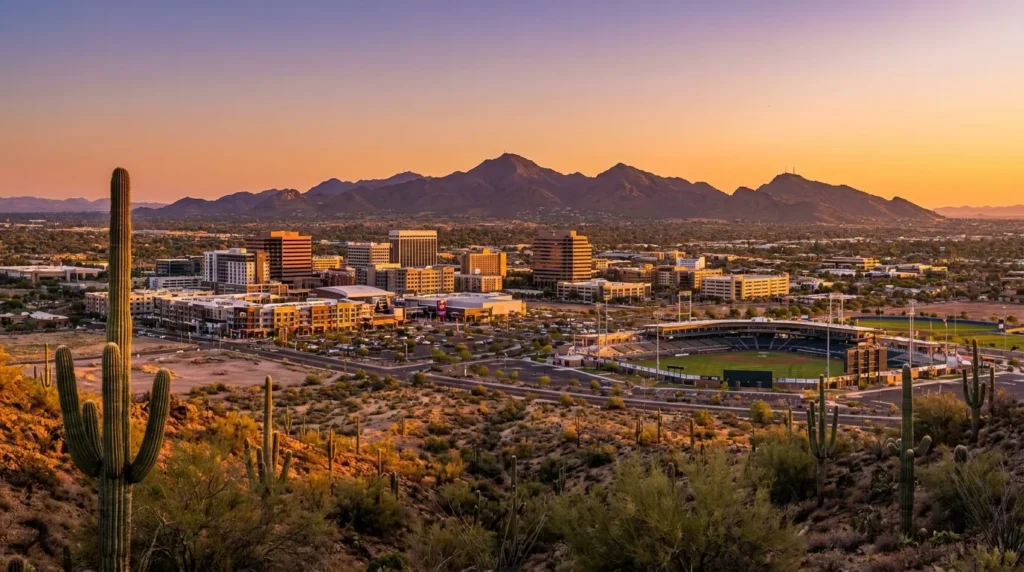
Peoria sits in the northwest corner of the Phoenix metropolitan area, offering Lake Pleasant for water sports, the Peoria Sports Complex for MLB spring training, and master-planned communities like Vistancia.

Lake Pleasant Regional Park, managed by Maricopa County, is the city's premier outdoor destination, with 23,000 acres for sailing, kayaking, and wakeboarding, plus hiking trails and camping. At the other end of the spectrum, the Peoria Sports Complex hosts the San Diego Padres and Seattle Mariners spring training in February and March, drawing fans from across the western United States.

Park West, a lifestyle center on Loop 101, brings together a Harkins cinema, restaurants, and nearby Arrowhead Hospital. The Peoria Center for the Performing Arts and the Peoria Community Center host plays, exhibitions, and programming organized by the Peoria Arts Commission.

For outdoor recreation, Sunrise Mountain Preserve and Calderwood Butte offer short trails with views across the Valley of the Sun. Old Town Peoria, along 83rd Avenue, preserves the city's historic character with Centennial Plaza, the Peoria Main Library, and events such as the Old Town Fall Festival.

  1. 1["Lake Pleasant Regional Park"
  2. 2"Peoria Sports Complex"
  3. 3"P83 Entertainment District"
  4. 4"Peoria Center for the Performing Arts"
  5. 5"Challenger Space Center (Arizona Science Center West)"
  6. 6"Pioneer Living History Museum"
Nightlife4.0 / 10
Parks & green spaces
  • ["Lake Pleasant Regional Park"
  • "Rio Vista Community Park"
  • "Pioneer Community Park"
  • "Sunrise Mountain Preserve"
  • "Paloma Park"
  • +1 more

Latest posts

Posts about Arizona

Coverage and updates related to this destination.

Showing content from Arizona, as there is no specific data for Peoria yet.