Visto n' Visa
Blog
Notícias e artigos
Destinations
Careers
Immigrants

Want to live and work in University City?

Personalized immigration plan with eligible visas, costs, and next steps for your goal!

If you are not eligible, you will know exactly why and what to do to improve your approval chances.

Save up to 12 hours in meetings

No pointless assessments.

Save up to 90%

Save money on vague or unfocused consultations

Avoid Fraud and Mistakes

One mistake can cost you your visa

Total Impartiality

Zero commercial bias

Decide with peace of mind

No toxic urgency

Fast and Accurate

Answers in minutes, no guesswork

A small city with many origins

A mix of African American families with long regional roots, international students, and immigrant communities from Asia, East Africa, and Latin America.

University City is demographically more diverse than most St. Louis suburbs. The African American population is large and historically important, concentrated mainly in the northern third of the city, in the area known as the Third Ward. Non-Hispanic whites form the largest share of the center and south, near the campuses and the Loop, and the number of Asian residents has grown steadily for two decades.

The presence of Washington University brings students and researchers from practically every continent, with visible Indian, Chinese, Korean, Iranian, and Brazilian communities in markets, restaurants, and religious centers. There are also clusters of Ethiopian, Eritrean, Somali, Vietnamese, Bosnian, and Mexican immigrants spread across U City, Olivette, and the South Grand area of St. Louis.

English is the majority language in daily life, but Spanish, Mandarin, Amharic, Vietnamese, and Bosnian are commonly heard in local businesses. The city has a progressive tradition, with a strong presence of Jewish institutions, historic African American churches, and interfaith organizations that welcome newly arrived families.

Languages spoken
  • English
  • Spanish
  • Mandarin
  • Amharic
  • Vietnamese
  • +1 more
Main religions
  • Protestant Christianity
  • Catholicism
  • Judaism
  • Islam
  • Hinduism
  • +1 more

Affordable cost of living by U.S. standards

Living in University City costs less than in major coastal cities, though slightly above the Missouri average due to location and schools.

The cost of living in University City is below the U.S. national average, especially for housing and transportation. Renting a one-bedroom apartment near the Delmar Loop is usually more affordable than in equivalent neighborhoods in Chicago, Minneapolis, or Denver, and prices for houses on quiet residential streets attract young families who work across the metro area.

What weighs a bit more is property tax, typical of the St. Louis area, and car insurance, which tends to be high statewide. Large supermarkets like Schnucks and Dierbergs have competitive prices, and the Ethiopian market on Olive Boulevard, the Asian markets, and Global Foods Market in Kirkwood help immigrant families maintain their home cuisine without major costs.

For those coming from countries with a more expensive economy, the initial feeling is usually one of budget relief. For those coming from cheaper U.S. cities, the adjustment is small, but the gains in urban quality and public services make up for it.

University City

Historic homes, apartments near the Loop, and affordable duplexes

A market split between leafy residential neighborhoods, modern apartment buildings, and older homes in the north, with a solid rental stock for students.

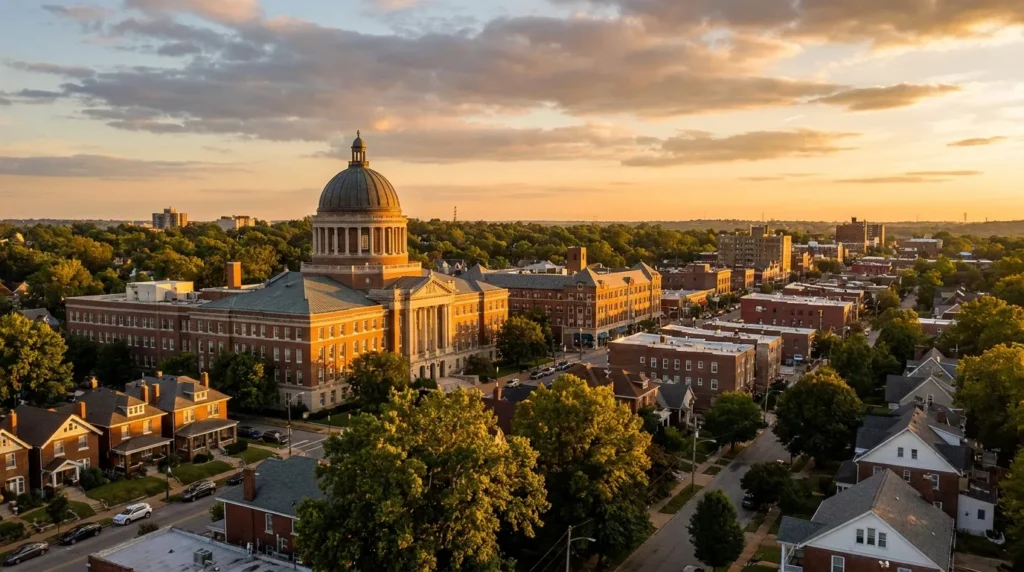
Southern University City, near Washington University, is home to brick houses from the 1920s and 1930s, tree-lined streets, and large backyards. It is the most sought-after area for families with school-aged children and university professors. Prices there rise over the years but remain well below equivalent neighborhoods in cities like Boston or San Francisco.

The center, along the Delmar and Kingsland axis, offers new apartments and condos above retail, popular with young professionals and graduate students. In the northern third, above Olive Boulevard, there are more single-family homes and duplexes at lower prices. It is an area of gradual revitalization, with municipal programs and community organizations working on affordable housing.

For newly arrived immigrants, it is common to start in a rented apartment in central areas or a sublet near the university, then move to homeownership as life stabilizes. The process usually requires local credit history, recent paystubs, and, in many cases, a co-signer or a two- to three-month security deposit.

Recommended neighborhoods
  • Parkview
  • University Heights
  • Ames Place
  • Delmar Loop
  • Pasadena Hills
  • +1 more

Jobs driven by universities, healthcare, and local retail

Most residents work in education, healthcare, retail, and services, and many commute to other parts of greater St. Louis every day.

University City does not have a large industrial hub of its own, but it is surrounded by strong employers in the St. Louis metropolitan area. Washington University in St. Louis and the BJC HealthCare hospital system, a few minutes away, are the largest employers in the area and offer positions in research, teaching, healthcare, administration, and support services.

Within the city itself, the Delmar Loop business district sustains restaurants, independent shops, bookstores, and the Tivoli theater. Healthcare has a significant weight, with clinics, medical offices, and senior living facilities spread across the neighborhoods. City hall, the school district, and the neighboring University of Missouri-St. Louis also hire regularly.

For immigrants with technical or academic qualifications, the gateway is usually the university and hospital sector. For those arriving without fluent English, the Loop retail district, ethnic restaurants on Olive Boulevard, cleaning, construction, and elder care offer many first-job opportunities.

Dominant sectors
  • Higher education
  • Healthcare
  • Retail
  • Restaurants and hospitality
  • Public services
  • +1 more
Major employers
  • Washington University in St. Louis
  • BJC HealthCare
  • University of Missouri-St. Louis
  • School District of University City
  • City of University City
  • +1 more

An independent school district and two major universities nearby

Local public schools with a strong community presence and immediate proximity to Washington University, one of the most respected in the United States.

The School District of University City runs the city's public schools, from kindergarten through high school. University City High School serves a diverse population, with music, arts, and robotics programs known in the region. There are also private and religious schools, including traditional Jewish and Catholic institutions.

For higher education, the surroundings are privileged. Washington University in St. Louis sits right at the southern border, with undergraduate and graduate programs internationally recognized in medicine, law, business, engineering, and the arts. The University of Missouri-St. Louis, known as UMSL, is a few minutes away and offers more affordable options, with a strong presence of first-generation students and immigrants.

Concordia Seminary, inside University City, is a historic Lutheran seminary, and St. Louis Community College has nearby campuses with technical and transfer programs in high demand among adults returning to study or newcomers seeking to revalidate credentials.

Notable universities
  • Washington University in St. Louis
  • University of Missouri-St. Louis
  • Concordia Seminary
  • St. Louis Community College
  • Fontbonne University

Easy access to one of the largest medical hubs in the Midwest

University City is minutes from BJC HealthCare and Barnes-Jewish Hospital, considered one of the best hospitals in the United States.

Access to healthcare is one of the strengths of living in University City. Barnes-Jewish Hospital, next to the Washington University campus, is a national reference in cardiology, oncology, and transplants. St. Louis Children's Hospital, next door, serves children from across the region and receives patients from other states.

Within the city there are several community clinics, private practices, 24-hour pharmacies, and mental health centers. Missouri Medicaid programs and federally qualified community clinics, such as Affinia Healthcare, serve low-income residents and uninsured immigrants with sliding-scale fees.

For newly arrived immigrants, the best entry point is usually a community clinic or a Federally Qualified Health Center, which offers interpreters in Mandarin, Spanish, Amharic, Arabic, and other languages. For those with employer-based insurance, the BJC and Mercy hospital networks cover virtually all specialties.

University City

Safety varies considerably between the quiet south and the transitioning north

The south and center are considered safe and family-friendly. The north has higher crime rates, in transition, with a strong community presence.

Safety in University City varies by neighborhood, as in most of the St. Louis metropolitan area. The south, near Washington University, and central neighborhoods like Parkview, University Heights, and Ames Place are considered very safe, with low rates of violent crime and a strong sense of community.

The Delmar Loop is busy and well patrolled, but, as with any nightlife area, it calls for basic care with belongings, especially on weekends. The north of the city, above Olive Boulevard, has higher crime rates, although it has been improving with investments in lighting, community programs, and new housing.

The University City police maintain active channels with neighborhood associations and immigrant organizations. In emergencies, it is worth remembering that 911 is free and answers in several languages via a translation service, and that the city has policies that limit cooperation with federal immigration, giving more legal security to undocumented families seeking help.

Safer neighborhoods
  • Parkview
  • University Heights
  • Ames Place
  • Sutter-Pennsylvania
  • Skinker-DeBaliviere (border)
  • Pasadena Hills
Areas to avoid
  • Isolated stretches of Olive Boulevard after midnight
  • Poorly lit areas north of Page Avenue
  • Empty parking lots near I-170 at night

MetroLink, buses, and walkable streets on the Loop

A city small enough to walk through in many stretches, with light rail connecting to downtown St. Louis and Lambert Airport.

MetroLink, the region's light rail system, serves University City through the Delmar Loop station. Within minutes, riders can reach downtown St. Louis, Forest Park, and Lambert International Airport. There is also the Loop Trolley, a heritage streetcar that connects the Delmar Loop to Forest Park, useful on weekends.

The MetroBus network covers the main corridors, including Olive Boulevard, Delmar, and Big Bend, with connections to Clayton, Maplewood, and downtown. For those working in other parts of the metro area, the car remains the most practical option, and the city has good links to I-170 and I-64.

Biking works well within U City, with some bike lanes and low-speed streets. The Delmar Loop and the areas near Washington University are especially walkable, with wide sidewalks, lighting, and human-scale retail, something rare in American suburbs.

Airports
  • STL, St. Louis Lambert International Airport
  • Bike infrastructure

Climate

University City

Delmar Loop, music, bookstores, and world cuisines

Cultural life revolves around the Loop, the music scene inherited from Chuck Berry, and the gastronomic diversity brought by decades of immigration.

The Delmar Loop has been named several times one of the coolest streets in the United States. It is home to The Pageant, a concert hall hosting national artists, Blueberry Hill, the historic restaurant where Chuck Berry played regularly, and the St. Louis Walk of Fame, with sidewalk stars honoring figures like Maya Angelou, Tennessee Williams, and Miles Davis.

The city has a literary and independent tradition, with bookstores like Subterranean Books and small bars hosting readings, stand-up comedy, and jam sessions. The best-known public festivities are Loop in Motion, the Loop Ice Carnival in winter, and neighborhood parties scattered throughout the summer.

The food scene reflects the diversity of the population. Ethiopian, Vietnamese, Indian, Lebanese, Mexican, and Thai restaurants share space with classic Missouri dishes like toasted ravioli, gooey butter cake, and St. Louis-style barbecue. Eating out in U City is often a trip around the world within a few blocks.

Notable dishes
  • Toasted ravioli
  • St. Louis-style barbecue
  • Gooey butter cake
  • St. Louis-style Provel pizza
  • Ted Drewes concrete custard
  • +1 more
Annual events
  • Loop in Motion
  • Loop Ice Carnival
  • U City in Bloom Garden Tour
  • Loop Arts Festival
  • Third Friday at the Tivoli

The Loop, parks, and museums within walking distance of the center

Historic cinema, walk of fame, neighborhood parks, and full proximity to Forest Park and its free museums.

University City's best-known attraction is the Delmar Loop itself, with the Tivoli movie theater, The Pageant concert hall, the St. Louis Walk of Fame, and dozens of restaurants and bars. Within a few blocks visitors can spend an entire afternoon between a bookstore, ice cream shop, and wax museum. On weekends, the area hosts events, fairs, and live performances.

The city has pleasant neighborhood-scale parks, like Heman Park, with a public swimming pool, and Ruth Park Woods, a native woodland area little known outside the area. For something larger, just cross the border and reach Forest Park, one of the largest urban parks in the United States, with the Saint Louis Art Museum, the Saint Louis Science Center, and the Saint Louis Zoo, all with free admission.

Architecture lovers enjoy the historic neighborhoods of the south, with brick houses, stained glass, and quiet streets. The decorated doors of Parkview Place are a must-stop for urban photography and relaxing walks.

  1. 1Delmar Loop
  2. 2Tivoli Theater
  3. 3St. Louis Walk of Fame
  4. 4The Pageant
  5. 5Blueberry Hill
  6. 6Loop Trolley
Parks & green spaces
  • Heman Park
  • Ruth Park Woods
  • Lewis Park
  • Fogerty Park
  • Forest Park (adjacent)

A small city with well-established immigrant communities

Strong presence of Asian, East African, and Latin American immigrants, as well as Bosnian families inheriting the large St. Louis community.

University City is one of the most cosmopolitan areas of greater St. Louis. The presence of Washington University and Barnes-Jewish Hospital attracts researchers and doctors from China, India, South Korea, Iran, Brazil, Nigeria, and dozens of other countries. Many families begin their first stay in the United States here.

The metropolitan area is home to one of the largest Bosnian communities in the world outside Bosnia, inheritor of the wave of refugees from the 1990s, with a strong presence in neighboring areas like Bevo Mill and Affton. There are Vietnamese, Ethiopian, Eritrean, and Somali clusters along Olive Boulevard, and Mexican and Central American communities around South Grand in St. Louis.

Organizations like the International Institute of St. Louis help newcomers with English, credential validation, employment, and housing. Diverse religious centers, from the Central Reform synagogue to the Daar-ul-Islam mosque in Manchester, and Spanish-language evangelical churches, sustain the social network for newcomers.

4,500
Foreign-born residents
estimated
Top countries of origin
  • China
  • India
  • Mexico
  • Ethiopia
  • Vietnam
  • Bosnia and Herzegovina
  • South Korea
  • Nigeria
Foreign consulates
  • Honorary Consulate of Mexico in St. Louis
  • Honorary Consulate of Germany in St. Louis
  • Honorary Consulate of France in St. Louis
  • Honorary Consulate of Italy in St. Louis
  • Consulate General of Mexico in Kansas City (jurisdiction)
  • +1 more
Community organizations
  • International Institute of St. Louis
  • Catholic Charities of St. Louis
  • Hispanic Chamber of Commerce of Metropolitan St. Louis
  • Asian American Chamber of Commerce of St. Louis
  • Bilingual International Assistant Services
  • African Mutual Assistance Association of Missouri

Latest posts

Posts about Missouri

Coverage and updates related to this destination.

Showing content from Missouri, as there is no specific data for University City yet.