Visto n' Visa
Blog
Notícias e artigos
Destinations
Careers
Immigrants

Want to live and work in Malden?

Personalized immigration plan with eligible visas, costs, and next steps for your goal!

If you are not eligible, you will know exactly why and what to do to improve your approval chances.

Save up to 12 hours in meetings

No pointless assessments.

Save up to 90%

Save money on vague or unfocused consultations

Avoid Fraud and Mistakes

One mistake can cost you your visa

Total Impartiality

Zero commercial bias

Decide with peace of mind

No toxic urgency

Fast and Accurate

Answers in minutes, no guesswork

One of the most diverse cities in Massachusetts

About 45% of residents were born outside the United States. Chinese, Haitian, Brazilian, Vietnamese, Moroccan, and Salvadoran communities coexist at the neighborhood scale.

Malden is now one of the cities with the highest proportion of immigrants in Massachusetts. Around four in ten residents were born outside the country, and more than half the population speaks a language other than English at home.

The Chinese community is the most visible: downtown has markets, Cantonese and northern Chinese restaurants, immigration offices, and temples. There is also a large Haitian community, with churches and commerce in Creole, along with a strong presence of Salvadorans, Brazilians, Moroccans, Vietnamese, and Indians.

Religiously, it is a plural city: historic Catholic parishes (Irish and Italian), evangelical churches in Portuguese, Spanish, and Creole, an active mosque, a conservative synagogue, and Buddhist temples. Living alongside neighbors from other countries is part of daily life, not an exception.

Languages spoken
  • English
  • Mandarin
  • Cantonese
  • Haitian Creole
  • Spanish
  • +3 more
Main religions
  • Catholics
  • Protestants
  • Evangelicals
  • Buddhists
  • Muslims
  • +2 more

Less expensive than Boston, but far from cheap

Rent and groceries are significantly lower than in Boston, Cambridge, or Somerville, though the city falls within the expensive Greater Boston metropolitan area.

Cost of living in Malden is one of its draws. A one-bedroom apartment consistently runs below the equivalent in Boston or Cambridge, and two-bedroom units are still generally accessible for dual-income households. This is why the city has become a natural destination for those who work downtown but were priced out of Boston rents.

Groceries and everyday food are also more affordable, largely because of the Asian and Latin supermarkets downtown, where fruit, vegetables, and rice cost less than at major chains. Eating out is inexpensive if one looks beyond the obvious choices: pho, neighborhood Chinese food, and Haitian lunch counters offer complete meals at modest prices.

That said, this is still the Boston metro area, with significant property taxes, expensive health insurance, and total housing costs that rank among the highest in the United States. Families with children need to factor in daycare, which is the heaviest budget item after rent.

106Cost index (US = 100)6% above US average
CategorySingleCoupleFamily (2 + 2)
iHousing$1,370$1,581$2,003
iFood$400$801$1,454
iTransport$527$896$1,160
iHealthcare$295$590$1,107
iChildcare$1,918
iOther$896$1,613$2,267
Monthly total$3,488$5,481$9,909

Source: U.S. BLS Consumer Expenditure Survey 2023 + BEA Regional Price Parities 2023 · Estimates in USD, monthly.

Triple-deckers, new condominiums, and subway stations driving up value downtown

Older multifamily homes rented floor by floor predominate, alongside new apartment buildings near Malden Center and Oak Grove stations.

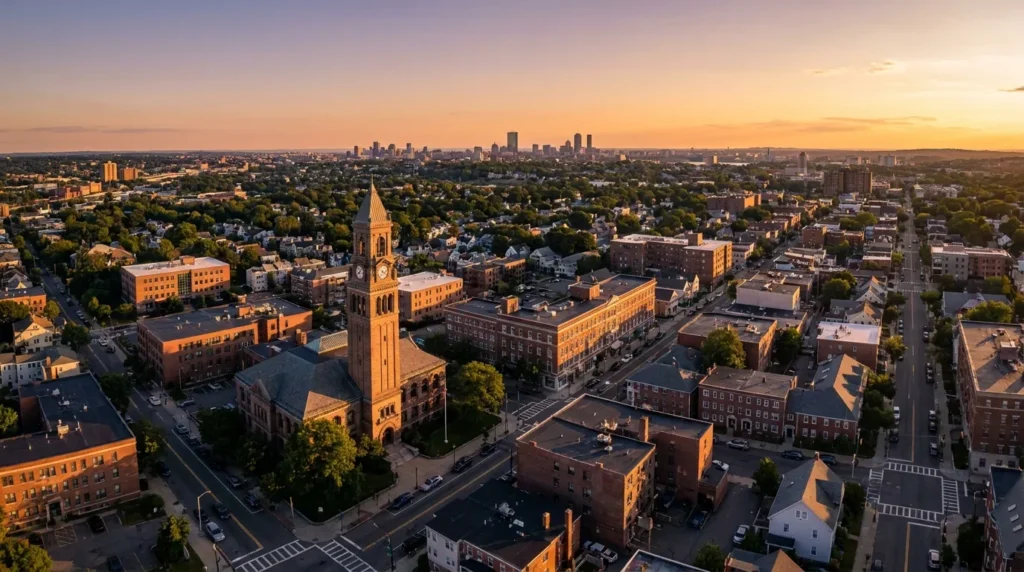
The housing stock has the look of a northeastern industrial city: wooden triple-deckers, Victorians, 1920s brick buildings, and duplexes. Most immigrants start by renting a floor of a triple-decker, the typical format in Greater Boston, where each level is an independent apartment.

The area around Malden Center station concentrates newer buildings with elevators and doormen, aimed at professionals who commute on the Orange Line. Neighborhoods like West End and Forestdale are more residential, with houses and few tall buildings. Linden and Maplewood are a bit farther from the subway and therefore tend to be less expensive.

It is worth noting that many properties in Malden are still rented by individual landlords who live on another floor of the same building. Reference letters, proof of income, and U.S. credit checks are required, which can be a barrier for those who have recently arrived in the country.

Recommended neighborhoods
  • Malden Center
  • Edgeworth
  • West End
  • Forestdale
  • Oak Grove
  • +1 more

Local commerce, regional healthcare, and Boston jobs a subway ride away

Malden's economy combines small immigrant-owned businesses, a hospital, and local schools, but most residents work in Boston or Cambridge.

Within Malden, the largest employers are the MelroseWakefield Healthcare system, the city's public schools, city government, and the downtown service sector. Immigrant commerce is strong: restaurants, ethnic markets, salons, laundromats, and accounting offices serving the Chinese and Latin communities generate many jobs.

The real engine, however, lies outside the city. The Orange Line runs directly to Downtown Boston, Back Bay, and the Longwood Medical Area hospital district. One transfer connects residents to Cambridge, Kendall Square, and the pharmaceutical and technology companies near MIT.

For newly arrived professionals, it is common to start in services (delivery, restaurants, construction, cleaning, elder care) while pursuing credentials or English skills. Those arriving with degrees tend to move into technology, healthcare, or education within a few years, as all of Greater Boston pulls in those directions.

Dominant sectors
  • Healthcare
  • Education
  • Local commerce
  • Services
  • Restaurants and food service
  • +1 more
Major employers
  • MelroseWakefield Healthcare
  • Malden Public Schools
  • City of Malden
  • National Grid
  • Eastern Bank

Multilingual public schools and accessible higher education

Public schools serve an extremely diverse population with strong support for students still learning English. Boston's higher education institutions are just a few subway stops away.

The Malden Public Schools system is a regional reference for diversity. More than 60 languages are spoken in the schools, and there are structured English as a Second Language (ESL) programs in both elementary schools and Malden High School. For immigrant families, this support is often a deciding factor in choosing the neighborhood.

Within the city, Bunker Hill Community College Malden Campus offers a low-cost option for starting a degree or completing a technical program in the United States. English classes for adults are offered by the Malden Adult Learning Center and community organizations.

A few subway minutes away are Tufts University (in Medford), Northeastern, Boston University, Harvard, MIT, and dozens of other institutions. Many Malden residents study or work at at least one of them, and the city serves as an accessible entry point into that academic and research ecosystem.

Notable universities
  • Bunker Hill Community College — Malden Campus
  • Tufts University (Medford, neighboring city)
  • Salem State University (regional access)

Local hospital and direct access to Boston's major medical centers

Malden has its own community hospital and is a short distance from some of the most recognized medical institutions in the world, located in the Longwood Medical Area.

The city's main healthcare facility is MelroseWakefield Hospital, a community hospital offering emergency services, maternity care, general surgery, and specialty clinics. For many residents, it is the first point of contact with the American healthcare system.

When cases require a specialist or complex treatment, the natural path leads to Boston's Longwood Medical Area, home to Mass General Brigham, Beth Israel Deaconess, Brigham and Women's, Dana-Farber, and Boston Children's Hospital. All are one subway or bus ride from downtown Malden.

Newly arrived immigrants need to consider that the system is private and tied to health insurance. Community centers such as the Cambridge Health Alliance Malden Care Center operate on a sliding fee scale and accept MassHealth, the state program that covers low-income families regardless of immigration status in many cases.

Malden

A dense city that is relatively calm for the Boston area

Crime rates are moderate, with minor property incidents concentrated in the commercial downtown at night and quite calm residential neighborhoods.

Compared to other populous cities in Greater Boston, Malden is considered mid-range in terms of safety, with low violent crime and more common incidents involving car theft, vehicle break-ins, and minor theft in the commercial district at night.

Residential neighborhoods such as Forestdale, West End, Oak Grove, and parts of Edgeworth are quiet, with a strong sense of community and streets that remain active well into the evening. Around the subway stations, foot traffic concentrates during peak hours and drops considerably after 10 p.m.

Practical recommendations follow the standard pattern for any American urban city: avoid leaving valuables visible inside cars, stay alert at bus stops late at night, and sign up for Malden Police alerts, which notify residents about scams and incidents by area.

Safer neighborhoods
  • Forestdale
  • West End
  • Oak Grove
  • Edgeworth
  • Maplewood
Areas to avoid
  • Isolated stretches near workshops and warehouses in the far south after 10 p.m.

Orange Line, buses, and the possibility of living without a car

Malden is one of the few suburban cities near Boston where it is possible to live without a car, thanks to the subway, an extensive bus network, and a commuter rail station.

Two Orange Line subway (T) stations serve the city: Malden Center, in the heart of the commercial district, and Oak Grove, at the northern end. From Malden Center, downtown Boston is about 12 minutes away. That same station hosts a bus terminal, a stop on the Haverhill commuter rail line, and a bike storage facility.

The bus network is dense and covers neighborhoods less served by the subway, connecting the city to Everett, Medford, Revere, and Chelsea. For Logan Airport, one can combine the subway and Silver Line, or take a rideshare at low cost given the short distance.

Those with a car will find parking easier than in Boston, though residential streets typically require a resident sticker. Cyclists have protected stretches on the Northern Strand Trail, a rail-trail that connects Malden to the coast at Lynn, passing through Everett, Revere, and Saugus.

Airports
  • BOS — Boston Logan International (approximately 6 miles / 10 km away)
  • Bike infrastructure

Climate

Malden

A city of festivals, food trucks, and food from around the world

Cultural life unfolds on commercial streets, at summer ethnic festivals, and at venues such as the historic Bread of Life theater and the Northern Strand memorial.

Downtown Malden is one of the best concentrated samples of immigrant food in Greater Boston within just a few blocks. Cantonese, Sichuan, northern Chinese, Salvadoran, Haitian, Brazilian, Moroccan, and Vietnamese restaurants appear at established addresses, and the mix is part of everyday life rather than a tourist attraction.

The summer calendar includes the Malden Summer Music Series in the downtown park, food truck festivals on Pleasant Street, the Memorial Day parade, and Chinese New Year celebrations. Churches and community associations hold Haitian, Salvadoran, and Brazilian patron saint festivals throughout the year.

For cinema, museums, opera, and major concerts, the city benefits from the proximity of Boston and Cambridge, a short train ride away. Within Malden, the Public Library and the local YMCA function as neighborhood cultural centers, offering English classes, children's activities, and civic programming.

Notable dishes
  • Cantonese dim sum
  • Northern Chinese noodle soup
  • Salvadoran pupusas
  • Haitian griot
  • Vietnamese pho
  • +2 more
Annual events
  • Malden Summer Music Series
  • Malden Pride
  • Chinese New Year celebrations
  • Memorial Day Parade
  • Northern Strand Trail Festival

Parks, trails, and the multicultural downtown as the city's showcase

Malden's attractions are more neighborhood than tourist: trails, reserves, a historic library, and immigrant commercial streets.

Pine Banks Park, on the border with Melrose, is the city's largest park, with trails, picnic areas, a playground, and sports courts. Fellsmere Park, in the center, has a lake, walking paths, and serves as a venue for summer events.

Farther north, the Middlesex Fells Reservation is one of Greater Boston's largest forest reserves, with trails for hiking and mountain biking. For urban cycling, the Northern Strand Trail connects Malden to the coast at Lynn, passing through Everett, Revere, and Saugus.

For a cultural experience, a walk along Pleasant Street and Main Street, stopping at different immigrant neighborhood spots in a single day, is one of the city's highlights. The Malden Public Library, a historic building, and the Converse Memorial Building round out the city's architectural points of interest.

  1. 1Pine Banks Park
  2. 2Fellsmere Park
  3. 3Middlesex Fells Reservation
  4. 4Northern Strand Trail
  5. 5Malden Public Library
  6. 6Pleasant Street multicultural district
Parks & green spaces
  • Pine Banks Park
  • Fellsmere Park
  • Middlesex Fells Reservation
  • Forestdale Park
  • Roosevelt Park

A gateway city into Greater Boston for immigrants from around the world

About 45% of residents were born outside the United States. Chinese, Haitian, Salvadoran, Brazilian, Moroccan, and Vietnamese communities have a strong and organized presence.

Malden is today one of the main entry points for new immigrants into Greater Boston. The combination of relatively affordable rent, direct subway access, and available service-sector jobs leads recently arrived families to settle here before, or instead of, trying Boston or Cambridge.

The most visible groups on streets, in shops, and in schools are the Chinese (mainland and Hong Kong), Haitian, Salvadoran, Brazilian, Moroccan, Vietnamese, and Indian communities. There is also a significant presence of people from Ethiopia, Nigeria, Colombia, and Cape Verde, among other countries.

General consulates are located in Boston, a few subway stops away, making it practical to handle documents without leaving the area. Regional community organizations serve clients in multiple languages and assist with immigration matters, English, employment, and housing.

27,000
Foreign-born residents
estimated
Top countries of origin
  • China
  • Haiti
  • El Salvador
  • Brazil
  • Morocco
  • Vietnam
  • India
  • Dominican Republic
Foreign consulates
  • Consulate General of Brazil in Boston
  • Consulate General of Haiti in Boston
  • Consulate General of El Salvador in Boston
  • Consulate General of China in New York (regional jurisdiction)
  • Consulate General of Portugal in Boston
  • +1 more
Community organizations
  • Immigrant Learning Center (Malden)
  • Greater Boston Chinese Cultural Association
  • Haitian-Americans United
  • Centro Presente
  • International Institute of New England
  • Catholic Charities of Boston

Latest posts

Posts about Massachusetts

Coverage and updates related to this destination.

Showing content from Massachusetts, as there is no specific data for Malden yet.