Visto n' Visa
Blog
Notícias e artigos
Destinations
Careers
Immigrants

Want to live and work in Massachusetts?

Personalized immigration plan with eligible visas, costs, and next steps for your goal!

If you are not eligible, you will know exactly why and what to do to improve your approval chances.

Save up to 12 hours in meetings

No pointless assessments.

Save up to 90%

Save money on vague or unfocused consultations

Avoid Fraud and Mistakes

One mistake can cost you your visa

Total Impartiality

Zero commercial bias

Decide with peace of mind

No toxic urgency

Fast and Accurate

Answers in minutes, no guesswork

More about Massachusetts

Harvard, MIT, and the largest Brazilian community in the northeastern US.

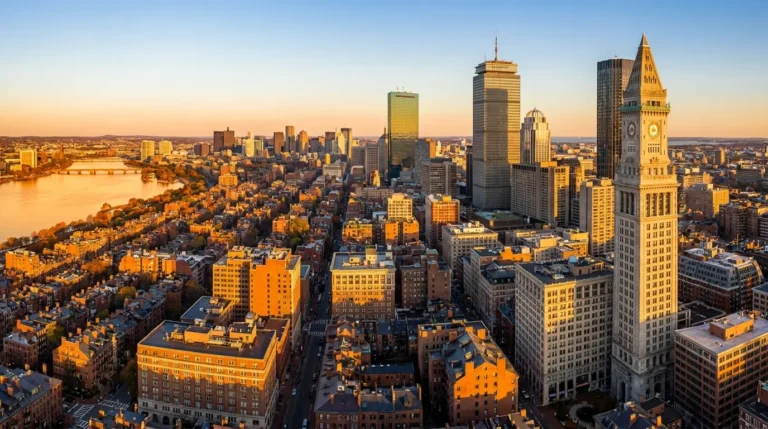
Massachusetts is located in New England, in the northeastern US. Boston is the largest city and the economic, cultural, and academic center of the state. Other important cities are Cambridge (Harvard and MIT, across the Charles River), Worcester (second city), Springfield (western part of the state), and suburban cities like Newton, Brookline, Framingham, and Lowell.

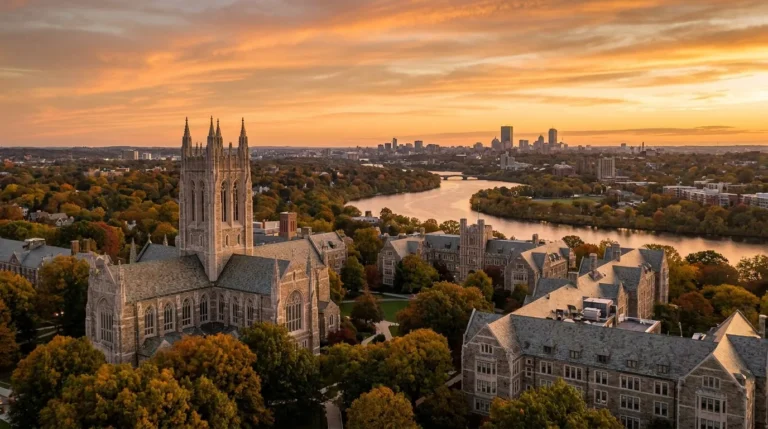
The state is small in area but economically powerful. It concentrates elite universities (Harvard, MIT, Tufts, Boston University, Boston College), top hospitals (Mass General, Brigham and Women's), biotech companies, financial funds, and a tech industry. Education and healthcare are the largest employment sectors.

The Brazilian community is one of the largest in the US, especially in cities like Framingham, Marlborough, Everett, Somerville, and Allston (a Boston neighborhood). There are grocery stores, churches, lawyers, and services in Portuguese. For qualified immigrants, especially in science, healthcare, and technology, Massachusetts is one of the best destinations in the country.

Population
6,981,974
Average monthly salary
80,500 USD/mo
42.2302°, -71.5301°

Featured places

Top 10 places in Massachusetts

The places most sought-after by immigrants in this region.

Massachusetts demographics: educated, diverse, and with a strong Brazilian presence

One of the most educated populations in the US. Irish, Italian, Brazilian, and Dominican communities define the state.

Massachusetts has one of the most educated populations in the US: a high percentage of adults have college or graduate degrees. Traditionally, the state had a strong presence of Irish and Italian descendants, especially in Boston. Today, diversity has grown with Chinese, Indian, Dominican, Haitian, and Brazilian communities.

The Brazilian community is the largest in the US after Florida and California. Cities like Framingham (the Brazilian capital of MA), Marlborough, Everett, Somerville, and Allston have a large presence. Portuguese-language churches, grocery stores, lawyers, doctors, and bakeries are common. The Hispanic community is strong in Lawrence, Lowell, and parts of Boston.

Most people live in the Greater Boston metropolitan area. Smaller cities in the west (Berkshires) and along the south coast (Cape Cod) have smaller, whiter populations. The state is strongly Democratic, especially in Boston and surroundings, and socially progressive (it was the first state to legalize same-sex marriage, in 2004).

6,981,974
Population
40 yrs
Median age
255/km²
Density
$96,510
Median income
per year
Urban population92.0%
Foreign-born17.5%
Languages spoken
  • English
  • Portuguese (one of the largest Brazilian communities in the US)
  • Spanish (especially in Lawrence, Lowell, Chelsea)
  • Mandarin and Cantonese
  • Haitian Creole
  • +2 more
Main religions
  • Catholic Christian (strong Irish and Italian heritage)
  • Protestant Christian
  • No religion (about 30%)
  • Jewish (strong in Brookline, Newton)
  • Brazilian evangelical (in Framingham and surroundings)
  • +1 more

Cost of living in Massachusetts: among the highest in the US

Boston is one of the most expensive cities in the country. Suburbs are also costly. High salaries partially offset the cost.

Massachusetts has one of the highest costs of living in the US. In Boston, a one-bedroom apartment rents for between $2,500 and $3,500 in central neighborhoods (Back Bay, South End, Beacon Hill). In Cambridge, similar rates. In suburbs like Newton and Brookline, $2,500 to $3,000. In mid-sized cities like Framingham and Marlborough, $1,800 to $2,300.

Groceries, restaurants, energy, and taxes are well above the national average. A meal at a casual restaurant costs $18 to $30. Parking in Boston is very expensive ($30 to $50 per day in central garages). Health insurance is also costly.

Salaries partially offset this. Professionals in healthcare, technology, finance, and biotech earn well. Families with combined incomes above $200,000 live comfortably in Boston. In Framingham and Marlborough, $100,000 provides a good family life. Those who arrive without a job need substantial savings: rental deposits typically require 3 to 4 months paid upfront.

110Cost index (US = 100)10% above US average
CategorySingleCoupleFamily (2 + 2)
iHousing$1,427$1,647$2,086
iFood$417$834$1,515
iTransport$549$933$1,208
iHealthcare$307$615$1,153
iChildcare$1,998
iOther$933$1,680$2,361
Monthly total$3,633$5,709$10,321

Source: U.S. BLS Consumer Expenditure Survey 2023 + BEA Regional Price Parities 2023 · Estimates in USD, monthly.

Housing in Massachusetts: small, expensive apartments in Boston, homes in Brazilian suburbs

Boston has an extremely expensive real estate market. Suburbs like Framingham and Marlborough have more affordable homes and large Brazilian communities.

In Boston, buying is difficult: one-bedroom condos in central neighborhoods exceed $800,000. Historic townhouses in Beacon Hill, Back Bay, and South End exceed $2 million. In Cambridge (Harvard, MIT), prices are similar. Nearby suburbs like Newton, Brookline, Belmont, and Lexington have homes starting at $1 million.

More distant suburbs with large Brazilian communities are more affordable. In Framingham, decent homes start at $500,000. In Marlborough, similar. In Everett and Somerville (closer to Boston), homes start at $700,000. In Worcester, the state's second city, homes range from $350,000 to $500,000.

To rent, landlords require proof of income (3x the rent), an American credit history (FICO score), and references. In Boston, it is common to pay the first month's rent, a security deposit, one month to the broker, and the first month upfront, totaling 4 times the monthly rate at move-in. Those who arrive without a credit score need a cosigner or to pay more months in advance.

Purchase price (m²)
  • Center$6,700/m²
  • Outside$4,200/m²
6.5×
Price-to-income
7.0%
Mortgage rate (20y)
Recommended neighborhoods
  • Back Bay and South End (Boston, central)
  • Cambridge (near Harvard and MIT)
  • Brookline (wealthy suburb, close to Boston)
  • Newton (suburb, top schools)
  • Framingham (Brazilian capital of MA)
  • +4 more

Job market in Massachusetts: healthcare, biotech, technology, and finance

Boston is a global biotech hub. Healthcare employs a huge number of people. MIT and Harvard attract startups. Boston is also strong in finance.

Healthcare is the state's largest employer. Mass General Brigham (Massachusetts General Hospital, Brigham and Women's), Beth Israel Deaconess, and Boston Children's employ tens of thousands. Salaries for doctors and nurses are among the best in the US. Biotech, especially in Kendall Square (Cambridge), concentrates Moderna, Biogen, Vertex, Sanofi Genzyme, and hundreds of startups.

Technology is strong: Wayfair, HubSpot, Akamai, Toast (all headquartered in Boston or nearby). Google and Microsoft have large offices in Cambridge. Finance is traditional, with Fidelity, State Street, and John Hancock in Boston. Higher education employs many: Harvard, MIT, BU, BC, Tufts, and Northeastern.

For the Brazilian community, opportunities range from construction, cleaning, restaurants, and services (the typical entry point) to qualified positions in healthcare, technology, and science for those with appropriate visas. In Framingham and Marlborough, there are established Brazilian and Latin companies, making it easier to find initial employment in Portuguese.

$80,500
Avg net salary
per month
$31,200
Minimum wage
per month
3.9%
Unemployment
65.5%
Labor force
Dominant sectors
  • Healthcare and hospitals
  • Biotech and pharmaceuticals
  • Higher education and research
  • Technology and software
  • Finance (asset management, insurance)
  • +3 more
Major employers
  • Mass General Brigham (Boston)
  • Harvard University (Cambridge)
  • Massachusetts Institute of Technology (MIT, Cambridge)
  • Moderna (Cambridge)
  • Vertex Pharmaceuticals (Boston)
  • +5 more

Education in Massachusetts: the best system in the US, from elementary to university level

Public schools among the best in the country. Harvard, MIT, and dozens of elite universities. More PhDs per capita than any other state.

Massachusetts is consistently listed as the state with the best K-12 education system in the US. Children and teenagers are entitled to free public school, regardless of immigration status. The best public school districts are Newton, Brookline, Lexington, Wellesley, Weston, Belmont, Acton-Boxborough, and Concord-Carlisle.

The university system is unrivaled. Harvard (Cambridge) and MIT (Cambridge) are among the world's best universities. Tufts, Boston University, Boston College, Northeastern, UMass Amherst, Wellesley, Williams, and Amherst are all recognized institutions. Medical schools (Harvard Medical, Tufts, BU) and law schools (Harvard Law) are global leaders.

For foreigners, coming as an international student (F-1 visa) is a classic path. Tuition at top private universities exceeds $80,000 per year (including room and board), but financial aid for low-income students is generous, especially at Harvard, MIT, and Williams. The community of Brazilian researchers and doctoral students is large, especially in healthcare and sciences.

Literacy98.0%
Tertiary education46.6%
478
PISA score (avg)
$24,500
Private school
per year
Notable universities
  • Harvard University (Cambridge)
  • Massachusetts Institute of Technology (MIT, Cambridge)
  • Tufts University (Medford)
  • Boston University (BU)
  • Boston College (BC)
  • Northeastern University (Boston)
  • Wellesley College (Wellesley)
  • Williams College (Williamstown)
  • Amherst College (Amherst)
  • University of Massachusetts (Amherst, Boston, Lowell)

Healthcare in Massachusetts: some of the world's best hospitals and near-universal state coverage

Mass General and Brigham and Women's are world references. Massachusetts pioneered near-universal state coverage (RomneyCare).

Massachusetts has some of the best hospitals in the US. Massachusetts General Hospital and Brigham and Women's (part of Mass General Brigham) regularly rank among the best in the country. Boston Children's is a pediatric reference. Dana-Farber is a world cancer specialist. Beth Israel Deaconess and Tufts Medical Center are also strong.

The state pioneered near-universal health coverage. The RomneyCare system (from 2006, the model for the Affordable Care Act) ensured that virtually all residents have health plans. Those who work at formal employers receive employer-sponsored plans. Without employment, there are plans on the state marketplace (Massachusetts Health Connector) with generous subsidies.

Medicaid (MassHealth) serves low-income families with broad coverage. Documented immigrants with a green card for more than 5 years may qualify. Because of the concentration of top hospitals, healthcare quality in the state is among the best in the US. ER visits without insurance can cost $1,500 to $4,000.

Healthcare index82.0 / 100
  • Life expectancyyears at birth
    80.8yrs
  • Doctors per 1kpracticing physicians
    4.5
  • Health spendper capita, per year
    $13,200
  • Public systemoverall quality rating
    Good

Safety in Massachusetts: one of the safest states in the US

Boston and its suburbs have low crime rates. Some areas of Springfield, Worcester, and Lawrence require more caution.

Massachusetts consistently ranks among the safest US states. Boston, despite being a large city, has violent crime rates below the national average. Suburbs like Newton, Brookline, Lexington, Wellesley, and Concord are extremely safe, regularly listed among the wealthiest and safest counties in the country.

Some areas require more attention. Neighborhoods like Dorchester, Roxbury, and Mattapan in Boston have higher rates compared to the rest of the city, though many are undergoing gentrification and improvement. Cities like Springfield, Worcester, Lawrence, Lowell, and Brockton have problem areas but also peaceful neighborhoods.

To choose where to live, Niche.com and GreatSchools provide safety and school quality ratings. In general, any well-rated Boston suburb is safe. Cities with a strong Brazilian community (Framingham, Marlborough, Everett, Somerville) also have safe areas with good access to services.

2.4
Homicides per 100k
per year
Safety index
62.0
Crime index
38.0
Safer neighborhoods
  • Newton and Brookline (wealthy suburbs)
  • Lexington and Wellesley (top schools)
  • Cambridge (near Harvard and MIT)
  • Belmont (suburb)
  • Framingham (Brazilians, residential areas)
  • Marlborough (Brazilians)
  • Acton and Concord (suburbs)
  • Back Bay and South End (Boston)
  • Andover and North Andover (suburbs)
Areas to avoid
  • Boston Mattapan at night
  • Boston Roxbury
  • Springfield downtown
  • Lawrence central areas

Transportation in Massachusetts: good metro system in Boston, car needed in suburbs

Boston has one of the best public transit systems in the US. Outside of it, a car is practical or necessary.

Boston has the T (operated by the MBTA), a system including subway, bus, Commuter Rail, and ferry. It is one of the best public transit systems in the US. Those who live in Boston, Cambridge, Brookline, or Somerville can easily get by without a car. The Red Line connects Cambridge to Boston; the Green Line serves Brookline and Newton.

The Commuter Rail connects Boston to Framingham, Worcester, Lowell, Providence (Rhode Island), and other suburban cities. Many people who live farther out take the train to work in Boston. In more distant suburbs, a car is more practical. Rideshare apps like Uber and Lyft work well.

The main airport is Boston Logan International (BOS), with direct flights to many US cities, Europe, Latin America, and Asia. Flights to São Paulo (with a connection) and Rio de Janeiro are easy to find. Amtrak trains (Acela Express) connect Boston to New York and Washington DC, making it the fastest train in the US. Boston traffic can be intense, with the Government Center rotary particularly chaotic.

5
Metro lines
130
Metro stations
31 min
Avg commute
62
Walkability
Airports
  • BOS (Boston Logan International)
  • International airport
  • Bike infrastructure

Massachusetts climate: four distinct seasons, cold snowy winters, and pleasant summers

Winter is long with snow. Summer is mild and short. Autumn has colorful foliage. Spring is unpredictable.

Massachusetts has a humid continental climate with four well-marked seasons. Summer (June to August) is mild and relatively short, with temperatures between 25°C and 30°C and moderate humidity. Some heat waves can push up to 35°C. It is the best season to sightsee, go to the beach (Cape Cod, North Shore), and do outdoor activities.

Winter (December to March) is cold and snowy, with temperatures frequently between -10°C and 0°C in January and February. Snowfalls of 30-60 cm occur several times per year. Major storms (nor'easters) can close schools and roads. Homes need strong heating, and quality thermal clothing is essential.

Spring is short and unpredictable, mixing cold and warmth. Autumn (September to November) is the favorite season: mild temperatures (10°C to 20°C) and trees turning yellow, red, and orange. The Berkshires in the west have the best fall foliage scenery. Rare weakened hurricanes may arrive in September and October.

Sunny days / year200 days
Avg high (°F)
  • 37°J
  • 39°F
  • 46°M
  • 56°A
  • 67°M
  • 76°J
  • 82°J
  • 80°A
  • 73°S
  • 62°O
  • 52°N
  • 42°D
Avg low (°F)
  • 23°J
  • 25°F
  • 31°M
  • 41°A
  • 50°M
  • 60°J
  • 66°J
  • 65°A
  • 58°S
  • 47°O
  • 38°N
  • 29°D
Rainfall (")
  • 3"J
  • 3"F
  • 4"M
  • 4"A
  • 3"M
  • 4"J
  • 3"J
  • 3"A
  • 4"S
  • 4"O
  • 4"N
  • 4"D

Massachusetts culture: colonial history, sports, academia, and a strong food scene

Birthplace of the US: Plymouth, Boston Tea Party. Sports are a passion (Red Sox, Celtics, Patriots, Bruins). Universities shape the culture.

Massachusetts is the birthplace of the US. Plymouth received the Mayflower Pilgrims in 1620, and the Boston Tea Party (1773) helped spark American independence. The Freedom Trail in Boston covers 16 colonial historical landmarks. Lexington and Concord hold memories of the revolution. History enthusiasts have much to explore.

Sports are a religion. The Red Sox (baseball, Fenway Park) stir passionate feelings. The Boston Celtics (basketball) have more NBA titles than any other team. The New England Patriots (American football) dominated the NFL with Tom Brady for two decades. The Boston Bruins (hockey) complete the quartet. The Boston Marathon in April is the oldest in the US.

The culture is strongly academic and progressive. Harvard, MIT, and other universities attract researchers from around the world, creating a cosmopolitan cultural scene. Cape Cod (summer), the Berkshires (music at Tanglewood), and Salem (Halloween, witches) are famous destinations. Seafood-driven cuisine: lobster, oysters, clam chowder, lobster rolls.

400
Major museums
Notable dishes
  • Lobster roll
  • Clam chowder (creamy shellfish soup)
  • Boston baked beans
  • Boiled lobster with butter
  • Fried clams
  • +3 more
Annual events
  • Boston Marathon (April)
  • Boston Calling (music festival, May)
  • Boston Pops Fireworks Spectacular (July 4)
  • Boston Film Festival (April)
  • Salem Halloween (all of October)
  • +3 more

Massachusetts' main economic sectors

Education, healthcare, biotech, technology, and finance lead the way. Defense (Raytheon) and robotics are also strong.

Education and research form one of the economic pillars. Harvard, MIT, BU, BC, Tufts, and other universities employ tens of thousands and generate research that becomes startups. The Kendall Square (Cambridge) ecosystem is one of the densest in the world in biotech, with Moderna, Vertex, Biogen, and hundreds of smaller companies.

Healthcare is enormous: Mass General Brigham is one of the world's largest hospital systems. Boston Children's, Dana-Farber, and Beth Israel Deaconess add to the ecosystem. Finance has Fidelity, State Street, and John Hancock in Boston, forming an important asset management financial center.

Technology grows with Wayfair, HubSpot, Akamai, Toast, and large offices of Google, Microsoft, and Amazon. Defense is represented by Raytheon Technologies (Waltham), one of the world's largest defense companies. Robotics advances with Boston Dynamics (Waltham) and iRobot. Tourism (history, Cape Cod, Berkshires) and the insurance industry round out the picture.

  • GDPgross domestic product
    $730.0B
  • GDP per capitaoutput per resident
    $104,500
  • GDP growth (yr)economy expanding
    +2.7%
Top sectors
  • Higher education and research
  • Healthcare and hospitals
  • Biotech and pharmaceuticals
  • Technology and software
  • Finance (asset management, insurance)
  • +3 more

Immigrant communities in Massachusetts

Around 1.2 million immigrants live in Massachusetts. Brazilians, Dominicans, Chinese, Indians, and Haitians form the largest communities.

Massachusetts has about 1.2 million foreign-born residents, close to 17% of the population. The largest communities come from Brazil, the Dominican Republic, China, India, and Haiti. Brazilians are the largest single-origin group in several towns in the Boston metro: Framingham, Everett, Marlborough, Somerville, and Allston have bakeries, churches, and shops in Portuguese, with a heavy presence from Minas Gerais and Espirito Santo. Dominicans dominate Lawrence and Chelsea, Haitians cluster in Mattapan and Hyde Park, and Chinese form Chinatowns in Boston and Quincy. The tech corridor in Cambridge and Waltham concentrates Indians and Chinese tied to universities and biotech.

Boston hosts strategic consulates: the Consulate-General of Brazil is one of the busiest in the Americas, alongside those of the Dominican Republic, China, Italy, Portugal, and Cape Verde. The support network is led by MIRA Coalition (Massachusetts Immigrant and Refugee Advocacy), the Brazilian Worker Center, the Brazilian Immigrant Center, Greater Boston Legal Services, and Catholic Charities Boston. PAIR Project and Political Asylum/Immigration Representation provide defense in asylum and deportation cases.

1,200,000
Foreign-born residents
estimated
Top countries of origin
  • Brazil
  • Dominican Republic
  • China
  • India
  • Haiti
Main immigrant hubs
  • Boston
  • Framingham
  • Lawrence
  • Lowell
  • Worcester
  • Cambridge
Foreign consulates
  • Brazilian Consulate General in Boston
  • Dominican Republic Consulate General in Boston
  • Chinese Consulate General in Boston
  • Portuguese Consulate General in Boston
  • Cape Verde Consulate General in Boston
  • +1 more
Community organizations
  • MIRA Coalition
  • Brazilian Worker Center
  • Brazilian Immigrant Center
  • Greater Boston Legal Services
  • Catholic Charities Boston
  • PAIR Project

Latest posts

Posts about Massachusetts

Coverage and updates related to this destination.