Visto n' Visa
Blog
Notícias e artigos
Destinations
Careers
Immigrants

Want to live and work in Connecticut?

Personalized immigration plan with eligible visas, costs, and next steps for your goal!

If you are not eligible, you will know exactly why and what to do to improve your approval chances.

Save up to 12 hours in meetings

No pointless assessments.

Save up to 90%

Save money on vague or unfocused consultations

Avoid Fraud and Mistakes

One mistake can cost you your visa

Total Impartiality

Zero commercial bias

Decide with peace of mind

No toxic urgency

Fast and Accurate

Answers in minutes, no guesswork

More about Connecticut

Small and wealthy, with Yale, insurance giants, and proximity to New York. Active Brazilian community.

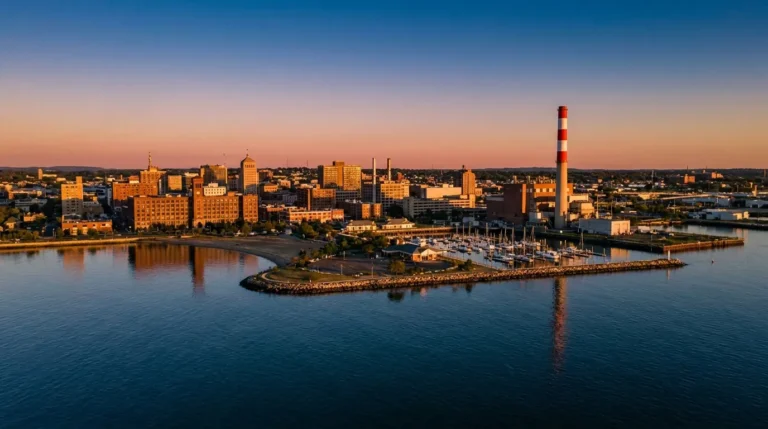
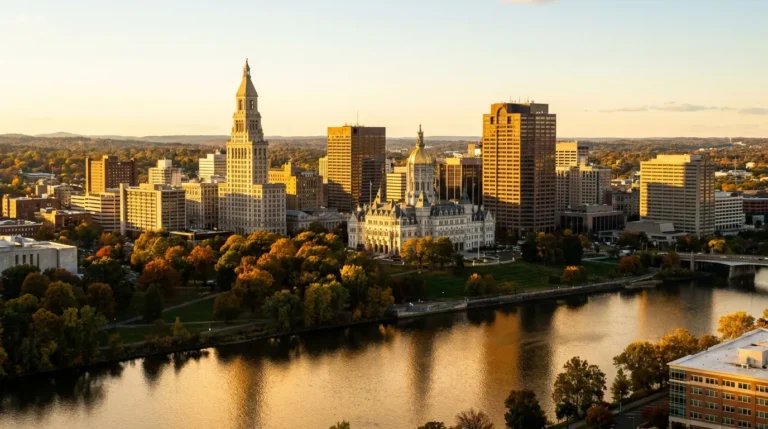
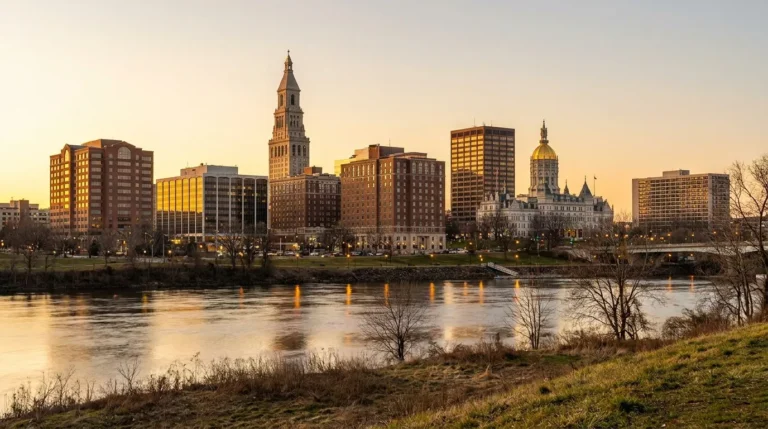
Connecticut is located in the northeastern United States, between New York and Massachusetts. It is one of the smaller states by area, but one of the wealthiest by per capita income. The main cities are Bridgeport (the largest), Hartford (the capital, home to insurance companies), New Haven (Yale University), Stamford (finance, close to NYC), Waterbury, and Norwalk.

The state has a split identity. The southwest (Stamford, Greenwich, Westport, Darien) is practically a suburb of New York, with luxury homes, bankers, and executives who commute to Manhattan by train. Hartford and Springfield (Massachusetts) form the Greater Hartford area, a hub for insurance (Aetna, The Hartford, Travelers). New Haven revolves around Yale.

For immigrants, Connecticut appeals because of its top schools, proximity to NYC and Boston, and jobs in finance, insurance, biotech, and healthcare. The cost of living is high, especially in the southwest. The Brazilian community is sizeable, concentrated in Bridgeport, Danbury, Stamford, and Waterbury. Hispanics (Puerto Ricans, Dominicans, and Brazilians) make up nearly 18% of the population.

Population
3,626,205
Average monthly salary
71,500 USD/mo
41.5978°, -72.7554°

Featured places

Top 10 places in Connecticut

The places most sought-after by immigrants in this region.

Connecticut's demographics: a White majority with Hispanic, African American, and Brazilian communities

About 65% White, 18% Hispanic, 12% African American. There is an active Brazilian community in Bridgeport, Danbury, and Stamford.

Connecticut has one of the highest proportions of Brazilians of any US state. Bridgeport, Danbury, Waterbury, Stamford, and Newark (nearby in NJ) form a region with thousands of Brazilians, many originally from Governador Valadares (MG) and the central region of Minas Gerais. There are churches, markets, restaurants, and even Brazilian medical offices and attorneys.

The Hispanic community is large and diverse: Puerto Ricans make up the largest share (especially in Hartford, Bridgeport, and New Haven), followed by Dominicans, Ecuadorians, Mexicans, and Central Americans. There is also a strong Portuguese community in Hartford, Danbury, and Bristol, with roots in 20th-century immigration from the Azores and Madeira.

African Americans make up about 12%, with a historical presence in Hartford, New Haven, Bridgeport, and Waterbury. Indian, Chinese, and Korean communities are growing in the wealthy southwestern suburbs. Non-Hispanic Whites make up 64-65% of the state, mainly of Italian, Irish, English, and Polish descent.

3,626,205
Population
41 yrs
Median age
253/km²
Density
$90,210
Median income
per year
Urban population88.0%
Foreign-born15.0%
Languages spoken
  • English
  • Spanish
  • Portuguese (strong Brazilian and Portuguese presence)
  • Italian (among older generations)
  • Polish
  • +2 more
Main religions
  • Christian (predominantly Catholic)
  • Catholic (among Hispanics, Portuguese, Italians, and Brazilians)
  • Evangelical (among Brazilians)
  • Jewish
  • No religion (growing)

Cost of living in Connecticut: high, with a peak in the southwest

Stamford and Greenwich are among the most expensive places in the US. Hartford and smaller cities are more affordable. Taxes are high.

Costs vary significantly by region. In Stamford, a one-bedroom apartment rents for between $2,200 and $3,000. In Greenwich, even more. Hartford is more affordable: $1,300 to $1,700. New Haven is around $1,500 to $2,000 (Yale drives prices up). Bridgeport and Waterbury have rentals starting from $1,200.

Stop & Shop, Big Y, Whole Foods, ShopRite, and Costco compete for shoppers. A meal at a casual restaurant costs $14 to $22, more in Stamford and Greenwich. Electricity is among the most expensive in the US, especially in winter. Heating (oil or natural gas) is a significant expense.

State income tax is progressive (up to 6.99%). Sales tax is 6.35%. Property tax is among the highest in the country: a middle-class home can cost $10,000 to $30,000 per year in property taxes. Tolls do not apply to residents, but there are truck tolls on some highways. Salaries need to be high: $100,000 to $150,000 for a family to live comfortably.

107Cost index (US = 100)7% above US average
CategorySingleCoupleFamily (2 + 2)
iHousing$1,396$1,611$2,041
iFood$408$816$1,482
iTransport$537$913$1,181
iHealthcare$301$601$1,128
iChildcare$1,955
iOther$913$1,643$2,309
Monthly total$3,555$5,584$10,096

Source: U.S. BLS Consumer Expenditure Survey 2023 + BEA Regional Price Parities 2023 · Estimates in USD, monthly.

Housing in Connecticut: expensive in the southwest, more affordable in Hartford and industrial cities

Greenwich, Westport, and Darien have multimillion-dollar homes. Hartford, Waterbury, and Bristol have much lower prices. Property taxes weigh on the budget.

In Greenwich, Westport, and Darien, homes in good neighborhoods cost from $1.5 million to $10 million. Stamford has options from $700,000 to $2 million. New Haven varies more: good neighborhoods (East Rock, Westville) from $500,000 to $900,000; others more affordable. In Hartford and surroundings, family homes in good neighborhoods (West Hartford, Glastonbury, Simsbury) run from $350,000 to $600,000.

In Bridgeport, Waterbury, and Bristol, homes sell for $250,000 to $400,000. To rent, standard American requirements apply: income of 3 times the rent, credit history, and references. Those arriving without a US credit score can offer 2-3 months upfront or a co-signer.

The biggest housing cost in Connecticut, after the price itself, is property tax. Cities like Hartford and Bridgeport have very high rates (above 70 mills, which is nearly 7% of assessed value per year). West Hartford, Glastonbury, and Simsbury are more reasonable. Recommended neighborhoods: West Hartford, Avon, Simsbury, Glastonbury (Hartford area); Westport, Fairfield, Trumbull (southwest); East Rock, Branford, Madison (New Haven area).

Purchase price (m²)
  • Center$4,400/m²
  • Outside$2,900/m²
4.6×
Price-to-income
7.0%
Mortgage rate (20y)
Recommended neighborhoods
  • West Hartford (Hartford area, top schools)
  • Glastonbury (Hartford, suburban)
  • Simsbury (Hartford, families)
  • Avon (Hartford)
  • Fairfield (between NYC and New Haven)
  • +4 more

Job market in Connecticut: insurance, finance, biotech, defense, and healthcare

Hartford is the insurance capital of the world. Stamford has finance and hedge funds. New Haven and Groton have biotech and pharma. Bridgeport and Sikorsky have defense.

Hartford is known as the Insurance Capital of the World. Aetna, The Hartford, Travelers, Cigna (in part), and dozens of insurance companies are headquartered or have major operations there. Together with pension funds and banks, the financial sector employs tens of thousands. Actuaries, analysts, programmers, and managers are well paid.

Stamford concentrates sophisticated finance: hedge funds (RBS, UBS, Point72), private equity, and investment banks. The southwestern part of the state is practically an extension of Manhattan's financial market. New Haven has Yale and a surrounding biotech ecosystem (Alexion, Achillion, various startups). Pfizer has a large campus in Groton on the coast.

Aerospace and defense: Sikorsky Aircraft (helicopters, in Stratford), Pratt & Whitney (aircraft engines, in East Hartford), Electric Boat (nuclear submarines, in Groton). Healthcare with Yale New Haven Health, Hartford HealthCare, and UConn Health. Salaries in finance and biotech in Connecticut are among the highest in the US, with averages above $90,000 per year in many sectors.

$71,500
Avg net salary
per month
$32,448
Minimum wage
per month
3.7%
Unemployment
65.2%
Labor force
Dominant sectors
  • Insurance and financial services
  • Sophisticated finance (Stamford)
  • Biotechnology and pharmaceuticals
  • Aerospace and defense
  • Healthcare
  • +3 more
Major employers
  • Aetna (Hartford)
  • The Hartford
  • Travelers (Hartford)
  • Cigna
  • Pratt & Whitney (East Hartford)
  • +6 more

Education in Connecticut: top suburban public schools, Yale as a world leader

West Hartford, Glastonbury, Westport, and Darien have schools among the best in the US. Yale leads globally, UConn is the main public university.

Connecticut has some of the best school districts in the US. Westport, Darien, Greenwich, Wilton, West Hartford, Avon, Glastonbury, Simsbury, Ridgefield, and Fairfield regularly appear in national rankings. By contrast, urban districts such as Bridgeport, Hartford, and New Haven face greater challenges.

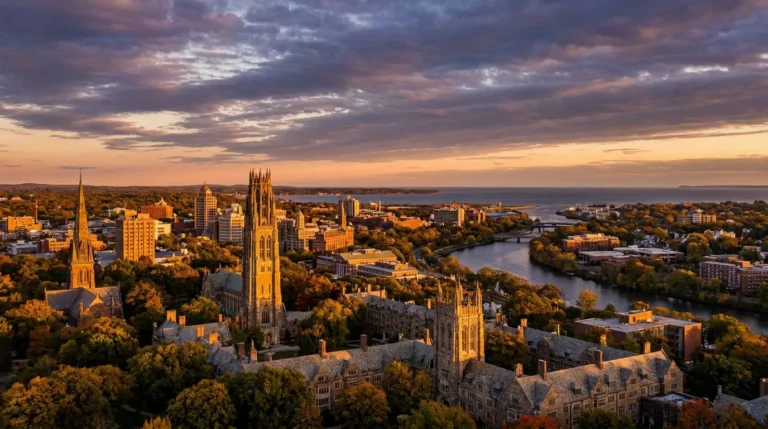
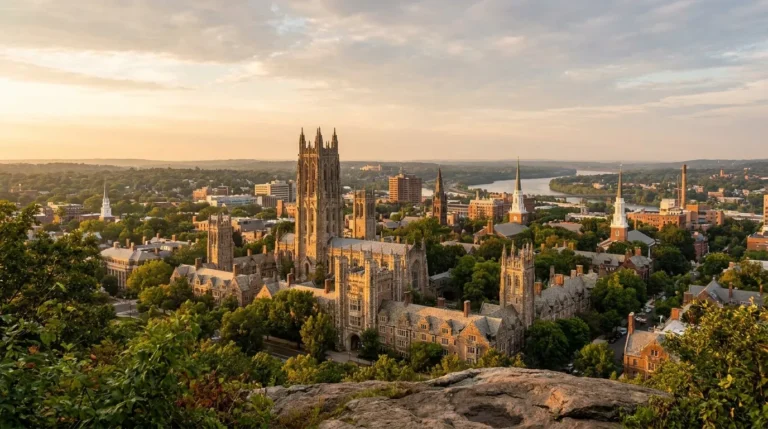
Yale University, in New Haven, is one of the oldest and most prestigious universities in the world, founded in 1701. It is strong in law (Yale Law School), medicine, drama, history, political science, and the humanities. The University of Connecticut (UConn), in Storrs, is the main public university, strong in medicine (UConn Health), agriculture, engineering, and social sciences.

Other respected universities include Wesleyan (private, Middletown), Connecticut College (New London), and Trinity College (Hartford). Yale tuition exceeds $65,000 per year, but generous scholarships are available. UConn for state residents costs around $16,000 per year. International students pay more.

Literacy98.0%
Tertiary education41.2%
478
PISA score (avg)
$18,900
Private school
per year
Notable universities
  • Yale University (New Haven)
  • University of Connecticut (UConn, Storrs)
  • Wesleyan University (Middletown, private)
  • Connecticut College (New London)
  • Trinity College (Hartford)
  • Fairfield University
  • Quinnipiac University (Hamden)
  • United States Coast Guard Academy (New London)

Healthcare in Connecticut: Yale New Haven among the US best, with broad coverage

Yale New Haven Hospital leads. Hartford HealthCare covers the central state. Connecticut's HUSKY Health (Medicaid) program offers broad coverage.

Connecticut has good hospitals. Yale New Haven Hospital is one of the best in the US, with a reputation in transplants, cardiology, oncology, and pediatrics. Hartford HealthCare operates a large network in the central state, including Hartford Hospital. UConn Health (Farmington) is the public university hospital. Stamford Health and Greenwich Hospital serve the southwest.

As throughout the US, there is no universal public system. Employer-provided insurance is the standard for those in formal employment. Connecticut expanded Medicaid under the ACA, and the state offers HUSKY Health, which covers children, pregnant women, and lower-income residents with broad coverage. Documented immigrants can access various programs.

The individual insurance marketplace is Access Health CT, with subsidies based on income. There is also HUSKY 4 (coverage for children up to a certain income level). Community clinics (FQHCs) serve patients regardless of documentation, on a sliding-fee scale. The system is more accessible than in many other states, though a private emergency room visit is still expensive without insurance (above $2,000).

Healthcare index75.0 / 100
  • Life expectancyyears at birth
    80.3yrs
  • Doctors per 1kpracticing physicians
    3.7
  • Health spendper capita, per year
    $12,100
  • Public systemoverall quality rating
    Good

Safety in Connecticut: extremely safe suburbs, urban areas with challenges

West Hartford, Westport, Darien, and Glastonbury are among the safest places in the US. Hartford, Bridgeport, and Waterbury have problem areas.

Connecticut's suburbs are among the safest places in the US. Westport, Darien, New Canaan, West Hartford, Avon, Simsbury, Madison, Wilton, and Ridgefield have very low crime rates. Families move to these neighborhoods for the combination of safety and school quality.

Urban cities (Bridgeport, Hartford, New Haven, Waterbury) have areas with crime above the national average, especially theft, assault, and drug-related violence. Neighborhoods such as Park Street and Frog Hollow in Hartford, downtown and East Side in Bridgeport, and Newhallville and Dixwell in New Haven require more care.

For immigrants, the rule is simple: live in suburbs with good schools. The Brazilian community in Bridgeport, Danbury, and Stamford does well; it is important to choose recommended neighborhoods such as the North End of Bridgeport (in Trumbull/Monroe) or areas near Danbury (Bethel, Brookfield). Roads are safe and the state has good police coverage.

4.6
Homicides per 100k
per year
Safety index
58.0
Crime index
42.0
Safer neighborhoods
  • West Hartford
  • Westport
  • Darien
  • New Canaan
  • Wilton
  • Simsbury
  • Madison
  • Avon
  • Ridgefield
  • Glastonbury
  • Trumbull
  • Fairfield
Areas to avoid
  • North Hartford
  • Bridgeport East End
  • New Haven downtown at night
  • Waterbury central districts

Transportation in Connecticut: trains to New York, car for everything else

Metro-North connects the southwest to Manhattan. Amtrak links New York to Boston through Connecticut. The rest of the state requires a car.

Southwestern Connecticut is connected to New York by the Metro-North New Haven Line, which runs from Grand Central Terminal (Manhattan) through Stamford, Norwalk, Westport, Fairfield, Bridgeport, and New Haven. Thousands of people make this commute daily. In Stamford and Greenwich, it is possible to live without a car if you work in Manhattan.

Amtrak Northeast Regional and Acela trains pass through the state, connecting New York, New Haven, Hartford, Springfield, Providence, and Boston. Hartford, New Haven, and Springfield now also have the Hartford Line (a regional rail service). In the interior, a car is essential. The main highways are I-95 (coast), I-84 (north-south from NYC via Danbury, Hartford), I-91 (north-south, New Haven to Hartford and Springfield), and the Merritt Parkway (southwest, more scenic).

Bradley International Airport (BDL), near Hartford, is the state's main airport, with domestic flights and some international routes (Dublin, Toronto, Cancun, Caribbean). Tweed New Haven (HVN) has a few regional flights. Those living in the southwest often use LaGuardia (LGA) or JFK in New York, or Westchester County (HPN). Traffic in Hartford is manageable; on the southwest's I-95, it can be heavy.

3
Metro lines
60
Metro stations
27 min
Avg commute
48
Walkability
Airports
  • BDL (Bradley International, near Hartford)
  • HVN (Tweed New Haven)
  • HPN (Westchester County, NY, used by southwestern CT)
  • GON (Groton-New London)
  • International airport
  • Bike infrastructure

Connecticut's climate: four well-defined seasons, snow in winter and heat in summer

Hot, humid summers; cold, snowy winters; fall with famous foliage colors. Coastal storms (Nor'easters) affect the shoreline.

Connecticut has a humid continental climate (Koppen Dfa/Dfb). Summer is hot and humid (June to August), with highs around 28-30°C. Air conditioning is common. Winter is cold (December to March), with January lows between -7°C and -3°C and highs near 2-4°C. Snowfall is frequent, averaging 100-150 cm per winter in some areas.

Fall is one of the most celebrated seasons. Leaves turn red, orange, and yellow between late September and mid-October, drawing tourists to see the colors in the Litchfield Hills and along routes like Route 169. Spring is wet and variable, with blooms from April to May.

The coast can experience strong storms (Nor'easters) in winter and occasional hurricanes in spring/fall. Hurricane Sandy (2012) significantly affected the coast. In general, the climate requires adaptation: real winter clothing (coat, gloves, boots), home heating (oil or gas), and car heating. May through October is the most pleasant season.

Sunny days / year194 days
Avg high (°F)
  • 38°J
  • 40°F
  • 47°M
  • 58°A
  • 68°M
  • 78°J
  • 83°J
  • 82°A
  • 75°S
  • 64°O
  • 54°N
  • 44°D
Avg low (°F)
  • 24°J
  • 26°F
  • 32°M
  • 42°A
  • 52°M
  • 62°J
  • 68°J
  • 67°A
  • 60°S
  • 48°O
  • 38°N
  • 30°D
Rainfall (")
  • 3"J
  • 3"F
  • 4"M
  • 4"A
  • 4"M
  • 4"J
  • 3"J
  • 4"A
  • 4"S
  • 4"O
  • 3"N
  • 4"D

Connecticut's culture: colonial history, Yale, college sports, and the Brazilian community

A blend of traditional New England, Yale's academic life, and Italian-Portuguese-Brazilian culture. New Haven-style pizza is a local phenomenon.

Connecticut was one of the original 13 US colonies, with a strong Puritan and Protestant heritage. Cities like Hartford, New Haven, Mystic, and Wethersfield have preserved historic centers. The state is the birthplace of several inventors (Eli Whitney invented the cotton gin in New Haven) and writers (Mark Twain lived in Hartford).

New Haven-style pizza (Neapolitan-inspired, thin, with charred crust) is among the most famous in the US. Frank Pepe Pizzeria Napoletana, Sally's Apizza, and Modern Apizza, on Wooster Square, are legendary. UConn women's basketball has dominated college women's sports for decades, with multiple national championships. Yale has traditional American football and rowing programs.

The Brazilian community is an active part of local culture, with June festivals, Carnival in Bridgeport and Stamford, and Brazilian steakhouses. The Portuguese community holds festivals (St. Mary in Hartford, for example). Italian culture is strong (patron saint celebrations, restaurants). Events include classical music (Yale School of Music), theater (Long Wharf, Hartford Stage), and art museums (Yale University Art Gallery, Wadsworth Atheneum in Hartford, the oldest art museum in the US).

230
Major museums
Notable dishes
  • New Haven-style pizza (apizza)
  • Lobster roll
  • Steamed cheeseburger (Meriden)
  • The original hamburger (allegedly invented at Louis' Lunch, New Haven)
  • New England clam chowder
  • +3 more
Annual events
  • Yale-Harvard football (The Game, November)
  • Hartford Marathon (October)
  • Brazilian June festivals (Bridgeport, June)
  • Travelers Championship (golf, Cromwell, June)
  • Mystic Seaport Sea Music Festival (June)
  • +2 more

Connecticut's main economic sectors

Insurance, finance, defense, biotech, and healthcare. Yale generates an academic-scientific ecosystem. Industrial manufacturing still relevant.

Insurance is the defining sector. Hartford is home to Aetna, The Hartford, Travelers, and Cigna, among others. This cluster generates tens of thousands of jobs in actuarial, analytics, technology, and management. Stamford concentrates sophisticated finance, with hedge funds, private equity, and investment banks.

Defense and aerospace are strong. Pratt & Whitney (aircraft engines) in East Hartford, Sikorsky (helicopters) in Stratford, and Electric Boat (nuclear submarines) in Groton are part of the state's military-industrial complex, with billions in federal contracts. Biotech has a cluster in New Haven (Yale generates startups) and Groton (Pfizer).

Healthcare with Yale New Haven and Hartford HealthCare is a major employer. Universities (Yale, UConn, Wesleyan, Trinity) are economic and cultural pillars. There is also tourism (Foxwoods and Mohegan Sun casinos in the east, wineries in the west, maritime coast) and specialized agriculture (dairy, fruit, tobacco). Traditional manufacturing, though smaller than in the past, still provides jobs.

  • GDPgross domestic product
    $322.0B
  • GDP per capitaoutput per resident
    $88,800
  • GDP growth (yr)economy expanding
    +1.6%
Top sectors
  • Insurance (Hartford, world capital)
  • Finance and hedge funds (Stamford)
  • Biotechnology and pharmaceuticals
  • Defense and aerospace
  • Healthcare
  • +3 more

Immigrant communities in Connecticut

About 540,000 immigrants live in Connecticut, with strong Latin American and Caribbean presence in Hartford, Bridgeport, and New Haven.

Connecticut is home to roughly 540,000 foreign-born residents, close to 15% of the population. The largest communities come from Jamaica, the Dominican Republic, India, Poland, and Mexico. The immigrant who arrives finds Latino concentration in Hartford, Bridgeport, Waterbury, and New Britain, with Dominican and Puerto Rican neighborhoods established for decades. Indians and Chinese cluster in Stamford and Fairfield County suburbs, tied to finance and pharmaceuticals. Danbury and Bridgeport also host a sizable Brazilian community.

The state has few consulates, and many consular services are handled through Boston or New York. Hartford hosts the Consulate-General of Jamaica and several honorary consulates. The support network is organized by the Connecticut Institute for Refugees and Immigrants (CIRI), Hartford Catholic Worker, and Integrated Refugee and Immigrant Services (IRIS) in New Haven, all offering legal aid and translation. Yale Law School runs a free immigration clinic handling asylum and deportation defense.

540,000
Foreign-born residents
estimated
Top countries of origin
  • Jamaica
  • Dominican Republic
  • India
  • Poland
  • Mexico
Main immigrant hubs
  • Hartford
  • Bridgeport
  • New Haven
  • Stamford
  • Waterbury
Foreign consulates
  • Jamaican Consulate General in Hartford
Community organizations
  • Connecticut Institute for Refugees and Immigrants (CIRI)
  • Integrated Refugee and Immigrant Services (IRIS)
  • Hartford Catholic Worker
  • Yale Law School Immigration Clinic

Latest posts

Posts about the United States

Coverage and updates related to this destination.

Showing content from the United States, as there is no specific data for Connecticut yet.