Visto n' Visa
Blog
Notícias e artigos
Destinations
Careers
Immigrants

Want to live and work in New Haven?

Personalized immigration plan with eligible visas, costs, and next steps for your goal!

If you are not eligible, you will know exactly why and what to do to improve your approval chances.

Save up to 12 hours in meetings

No pointless assessments.

Save up to 90%

Save money on vague or unfocused consultations

Avoid Fraud and Mistakes

One mistake can cost you your visa

Total Impartiality

Zero commercial bias

Decide with peace of mind

No toxic urgency

Fast and Accurate

Answers in minutes, no guesswork

New Haven's population: a university, African American, and Latino mix

Around 30% Hispanic (primarily Puerto Rican and Mexican), 30% African American, 30% white, and 5% Asian. Large presence of international students and researchers.

New Haven is a city divided between two worlds: the university world, with students and professors from around the globe drawn by Yale, Southern Connecticut State University, and Albertus Magnus College, and the long-established resident community, predominantly African American and Latino.

The Hispanic community is strong in Fair Haven, with many Puerto Ricans, Mexicans, Ecuadorians, and Guatemalans. Spanish-language churches, grocery stores, and media are part of the landscape. There is also a historic Italian community in Wooster Square, with pizzerias and festivals. The Brazilian community is small but has active groups and a few stores.

The student population adds further diversity: Chinese, Indian, South Korean, European, and Latin American residents. Around Yale, especially in East Rock and downtown, people from every continent can be found. Traditional African American and Italian families live alongside postdoctoral researchers and undergraduate students.

Languages spoken
  • English
  • Spanish (Puerto Rican and Mexican)
  • Italian (Wooster Square)
  • Mandarin (student community)
  • Portuguese (small Brazilian community)
  • +1 more
Main religions
  • Catholic Christian
  • Protestant Christian
  • No religion (prevalent among university students)
  • Jewish (historically significant)
  • Muslim
  • +1 more

Cost of living in New Haven: moderate by New England standards

More affordable than Boston and New York, but pricier than other Connecticut cities. Rent is pushed up by university demand.

New Haven is more accessible than Boston and nearby cities like Stamford or Fairfield, though rents in neighborhoods close to Yale push the average higher. A one-bedroom apartment in East Rock or downtown runs around USD 1,500 to USD 2,000. In Fair Haven or Westville, prices drop to USD 1,100 to USD 1,500.

Grocery shopping at chains like Stop & Shop, Whole Foods, ShopRite, and local markets such as Ferraro's Market is reasonably priced. A meal at a casual restaurant costs around USD 18 to USD 30. New Haven's famous pizzerias (Pepe's, Sally's, Modern) serve coal-fired pizza at mid-range prices. Cafes and bars downtown are priced like a typical college town.

Connecticut's state income tax reaches 6.99% in the higher brackets. The sales tax is 6.35%. Those living near Yale can often forgo a car, which helps the budget considerably. Downtown parking and car insurance are not cheap. Heating bills (Eversource) can be substantial in winter.

107Cost index (US = 100)7% above US average
CategorySingleCoupleFamily (2 + 2)
iHousing$1,396$1,611$2,041
iFood$408$816$1,482
iTransport$537$913$1,181
iHealthcare$301$601$1,128
iChildcare$1,955
iOther$913$1,643$2,309
Monthly total$3,555$5,584$10,096

Source: U.S. BLS Consumer Expenditure Survey 2023 + BEA Regional Price Parities 2023 · Estimates in USD, monthly.

Housing in New Haven: Victorian homes, university buildings, and duplexes

Varied housing stock: older homes in East Rock and Westville, apartments near Yale, duplexes in Fair Haven, and newer neighborhoods in West Rock.

New Haven offers housing from many eras and styles. East Rock is the most sought-after neighborhood for Yale professors and graduate students, with Victorian homes, tree-lined streets, and bakeries. Wooster Square features traditional homes and the neighborhood's famous cherry blossom bloom in spring. Downtown has newer buildings catering to students.

Westville, on the west side, attracts families with larger homes, a suburban feel, and good schools. Fair Haven, to the east, is the most Latino neighborhood, with duplexes and more affordable options. Dixwell and Newhallville are traditionally African American communities undergoing change. The Hill, near Yale hospital, mixes medical students with long-time residents.

To rent, landlords typically require proof of income (3x the monthly rent), references, and a security deposit. Those arriving as students often need a co-signer or must pay several months upfront. Yale Off-Campus Living is a popular listing resource. Zillow, Apartments.com, Trulia, and Facebook groups are also widely used.

Recommended neighborhoods
  • East Rock (graduate students, professors)
  • Wooster Square (historic Italian neighborhood, cherry blossoms)
  • Downtown New Haven (vibrant center)
  • Westville (families, larger homes)
  • Fair Haven (Latino community, better prices)
  • +1 more

Job market in New Haven: Yale, healthcare, and biotechnology

Yale and its hospital are the largest employers. A growing biotech cluster surrounds the university. Light manufacturing and urban services are also present.

Yale University and Yale New Haven Hospital together employ more than 25,000 people in the city. The two form the backbone of the local economy, with positions in teaching, research, healthcare, administration, maintenance, security, and services. For many immigrants, these institutions are the first point of entry as technicians, aides, and healthcare professionals.

Around Yale, a biotechnology cluster is growing, with university spin-off companies working in pharmaceuticals, genomics, and medical devices. Alexion (formerly Alexion Pharmaceuticals), for example, was founded in New Haven. Tetraphase, BioXcel, and other startups round out the ecosystem. Technical and scientific positions require high levels of qualification.

Outside Yale, there is light manufacturing, construction, and urban services. The Port of New Haven handles cargo and generates jobs. Downtown restaurants and hotels hire for front-of-house, kitchen, and hospitality roles, with Connecticut's minimum wage set at USD 15.69 per hour in 2024. Many residents work at regional hospitals and schools.

Dominant sectors
  • University and research (Yale)
  • Healthcare and hospitals
  • Biotechnology and pharmaceuticals
  • Construction
  • Commerce and services
  • +1 more
Major employers
  • Yale University
  • Yale New Haven Hospital
  • Yale New Haven Health System
  • Knights of Columbus (world headquarters)
  • Alexion (biotech, historic headquarters)
  • +2 more

Education in New Haven: a diverse public system with Yale as anchor

The public district features renowned magnet schools. Yale, Southern Connecticut State University, and Albertus Magnus College make up the local higher education landscape.

New Haven Public Schools operates more than 40 schools, including prestigious magnet schools such as the Cooperative Arts & Humanities High School and the Engineering and Science University Magnet School. Families from across southern Connecticut apply for spots in these magnets, which use a lottery system and draw students from outside the city.

Children of immigrants with valid visas are entitled to attend public school. Bilingual programs in Spanish and English-language learner support are available. Catholic schools (St. Martin de Porres Academy) and private schools (Hopkins School, founded in 1660) offer paid alternatives.

In higher education, Yale University, founded in 1701, is one of eight Ivy League institutions, with its schools of medicine, law, drama, management, and architecture ranked among the best in the world. Southern Connecticut State University, a public institution, serves thousands of local students. Albertus Magnus College, a Catholic institution, is smaller and well regarded in the state. Gateway Community College is located downtown.

Notable universities
  • Yale University (Ivy League)
  • Southern Connecticut State University
  • Albertus Magnus College
  • Yale School of Medicine
  • Gateway Community College
  • Yale Law School

Healthcare in New Haven: Yale New Haven Hospital, a national reference

Yale New Haven Hospital ranks among the best hospitals in the United States, with cutting-edge technology and Yale research.

Yale New Haven Hospital is one of the most respected academic medical centers in the United States, with more than 1,500 beds and specialties in oncology (Smilow Cancer Hospital), cardiology, neurology, pediatrics (Yale New Haven Children's Hospital), and transplantation. It treats patients from across New England and internationally.

The American healthcare system operates through private insurance plans. Employers typically offer insurance as a benefit. Those without coverage can apply for Husky Health (Connecticut's Medicaid program) or purchase a plan through Access Health CT, the state marketplace. Newly arrived residents without permanent status depend on private plans, direct payment, or community health centers.

For basic care without insurance, Cornell Scott-Hill Health Center and Fair Haven Community Health Care offer sliding-scale payment. In an emergency, any hospital emergency department must provide care, though bills for the uninsured can be significant. Yale also operates clinics focused on specific populations, including immigrants and patients with HIV.

Healthcare index72.0 / 100
  • Life expectancyyears at birth
    78.4yrs
  • Doctors per 1kpracticing physicians
    3.7
  • Health spendper capita, per year
    $13,473
  • Public systemoverall quality rating
    Good

Safety in New Haven: safer than Bridgeport, with areas requiring attention

The city is considered moderately safe. East Rock, Westville, and Wooster Square are quiet. Newhallville, Dixwell, and parts of Fair Haven require caution.

New Haven has crime rates above the Connecticut average, but below those of Bridgeport. Neighborhood choice matters significantly: East Rock, Westville, Wooster Square, and downtown during the day are considered safe. Yale maintains its own police department (Yale Police Department), which patrols not only the campus but surrounding areas as well.

Neighborhoods such as Newhallville, Dixwell, parts of Fair Haven, and The Hill show higher incident rates, primarily theft, robbery, and drug-related offenses. Violent crimes tend to occur between people who know each other and rarely affect visitors or students who take basic precautions.

For immigrants deciding where to live, checking the ZIP code before signing a lease is worthwhile. Standard precautions apply: avoid leaving valuables visible in a parked car, lock bicycles securely (theft is a real issue), use ride-share apps at night, and stay alert on empty streets. Yale offers a safe escort service for students during nighttime hours.

5.8
Homicides per 100k
per year
Safety index
40.0
Crime index
60.0
Safer neighborhoods
  • East Rock
  • Westville
  • Wooster Square
  • Downtown (near Yale)
  • Prospect Hill
  • Morris Cove
Areas to avoid
  • parts of Newhallville at night
  • Dixwell during late hours
  • Fair Haven on certain streets after dark
  • The Hill on specific blocks

Transportation in New Haven: trains to New York and Boston, walkable downtown

Union Station offers Metro-North service to Manhattan and Amtrak to Boston, Washington, and beyond. Downtown is compact and walkable.

New Haven's Union Station is one of the busiest stations in the northeastern United States. It is served by Metro-North (New Haven Line) with continuous service to Stamford and Grand Central Terminal in Manhattan, in about 2 hours. Amtrak runs through the Northeast Corridor, connecting New Haven to Boston, Providence, Philadelphia, Washington, and New York via the Acela and Northeast Regional routes.

Within the city, CT Transit New Haven buses cover all neighborhoods at low fares. Downtown is compact and walkable, and Yale operates its own shuttles for students and staff. Bike lanes are expanding, though the infrastructure is not yet complete. Many residents in East Rock or Wooster Square walk to downtown.

Interstate 95, I-91, and the Wilbur Cross Parkway run through or alongside the city. Downtown parking is expensive. Tweed New Haven Airport offers regional flights (Avelo Airlines serves several routes), but international flights depart from Bradley International (in Windsor Locks, about 1 hour away), LaGuardia, JFK, or Newark.

22 min
Avg commute
71
Walkability
Airports
  • HVN — Tweed New Haven Airport (regional)
  • Bike infrastructure

What the climate is like living in New Haven

Four distinct New England coastal seasons, with humid summers near 28 degrees Celsius, cold winters with regular snowfall, and an Atlantic breeze year-round.

Summer in New Haven runs from June through September, with highs between 26 and 30 degrees Celsius and high humidity. The proximity of Long Island Sound moderates the heat somewhat, but thunderstorms and occasional heat waves still make air conditioning a necessity at home and in the office.

Winter brings the harsher side of the climate. Between December and March, lows drop below freezing and the city accumulates an average of 80 to 100 centimeters of snow. Central heating systems, window insulation, and layered clothing are essential parts of the household budget.

Spring and autumn pass quickly but reward the investment. Fall colors the parks in red and orange, while spring brings flowering to the university campuses. For those arriving from tropical climates, the first winter is the most difficult adaptation challenge.

Sunny days / year195 days
Avg high (°F)
  • 40°J
  • 42°F
  • 49°M
  • 58°A
  • 67°M
  • 76°J
  • 83°J
  • 81°A
  • 74°S
  • 64°O
  • 53°N
  • 45°D
Avg low (°F)
  • 26°J
  • 27°F
  • 32°M
  • 41°A
  • 50°M
  • 60°J
  • 68°J
  • 67°A
  • 60°S
  • 51°O
  • 38°N
  • 32°D
Rainfall (")
  • 5"J
  • 4"F
  • 4"M
  • 6"A
  • 4"M
  • 4"J
  • 5"J
  • 4"A
  • 6"S
  • 6"O
  • 3"N
  • 6"D

Culture in New Haven: Yale, coal-fired pizza, and festivals

An intense cultural life for the city's size, with Yale museums, theaters, jazz, and pizza that fans rank alongside Naples.

Yale's presence makes New Haven one of the most culturally rich cities in the United States for its size. The Yale University Art Gallery and the Yale Center for British Art (both free) hold internationally renowned collections. The Peabody Museum covers natural history, and the Beinecke Rare Book and Manuscript Library preserves rare manuscripts. The Shubert Theatre is a historic venue for Broadway tryouts.

New Haven-style pizza is an institution. Frank Pepe's Pizzeria Napoletana (since 1925), Sally's Apizza, and Modern Apizza compete for the title of city's best. The thin-crust pie, with charred edges from a coal-fired oven and toppings such as white clam pizza, is the city's calling card. Louis' Lunch also draws lines, claiming to have invented the American hamburger.

The International Festival of Arts and Ideas in summer and the Cherry Blossom Festival in Wooster Square (home to historic Italian cherry trees) mark the calendar. Bars, cafes, and venues such as Toad's Place (which has hosted Bob Dylan and the Rolling Stones) fill the nights. A strong classical music, jazz, and experimental theater scene is also present.

New Haven

New Haven, home of Yale and Connecticut's cultural capital

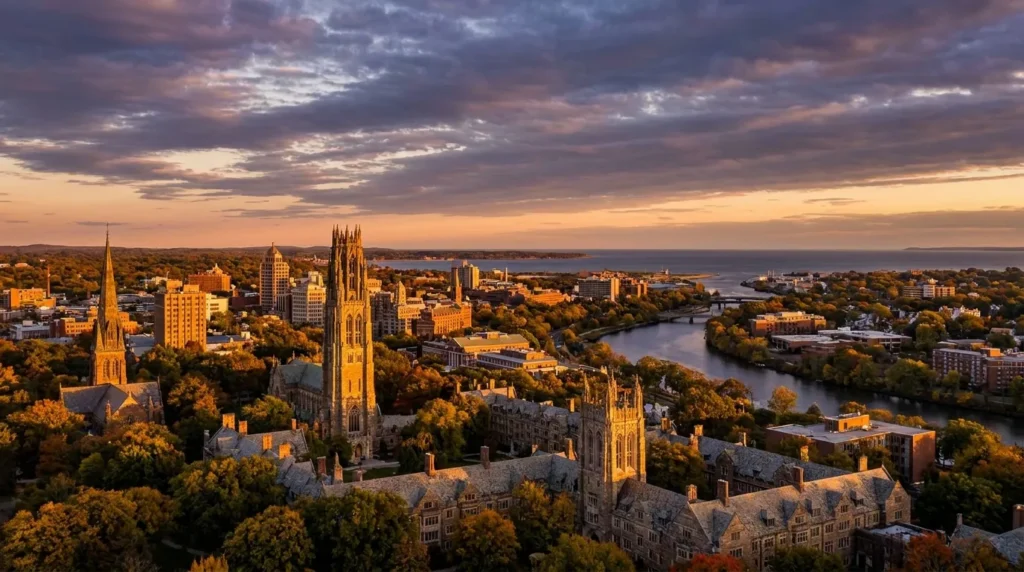
A harbor city on Long Island Sound, New Haven revolves around Yale University, New Haven-style apizza, and an established theater and jazz scene centered on Chapel Street and the New Haven Green.

Yale University occupies much of the downtown area with neo-Gothic buildings. Guided tours depart from the Yale Visitor Center, and two campus museums are free and outstanding: the Yale University Art Gallery, with works by Van Gogh and Hopper, and the Yale Center for British Art. The Peabody Museum of Natural History, currently under renovation, is expected to reopen with its famous dinosaur gallery.

The New Haven Green anchors downtown with three historic churches and seasonal markets. Wooster Square, the traditional Italian-American neighborhood, is where apizza was born, and Frank Pepe's, Sally's, and Modern Apizza all compete for the title of best in the city. Chapel Street and College Street are lined with restaurants, bars, and the Shubert Theatre, a stage for Broadway premieres.

East Rock Park offers the best viewpoint in the city. Lighthouse Point Park, at the mouth of the harbor, is a popular urban beach in summer. Festivals such as the International Festival of Arts and Ideas in June and the Wooster Square Cherry Blossom Festival in April mark the calendar.

  1. 1["Yale University campus and Old Campus"
  2. 2"Yale University Art Gallery"
  3. 3"Yale Center for British Art"
  4. 4"Peabody Museum of Natural History"
  5. 5"New Haven Green"
  6. 6"Shubert Theatre"
Nightlife6.0 / 10
Parks & green spaces
  • ["New Haven Green"
  • "East Rock Park"
  • "West Rock Ridge State Park"
  • "Edgerton Park"
  • "Wooster Square Park"
  • +1 more

Latest posts

Straight from the blog

There are no posts specifically about New Haven yet. In the meantime, check out our latest posts.