Visto n' Visa
Blog
Notícias e artigos
Destinations
Careers
Immigrants

Want to live and work in Waterbury?

Personalized immigration plan with eligible visas, costs, and next steps for your goal!

If you are not eligible, you will know exactly why and what to do to improve your approval chances.

Save up to 12 hours in meetings

No pointless assessments.

Save up to 90%

Save money on vague or unfocused consultations

Avoid Fraud and Mistakes

One mistake can cost you your visa

Total Impartiality

Zero commercial bias

Decide with peace of mind

No toxic urgency

Fast and Accurate

Answers in minutes, no guesswork

Waterbury's population: strong Puerto Rican and Dominican presence

About 35% Hispanic, 20% African American, 40% white, and 5% Asian. Puerto Rican, Dominican, Albanian, and Italian communities carry historical weight.

Waterbury has one of the largest Puerto Rican communities per capita in the northeastern United States, arriving during the immigration waves of the 1950s and 1960s to work in the factories. Today the Hispanic community represents about 35% of the total population, including Dominicans, Mexicans, and Central Americans.

The African American population is around 20%, with long-established families and recent immigrants from the Caribbean and West Africa. The white community, about 40%, includes strong Italian-descended populations (Town Plot and Brooklyn) and historical French-Canadian roots. There is also an Albanian-Kosovar community (one of the largest in the US by proportion) and a Portuguese community, particularly from the Azores.

English predominates, but Spanish is widely spoken downtown and in neighborhoods like Brooklyn and North End. In Albanian and Portuguese communities, the languages are still heard at home and in churches. The Brazilian community in Waterbury is small but present, with some grocery stores and professionals working in construction and cleaning.

Languages spoken
  • English
  • Spanish (Puerto Rican and Dominican)
  • Albanian
  • Portuguese (Azorean community)
  • Italian (third generation)
  • +1 more
Main religions
  • Roman Catholic
  • Protestant and Pentecostal Christian
  • No religion
  • Muslim (Albanian community)
  • Orthodox (European community)

Cost of living in Waterbury: among the lowest in Connecticut

Rent and real estate are affordable compared to any city in southwestern Connecticut. Property tax is high, reflecting the city's limited tax base.

Waterbury has some of the lowest housing costs in Connecticut. A one-bedroom apartment ranges from USD 900 to USD 1,300. Buying a home starts around USD 130,000 in more modest neighborhoods and rarely exceeds USD 250,000 in residential areas. Compared with Stamford or Greenwich, the difference is substantial.

The challenge is property tax. Waterbury has a high mill rate, reflecting the limited tax base of a post-industrial city. For a home valued at USD 180,000, annual property taxes can reach USD 5,000 to 7,000. Those seeking low prices need to factor this into their monthly budget.

Grocery shopping at chains such as Stop & Shop, ShopRite, Aldi, Walmart, and Latin markets is reasonably priced. A meal at a popular restaurant costs USD 10 to USD 20. State income tax reaches 6.99% in higher brackets, and the sales tax is 6.35%. Heating bills (Eversource) are significant in winter. Car insurance in Waterbury is expensive due to a history of vehicle theft.

107Cost index (US = 100)7% above US average
CategorySingleCoupleFamily (2 + 2)
iHousing$1,396$1,611$2,041
iFood$408$816$1,482
iTransport$537$913$1,181
iHealthcare$301$601$1,128
iChildcare$1,955
iOther$913$1,643$2,309
Monthly total$3,555$5,584$10,096

Source: U.S. BLS Consumer Expenditure Survey 2023 + BEA Regional Price Parities 2023 · Estimates in USD, monthly.

Housing in Waterbury: duplexes, Victorian homes, and converted industrial buildings

The city has a large supply of duplexes and older homes at accessible prices. Town Plot and Bunker Hill are traditional neighborhoods. Downtown has converted industrial buildings.

Waterbury is full of duplexes (two-family houses) and large Victorian homes, a legacy of industrial prosperity. Town Plot is one of the traditional neighborhoods, with homes on steep streets and views of the city. Bunker Hill, to the east, is also an established residential area. Overlook has larger, better-valued homes. Brooklyn is traditionally Italian and Latino.

Downtown has old industrial buildings converted into apartments, part of an ongoing revitalization effort. Hopeville and Long Hill are in the west and east, respectively, with modest homes. East Mountain and Bucks Hill, further north and northeast, have a suburban feel with newer homes. North End and parts of downtown have the most affordable properties, but also greater social challenges.

To rent, landlords typically require proof of income (3x the rent), references, and a deposit. Those arriving without a U.S. credit history may need a co-signer or to pay several months upfront. Popular platforms include Zillow, Apartments.com, Trulia, Realtor.com, and Facebook Marketplace. Buying a duplex and living on one floor while renting the other is a common strategy in Waterbury.

Recommended neighborhoods
  • Town Plot (traditional, city views)
  • Bunker Hill (established residential)
  • Overlook (more valued, large homes)
  • East Mountain (suburban, newer homes)
  • Bucks Hill (residential, suburban feel)
  • +1 more

Job market in Waterbury: healthcare, light manufacturing, and logistics

Healthcare is the fastest-growing sector, with Saint Mary's Hospital and Waterbury Hospital as major employers. Light manufacturing, construction, and logistics round out the picture.

Waterbury has been in economic transition since the end of the brass era. Healthcare has become the largest sector, with Saint Mary's Hospital (part of Trinity Health Of New England) and Waterbury Hospital (part of Prospect Medical Holdings) as the dominant employers. Together they hire thousands of professionals in nursing, technical roles, administration, and services.

Manufacturing still exists, though at a much smaller scale. Companies such as Webster Bank (headquartered in Waterbury with a large operation), Post University, and some remaining industries (medical instruments, automotive parts) continue to hire. Logistics has grown with I-84, which connects Boston and New York. Warehouses and distribution centers operate throughout the region.

For newly arrived immigrants, traditional job openings are in restaurants, construction, cleaning, driving, elder care, and landscaping. Connecticut's minimum wage is USD 15.69 per hour (2024). Many Waterbury residents work in Hartford, New Haven, Danbury, or Bristol, commuting by car via I-84 or Route 8.

Dominant sectors
  • Healthcare and hospitals
  • Light manufacturing
  • Construction
  • Logistics and warehouses
  • Higher education
  • +1 more
Major employers
  • Saint Mary's Hospital (Trinity Health)
  • Waterbury Hospital (Prospect)
  • Webster Bank (headquarters)
  • Post University
  • Naugatuck Valley Community College
  • +2 more

Education in Waterbury: a large public school system and Naugatuck Valley Community College

Waterbury Public Schools operates more than 30 schools. Post University (private) and Naugatuck Valley Community College are the main higher education institutions.

Waterbury Public Schools is the third largest district in Connecticut, with more than 30 schools. Quality varies considerably, and many families seek inter-district magnet schools or charter schools. Children of immigrants with valid visas are entitled to public education. Bilingual programs in Spanish and support for English language learners are available.

Private schools such as Holy Cross High School (Catholic) and Chase Collegiate (secular, now closed) have historically served families with more resources. In neighboring towns such as Middlebury, Cheshire, and Watertown, public schools tend to be better rated, and families who have the option often prefer to live outside the city for this reason.

Post University, downtown, is a private college with a strong online program. Naugatuck Valley Community College offers two-year degrees at affordable prices. UConn Waterbury, part of the University of Connecticut, has a campus in the city. For elite colleges, Yale (in New Haven), Trinity College (in Hartford), and the University of Hartford are 30 to 60 minutes away.

Notable universities
  • Post University
  • Naugatuck Valley Community College
  • UConn Waterbury
  • Yale University (in New Haven, nearby)
  • Trinity College (in Hartford, nearby)
  • University of Hartford (nearby)

Healthcare in Waterbury: two large hospitals serve the region

Saint Mary's Hospital and Waterbury Hospital cover the Naugatuck Valley. For complex treatments, patients travel to Hartford or New Haven.

Waterbury has two large hospitals serving the Naugatuck Valley. Saint Mary's Hospital, part of Trinity Health Of New England, has around 350 beds and provides emergency, maternity, surgery, and cardiology services. Waterbury Hospital, part of Prospect Medical Holdings, is the second facility, with a similar profile.

For complex treatments such as advanced cancer, transplants, or neurosurgery, patients are typically referred to Hartford Hospital (35 minutes away) or Yale New Haven Hospital (45 minutes away). UConn Health, in Farmington, also handles specialized cases. Both local hospitals offer 24-hour emergency services.

The American system operates through private insurance plans. Employers in Waterbury commonly offer coverage as a benefit, though quality varies. Those without coverage can apply for Husky Health (Connecticut Medicaid) or purchase a plan through Access Health CT. For basic care without insurance, StayWell Health Center offers a sliding-scale fee based on income.

Healthcare index64.0 / 100
  • Life expectancyyears at birth
    78.4yrs
  • Doctors per 1kpracticing physicians
    3.7
  • Health spendper capita, per year
    $13,473
  • Public systemoverall quality rating
    Good

Safety in Waterbury: crime rates above the state average

City with crime rates above Connecticut's average. Residential neighborhoods like Town Plot, Bunker Hill, and Overlook are quiet. Downtown and North End require attention.

Waterbury has crime rates above Connecticut's average, similar to Bridgeport and Hartford. Distribution is uneven. Residential neighborhoods such as Town Plot, Bunker Hill, Overlook, East Mountain, and Bucks Hill are considered safe, with a typical suburban lifestyle.

Downtown and North End concentrate the majority of incidents, with crimes related to drug trafficking, theft, and group violence. Violent crimes typically occur between acquaintances and rarely affect bystanders. The Waterbury Police Department maintains patrols and community initiatives. Car theft is a long-standing problem in the city, with Waterbury appearing in national vehicle theft rankings.

For immigrants deciding where to live, researching the ZIP code before signing a lease is advisable. Tools such as City-Data, NeighborhoodScout, and the city's own website are helpful. Standard precautions: do not leave anything visible in the car (including an unlocked vehicle), use anti-theft devices, and be aware of deserted streets at night.

5.8
Homicides per 100k
per year
Safety index
42.0
Crime index
58.0
Safer neighborhoods
  • Town Plot
  • Bunker Hill
  • East Mountain
  • Country Club area (North End)
  • Overlook
Areas to avoid
  • parts of North Square at night
  • Crownbrook on isolated streets
  • South End in industrial areas
  • Brooklyn during late hours

Transportation in Waterbury: train to Bridgeport, I-84 to Hartford and New York

The Metro-North Waterbury Branch connects to Bridgeport, with service to Manhattan. I-84 runs through the city. Route 8 heads south to Bridgeport and north to Massachusetts.

Waterbury has a Metro-North station downtown (Waterbury Station), but service frequency is low. The Waterbury Branch of the New Haven Line offers only a few trains per day, with a connection at Bridgeport to reach Manhattan. The full journey to Grand Central takes over 2 hours and 30 minutes. For many people, it is faster to drive to Bridgeport or Stamford and board the train there.

I-84 runs east-west through the city, connecting to Hartford (and Boston) to the west, and Newburgh, New York, to the east. Route 8 runs north-south, from Bridgeport on the coast up to Winsted and Massachusetts. During peak hours, traffic on I-84 can be heavy. Within the city, CT Transit Waterbury buses cover the neighborhoods at low fares.

For air travel, Bradley International Airport (BDL) in Windsor Locks is about one hour away. New York area airports (JFK, LaGuardia, Newark) are 1.5 to 2 hours by car. Downtown Waterbury is small and partially walkable, but the city is hilly and generally requires a car to get around.

24 min
Avg commute
56
Walkability
Airports
  • OXC — Waterbury-Oxford Airport (regional, general aviation)
  • BDL — Bradley International (Windsor Locks, main international option)

What the climate is like living in Waterbury

Inland Connecticut city with four distinct seasons, humid summers near 28 degrees Celsius, harsh snowy winters, and colorful autumns.

Summer in Waterbury runs from June through September, with highs typically between 26 and 29 degrees Celsius and elevated humidity. Afternoon thunderstorms are common in July and August. Most homes are equipped with central or window air conditioning to handle heat waves comfortably.

Winters are cold and snowy. From December through March, lows drop below freezing, and the city averages around 100 centimeters of snow over the season. Gas or oil heating systems and layered thermal clothing are essential for getting through the coldest months.

Spring and autumn are brief but visually striking. Fall is the city's most photogenic season, with red and yellow foliage covering the surrounding hills. Newcomers from warmer climates will need time to adjust to the first winter, though local infrastructure handles the conditions well.

Sunny days / year195 days
Avg high (°F)
  • 38°J
  • 40°F
  • 49°M
  • 58°A
  • 68°M
  • 78°J
  • 84°J
  • 82°A
  • 73°S
  • 63°O
  • 51°N
  • 43°D
Avg low (°F)
  • 24°J
  • 24°F
  • 30°M
  • 39°A
  • 48°M
  • 58°J
  • 66°J
  • 65°A
  • 57°S
  • 48°O
  • 35°N
  • 29°D
Rainfall (")
  • 4"J
  • 4"F
  • 4"M
  • 6"A
  • 4"M
  • 4"J
  • 6"J
  • 4"A
  • 6"S
  • 6"O
  • 3"N
  • 6"D

Culture in Waterbury: Palace Theater, Mattatuck Museum, and industrial heritage

Historic downtown with buildings from the brass era. Palace Theater (restored), Mattatuck Museum, ethnic festivals, and a local music scene.

The Palace Theater, restored in 2004, is the city's cultural gem. Opened in 1922, it hosts Broadway tours, concerts, ballet, and other performances. The Mattatuck Museum, downtown, is one of the finest museums for a city of Waterbury's size, with American art and a collection on the history of brass manufacturing. The Brass Mill Center mall occupies former industrial grounds.

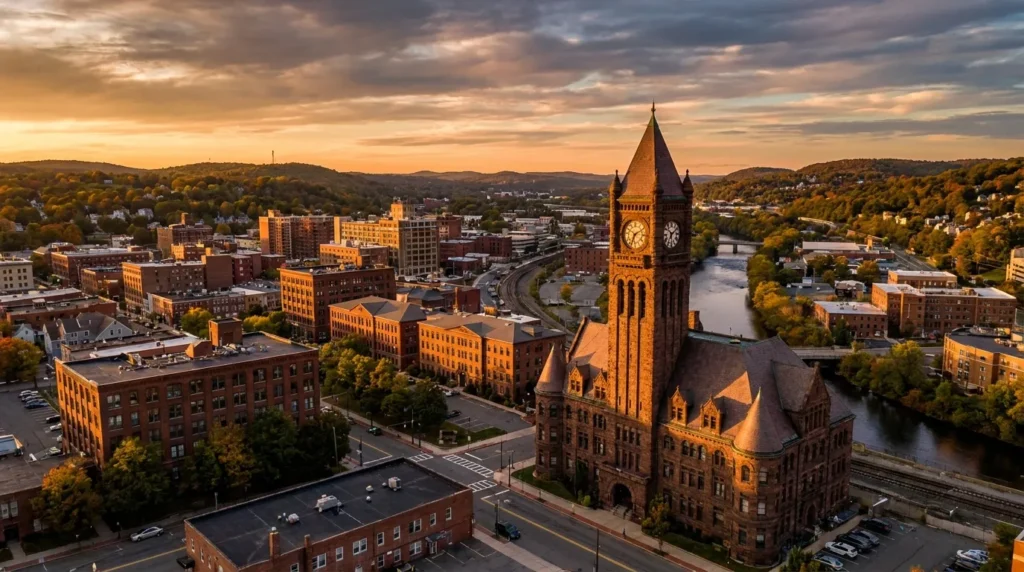
Industrial heritage is visible throughout downtown, with brick buildings, old smokestacks, and vintage clocks. The Clock Tower of the former Union Station is one of the city's symbols. Holy Land USA, a religious theme park on the hillside, is a curious attraction, abandoned for decades and undergoing partial revitalization.

The city has a strong ethnic food scene. Puerto Rican restaurants serve mofongo and jibarito. Italian-style pizza shops compete in the New Haven tradition (Brick Oven, Roselli's). Albanian, Dominican, and Azorean restaurants round out the options. Festivals such as the Puerto Rican Day Parade and the Greek Festival at Holy Trinity Church bring communities together.

Waterbury

Attractions and culture in Waterbury, Connecticut

Historic industrial city in the Naugatuck River valley, known as the Brass City, featuring Beaux-Arts architecture downtown, the Mattatuck Museum, and Olmsted-designed parks.

Waterbury was once the center of America's brass industry, earning it the nickname Brass City, and that heritage is visible throughout the historic downtown, with Beaux-Arts buildings surrounding the Green. The Clock Tower, next to the former Union Station (now home to the Republican-American), was modeled after the Torre del Mangia in Siena and remains the city's defining landmark.

The Mattatuck Museum, located downtown, holds a strong collection of American art and a section dedicated to local industrial history. The restored Palace Theater hosts Broadway touring shows and concerts, while Seven Angels Theatre supports the local arts scene. The Basilica of the Immaculate Conception and the Cathedral of Saints Peter and Paul are notable architectural landmarks in the city center.

Fulton Park, designed by the Olmsted Brothers firm, is the primary green space, offering a lake, walking trails, and gardens. Hamilton Park and Lakewood Park round out the park system. Holy Land USA, an abandoned religious theme park, has become an offbeat pilgrimage destination and has been partially restored. For natural escapes outside the city, Mattatuck Forest and Lake Quassapaug are close by.

  1. 1["Mattatuck Museum"
  2. 2"Palace Theater (historic
  3. 31922)"
  4. 4"Holy Land USA (biblical theme park
  5. 5partially restored)"
  6. 6"Timexpo Museum (partially closed
Nightlife4.0 / 10
Parks & green spaces
  • ["Hamilton Park"
  • "Fulton Park"
  • "Library Park"
  • "Chase Park"
  • "Lakewood Park"
  • +1 more

Latest posts

Straight from the blog

There are no posts specifically about Waterbury yet. In the meantime, check out our latest posts.