Visto n' Visa
Blog
Notícias e artigos
Destinations
Careers
Immigrants

Want to live and work in Tanaina?

Personalized immigration plan with eligible visas, costs, and next steps for your goal!

If you are not eligible, you will know exactly why and what to do to improve your approval chances.

Save up to 12 hours in meetings

No pointless assessments.

Save up to 90%

Save money on vague or unfocused consultations

Avoid Fraud and Mistakes

One mistake can cost you your visa

Total Impartiality

Zero commercial bias

Decide with peace of mind

No toxic urgency

Fast and Accurate

Answers in minutes, no guesswork

Tanaina's population: young families, military presence, and Native residents

Predominantly white, with military families (Elmendorf-Richardson base), workers commuting from Anchorage and Wasilla, and Athabascan residents.

Most residents are white, with young families who relocated from the Lower 48 or from Anchorage in search of cheaper land. The region's growth rate has attracted substantial new construction over recent decades, and Tanaina is one of the focal points.

The military presence is considerable, with families connected to Elmendorf-Richardson (about an hour's drive) preferring to live off-base. The Athabascan community also maintains a historical presence, with Dena'ina families living throughout the area.

Brazilians are rare. Hispanics, Filipinos, and Asians form smaller minorities. The predominant profile is families with children, in homes with yards, pets, and a snowmachine in the garage. Churches play an important social role, with a notable LDS (Mormon) presence.

Languages spoken
  • English
  • Spanish
  • Tagalog (Filipino)
  • Athabascan (Dena'ina)
  • Korean
Main religions
  • Protestant Christian (various denominations)
  • No religion
  • Mormon (LDS)
  • Catholic

Cost of living in Tanaina: more affordable than Anchorage, no state income tax

Housing and rent are cheaper than in Anchorage. Food and fuel follow Alaska's pattern, higher than the rest of the U.S.

Tanaina's main draw is housing cost. Large-lot homes are priced significantly below comparable properties in Anchorage. Military families with housing allowances (BAH) can live very comfortably in the area.

Food, gas, and goods follow the Alaskan standard: more expensive than the rest of the country due to freight costs. Home heating in winter is the largest extra expense, especially in large or poorly insulated homes. The Matanuska Electric Association provides electricity to the region.

There is no state income tax and no state or municipal sales tax in the Mat-Su. Residents who have lived in Alaska for a full year receive the annual Permanent Fund Dividend. This offsets part of the extra cost of living this far north.

Tanaina

Housing in Tanaina: spacious homes in newer subdivisions

Single-family homes on large lots dominate. Much recent construction, with new neighborhoods developed over the past 10 years.

The standard is a detached home on a generous lot, generally half a hectare or more. Recent construction features good thermal insulation, double garages, and in many cases heated basements. New subdivisions have been appearing throughout the region, part of the Mat-Su's rapid population growth.

Neighborhoods closer to the Knik Arm have homes with water views and views of Mount Susitna volcano. Areas near Wasilla are denser and more convenient, with commercial services close at hand. Further west, homes become more isolated, on gravel roads that require 4x4 vehicles in winter.

Renting is possible but most of the market is purchase. Those relocating from the Lower 48 seeking lower costs frequently choose the area to buy land and build. Zillow, Realtor.com, and local brokers are the primary resources.

Recommended neighborhoods
  • Near Wasilla (most convenient, commercial services close by)
  • Settlers Bay (views of the Knik Arm)
  • Knik-Goose Bay Road (central residential area)
  • Western areas (more rural, larger lots)

Job market in Tanaina: commuter town, employment in Wasilla or Anchorage

Almost no one works in Tanaina itself. Most residents drive to Wasilla (15 min) or Anchorage (1 hour). Local jobs are in retail and construction.

Tanaina has no significant local economy. Most residents work in Wasilla (healthcare, retail, the school district) or in Anchorage (government, healthcare, oil, Elmendorf-Richardson military base). Remote work expanded substantially after 2020.

Nearby employers include Mat-Su Regional Medical Center, the Mat-Su Borough School District, retail chains (Fred Meyer, Target, Walmart in Wasilla), and the construction sector, which continues to grow with the region's population increase.

Seasonal jobs in fishing, tourism (lodges, tours), and construction pay well between May and September. The oil industry and Elmendorf-Richardson military base in Anchorage offer stable employment with above-average salaries.

Dominant sectors
  • Construction
  • Healthcare (in Wasilla and Anchorage)
  • Retail
  • Education (Mat-Su district)
  • Remote work
  • +2 more
Major employers
  • Mat-Su Regional Medical Center (Wasilla)
  • Mat-Su Borough School District
  • Joint Base Elmendorf-Richardson (Anchorage)
  • Providence Alaska Medical Center (Anchorage)
  • Fred Meyer (Wasilla)

Education in Tanaina: Mat-Su schools and a nearby community college

Children attend schools in the Mat-Su Borough School District. Mat-Su College (UAA) is located in Palmer and offers introductory higher education.

The Mat-Su Borough School District serves the area. Children living in Tanaina attend schools such as Knik Elementary, Houston Middle, Houston Junior/Senior High, and other units depending on their exact address. The district is growing alongside the population and operates more than 40 schools.

Mat-Su College, an extension of the University of Alaska Anchorage (UAA), is located in Palmer and offers associate degree programs in nursing, criminal justice, business administration, and technical trades. For a full bachelor's degree, most students go to UAA in Anchorage or UAF in Fairbanks.

Homeschooling is widespread in the region, with families using programs such as IDEA, which reimburses a portion of educational expenses. Tuition at Alaska public colleges is lower for state residents (after one year of residency).

Notable universities
  • Mat-Su College (UAA, in Palmer)
  • University of Alaska Anchorage (UAA)
  • Charter College (Wasilla)

Healthcare in Tanaina: Mat-Su Regional in Wasilla is the primary reference

The closest hospital is Mat-Su Regional in Wasilla. Complex cases are transferred to Anchorage. Standard American private insurance-based system.

The closest hospital is Mat-Su Regional Medical Center in Wasilla, a 15-minute drive away. It offers emergency care, maternity, general surgery, and some specialties. Complex cases are transferred to Anchorage (Providence Alaska, Alaska Regional).

The system follows the standard American model: private, based on employer insurance, Medicaid (DenaliCare), or the marketplace. Walk-in clinics in Wasilla and expanding telehealth options are available. Military families use TRICARE and can receive care at Elmendorf-Richardson in Anchorage.

For Alaska Natives, the Southcentral Foundation and the Alaska Native Medical Center in Anchorage provide comprehensive care. Mental health and addiction treatment have received growing attention, reflecting statewide challenges.

Healthcare index58.0 / 100
  • Life expectancyyears at birth
    78.4yrs
  • Doctors per 1kpracticing physicians
    3.7
  • Health spendper capita, per year
    $13,473
  • Public systemoverall quality rating
    Fair

Safety in Tanaina: peaceful, with wildlife and road hazards

Safe rural community. Main risks are moose and bears, icy roads in winter, and snowmachine accidents.

Tanaina has low crime rates, consistent with American suburban and rural areas. Patrols are conducted by the Alaska State Troopers. The most common incidents are break-ins at isolated homes (when owners are away) and domestic disturbances.

The main practical concern is winter traffic accidents, with Knik-Goose Bay Road and Parks Highway accumulating ice. Winter tires are essential, and driving cautiously with an emergency kit in the vehicle (blanket, water, flashlight, food) is part of local culture.

Moose cross roads constantly, and collisions cause serious accidents. Black and brown bears visit yards in summer, attracted by garbage and bird feeders. Bear spray is standard equipment on trails. Snowmachines, while a source of enjoyment, cause annual accidents when riders disregard terrain or consume alcohol.

5.8
Homicides per 100k
per year
Safety index
56.0
Crime index
44.0
Safer neighborhoods
  • Residential neighborhoods north of Parks Highway
  • Areas near Lucille Lake
  • Settlers Bay (adjacent)
Areas to avoid
  • Isolated stretches near Parks Highway at night
  • Industrial areas near the highway interchange

Transportation in Tanaina: total car dependency

A personal vehicle is essential. No regular public transit. Parks Highway connects to Wasilla and Anchorage.

In Tanaina, owning a car is absolutely essential. Distances are long, winter weather discourages walking, and public transportation is virtually nonexistent. A pickup truck or 4x4 SUV is the norm, with winter tires from October through April.

Knik-Goose Bay Road serves the residential core and connects to the Parks Highway, which links Anchorage (to the south) and Wasilla (to the north). During peak hours, the morning commute toward Anchorage and the afternoon return can become congested.

Ted Stevens Anchorage International Airport (ANC) is the gateway for long-haul flights. Locally, Palmer Airport and floatplane bases on nearby lakes serve bush planes for remote destinations across the state.

34 min
Avg commute
10
Walkability
Airports
  • ANC — Ted Stevens Anchorage International Airport (approximately 70 km / 43 miles away)
  • PAQ — Palmer Municipal Airport

What the Climate Is Like Living in Tanaina

Tanaina has a subarctic climate, with short, mild summers of extended daylight and long, severe winters with persistent snow and lows that frequently drop below -4 F (-20 C).

Summer is brief, beginning in June and running through August. Highs reach around 72 F (22 C), with cool nights. The near-continuous daylight of June creates long windows for hiking, lake fishing, and gardening during the short growing season.

Winter is the dominant season, lasting from October through April. Lows range from -8 F to 18 F (-22 C to -8 C), with extremes below -22 F (-30 C) in January. Snow covers the ground for roughly six months, and December brings about five and a half hours of daylight per day. Robust heating systems and vehicles equipped for ice and snow are essential.

For day-to-day living, expect high heating bills, full dependence on a vehicle, and adjustment to limited winter light. Layered clothing, double-pane windows, and a heated garage are local standards. Air conditioning is rarely used.

Sunny days / year120 days
Avg high (°F)
  • 24°J
  • 26°F
  • 34°M
  • 44°A
  • 58°M
  • 65°J
  • 68°J
  • 65°A
  • 55°S
  • 43°O
  • 29°N
  • 24°D
Avg low (°F)
  • 13°J
  • 14°F
  • 19°M
  • 26°A
  • 39°M
  • 49°J
  • 53°J
  • 50°A
  • 42°S
  • 31°O
  • 18°N
  • 13°D
Rainfall (")
  • 2"J
  • 3"F
  • 2"M
  • 2"A
  • 2"M
  • 2"J
  • 4"J
  • 5"A
  • 6"S
  • 5"O
  • 3"N
  • 4"D

Culture in Tanaina: Mat-Su life, outdoors and family-oriented

Rural suburban Alaska culture. Fishing, hunting, snowmachining in winter, gardens in summer, and the state fair in Palmer.

Life in Tanaina is family-oriented and outdoors-centered. In summer, residents fish for salmon on the Little Susitna and Knik rivers, ride ATVs on trails, and tend gardens during the long days. In winter, snowmachines serve as both transportation and recreation, and ice fishing on local lakes is a tradition.

The Alaska State Fair in Palmer (about 30 minutes away) is the major regional event in August. It draws tens of thousands of visitors for giant pumpkins (Alaska breaks world records due to the long days), concerts, and fair food. The Iditarod starts in Willow, nearby.

The cuisine is typical of rural Alaska: king and silver salmon, moose, whitefish, homemade bread. Restaurants in Wasilla cover American, Mexican, and Asian food. Churches play a strong social role, especially among LDS families.

Tanaina

Life in Tanaina and the Surrounding Mat-Su Valley, Alaska

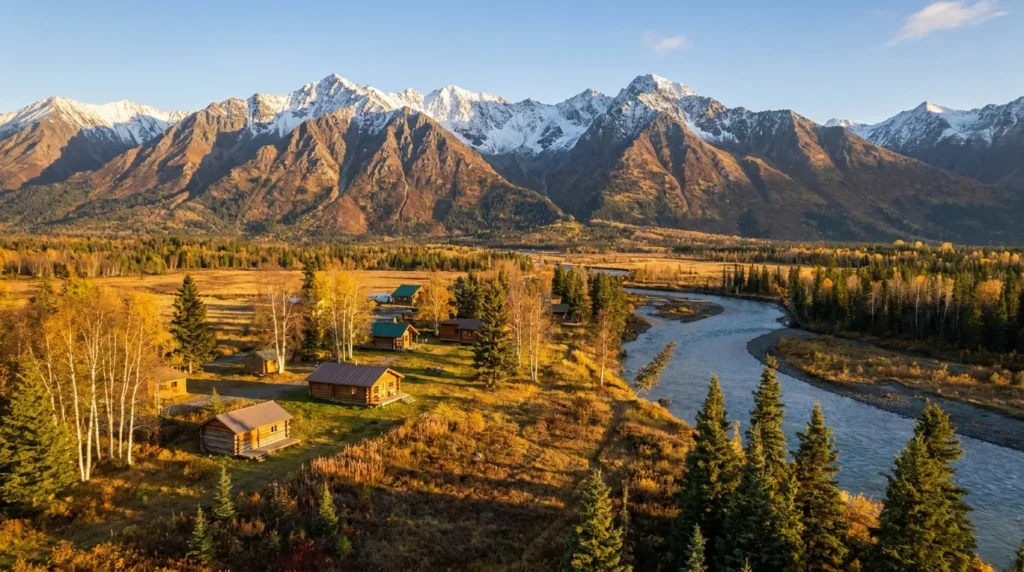
A residential community in the Mat-Su Borough, north of Anchorage, with direct access to Hatcher Pass, Lake Lucille, and a broad range of outdoor recreation.

Tanaina is a census-designated place in the Matanuska-Susitna Borough, adjacent to Wasilla. Daily life centers on Wasilla, the Mat-Su Valley Frontier Visitors Center, Lake Lucille Park, and the Iditarod Trail Headquarters, home base of the famous sled dog race that runs from Anchorage to Nome. The Dorothy G. Page Museum documents the colonial and indigenous history of the valley.

The primary draw for residents is the natural landscape. Hatcher Pass, about 30 minutes away, offers alpine trails, the Independence Mine State Historical Park (a restored gold mine), and ample snow for cross-country skiing. Big Lake and Wasilla Lake are popular spots for fishing and boating in summer, with the Talkeetna Mountains visible in the background across nearly every vista.

Anchorage, about an hour south via the Glenn Highway, provides what the immediate area lacks: the Anchorage Museum, a Saturday market, larger hospitals, and an international airport. Tanaina functions as a bedroom community, with grocery stores, schools (Mat-Su Borough School District), and services concentrated in Wasilla, and features the spacious lots typical of Alaskan residential development.

  1. 1["Iditarod Trail Sled Dog Race Headquarters (Wasilla)"
  2. 2"Dorothy G. Page Museum"
  3. 3"Hatcher Pass"
  4. 4"Matanuska Glacier"
  5. 5"Lake Lucille"
  6. 6"Wasilla Lake"]
Nightlife1.0 / 10
Parks & green spaces
  • ["Lake Lucille Park"
  • "Wasilla Lake Park"
  • "Hatcher Pass Recreation Area"
  • "Settlers Bay Coastal Park"
  • "Matanuska River Park"]

Latest posts

Posts about Alaska

Coverage and updates related to this destination.

Showing content from Alaska, as there is no specific data for Tanaina yet.