English
  Português
  Español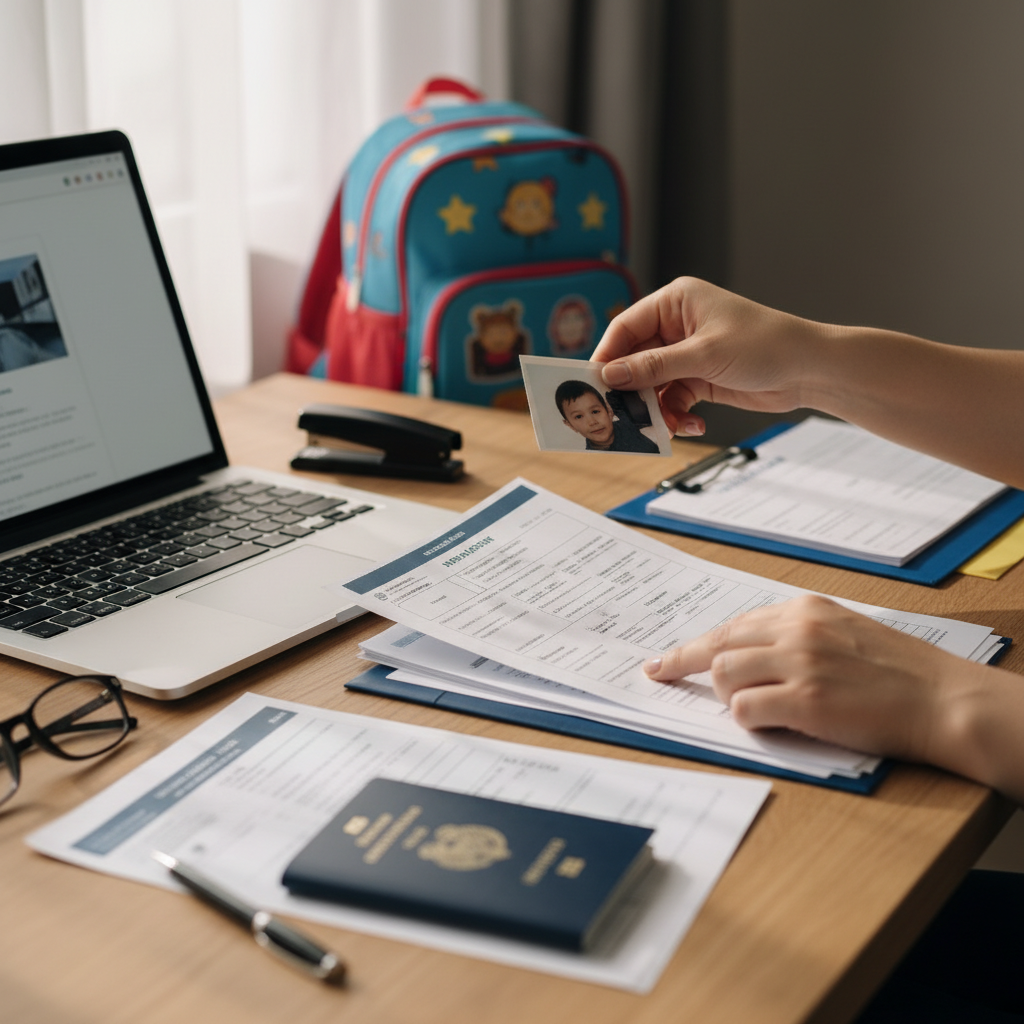
International families planning to travel to the United States with children quickly discover that minors need their own US visa, regardless of their age or whether the parents already hold valid visas. The process for minors has its own steps, specific documentation requirements, and — since September 2025 — attendance rules that changed for all age groups. This guide explains the updated step-by-step process for 2026, applicable to applicants from any country who need a B-1/B-2 visa for a child under 18.
Minors need their own US visa
There is no automatic visa exemption for foreign children or teenagers entering the United States under the non-immigrant visa program. Each minor needs an individual passport and visa issued in their own name. A parent’s visa does not extend coverage to their children, and newborn infants also need their own visa for their first trip.
The most common visa requested for minors traveling for tourism or to accompany family is the B-1/B-2, the same one used by adults for business or leisure visits. The application follows the same formal process: DS-160 form, MRV fee payment, appointment scheduling at the application center, and a consular interview.
The decisive change of September 2025
Through the first half of 2025, the US Department of State allowed, in some countries and consulates, an in-person interview waiver for applicants under 14 years old when both parents held valid US visas. That automatic exemption was discontinued in September 2025. Since then, all applicants of any age must appear in person at the visa application center (typically the VAC or local equivalent) for biometric collection and at the consular interview, always accompanied by at least one legal guardian.
The rule applies to infants, young children, and teenagers. The minor’s physical presence is required at both stages, even if they do not speak or answer questions directly to the consular officer.
Step-by-step process for minors
The minor’s passport
Before any visa step, the minor must have a valid passport issued by their country of origin. In most countries, a child’s passport has a shorter validity period (generally five years) and requires both legal guardians to be present at the time of issuance, unless a court order states otherwise. Each country has its own issuing authority and its own documentation requirements for minors, so it is best to check the issuance timeline in the city of origin well in advance.
Completing the DS-160
The DS-160 form is individual and mandatory. For a minor, the guardian fills out the form with the child’s or teenager’s information: in the occupation field, enter student; in income fields, leave blank or enter zero, according to what the system accepts. The details of whoever is funding the trip are entered in the sponsor sections. The digital photo attached must meet US standards (2×2 inches, white background, no glasses, face fully visible).
Paying the MRV fee
The MRV fee is charged per applicant, with no discount or exemption based on age. In 2026 the fee remains at US$ 185 for the B-1/B-2 visa. Payment is made through the official consular services portal of the country where the application will be processed, and the receipt must be registered in the system to unlock scheduling.
Scheduling both appointments
Scheduling involves two dates: biometric collection at the application center and the consular interview. When creating the account in the system, the guardian can include the minor in the same family group booking, which increases the chances of joint attendance at the same time slot. This reduces logistical stress, especially for families traveling from other cities to the nearest consulate.
Attending the biometric collection
At the biometric stage, the minor must be physically present. For children under 14, fingerprint collection is simplified or waived depending on the age group, but personal attendance remains mandatory. The guardian presents all required documentation and accompanies the child throughout the procedure.
Consular interview
The minor must also be present at the interview. For young children, the consular officer directs questions to the guardian. For teenagers aged 14 and older, the officer commonly asks the young person direct questions in simple terms: where are you going, with whom, for how long, what do you study. The interview is brief and rarely exceeds five minutes.
Required documentation for the minor
The folder brought to the application center and consulate must contain:
- The minor’s valid passport
- Printed DS-160 confirmation page
- Printed appointment confirmation page
- Photo printed to US standards
- Birth certificate (or equivalent document proving parentage)
Documents from the guardians
- Passports of parents or legal guardians
- Previous US visas of the parents, if any
- Proof of family income (pay stubs, tax returns, bank statements)
- Proof of ties to the home country (employment, property, business, parents’ enrollment records)
When only one parent accompanies the minor
If only one legal guardian accompanies the minor in the process and on the trip, it is recommended to bring a notarized authorization from the other parent (or equivalent notary in the country of origin), explicitly authorizing the visa application and travel to the United States. In cases of sole custody, the guardian presents the corresponding court order.
When the minor travels with third parties
When grandparents, aunts and uncles, or another adult who is not a parent accompanies the minor, notarized authorizations from both parents are required, along with documents proving the family relationship or temporary legal responsibility.
How the minor’s interview works
The consular officer evaluates the full family profile, focusing on three points: the parents’ ties to the home country (indicating intent to return), the financial ability to cover the trip, and the consistency between what was declared on the DS-160 and what is said in person. For teenagers, the guidance is simple: answer naturally, without rehearsed responses, and stay consistent with the information on the form.
The officer may ask the young person directly about destination, duration, purpose of the trip, and planned activities. Honest, direct answers carry more weight than long or rehearsed ones.
Validity of the visa issued for minors
The B-1/B-2 visa issued for minors has the same maximum validity of up to ten years applicable to applicants from the country of origin (the effective duration depends on nationality, as per the Department of State’s reciprocity table). Since a minor’s passport typically expires in five years, the visa often outlives the document. In that case, the young person travels with both passports: the new, valid one and the expired one containing the stamped visa. The combination is officially accepted at the border inspection.
Frequently asked questions
Does a minor need to attend the US visa interview? Yes. Since September 2025, all applicants of any age must appear in person for biometric collection and the consular interview, accompanied by at least one legal guardian.
Can only one parent accompany the minor? Yes, provided they present a notarized authorization from the other parent or judicial documentation of sole custody. At some consulates, this document is required at the interview.
Does a parent’s visa cover their minor children? No. Each foreign national needs an individual passport and visa, including newborn infants.
Is there a discount on the MRV fee for children? No. The MRV fee is the same for all ages, currently US$ 185 per applicant.
Is the interview difficult for teenagers? Generally not. Questions tend to be short and direct: destination, duration, reason for the trip, and current studies. The recommendation is to answer naturally and in keeping with the DS-160.
Learn more about B-1/B-2 Visa
- Duration
- Up to 6 months
- Extension
- Possible (up to 6 months)
- Work
- Not permitted
- Processing
- 2-8 weeks

Victoria Harper
Editor-in-Chief
Leading journalism and editorial content at Visto n’ Visa, Victoria helps make immigration topics clear, trustworthy, and easy to understand. Her focus is on delivering useful, human, and relevant content for people exploring new paths abroad.