English
 Português
 Español


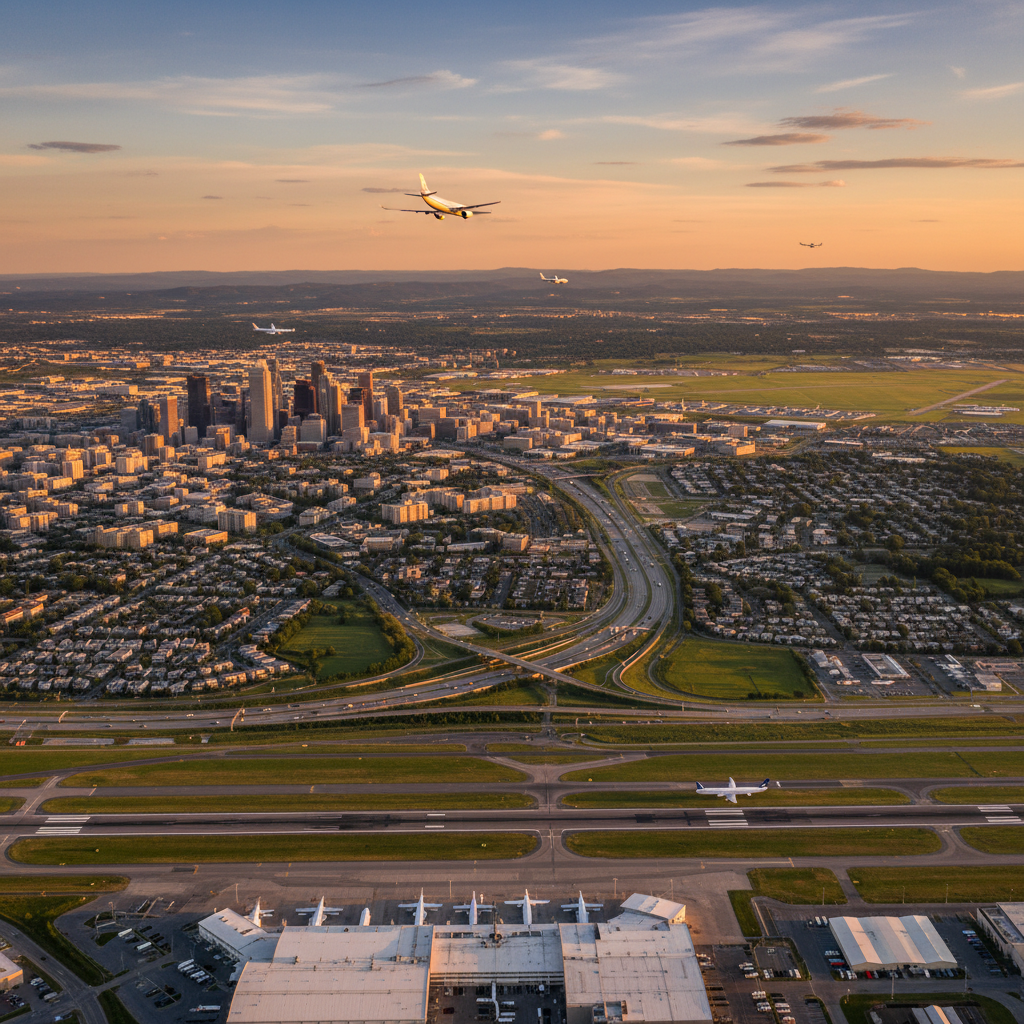
The U.S. aviation sector combines three elements rarely found together in other markets: high compensation, structural demand projected to last for decades, and a certification system rigorously standardized by the Federal Aviation Administration (FAA). For foreign professionals, this landscape creates concrete opportunities — provided they understand how to align an American technical credential with a viable immigration strategy. This guide details current market figures, certification pathways, and the main visas available to those planning to transfer an aeronautical career to U.S. soil.
Median salaries in the sector
The most recent data from the Bureau of Labor Statistics (BLS), covering May 2024, confirms the privileged position of aviation careers. Airline pilots, copilots, and flight engineers recorded a median annual salary of $226,600. Commercial pilots — a category that includes operations outside scheduled airlines, such as air taxi, agricultural aviation, and aerial photography — had a median of $122,670 in the same period.
Outside the cockpit, compensation is equally competitive. FAA-certified airframe and powerplant mechanics had a mean annual salary of $78,680, while avionics technicians reached $81,390. In specific segments of passenger air transportation, avionics technicians can earn around $99,150. It is worth noting that the median represents the midpoint of the distribution: half of all professionals earn more than these figures, especially in established air hubs such as Atlanta, Chicago, Dallas-Fort Worth, Los Angeles, and New York.
Projected demand through 2034
The salary strength reflects a classic market equation: the supply of qualified professionals is not keeping pace with expanding demand. The BLS projects 4% job growth for pilots and 5% for airframe, powerplant, and avionics technicians between 2024 and 2034 — numbers that, taken in isolation, may seem modest, but translate into a significant volume of annual openings.
Approximately 18,200 new annual job openings for pilots and 13,100 for maintenance professionals are projected, factoring in net growth plus replacements from retirements and turnover. The FAA reinforces this outlook in its Aerospace Forecast 2024–2044, projecting that IFR (instrument flight rules) operations will grow from 46.8 million in 2024 to 67.7 million in 2044. General aviation flight hours are expected to grow 17.4% over the same span. More flights mean greater demand across the entire chain: piloting, maintenance, flight dispatch, aeronautical engineering, and ground support services.
Diversification beyond the airlines
Unlike markets where aviation is concentrated in two or three national carriers, the American ecosystem is highly fragmented. In 2023, the FAA counted more than 106,000 active commercial pilots, more than 174,000 holders of the Airline Transport Pilot (ATP) certificate, and more than 316,000 student pilots. The multiplicity of operators — regional carriers, business aviation, charter, air medical, flight training, and aerial agriculture — multiplies the professional entry points.
Emerging sectors expand the landscape even further. The FAA formally recognizes Unmanned Aircraft Systems (UAS) and Advanced Air Mobility (AAM) as expanding frontiers. By December 2023, more than 368,000 remote pilot certifications had been issued, reflecting the commercial advancement of drones in infrastructure inspection, mapping, agriculture, media, and logistics. For the foreign professional, this diversification means that an aviation career in the U.S. is not limited to flying transport aircraft — it encompasses engineering, maintenance, drone operations, air logistics, manufacturing, and urban air mobility.
FAA certification step by step
The American certification system is comprehensively codified in 14 CFR Part 61 (pilots) and 14 CFR Part 65 (technicians). For piloting, the typical path begins with the student pilot certificate, progresses to private pilot, commercial pilot, and culminates in the ATP, required to serve as captain under 14 CFR Part 121 operations. Each stage requires minimum flight hours, FAA knowledge tests, a check ride with a designated examiner, and the corresponding medical exams (class 1, 2, or 3).
For airframe and powerplant mechanics, the model is equally structured. The candidate must be at least 18 years old, demonstrate English proficiency — an operational requirement, not merely an academic one — and meet one of three qualification pathways: 18 months of hands-on experience in either airframe or powerplant, 30 months covering both ratings, or completion of a program at an FAA-certificated school under 14 CFR Part 147. After qualifying, the candidate takes written, oral, and practical exams. This national standardization is what allows professionals to plan their careers in stages recognized across all 50 states.
Visas for aviation professionals
The viability of a career in the U.S. depends on an immigration pathway suited to the professional’s profile. The options most commonly used in the sector are:
- H-1B: specialty occupation worker visa with an annual cap of 85,000 slots (65,000 regular + 20,000 for holders of a U.S. master’s degree or higher). In 2024, more than 219,000 H-1B approvals were recorded by the Department of State, including renewals and extensions. Importantly, as of September 2025, an additional fee of $100,000 charged to the employer was introduced for new H-1B petitions under a new presidential proclamation — a factor that has reduced appetite among smaller employers and requires candidates to carefully assess who is sponsoring the petition.
- EB-2 NIW: Green Card based on national interest, requiring neither a job offer nor PERM labor certification, suited for professionals with advanced degrees or exceptional ability whose work significantly benefits the United States. Aeronautical engineers with relevant technical output, researchers in propulsion, air traffic control, or aviation safety typically have a matching profile.
- O-1: visa for individuals with extraordinary ability. In 2024, more than 19,000 issuances were recorded. In the aviation sector, typical candidates include elite flight instructors, test pilots, internationally recognized operational safety specialists, and engineers with high-impact awards and publications.
- F-1 with OPT and STEM extension: international students enrolled in aviation, aerospace engineering, or related technology programs may work for up to 12 months under Optional Practical Training (OPT) and, in eligible STEM programs, extend for an additional 24 months, totaling up to 36 months of authorized employment — a useful window to accumulate U.S. experience and transition to H-1B or EB-2 NIW.
Integrated strategy: technical and immigration
Building an aeronautical career in the U.S. requires aligning three pillars: FAA technical certification, documented professional experience, and an immigration strategy defined from the outset. The typical sequence for those arriving from abroad involves studying at an FAA-approved school on an F-1 visa, accumulating flight hours or months of maintenance practice, joining a company through OPT (with STEM extension when applicable), and then transitioning to an employer-sponsored H-1B or filing an independent EB-2 NIW petition.
For U.S. employers, international hiring remains a recurring practice given the chronic shortage of qualified labor. Formal requirements include, in many cases, PERM labor certification and processing with USCIS, with timelines varying by category and service center. Professionals with a stronger portfolio — authors of technical articles, speakers at industry conferences, instructors in training programs, engineers with patents — find in the EB-1A and EB-2 NIW categories direct pathways that bypass the need for an employer intermediary.
Practical considerations before relocating
A few checks save both time and cost. First, foreign license recognition: the FAA does not automatically convert certificates issued in other countries; Brazilian pilots must, in practice, redo part of their training and pass the American exams. Second, the medical exam: the class 1 exam (required for ATP) is more rigorous than its Brazilian equivalent and may disqualify candidates with conditions that are manageable under other systems. Third, financial documentation for the F-1 visa or to cover training costs: integrated flight training programs in the U.S. can exceed $90,000 when combining tuition, flight hours, materials, and living expenses.
The body of official data — BLS, FAA, and Department of State — paints a picture of a market with above-average compensation, structural demand through 2044, clear technical rules, and multiple immigration pathways. For the foreign professional willing to invest in U.S. certification and plan the transition well in advance, American aviation remains one of the most predictable and rewarding sectors in the global landscape of skilled mobility.
Learn more about EB-2 NIW
- Category
- EB-2 NIW Green Card
- Self-petition
- Allowed (no sponsor needed)
- PERM
- Waived
- Processing
- 12-36 months
About the author

Victoria Harper
Editor-in-Chief
As a journalist and lead editor at Visto n’ Visa, Victoria helps ensure that immigration topics are covered in a clear, trustworthy, and easy-to-understand way. Her focus is on delivering useful, human, and relevant content for people exploring new paths abroad.