English
  Português
  Español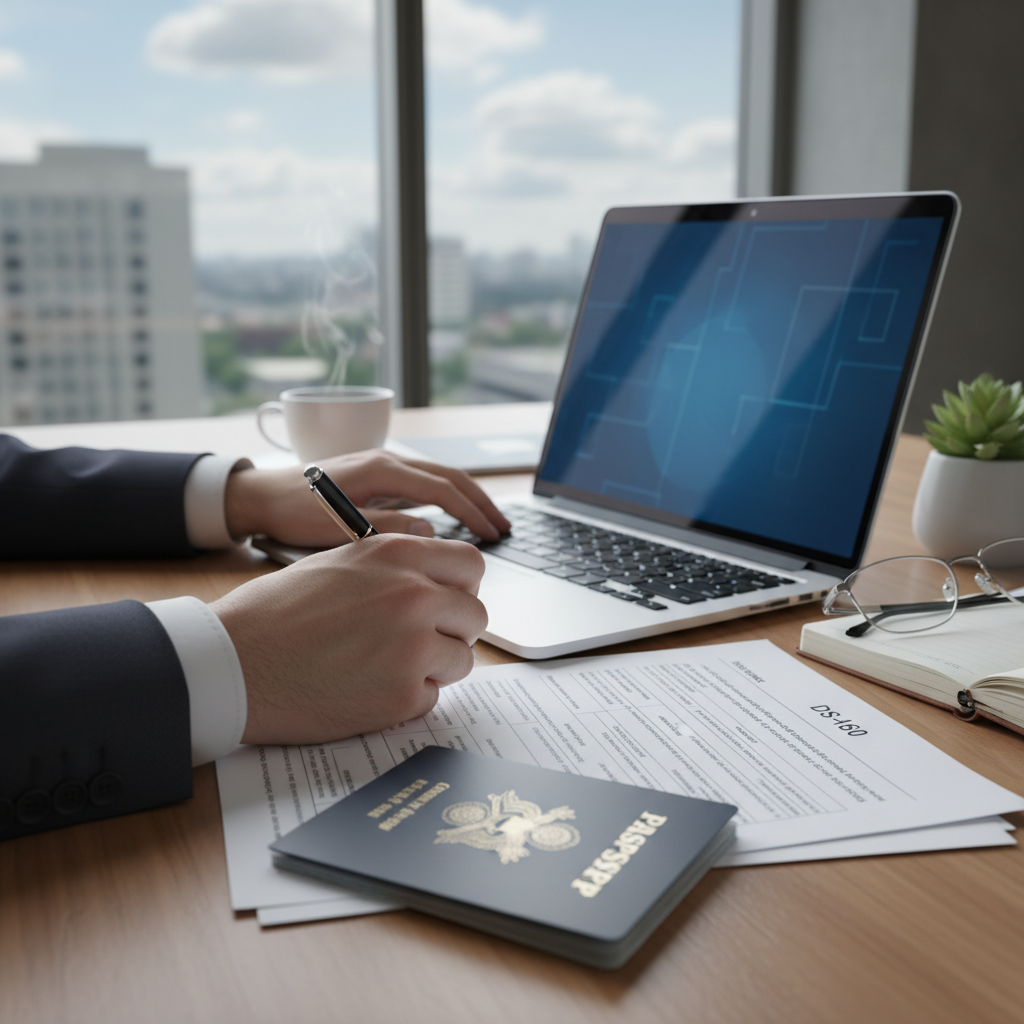
The consular interview for a U.S. visa lasts, on average, three to five minutes. During that short window, the consular officer evaluates far more than the applicant’s verbal answers: they observe posture, clarity of communication, consistency with what was declared on the DS-160, and the overall coherence of the profile presented. Dress and behavior do not single-handedly determine approval or denial, but they shape the first impression in front of a foreign official who will also make a decision based on non-verbal signals.
This guide is aimed at any international applicant preparing for a B-1/B-2 visa interview at a U.S. consular post, whether in Latin America, Europe, Asia, or Africa. The consulate’s security rules, the logic of the DS-160, and the pace of the interview are essentially the same in every country, with minor local variations.
What your clothing communicates to the consular officer
There is no official dress code published by the State Department for visa interviews. Applicants are not denied for choosing jeans over a suit. Your clothing choice, however, communicates something before the first word is spoken: organization, seriousness, and respect for the formal setting of a diplomatic mission.
The interview is an institutional conversation with an agent of the U.S. government. Presenting yourself in a polished manner reinforces the image of a methodical, responsible person with a legitimate travel intention. Very casual clothing does not automatically sink an otherwise strong application, but it adds unnecessary noise in a process where every detail can carry weight.
Recommended attire for men
The practical benchmark is the clothing you would wear to an important business meeting or a mid-to-senior-level job interview. A full suit is not required, but whatever you wear should be clean, pressed, and in good condition.
- A dress shirt or polo in a neutral color: white, light blue, gray, or beige.
- Dress pants, chinos, or dark jeans without rips.
- Closed-toe shoes, loafers, or clean, understated sneakers.
- In warm climates, a light blazer is optional; in temperate climates, it adds a note of seriousness.
Avoid: shorts, tank tops, T-shirts with large prints or slogans, sports team jerseys, flip-flops, open sandals, and anything dirty, wrinkled, or visibly stained.
Recommended attire for women
The same principle applies: clean pieces, modestly fitted, that convey professionalism without being overly rigid.
- A blouse, dress shirt, or non-transparent fabric top.
- Dress pants, dark jeans, or a knee-length skirt.
- A midi-length dress in a subdued fabric.
- Closed-toe shoes, flats, or low-heeled, stable sandals.
Avoid: very short clothing, low necklines, tank tops, sheer fabrics, loud prints, beach footwear, heavy makeup, and bulky or overly flashy accessories.
Variation by climate and season
Consular posts typically maintain strong air conditioning, especially in indoor waiting areas where applicants may spend a considerable amount of time before being called. In hot months, it is worth bringing an extra layer — such as a light long-sleeve shirt or thin blazer — so you are not visibly uncomfortable during the wait.
Before arriving at the consulate
Arriving early and security screening
Entry into any U.S. consular post involves rigorous screening, with metal detectors and document checks. On high-volume days, this process can take significant time. The practical recommendation is to arrive between twenty and thirty minutes before your scheduled appointment, accounting for travel, the outdoor line, and security screening.
Arriving late typically means forfeiting your appointment window. You will need to reschedule both the CASV or equivalent biometric collection center and the interview itself, with wait times that can stretch for weeks at busy posts.
Items prohibited inside the consulate
One of the most important pieces of information — and one frequently discovered at the last minute — is the restricted items list. Depending on the post, even turned-off devices or devices in airplane mode may be barred.
- Cell phones and smartphones, even when turned off.
- Smartwatches, earphones, and wearables.
- Tablets, laptops, and cameras.
- USB drives and any storage media.
- Food, beverages, and water bottles.
- Medium or large bags, backpacks, and briefcases.
- Sharp, pointed, or non-standard metal objects.
The practical guidance is to bring only the essentials: a thin folder or small bag containing your passport, appointment confirmation, DS-160 confirmation page, and the supporting documents for your declared profile. The smaller the volume, the faster and smoother the screening process will be.
Conduct in line and in the waiting area
Observable behavior begins before you reach the service window. Staff and officers move through the environment and notice the general conduct of applicants in the waiting area.
Patience is the rule. Lines may stretch depending on the day’s volume. Showing irritation, tapping your foot, complaining loudly, or pressuring staff about wait times creates a negative impression that can follow you to the window. Conversations with other applicants about response strategies or what to say to the officer should be avoided: the environment is monitored, and that kind of coordination can be interpreted as rehearsed fraud.
During the interview at the window
Body language and eye contact
When called to the window, approach with an upright posture, relaxed shoulders, and establish eye contact with the consular officer even through the glass between you. Sustained eye contact, without rigidity, conveys confidence and sincerity.
Avoid: crossed arms, frequent sideways glances, repetitive gestures such as tapping fingers on the counter, swaying your body, or constantly fidgeting with your passport. These signals are read as nervousness or discomfort with your own answers.
Tone of voice and language
The interview should be conducted in a clear, moderate tone: loud enough to come through the glass clearly, without sounding aggressive. Speaking too softly forces repetitions and creates unnecessary friction.
At U.S. consular posts around the world, the interview is typically conducted in the local language or in English, depending on the declared profile. If the applicant indicated fluency in English on the DS-160, the officer may begin the conversation in English. Otherwise, they will proceed in the country’s language. The practical rule is to answer in the language in which the question was asked.
Answer only what was asked
One of the most common mistakes is volunteering too much information. Consular officers ask short questions and expect short answers. Long answers with unsolicited details open the door to inconsistencies, contradictions with the DS-160, or the impression of a rehearsed script.
When asked something like what is the purpose of your trip, a response such as tourism in Orlando with my family for ten days is sufficient. There is no need to detail parks, hotel, flights, or prior travel history unless the officer specifically asks.
If a question is not understood, politely ask for it to be repeated or rephrased. That request is preferable to an answer that does not correspond to what was actually asked.
Consistency with the DS-160
The consular officer has the DS-160 open during the interview and cross-references, in real time, each answer with what was declared on the form. Any inconsistency between spoken answers and the form is detected immediately.
Do not try to impress with inflated income, undeclared assets, or professional ties that do not exist. If your actual profile is solid, it stands on its own. If there are weaknesses, lies make the situation worse and can constitute consular fraud, with serious consequences for future applications.
Institutional tone — no forced rapport
Consular officers work under tight schedules and institutional protocol. Attempts to build rapport through jokes, comments about the weather, compliments to the officer, or observations about international politics are inappropriate and can be read as attempts to divert focus from the interview.
Receiving a denial
If the visa is denied, the officer communicates it verbally and returns the passport with a letter explaining the legal basis for the decision, typically under Section 214(b) of the INA for nonimmigrant visas. The appropriate reaction is to receive the news calmly, say thank you, and leave the window.
Arguing with the officer, insisting on reviewing the decision at the same window, or showing hostility does not change the outcome and can hinder future attempts, since the history is recorded in the consular system. The next step is to study the legal basis cited in the letter and structure a new application with a strengthened profile.
Practical summary
| What to do | What to avoid |
|---|---|
| Clean, pressed, understated clothing | Shorts, tank tops, flip-flops, sports jerseys |
| Arrive 20 to 30 minutes early | Cutting it close or arriving late |
| Bring only a folder with documents | Large backpacks, electronics, food |
| Direct, to-the-point answers | Unsolicited details or rambling |
| Firm eye contact and upright posture | Wandering gaze and repetitive gestures |
| Complete consistency with the DS-160 | Inflating income, assets, or ties |
| Clear, moderate tone of voice | Speaking too softly or too loudly |
| Patience while waiting | Complaints and visible impatience |
Frequently asked questions
Is formal attire required for a U.S. visa interview? No. The State Department does not publish an official dress code. The recommendation is to dress as you would for an important business meeting: clean, understated, well-fitted clothing. Shorts, tank tops, flip-flops, and sports jerseys should be avoided.
Can I bring a cell phone to the consulate interview? No. Cell phones and other electronic devices are prohibited inside U.S. consular posts, even when turned off. Leave your devices at home, in your vehicle, or in an external locker if one is available near the consulate.
What language is the interview conducted in? In the local language of the country of application in most cases, or in English if the profile declared on the DS-160 indicates fluency. The practical rule is to answer in the language in which the officer asked the question.
What happens if I arrive late? Arriving after your scheduled time typically results in losing your appointment. You will need to reschedule both the biometric collection center and the interview, with wait times varying by post. A twenty-to-thirty-minute buffer is the safe margin for getting through screening.
Can I bring a large bag with my documents? It is not recommended. Large bags and backpacks are usually turned away. The ideal is a thin folder or small handbag containing your passport, appointment confirmation, DS-160 confirmation page, and the essential supporting documents for your declared profile.
Dress and behavior are only the visible layer of a preparation that begins much earlier: a DS-160 completed with absolute accuracy, documents organized in order of relevance, and clarity about your own travel profile. When those foundations are solid, your personal presentation at the interview does its job of reinforcing an already well-structured application.
Learn more about B-1/B-2 Visa
- Duration
- Up to 6 months
- Extension
- Possible (up to 6 months)
- Work
- Not permitted
- Processing
- 2-8 weeks

Victoria Harper
Editor-in-Chief
Leading journalism and editorial content at Visto n’ Visa, Victoria helps make immigration topics clear, trustworthy, and easy to understand. Her focus is on delivering useful, human, and relevant content for people exploring new paths abroad.