English
 Português
 Español


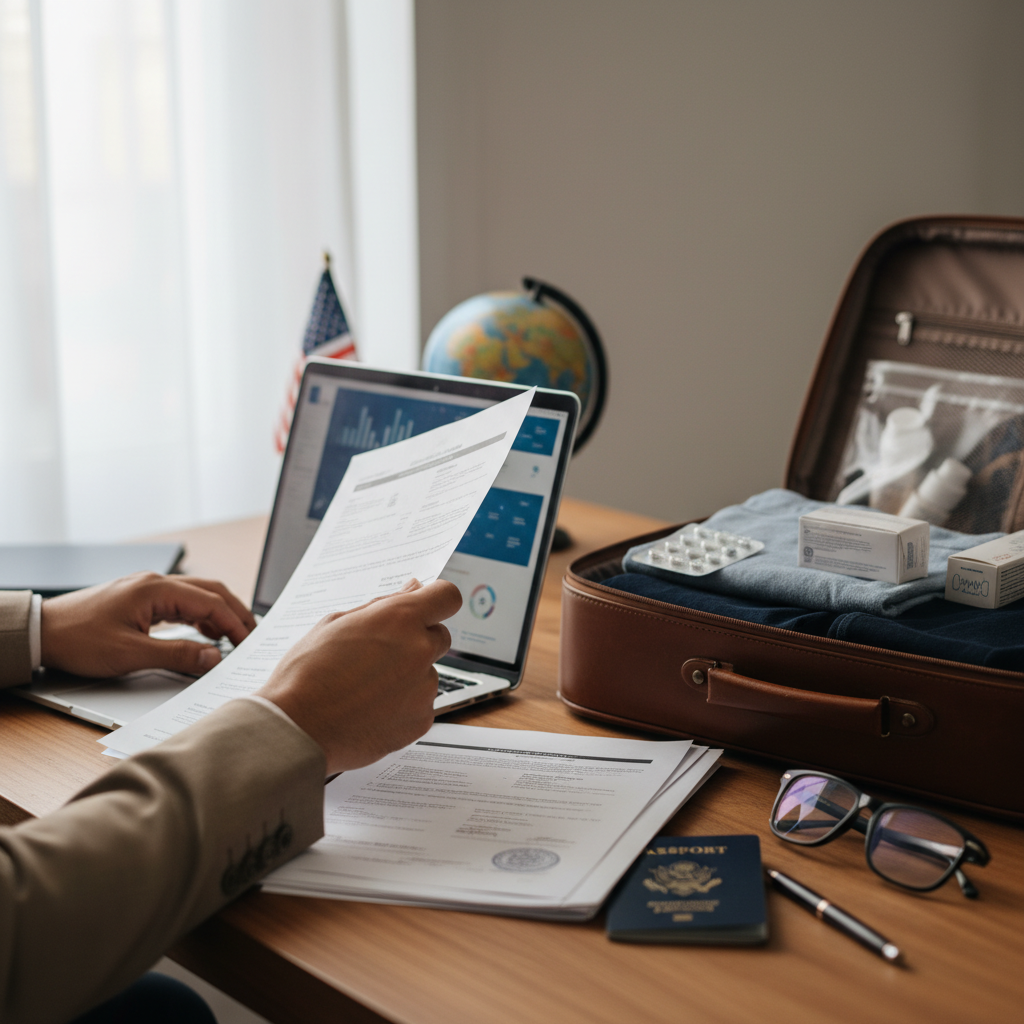
Packing for a trip to the United States requires more than just choosing clothes and organizing belongings. The rules of Customs and Border Protection (CBP), the Transportation Security Administration (TSA), the Food and Drug Administration (FDA), and the Department of Agriculture (USDA) are strict, and ignorance of them can result in confiscation of items, fines, detention, and even deportation. Recent cases of travelers detained for carrying controlled medications without an English-language prescription show that a seemingly small oversight can end a trip before it even begins.
This guide consolidates the main rules in effect in 2026 on what can and cannot be packed in luggage destined for the US, separating carry-on and checked baggage, and detailing sensitive categories such as medications, food, beverages, cosmetics, and electronics. The goal is to avoid surprises at the airport and ensure a smooth entry into the country.
Medications Under Strict Control
Medications represent the highest-risk category for Latin American travelers. Substances sold freely at pharmacies throughout Latin America may be controlled, restricted, or outright prohibited in the United States. Regulation is divided between the FDA, which controls the approval of medications for use in the country, and the Drug Enforcement Administration (DEA), which regulates controlled substances.
Opioids such as tramadol, codeine, and oxycodone, and benzodiazepines such as diazepam and clonazepam (Rivotril), are controlled substances. Even with a foreign medical prescription, the traveler must present a prescription translated into English, keep the medication in its original packaging with the package insert, and bring only the amount needed for the stay. The DEA may require prior authorization in specific cases.
Prohibited Medications
Dipyrone (metamizole), a widely used painkiller in Latin America, has been banned in the United States since 1977 due to the risk of agranulocytosis, a severe reduction of white blood cells. Non-prescription amphetamines, certain weight-loss compounds, and compounded formulas containing FDA-unapproved substances are also not allowed into the country. Before traveling, it is worth consulting the DEA database at dea.gov/drug-information and Chapter 9-2 of the FDA’s Regulatory Procedures Manual.
Best Practices for Travelers
- Keep medications in the original packaging with the package insert and physician’s instructions
- Carry a medical prescription translated into English or a letter from the doctor explaining the clinical condition
- Bring only the equivalent of up to 90 days of personal use
- For longer stays, it is possible to receive medications by mail upon proof of personal use
- US citizens, as a rule, cannot import medications purchased abroad, except under specific circumstances provided by the FDA
Cosmetics and Personal Care Products
The rule governing liquids, gels, and aerosols in carry-on baggage is the TSA’s 3-1-1 rule: containers of up to 100 ml each, all placed in a single clear, resealable plastic bag of approximately one liter, with a limit of one bag per passenger. Moisturizers, perfumes, liquid foundations, face masks, gel deodorants, and similar products fall under this rule.
In checked baggage, there is no volume limit per container, but flammable aerosols with high alcohol concentration (such as certain hair sprays and lacquers) are prohibited. Poorly sealed containers pose a leakage risk and may be discarded by the airline. Solid cosmetics, such as lipsticks, compact powder, bar shampoo, and stick blush, are exempt from the 3-1-1 rule and can be freely carried in carry-on baggage.
Food and Agricultural Products
The USDA maintains one of the most rigorous agricultural inspection systems in the world, aimed at protecting American agriculture from pests, diseases, and contaminants. The general rule is to declare all food items to the CBP officer on the customs declaration form (CBP Form 6059B). Failure to declare can result in a civil fine of up to US$10,000 and significantly delay entry into the country.
Allowed with Caution
- Processed and well-packaged foods: crackers, chocolates, roasted whole or ground coffee, non-meat canned goods
- Breads, cakes, and sweets without meat or fresh fruit fillings
- Dry spices (except fresh citrus leaves)
- Commercially manufactured candies and sweets
- Breast milk and infant formula in reasonable quantities, declared to inspection
Prohibited
- Fresh, dried, smoked, or processed meats (including jerky, cured ham, salami, dried meat)
- Fresh fruits and vegetables without a phytosanitary certificate
- Unprocessed seeds and live plants
- Artisanal dairy products, unpasteurized soft cheeses, homemade yogurts
- Honey not sold in industrial packaging
- Eggs and poultry-derived products from countries with active avian influenza
Alcoholic Beverages
In carry-on baggage, alcoholic beverages follow the 3-1-1 rule: only miniatures of up to 100 ml inside the transparent bag. Duty-free purchases made after the security checkpoint may exceed this limit, as long as they are in a sealed bag from the retailer, with a visible receipt, and remain closed until the final destination. Note: on international connections with new security screening in the US, the bag may be confiscated if the liquid exceeds 100 ml.
In checked baggage, three technical rules apply:
- Beverages with alcohol content below 24% (beer, wine, some light liqueurs): no specific volume limit beyond the airline’s rules
- Beverages with alcohol content between 24% and 70% (most distilled spirits): limit of 5 liters per passenger, in sealed commercial packaging
- Beverages with alcohol content above 70%: prohibited in any baggage as they are considered dangerous flammable material
Even within federal limits, some US states have their own laws regarding alcohol importation. Travelers need to check whether their destination state imposes additional restrictions or state taxes.
Electronics and Lithium Batteries
Loose lithium batteries, power banks, and spare batteries cannot be checked in the aircraft hold due to the risk of overheating and fire. They must travel exclusively in carry-on baggage. Devices with integrated non-removable batteries, such as laptops, tablets, smartphones, and cameras, may be checked, but the Federal Aviation Administration (FAA) recommends carrying them in carry-on baggage for a quick response in case of emergency.
Power banks have additional limits: up to 100 Wh are allowed without prior approval, between 100 Wh and 160 Wh require airline approval, and above 160 Wh are prohibited on commercial flights.
Prohibited Items by Category
Carry-On Baggage
- Liquids, gels, and aerosols in containers over 100 ml outside of sealed duty-free purchases
- Sharp objects: knives, scissors with blades longer than 6 cm, long knitting needles, pliers
- Heavy tools: hammers, long screwdrivers, saws
- More than one standard lighter per passenger
- Firearms, ammunition, and realistic replicas
Checked Baggage
- Loose lithium batteries and power banks
- Flammable aerosols and highly combustible fluids
- Fresh meats, fresh fruits, and vegetables not inspected by the USDA
- Counterfeit products (bags, watches, pirated electronics)
- Illegal substances under federal law, including cannabis in any form, even from states where its use is legal
Baggage and Electronic Device Inspection
The CBP has the legal authority to inspect baggage, electronic devices, cell phones, and social media accounts of anyone entering the United States, without the need for a court warrant. This policy has intensified in recent years, with a focus on verifying consistency between the declared purpose of travel and the content found in messages, emails, and public profiles.
It is recommended to avoid messages, contracts, or conversations that might suggest unauthorized work, intent to immigrate permanently under a tourist visa, or activities incompatible with the immigration status requested. Documents such as hotel reservations, return tickets, proof of employment ties in the country of origin, and a detailed itinerary help demonstrate nonimmigrant intent.
Medical Devices and Special Needs
Prosthetics, pacemakers, insulin pumps, post-surgical bras, and other medical devices integrated into the body are recognized by the TSA as items of medical necessity. Removal during X-ray inspection is not mandatory. The passenger should inform the agent before the screening, who may offer an alternative inspection by manual contact or portable metal detector. Prescription eyeglasses and spare glasses are also recommended to avoid inconveniences in case of loss.
Before Closing Your Suitcase
The golden rule is transparency: declare everything you are uncertain about on the customs form and answer CBP questions clearly. Hiding prohibited items can turn a simple confiscation into a fine, or in extreme cases, into a denial of entry and a bar on future return. Always consult before boarding the TSA’s official What Can I Bring? page, the CBP website, and the airline’s guidelines, as rules can change with little notice.
About the author

Victoria Harper
Editor-in-Chief
As a journalist and lead editor at Visto n’ Visa, Victoria helps ensure that immigration topics are covered in a clear, trustworthy, and easy-to-understand way. Her focus is on delivering useful, human, and relevant content for people exploring new paths abroad.