Visto n' Visa
Blog
Notícias e artigos
Destinations
Careers
Immigrants

Want to live and work in Aberdeen?

Personalized immigration plan with eligible visas, costs, and next steps for your goal!

If you are not eligible, you will know exactly why and what to do to improve your approval chances.

Save up to 12 hours in meetings

No pointless assessments.

Save up to 90%

Save money on vague or unfocused consultations

Avoid Fraud and Mistakes

One mistake can cost you your visa

Total Impartiality

Zero commercial bias

Decide with peace of mind

No toxic urgency

Fast and Accurate

Answers in minutes, no guesswork

Who lives in Aberdeen

A predominantly white population of German, Scandinavian, and Dutch heritage, with a small presence of Hispanics, refugees, and international students at the university.

Aberdeen's population is traditionally white, with strong heritage from Volga German, Scandinavian, and Dutch immigrants who settled northeastern South Dakota in the late 19th century. Germanic surnames, ethnic festivals, and Lutheran churches still define much of the city's character.

Small communities of Hispanics (Mexican and Central American), Karen refugees from Myanmar, Sudanese families, and some Eastern European households have settled over the past fifteen years, primarily to work in factories and food processing. Northern State University brings international students from Asia and Africa, adding some temporary diversity to the city.

English is the dominant language, with ESL programs in the public school system for immigrants. The Brazilian presence is minimal. Religiously, Lutherans, Catholics, Methodists, and Baptists predominate, with a small evangelical presence and far fewer mosques and temples than in Sioux Falls.

Languages spoken
  • English
  • Spanish
  • Karen
  • German (traditional domestic use)
Main religions
  • Lutheranism
  • Catholicism
  • Methodism
  • Baptist churches
  • Pentecostalism
  • +1 more

Cost of living in Aberdeen

One of the lowest costs of living in South Dakota, with rents and housing well below the national average and no state income tax.

Aberdeen is one of the most affordable cities to live in South Dakota. Two-bedroom apartment rents run well below Sioux Falls levels, and homeownership is feasible for professionals earning a median income. Three-bedroom homes with yards in established residential neighborhoods are accessible.

South Dakota levies no state income tax, which significantly improves take-home pay. State and local sales tax is above average and applies to groceries. Energy and gas costs exceed the national average in winter due to the prolonged cold, but fuel and basic groceries come in below the national average.

Healthcare through Avera or Sanford depends on employer-provided coverage. For those working in factories, agriculture, or service jobs without benefits, out-of-pocket costs can be burdensome. For qualified professionals at the university, in healthcare, or in small industries, Aberdeen offers a comfortable standard of living.

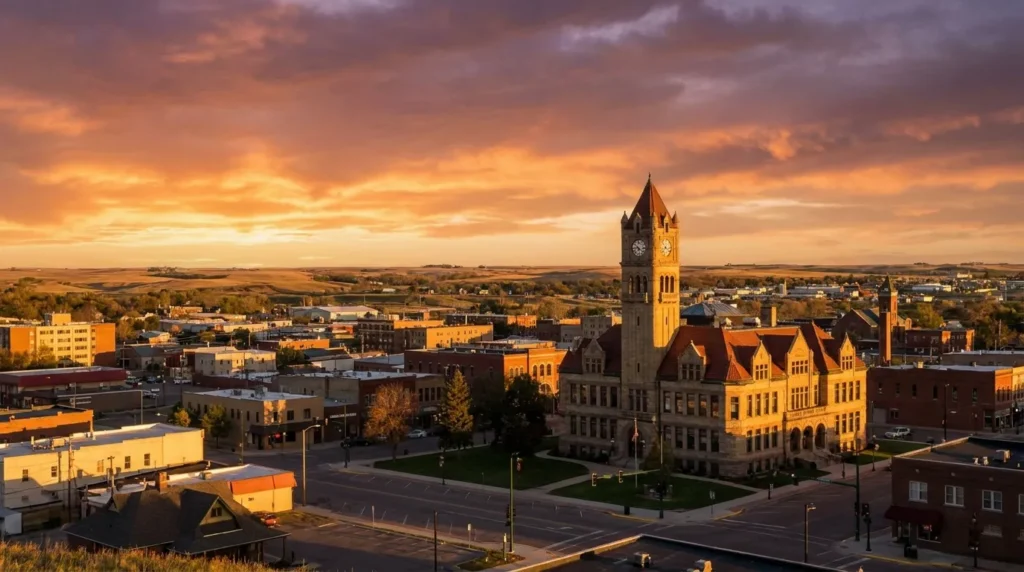
Aberdeen

Housing in Aberdeen

A city of single-family homes with yards, abundant supply, low rents, and recent expansion along the southern and southwestern edges.

Aberdeen is dominated by single-family homes with full basements and garages, spread across neighborhoods of wide, tree-lined streets. The most sought-after areas for families are to the south and southwest, near Wylie Park, with well-rated schools and larger lots. Neighborhoods such as Highland Acres and Wylie consistently appear on lists of the most desirable locations.

Downtown features historic brick homes, some restored, and duplexes near Main Street. Northern State University occupies the eastern side of the city, and the campus surroundings include student apartments and homes for faculty and staff. Rents are low even by South Dakota standards.

New construction continues along the outskirts, with modern subdivisions in the southwest. New apartment complexes with fitness centers and pools exist but in smaller numbers than in Sioux Falls. For those working at factories such as 3M or Molded Fiber Glass, areas north and east of downtown offer a favorable balance of price and commute distance.

Recommended neighborhoods
  • South Aberdeen
  • Highland Acres
  • Wylie
  • Southwest Aberdeen
  • Historic Downtown
  • +1 more

Job market in Aberdeen

An economy built on agriculture, light industry, healthcare, education, and government, with historically low unemployment.

Aberdeen's largest employers include the Avera system (Avera St. Luke's Hospital), Sanford, Northern State University, and industrial companies such as Molded Fiber Glass, 3M, Banner Engineering, Hub City Inc., and Agtegra Cooperative. Agriculture structures the calendar year-round, and grain elevators dot the surrounding landscape.

Light industry absorbs lower-skilled labor at above-minimum wages and offers stability. Healthcare is a consistently high-demand sector, with openings in nursing, technical, and administrative roles. The university employs faculty, researchers, and administrators. The public sector (city, schools, state government) is sizable relative to the city's population.

For immigrants, factories and food processing are typically the point of entry. Construction and services (hotels, restaurants) also hire regularly. Northern State attracts international students who work part-time. Those with credentials in healthcare, engineering, or education generally find placement quickly.

Dominant sectors
  • Healthcare
  • Agriculture and agribusiness
  • Light industry
  • Higher education
  • Retail
  • +1 more
Major employers
  • Avera St. Luke's Hospital
  • Sanford Aberdeen Medical Center
  • Northern State University
  • Molded Fiber Glass
  • 3M Aberdeen
  • +4 more

Education in Aberdeen

Northern State University anchors higher education locally, with Presentation College recently closed and a solid public K-12 system.

Northern State University is a public state university with approximately 3,000 students, known for programs in education, business administration, esports, and music. The compact campus on the east side of the city includes Beulah Williams Library, Johnson Fine Arts Center, and Wachs Arena. It draws local and international students with competitive tuition.

Presentation College, affiliated with the Catholic sisters, closed in 2023, leaving a gap in nursing education that Northern State and Lake Area Technical College (in nearby Watertown) are working to fill. Avera has launched healthcare education programs on the former campus.

Aberdeen Public Schools operates a K-12 system with three middle schools and Aberdeen Central High School. Catholic private schools (Roncalli Catholic School System) are a traditional alternative. ESL programs in the public school system and at the university support immigrant adults and children.

Notable universities
  • Northern State University
  • Roncalli Catholic School System (K-12)
  • Lake Area Technical College (in Watertown, nearby)

Healthcare in Aberdeen

Two competing hospital systems (Avera and Sanford) serve the city, with sufficient infrastructure for the region and complex cases transferred to Sioux Falls.

Avera St. Luke's Hospital is Aberdeen's largest hospital, offering an emergency department, maternity ward, cardiology, oncology, and specialized clinics. It serves as the regional referral hospital for northeastern South Dakota, treating patients from smaller communities such as Webster, Britton, and Eureka.

Sanford Aberdeen Medical Center is the city's second major health system, with an emergency department, surgery, and clinics. Competition between Avera and Sanford sustains ongoing investment in facilities. For highly complex cases (transplants, advanced pediatric oncology), patients are transferred to Sioux Falls or Rochester, Minnesota, home of the Mayo Clinic.

Private American insurance is widely accepted. For uninsured immigrants, Community Health Center programs and Aberdeen Area Indian Health Service provide alternatives. Spanish- and Karen-speaking healthcare professionals are scarce, and telephone interpreters are used in most clinical encounters.

Healthcare index64.0 / 100
  • Life expectancyyears at birth
    78.4yrs
  • Doctors per 1kpracticing physicians
    3.7
  • Health spendper capita, per year
    $13,473
  • Public systemoverall quality rating
    Good

Safety in Aberdeen

A quiet city by American standards, with low crime concentrated in a few specific areas.

Aberdeen ranks among the lowest-crime cities for its size in the United States. Violent crime is rare, and property crimes (vehicle break-ins, vandalism) are the most common incidents, concentrated near Sixth Avenue, downtown, and some budget motels along US-12.

Residential neighborhoods such as South Aberdeen, Highland Acres, Wylie, and the eastern area near campus are quiet, with very low incidence of any crime type. Children playing outside are a common sight, and unlocked bicycles at schools remain normal. The local police department is small and visible.

Basic precautions apply: locking vehicles and homes, staying alert in bar parking lots after 10 p.m., and exercising caution on icy surfaces in winter. Extreme cold is perhaps the greatest real personal safety risk, with temperatures dropping to 30 degrees below zero.

Safer neighborhoods
  • South Aberdeen
  • Highland Acres
  • Wylie
  • Eastern area near Northern State University
  • Historic Downtown
  • Southwest Aberdeen
Areas to avoid
  • US-12 corridor (motel area)
  • Sixth Avenue at night
  • Some sections of Main Street after 10 p.m.

Getting around Aberdeen

A small, car-dependent city with a regional airport, no direct interstate access, and minimal public transit.

Aberdeen is a car-dependent city, but its small size keeps things manageable: crossing from one end to the other takes under fifteen minutes. The main corridors are US-12 (east-west) and US-281 (north-south). No interstate highway passes through the city; I-29 lies roughly an hour to the east, and I-90 is far to the south of the state.

Public transit is minimal. Aberdeen Ride Line and Aberdeen Area Transit operate buses on limited routes and Dial-a-Ride service for seniors. Most residents depend on personal vehicles. The Northern State University campus is walkable internally. The city lacks a developed urban bike lane network.

Aberdeen Regional Airport (ABR) offers daily flights to Minneapolis via Delta Connection, sufficient to connect to the rest of the United States and the world through MSP. For international flights, most travelers drive to Sioux Falls (FSD) or Minneapolis (MSP). Passenger rail does not serve the city.

Airports
  • ABR — Aberdeen Regional Airport

What the Climate Is Like Living in Aberdeen

Aberdeen has a humid continental climate typical of the Great Plains. Short, hot summers, very cold and snowy winters, and a wide annual temperature range define the year.

Summer is short but hot, with highs near 30°C (86°F) in July and moderate humidity. Severe storms and hail occur in May and June, and air conditioning is essential during heat waves.

Winter is the most demanding season. Between December and February, lows frequently drop below -15°C (5°F), and the city receives around 90 cm (35 in) of snow per year. Prairie winds drive wind chills below -30°C (-22°F) in January. Extreme cold-weather gear, insulated boots, warm hats, and reliable heating are all necessities.

Spring and autumn are brief. Annual rainfall totals around 580 mm (23 in), concentrated between May and September. The region falls within the extended Tornado Alley, with a risk of severe storms in late spring.

Sunny days / year210 days
Avg high (°F)
  • 38°J
  • 49°F
  • 63°M
  • 79°A
  • 86°M
  • 98°J
  • 100°J
  • 98°A
  • 93°S
  • 81°O
  • 63°N
  • 46°D
Avg low (°F)
  • -19°J
  • -17°F
  • M
  • 17°A
  • 29°M
  • 48°J
  • 54°J
  • 53°A
  • 41°S
  • 16°O
  • 10°N
  • -8°D
Rainfall (")
  • 1"J
  • 1"F
  • 1"M
  • 2"A
  • 3"M
  • 3"J
  • 3"J
  • 3"A
  • 2"S
  • 2"O
  • 1"N
  • 1"D

Aberdeen culture: Hub City, Wizard of Oz, and agricultural frontier

A small city with a cultural life tied to the university, Storybook Land theme park, and European immigrant heritage.

Aberdeen draws on its connection to L. Frank Baum, author of The Wizard of Oz, who lived in the city in the 1880s. The Land of Oz within Wylie Park features life-size characters, and in June the city hosts the Storybook Land Festival with readings and children's activities. Events such as the Brown County Fair and Aberdeen JuneFest draw regional crowds.

Cultural life centers on Northern State University, with the Johnson Fine Arts Center hosting concerts, plays, and exhibitions, alongside the Aberdeen Community Theatre, which stages four to five productions per season. The Dacotah Prairie Museum chronicles the agricultural and railroad history of the region. Local cuisine features chislic, kuchen, knoephla soup (of Volga German origin), and barbecue.

Sports revolve around the Northern State Wolves (NCAA Division II) and the Aberdeen Wings hockey team (junior league). Nightlife is understated, concentrated in bars and brewpubs such as Red Rooster Coffee House and Hub City Brewing. Friday evenings downtown in summer, with live music, are a longstanding local tradition.

Notable dishes
  • Knoephla soup (Volga German)
  • Kuchen
  • Chislic
  • Pheasant
  • Fried walleye
  • +1 more
Annual events
  • Brown County Fair
  • Aberdeen JuneFest
  • Storybook Land Festival
  • Northern State University Homecoming
  • Aberdeen Community Theatre season
  • +1 more

What to see in Aberdeen

Wylie Park with Storybook Land, Dacotah Prairie Museum, university events, and hunting and fishing at regional lakes define local leisure.

Aberdeen's main attraction is Wylie Park, a complex that includes Storybook Land with life-size children's characters, the Land of Oz, a small zoo, a paddleboat lake, and camping. Admission is free and it draws families from across northeastern South Dakota, especially in summer.

The Dacotah Prairie Museum holds collections of wildlife specimens, agricultural and railroad tools, and history of the Dakota and Lakota tribes. Centennial Village recreates a late 19th-century pioneer settlement. Aberdeen Public Library and Aberdeen Community Theatre round out the urban cultural offerings.

For outdoor recreation, regional lakes (Mina Lake, Richmond Lake, Sand Lake National Wildlife Refuge) offer walleye fishing, duck and pheasant hunting in season, camping, and canoeing. Mount Rushmore and the Black Hills are about six hours away by car, and Minneapolis roughly five. Outdoor life is central to living in Aberdeen.

  1. 1Wylie Park & Storybook Land
  2. 2Dacotah Prairie Museum
  3. 3Centennial Village
  4. 4Aberdeen Community Theatre
  5. 5Northern State University campus
  6. 6Wachs Arena
Parks & green spaces
  • Wylie Park
  • Melgaard Park
  • Anderson Park
  • Memorial Park
  • Sand Lake National Wildlife Refuge (nearby)
  • +1 more

Latest posts

Posts about South Dakota

Coverage and updates related to this destination.

Showing content from South Dakota, as there is no specific data for Aberdeen yet.