Visto n' Visa
Blog
Notícias e artigos
Destinations
Careers
Immigrants

Want to live and work in Williston?

Personalized immigration plan with eligible visas, costs, and next steps for your goal!

If you are not eligible, you will know exactly why and what to do to improve your approval chances.

Save up to 12 hours in meetings

No pointless assessments.

Save up to 90%

Save money on vague or unfocused consultations

Avoid Fraud and Mistakes

One mistake can cost you your visa

Total Impartiality

Zero commercial bias

Decide with peace of mind

No toxic urgency

Fast and Accurate

Answers in minutes, no guesswork

Who lives in Williston: oil workers of varied backgrounds

The population is predominantly white, with Scandinavian and German roots. The oil boom brought workers from other states and other countries, creating a more diverse mix than would otherwise be expected.

The historical base is typical of western North Dakota: descendants of Norwegians, Swedes, Germans, and Ukrainians who settled in the late nineteenth century as farmers and ranchers. Surnames like Olson, Knutson, Schmidt, and Petersen appear in families with multiple generations in the region, with strong ties to the land and to agricultural cooperatives.

The oil boom brought workers from Texas, Oklahoma, Louisiana, and other parts of the United States, as well as immigrants from Mexico, Honduras, Guatemala, and the Philippines. In some bars and markets, Spanish is heard more than English. The Native American community of the Mandan, Hidatsa, and Arikara nations from the nearby Fort Berthold Reservation also has a presence in the city.

The population is young, predominantly male, and tends to fluctuate with the oil cycle. During upswings, new workers arrive; during downturns, many leave. Brazilians are rare and scattered. Families settled more firmly after the initial boom, and Williston took on more of the character of a city than a camp.

Languages spoken
  • English
  • Spanish
  • Tagalog
  • Norwegian (heritage)
  • Mandan/Hidatsa Indigenous Languages
Main religions
  • Lutheranism
  • Catholicism
  • Pentecostalism
  • Native spiritualities
  • No religion

Cost of living in Williston: fluctuates with oil, wages compensate

Williston has a volatile cost of living. During booms, rent spikes; during slow periods, supply grows and prices fall. Wages in the energy sector offset costs, and food and transportation remain affordable.

The main indicator is rent. During oil price upswings, apartments can cost as much as in New York, with houses and sublet rooms at prices that can seem alarming. During slow periods, supply surges and prices fall to reasonable levels. Today, with a more mature market, there is balance: modern complexes and temporary man camps coexist with family homes.

Heating bills from November through April represent the second largest budget burden. Homes with adequate insulation absorb much of the impact. Electricity provided by local cooperatives is reasonable. The combined sales tax is around 7.5 percent. North Dakota has a low state income tax, which helps when saving on a high wage.

Grocers such as Cash Wise, Walmart, and Albertsons cover everyday needs. The nearest Costco is in Bismarck, two and a half hours away. Local restaurants like Stonehome Brewing and national chains like Buffalo Wild Wings provide dining options. Fuel is among the cheapest in the country, a natural advantage of living in an oil-producing region.

Williston

Housing in Williston: growing supply after the boom and rent fluctuation

After the boom, Williston now has a robust supply of modern apartments, homes in new subdivisions, and some remaining man camp options. Rent fluctuates with the oil cycle.

Much of the supply comes from what was built during the boom: modern apartments in complexes such as Roosevelt Park Apartments and various other new properties near US-2 and US-85. Prices fluctuate with oil demand. During slower periods, good deals are available. Homes for purchase are reasonably priced in subdivisions such as Eagle Crest and North Heights.

The city center has older homes on generous lots with historic character. New neighborhoods to the south and east offer planned homes with double garages, aimed at families of skilled workers. For temporary workers, man camps still exist, though far fewer than during the boom.

Newcomers typically rent first in modern complexes with utilities included, a common practice because of the winter. Purchasing property is viable for those with stable employment and credit. Real estate agencies such as Basin Brokers and Coldwell Banker Lakeland dominate the market. A heated garage is practically essential, and good thermal insulation significantly changes natural gas costs.

Recommended neighborhoods
  • Eagle Crest
  • North Heights
  • South Williston
  • Downtown Williston
  • West Dakota Parkway corridor

Job market in Williston: oil, transportation, construction, and healthcare

The economy revolves around Bakken oil. Employment opportunities exist in production, freight transportation, maintenance, and construction. Healthcare and retail grew to serve the expanding population.

Oil is the central pillar. Companies such as Hess, Continental Resources, ConocoPhillips, and Marathon Oil maintain operations in the basin. Positions range from production engineers, geologists, maintenance technicians, welders, and heavy equipment operators to CDL truck drivers, who are especially sought after. For immigrants with recognized technical skills, wages are significantly high.

Oilfield service companies such as Halliburton, Schlumberger, and Baker Hughes employ hundreds. Freight transport of fracking sand, produced water, and equipment requires a constant fleet of trucks, creating ongoing demand for drivers. Civil construction also heats up with each new subdivision. CHI St. Alexius Health and Mercy Medical Center serve regional healthcare needs.

Williston Basin International Airport maintains active operations, and BNSF Railway operates an important yard. For those arriving without fluent English, positions in restaurants, hotels, cleaning, and construction open quickly, with wages well above the rural American average. The key consideration is understanding the oil cycle and avoiding impulsive moves during boom phases.

Dominant sectors
  • Oil and gas
  • Freight transportation (CDL)
  • Construction
  • Healthcare
  • Oilfield services
  • +1 more
Major employers
  • Hess Corporation
  • Continental Resources
  • Marathon Oil
  • Halliburton
  • CHI St. Alexius Health
  • +2 more

Education in Williston: public schools and an expanded community college

Williston Public Schools grew during the boom to accommodate more students. Williston State College, the public community college, became a key institution for training workers in energy and nursing.

Williston Public Schools covers the public network, with Williston High School as the main institution. The system expanded rapidly during the oil boom to accommodate population growth. English as a second language programs are available for immigrant students, with Spanish and other language translators for parent meetings.

Williston State College is the public community college and offers technical courses oriented toward the local industry: welding, industrial mechanics, drilling, practical nursing, and business administration. Accessible tuition and partnerships with oil sector companies make the college a practical path for immigrants seeking quick qualification.

Research universities are farther away. Minot State University, two hours away, and UND, four hours away, are the nearest four-year state options. There are small private Catholic schools. For young children, private daycare centers and the Head Start program, aimed at low-income families, are available.

Notable universities
  • Williston State College
  • Minot State University (2h away)
  • University of North Dakota (4h away)

Healthcare in Williston: local hospital and limited regional referral

CHI St. Alexius Health Williston serves the region. For complex cases, patients are transferred to Bismarck, Minot, Fargo, or Minneapolis. Standard American system, with insurance as the central piece.

CHI St. Alexius Health Williston is the city's main hospital, with an emergency department, maternity ward, basic surgery, and specialty clinics. Mercy Medical Center also operates smaller units in the region. For complex cases such as cardiac surgery, advanced oncology, or neurosurgery, patients are transferred to larger hospitals in Bismarck, Minot, Fargo, or Minneapolis.

As in any American city, having health insurance defines access. Oil workers in formal employment typically have employer-negotiated plans, but independent contractors and self-employed individuals must purchase their own coverage. North Dakota Medicaid covers children, pregnant women, and some low-income categories. Eligible refugees may also enroll.

In emergencies, the ER treats anyone, but the bill follows. Specialists can have long wait times in some fields. Mental health services have limited availability, though growing, particularly for treating alcohol and drug abuse, problems common in oil-industry cities. Dental care is separate and expensive without a dental plan. Vision care is billed separately.

Healthcare index60.0 / 100
  • Life expectancyyears at birth
    78.4yrs
  • Doctors per 1kpracticing physicians
    3.7
  • Health spendper capita, per year
    $13,473
  • Public systemoverall quality rating
    Fair

Safety in Williston: crime tied to oil cycles

Williston has higher crime rates than the North Dakota average due to the flow of temporary workers. During boom phases, incidents increase; during slow phases, they return to low levels.

Crime in Williston is higher than in other cities in the state due to the movement of temporary workers, alcohol, and fast-circulating money. During boom phases, more assaults, vandalism, DUI incidents, and business robberies are recorded. During slow phases, the city returns to low levels, close to those of other cities in the state.

Family neighborhoods to the south and in new subdivisions such as Eagle Crest are quiet. Areas near downtown and bars see more activity at night and require more caution on weekends. The Williston Police Department expanded its force during the boom and maintains active operations. The basic recommendation for newcomers is to avoid bar districts late at night and to drive carefully.

Weather danger is as real as in other cities in the state. Snowstorms, wind chill below minus 40 degrees in January, prairie winds that cut through everything, and icy roads make accidents common. Those arriving from tropical countries need to invest in appropriate clothing and winter tires before venturing outside.

5.8
Homicides per 100k
per year
Safety index
58.0
Crime index
42.0
Safer neighborhoods
  • Bakken Heights
  • Pheasant Ridge
  • South Williston residential area
  • Liberty Village
  • Eagle Ridge
  • Harvest Hills
Areas to avoid
  • Areas near former man camps to the north late at night
  • Isolated industrial stretches tied to the oil industry after business hours

Transportation in Williston: new airport, active railway, and total car dependency

Williston has a new airport (Williston Basin International), an Amtrak stop, and two major highways passing through the city. Like all western cities, it depends entirely on the car.

Williston Basin International Airport, opened in 2019, replaced the old Sloulin. It operates direct flights to Denver and Minneapolis via United and Delta, with connections to the rest of the country. International travelers require a mandatory connection. US-2 runs through the city east-west and US-85 runs north-south. Bismarck is two and a half hours away, Minot two hours, and Billings, Montana, three and a half hours.

The Amtrak Empire Builder line passes through downtown daily, with a stop connecting Williston to Chicago, Minneapolis, Spokane, and Seattle. This is useful for those who prefer not to fly. BNSF Railway dominates the rail landscape, with frequent freight trains carrying oil, grain, and minerals. There is no robust municipal bus system.

A car is mandatory. The city spreads in all directions, and workplaces are frequently outside the urban perimeter. Pickup trucks are the near-universal choice because of winter and snow. Uber and Lyft operate but with longer wait times. Obtaining a North Dakota driver's license is straightforward.

14 min
Avg commute
30
Walkability
Airports
  • XWA — Williston Basin International Airport
  • International airport

What the Climate Is Like Living in Williston

Williston has a semi-arid continental climate, with very long and frigid winters, short and warm summers, and strong winds through most of the year.

Winters are severe and long, with lows frequently dropping below -8°F (-22°C) and regular blizzards. Strong winds across the plains push wind chill to extremely dangerous levels.

Summers are short, sunny, and warm, with highs between 82°F and 90°F (28-32°C) in July, low humidity, and dry air. Severe storms occasionally develop in the late afternoon.

Residents need robust heating, extreme-cold winter coats, a heated garage, and snow tires. Air conditioning helps in July and August, and facial protection is essential on bitter cold, windy days.

Sunny days / year215 days
Avg high (°F)
  • 28°J
  • 25°F
  • 40°M
  • 51°A
  • 67°M
  • 79°J
  • 84°J
  • 83°A
  • 74°S
  • 53°O
  • 39°N
  • 29°D
Avg low (°F)
  • 12°J
  • F
  • 19°M
  • 29°A
  • 43°M
  • 56°J
  • 62°J
  • 60°A
  • 52°S
  • 37°O
  • 24°N
  • 13°D
Rainfall (")
  • 1"J
  • 1"F
  • 0"M
  • 2"A
  • 3"M
  • 2"J
  • 2"J
  • 1"A
  • 2"S
  • 2"O
  • 1"N
  • 1"D

Culture in Williston: rodeos, festivals, and frontier identity

The culture blends prairie roots with an oil industry identity. Rodeos, Scandinavian festivals, the historic Fort Union Trading Post, and local breweries mark the city's rhythm.

Fort Union Trading Post National Historic Site, west of the city, recreates a nineteenth-century trading post that served as a hub for commerce with Indigenous peoples. Fort Buford State Historic Site is where Sitting Bull surrendered in 1881. These two sites recall that Williston stood at the heart of the encounter between the western frontier and the Indigenous nations of the plains.

James Memorial Art Center, downtown, offers a small but consistent cultural program. The Upper Missouri Valley Fair takes place every summer with a rodeo, performances, agricultural exhibits, and a fairground. Hockey, high school football, and basketball dominate local sports. Stonehome Brewing and other craft breweries grew post-boom, serving the young population that remained.

The cuisine blends Upper Midwest classics (knoephla, kuchen, hotdish) with Native American heritage, Texas-style barbecue brought by oil workers, and a growing Mexican tradition. Markets such as El Latino serve the Hispanic community. A small city deep in the prairie, with a very different character than it had two decades ago.

Williston

What to See in Williston, Hub of the Bakken Oil Patch

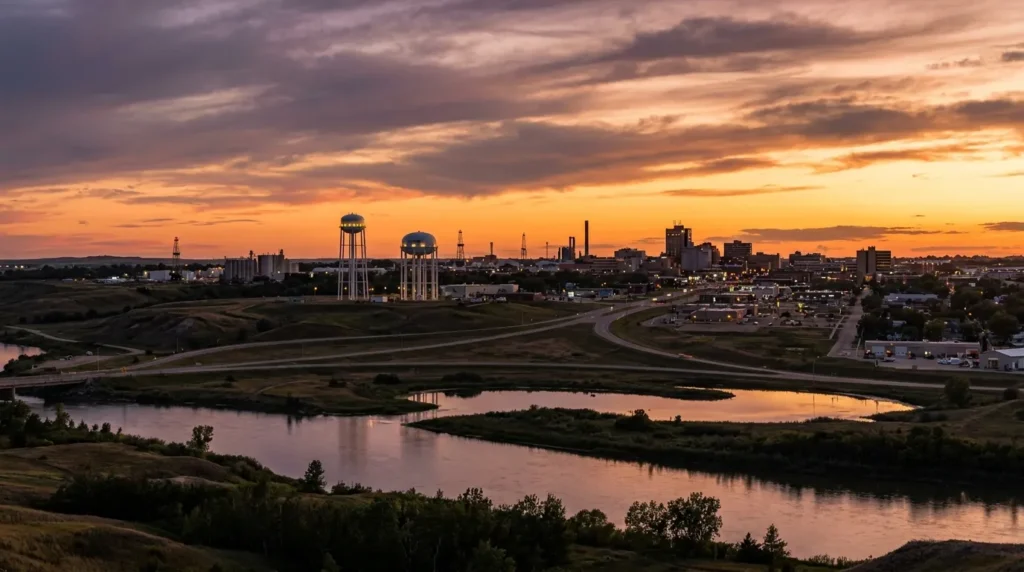
Williston grew from fewer than 15,000 to over 27,000 residents during the Bakken oil boom of the 2010s. Prairie, a historic fur-trading post, and boom-town culture define the city.

The Fort Union Trading Post National Historic Site, 30 minutes from Williston, recreates the most important fur trading post on the Upper Missouri, active from 1828 to 1867 between the American Fur Company and the Assiniboine, Crow, and Lakota tribes. Fort Buford State Historic Site, nearby, is where Sitting Bull surrendered in 1881. The Confluence Center tells the story of Lewis & Clark.

The James Memorial Art Center and the Frontier Museum, both in town, preserve local heritage. The Williston Area Recreation Center (ARC) is one of the largest rural public recreation centers in the US, featuring pools, climbing walls, gymnasiums, and covered tennis courts, built with oil royalties. Spring Lake Park and Harmon Park offer outdoor options.

Lake Sakakawea, 30 minutes away, is the second largest artificial reservoir in the US, with fishing for walleye, pike, and salmon. Theodore Roosevelt National Park, with its badlands and bison herds, is about an hour's drive. Daily life in Williston is defined by the Bakken boom-bust cycle: oil jobs, high costs when barrel prices rise, and emptiness when they fall. Winter arrives early, and temperatures can drop to -22°F (-30°C).

  1. 1["Fort Union Trading Post National Historic Site"
  2. 2"Fort Buford State Historic Site"
  3. 3"Lake Sakakawea (nearby)"
  4. 4"Missouri-Yellowstone Confluence Interpretive Center"
  5. 5"James Memorial Art Center"
  6. 6"Frontier Museum"
Nightlife3.0 / 10
Parks & green spaces
  • ["Harmon Park"
  • "Davidson Park"
  • "Spring Lake Park"
  • "Lewis and Clark State Park (nearby)"
  • "Riverview Park"
  • +1 more

Latest posts

Posts about North Dakota

Coverage and updates related to this destination.

Showing content from North Dakota, as there is no specific data for Williston yet.