Visto n' Visa
Blog
Notícias e artigos
Destinations
Careers
Immigrants

Want to live and work in Grand Forks?

Personalized immigration plan with eligible visas, costs, and next steps for your goal!

If you are not eligible, you will know exactly why and what to do to improve your approval chances.

Save up to 12 hours in meetings

No pointless assessments.

Save up to 90%

Save money on vague or unfocused consultations

Avoid Fraud and Mistakes

One mistake can cost you your visa

Total Impartiality

Zero commercial bias

Decide with peace of mind

No toxic urgency

Fast and Accurate

Answers in minutes, no guesswork

Who lives in Grand Forks: students, military families, and refugees

The population skews young because of UND and the air force base. The majority is white with Scandinavian and German ancestry, alongside a diverse military community and a growing population of refugees and international students.

Grand Forks demographics diverge somewhat from the state's rural norm because of its two major anchors: the university and the air force base. UND enrolls around 14,000 students and attracts international students, particularly from India, China, South Korea, and Nepal, in aviation, engineering, and science programs. This keeps the median age relatively low.

The military base brings families from every U.S. state, making the environment considerably more cosmopolitan than one might expect for an interior city. Resettlement programs have brought refugees from Bhutan, the Democratic Republic of the Congo, Somalia, and Ukraine. The Hispanic community is also growing, with Mexican and Venezuelan immigrants drawn by agricultural and construction work.

Brazilians are rare, typically connected to graduate programs at UND. Local roots remain strongly Norwegian, Swedish, German, and Ukrainian, visible in surnames, churches, and local cuisine. The result is a city that feels small on the surface but holds considerably more human diversity than it might first appear.

Languages spoken
  • English
  • Spanish
  • Hindi
  • Nepali
  • Somali
  • +1 more
Main religions
  • Lutheranism
  • Catholicism
  • No religion
  • Hinduism
  • Islam

Cost of living in Grand Forks: among the lowest for a university city

Grand Forks combines a very low cost of living with the presence of a university and a military base, which keeps services solid at affordable prices. Rent, food, and transportation fall well below the national average.

Rent is perhaps the strongest selling point. Apartments near UND, in the University Park area, are affordable even for students, and family homes in residential neighborhoods sell at prices that seem almost unreal to those coming from large cities. Homeownership is within reach on an average salary, and property taxes remain in a moderate range.

The major annual expense is heating, which runs from November through April. Well-insulated homes with double-pane windows and an efficient furnace soften the impact, and apartments in modern buildings often include heat in the rent. Sales tax in Grand Forks runs around seven percent, and North Dakota has a low state income tax rate.

For daily needs, grocery stores such as Hugo's, Cashwise, Walmart, and Target cover the basics. There are small ethnic markets near the university. Dining at chains like Olive Garden, Texas Roadhouse, and Buffalo Wild Wings is common and reasonably priced. Fuel costs less than in almost any other part of the U.S. outside the deep Midwest.

87Cost index (US = 100)13% below US average
CategorySingleCoupleFamily (2 + 2)
iHousing$1,136$1,310$1,660
iFood$332$664$1,206
iTransport$437$743$961
iHealthcare$245$490$918
iChildcare$1,590
iOther$743$1,336$1,879
Monthly total$2,893$4,543$8,214

Source: U.S. BLS Consumer Expenditure Survey 2023 + BEA Regional Price Parities 2023 · Estimates in USD, monthly.

Housing in Grand Forks: diverse options near the university and downtown

Options range from student apartments near UND to family homes in the southern part of the city. East Grand Forks, just across the river in Minnesota, is a nearby alternative. Rents remain very affordable.

Near UND, the supply of student apartments is substantial, including four- to six-bedroom shared units, converted houses, and newer complexes. The Near North End and South End neighborhoods have traditional family homes with generous yards. The Downtown Historic District contains the city's oldest properties, some converted into modern apartments after the post-flood reconstruction.

The southern part of the city, around South Washington Street and South Columbia Road, is the most sought-after area for families because of its schools and proximity to shopping. Those working on the air force base have access to newer residential developments nearby. East Grand Forks, Minnesota, offers competitive prices and is just minutes away by bridge.

Newcomers typically rent for six months to a year before purchasing. Real estate firms like Crary Real Estate are prominent in the market. U.S. credit history is required for mortgage financing, but North Dakota offers first-time buyer programs. Apartments with utilities included are worth the extra cost during winter months.

Recommended neighborhoods
  • Near South End
  • Riverside
  • University Park
  • Downtown Historic District
  • South Washington corridor
  • +1 more

Job market in Grand Forks: university, military aviation, healthcare, and agriculture

The local economy revolves around UND, Grand Forks Air Force Base, Altru Health System, and agriculture. The city maintains low unemployment and stable opportunities across several skilled sectors.

The University of North Dakota is the largest civilian employer, with administrative, technical, academic, and research positions. Its strong programs in aviation, aerospace engineering, and UAS (unmanned aerial systems) attract industry partners to establish operations in the region. Grand Forks Air Force Base sustains thousands of military and civilian jobs tied to surveillance and aerial refueling missions.

Altru Health System is the main hospital complex, encompassing a general hospital, clinics, and care centers. As throughout the Upper Midwest, healthcare professionals are in short supply, creating openings for immigrant nurses, technicians, and physicians with recognized credentials. Companies such as J.R. Simplot and American Crystal Sugar carry significant weight in the regional agribusiness sector.

Grand Forks International Airport and its drone research hub have created a UAS ecosystem that draws engineers and technicians. For those arriving without fluent English, agriculture, sugar beet processing, construction, restaurant work, and cleaning services are the most common entry points, with wages above the rural American average.

Dominant sectors
  • Higher education
  • Military aviation
  • Healthcare
  • Agribusiness
  • UAS/drone technology
  • +1 more
Major employers
  • University of North Dakota
  • Grand Forks Air Force Base
  • Altru Health System
  • Grand Forks Public Schools
  • American Crystal Sugar
  • +1 more

Education in Grand Forks: a prominent university and a well-regarded public school system

The University of North Dakota sets the academic tone. Public schools have a solid reputation, with English-language programs for immigrant students. Private religious and technical options are also available.

The University of North Dakota is the oldest and largest institution of higher education in the state, founded in 1883. It has well-regarded programs in aviation, aerospace engineering, geology, health sciences, and law. The aviation program is a national reference and draws international students. In-state tuition is affordable relative to comparable universities.

Grand Forks Public Schools covers the public system, with Red River High School and Central High School as local landmarks. The district maintains English as a Second Language programs for refugee and immigrant students, with translators available in multiple languages at parent meetings.

For technical and vocational training, Northland Community and Technical College, just across the river in Minnesota, offers practical programs at accessible tuition rates. Private Catholic schools such as St. Michael's School serve families seeking a religious environment. For younger children, there are good subsidized childcare options and the Head Start program.

Notable universities
  • University of North Dakota (UND)
  • Northland Community and Technical College
  • Rasmussen University

Healthcare in Grand Forks: Altru Health System handles the majority of care

Altru Health System is the dominant provider, covering the general hospital, clinics, specialties, and regional referrals. For cases beyond local capacity, patients are transferred to Fargo or Minneapolis.

Altru Hospital, located in the city center, is the only large general hospital, offering emergency care, maternity services, cardiology, oncology, and orthopedics. The network includes clinics spread throughout the city. For complex or rare procedures, patients are referred to Sanford Fargo, the Mayo Clinic, or facilities in Minneapolis.

As with the U.S. system generally, having insurance is essential. Employees of UND, the air force base, or Altru have access to negotiated plans. Refugees eligible for Medicaid can enroll through Lutheran Social Services. Those without coverage can access Valley Community Health Centers, which offers income-based sliding-scale fees.

In emergencies, the Altru ER treats anyone regardless of coverage, with billing handled afterward. Specialist appointments may involve waits of several weeks. Mental health services are reasonably available, particularly for veterans through the nearby VA Medical Center. Dental care is separate and expensive without a dental plan, and vision care requires separate appointments and out-of-pocket costs.

Healthcare index64.0 / 100
  • Life expectancyyears at birth
    78.4yrs
  • Doctors per 1kpracticing physicians
    3.7
  • Health spendper capita, per year
    $13,473
  • Public systemoverall quality rating
    Good

Safety in Grand Forks: calm by American standards

Grand Forks has low crime rates by American standards. Residential neighborhoods are safe, the downtown nightlife functions well, and the greatest ongoing risk remains winter weather.

Crime in the city is low, with most incidents involving alcohol on weekend evenings downtown, retail theft, and traffic violations. Residential neighborhoods in the southern part of the city are quiet, and walking on tree-lined streets during the day feels safe. Bicycle theft and car break-ins do occur.

The downtown has an active nightlife, and, as in any university city, altercations and alcohol-related incidents happen on some late nights. The police maintain a visible community presence, and translators are available for cases involving refugees. The air force base has its own security and a restricted perimeter, but interaction with the city is generally smooth.

The greatest hazard remains winter. Snowstorms close roads, wind chill temperatures can plunge below -40°F (-40°C) in January, and driving on icy roads requires preparation. Hypothermia cases occur every year, and those arriving from tropical climates need to invest in proper cold-weather clothing before venturing outside.

5.8
Homicides per 100k
per year
Safety index
62.0
Crime index
38.0
Safer neighborhoods
  • Riverside Park area
  • Belmont Park
  • South Grand Forks
  • University District (UND)
  • Lincoln Drive Park area
  • Adjacent East Grand Forks (MN)
Areas to avoid
  • Stretches of western DeMers Avenue late at night
  • Isolated areas near the river port

Transportation in Grand Forks: regional airport, city buses, and an Amtrak stop

Grand Forks depends on the car, as most mid-size Midwest cities do. It has a small regional airport, local bus service, an Amtrak stop, and road access to Minneapolis roughly four hours away.

Grand Forks International Airport operates direct flights to Minneapolis via Delta, as well as service to Chicago and select seasonal destinations, with international connections through Minneapolis. Interstate 29 runs through the city on a north-south axis, reaching Fargo in about 80 minutes and Winnipeg, Canada, in roughly two and a half hours through the Pembina border crossing.

CAT (Cities Area Transit) is the municipal bus service, with routes serving the university, the air force base, and the main commercial corridors. Service is reasonable during business hours but limited on weekends and evenings. Uber and Lyft operate in the city. The Amtrak Empire Builder, connecting Chicago to Seattle, stops in Grand Forks in the early morning hours.

A car is essentially necessary for those working outside the downtown core or on irregular schedules. Cycling works in summer, partly because of the Greenway, a nearly 19-mile (30 km) linear park along the Red River, but winter ends the season early. A North Dakota driver's license is straightforward to obtain, and the written test is available in several languages at some locations.

15 min
Avg commute
38
Walkability
Airports
  • GFK — Grand Forks International Airport
  • International airport
  • Bike infrastructure

What the climate is like living in Grand Forks

Grand Forks has an extreme humid continental climate, with very long and frigid winters, short hot summers, and biting winds across the plains.

Winters are extremely long and severe, with lows frequently dropping below -8 degrees Fahrenheit (-22 Celsius) and regular blizzards. The Red River can flood in spring when snowmelt is rapid.

Summers are short, sunny, and warm, with highs between 81 and 86 degrees Fahrenheit (27-30 Celsius) in July, moderate humidity, and abundant mosquitoes. Severe thunderstorms bring occasional tornadoes.

Residents need robust heating, extreme-cold winter outerwear, a heated garage, snow tires, and attention to icy surfaces. Air conditioning is helpful in July and August, and insect repellent is essential during the wet months.

Sunny days / year200 days
Avg high (°F)
  • 19°J
  • 18°F
  • 35°M
  • 49°A
  • 67°M
  • 81°J
  • 83°J
  • 80°A
  • 72°S
  • 54°O
  • 38°N
  • 26°D
Avg low (°F)
  • J
  • -1°F
  • 17°M
  • 29°A
  • 44°M
  • 60°J
  • 63°J
  • 61°A
  • 54°S
  • 38°O
  • 24°N
  • 10°D
Rainfall (")
  • 1"J
  • 1"F
  • 1"M
  • 3"A
  • 2"M
  • 3"J
  • 2"J
  • 2"A
  • 2"S
  • 2"O
  • 1"N
  • 2"D

Culture in Grand Forks: hockey, festivals, and a revitalized downtown bar scene

Local culture is defined by UND hockey, summer events on the Greenway, ethnic festivals, and the revitalized bar and restaurant scene in the historic downtown. Scandinavian heritage remains visible in everyday life.

University hockey is practically a religion here. Ralph Engelstad Arena, home of the UND Fighting Hawks, is one of the finest college hockey venues in the country. On game days, the city turns green and social life revolves around the match. College football and basketball also draw loyal followings, though smaller ones.

The Greenway is the city's outdoor hub in summer. Trails, pools, a water park, and Lincoln Park draw families during the warm months. Town Square in the downtown hosts outdoor concerts, and the Empire Arts Center screens films and presents theatrical productions. For newcomers, UND offers international cultural exposure through the International Cultural Night and various student clubs.

The food scene blends Upper Midwest tradition with a university-town sensibility. Hotdish, lefse, kuchen, and knoephla soup appear on menus at local diners such as Darcy's Cafe. There are solid Mexican restaurants, Asian options like Hong Kong House, and small ethnic markets. For an interior city of its size, the culinary variety is notable.

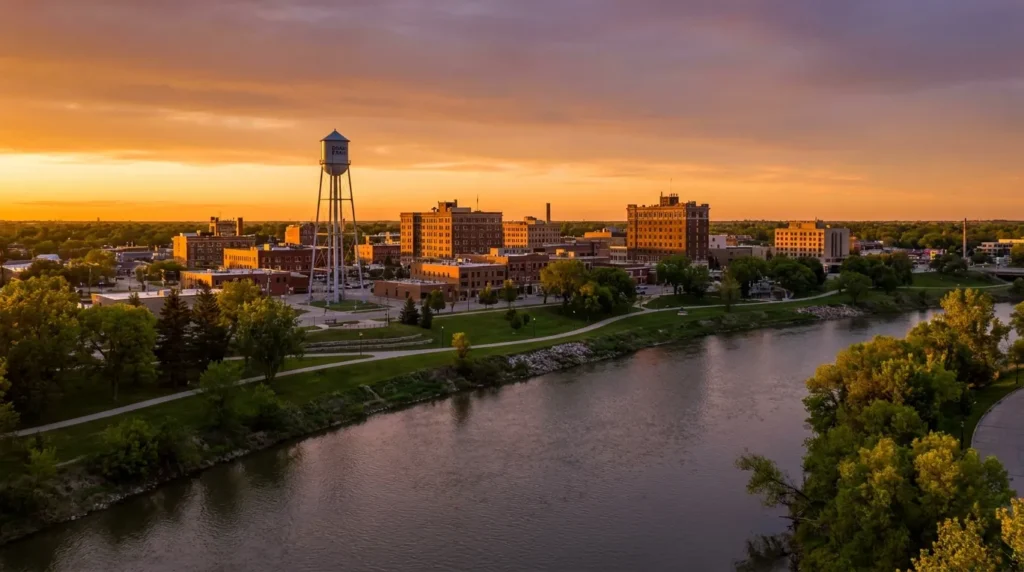
Grand Forks

North Dakota university city at the confluence of the Red and Red Lake rivers

The state's third-largest city, home to the University of North Dakota, with a Greenway along the Red River banks, a nearby air force base, and a cultural scene tied to the university.

Grand Forks sits on the Minnesota border at the confluence of the Red and Red Lake rivers, and its identity is strongly shaped by the University of North Dakota, founded in 1883. UND has nationally recognized aviation programs, and hockey is a local religion: the Ralph Engelstad Arena is one of the most lavish college arenas in the country and home ice for the Fighting Hawks.

The Greenway, a linear park along the Red River built after the great flood of 1997, connects the twin cities of Grand Forks (ND) and East Grand Forks (MN) with trails, bridges, and picnic areas. The North Dakota Museum of Art on the UND campus and the Empire Arts Center in the renovated downtown anchor the cultural scene.

UND's Center for Aerospace Sciences and Grand Forks Air Force Base give the city a technical and scientific profile. For outdoor activities, Turtle River State Park to the west and Lake Bemidji State Park in Minnesota to the east serve as weekend destinations. Events such as the UND Time Out Wacipi Powwow and the Greek Festival reflect occasional community diversity.

  1. 1["North Dakota Museum of Art"
  2. 2"Ralph Engelstad Arena"
  3. 3"Alerus Center"
  4. 4"Empire Arts Center"
  5. 5"Children's Museum"
  6. 6"Air Force Base Museum (Grand Forks AFB)"
Nightlife3.0 / 10
Parks & green spaces
  • ["Greenway of Greater Grand Forks"
  • "Sertoma Japanese Garden"
  • "Riverside Park"
  • "Lincoln Drive Park"
  • "University Park"
  • +1 more

Latest posts

Posts about North Dakota

Coverage and updates related to this destination.

Showing content from North Dakota, as there is no specific data for Grand Forks yet.