Visto n' Visa
Blog
Notícias e artigos
Destinations
Careers
Immigrants

Want to live and work in Bismarck?

Personalized immigration plan with eligible visas, costs, and next steps for your goal!

If you are not eligible, you will know exactly why and what to do to improve your approval chances.

Save up to 12 hours in meetings

No pointless assessments.

Save up to 90%

Save money on vague or unfocused consultations

Avoid Fraud and Mistakes

One mistake can cost you your visa

Total Impartiality

Zero commercial bias

Decide with peace of mind

No toxic urgency

Fast and Accurate

Answers in minutes, no guesswork

Who lives in Bismarck: a white majority, a Native American presence, and new immigrants

Bismarck's population is predominantly white, with strong German and Norwegian heritage. Indigenous nations of the region have a historical presence, and refugees and Latinos have been growing in recent years.

Bismarck was founded as a railroad town in the late 19th century and retains the mark of German, Swedish, Norwegian, and Ukrainian immigration. Surnames ending in sen and son appear throughout schools and businesses. Local cuisine follows those roots: knoephla, kuchen, fleischkuekle, and bratwurst are part of everyday life.

The presence of Indigenous peoples is significant, with members of the Mandan, Hidatsa, Arikara, and Standing Rock Sioux nations living in and around Bismarck. Cultural events such as the United Tribes International Powwow bring together tribes from multiple regions. Understanding this aspect of the state helps in understanding the city.

Newly arrived refugees, primarily from Bhutan, the Congo, Somalia, and Ukraine, have been resettled in the region over recent decades. The Hispanic community is growing, with Mexicans and Venezuelans drawn by jobs in healthcare, agriculture, and construction. Brazilians are rare and scattered. The population skews older than in Fargo, though still within the state average.

Languages spoken
  • English
  • Spanish
  • Dakota/Lakota
  • German (heritage)
  • Nepali
Main religions
  • Catholicism
  • Lutheranism
  • Pentecostalism
  • Native spiritualities
  • No religion

Cost of living in Bismarck: among the lowest in the United States

Bismarck offers a cost of living well below the American average. Rent, food, and transportation fit within mid-range salaries. The main burden remains heating costs during the colder months.

Rent for a two-bedroom apartment in relatively new complexes is very affordable by American standards, and homes for purchase in established neighborhoods are also within reach for middle-class families. North Dakota has low state income tax with minimal withholding, which helps retain more take-home pay.

Natural gas bills can double between December and March. Homes with modern insulation and double-pane windows soften the blow. Electricity is inexpensive and provided by Montana-Dakota Utilities. The state sales tax is low, around five percent, plus a modest municipal rate.

For groceries and household needs, Cashwise, Dan's Supermarket, Walmart, and Target cover most families. Costco and Sam's Club attract bulk shoppers. Dining out at Midwest chains and local diners like Kroll's Diner is budget-friendly. Fuel, even through the harshest winters, tends to rank among the cheapest in the country.

87Cost index (US = 100)13% below US average
CategorySingleCoupleFamily (2 + 2)
iHousing$1,136$1,310$1,660
iFood$332$664$1,206
iTransport$437$743$961
iHealthcare$245$490$918
iChildcare$1,590
iOther$743$1,336$1,879
Monthly total$2,893$4,543$8,214

Source: U.S. BLS Consumer Expenditure Survey 2023 + BEA Regional Price Parities 2023 · Estimates in USD, monthly.

Housing in Bismarck: spacious homes and a growing rental supply

Bismarck has large homes in quiet neighborhoods, modern apartments on the south side, and some historic options downtown. Rent remains affordable and most newcomers start in newer complexes.

The south side of the city concentrates the newer neighborhoods, with spacious homes, double garages, and wide streets. Areas such as North Hills and Pebble Creek offer higher-end options. Closer to downtown, North Bismarck and the historic Cathedral District have older homes on generous lots with tree-lined streets and their own charm.

Rental apartments are available in modern complexes with pools and fitness centers, primarily on the south side near State Street and Bismarck Expressway. Many units include heat, which is an advantage in winter. Single-family rental homes are also easy to find outside the university peak months.

Purchasing property is feasible even for families with average salaries. The process follows the American standard: bank pre-approval, offer, inspection, and closing. Immigrants with limited credit history may need a co-signer or a larger down payment. Mandan, across the river, offers even lower prices for those willing to cross the bridge daily.

Recommended neighborhoods
  • Cathedral District
  • North Hills
  • Pebble Creek
  • South Bismarck
  • Lincoln
  • +2 more

Job market in Bismarck: government, healthcare, energy, and agriculture

Bismarck combines state government jobs, large hospitals, energy industries tied to Bakken oil, and agriculture. Unemployment has remained at very low levels for years.

The State of North Dakota is the city's largest employer, with offices across all departments, generating administrative, legal, and IT positions. Sanford Health Bismarck and CHI St. Alexius are the two major hospitals and absorb healthcare professionals, with a constant shortage of nurses and technicians that opens doors for qualified immigrants.

The Bakken oil field industry to the west generates demand for engineers, truck drivers, welders, and maintenance technicians. Companies such as Hess, Continental Resources, and Marathon Oil have operations in the region, with offices in Bismarck. Agriculture remains strong, with cooperatives and processors handling soybeans, wheat, and livestock.

The financial sector includes institutions such as Bank of North Dakota, the only state-owned bank in the United States, and BNC National Bank. Construction hires heavily during summer, the main building season. For those arriving without fluent English, restaurants, hotels, cleaning services, and construction concentrate the immediate opportunities, with wages above the rural south's average.

Dominant sectors
  • State public administration
  • Healthcare and hospitals
  • Energy and oil
  • Agribusiness
  • Financial services
  • +1 more
Major employers
  • State of North Dakota
  • Sanford Health Bismarck
  • CHI St. Alexius Health
  • Bank of North Dakota
  • Bismarck Public Schools
  • +1 more

Education in Bismarck: solid public school system and state colleges

Bismarck's school system has a strong reputation within the state. The city is home to the University of Mary, Bismarck State College, and United Tribes Technical College, each with its own profile.

Bismarck Public Schools administers the regular network, with schools such as Bismarck High, Century High, and Legacy High, all offering competitive high school programs and strong extracurricular activities. English as a Second Language programs are available for immigrant and refugee students, with interpreters in multiple languages. Mandan Public Schools covers the west side of the river.

In higher education, the University of Mary, a Benedictine Catholic institution, offers programs in healthcare, business, and education, with a more spiritually oriented profile. Bismarck State College is the public community college, strong in energy, technology, and technical nursing, with affordable tuition. United Tribes Technical College serves primarily Indigenous students, with technical programs oriented toward tribal communities.

For broader degree programs, NDSU in Fargo and the University of North Dakota in Grand Forks are about three and four hours away by car, respectively. Private Catholic schools such as St. Mary's Central High round out the options. Bismarck offers a modest but focused academic environment, well-aligned with the regional job market.

Notable universities
  • University of Mary
  • Bismarck State College
  • United Tribes Technical College
  • Rasmussen University (campus)

Healthcare in Bismarck: two major hospitals serving the entire western state

Sanford Health Bismarck and CHI St. Alexius Health are the system's pillars. They serve not only the city but also patients from farms, ranches, and the oil fields of western North Dakota.

Sanford Medical Center Bismarck and CHI St. Alexius Health serve as referral hospitals for the entire western half of the state. Services include trauma, cardiology, oncology, maternity, and neonatal intensive care. Highly complex cases may be transferred to Sanford Fargo or Mayo Clinic hospitals in Rochester, Minnesota, depending on the plan.

As in the rest of the United States, health insurance is the central axis of the system. State employees have negotiated plans, which benefits those working in government. Those without coverage turn to Coal Country Community Health Center or community clinics with sliding-scale fees. Medicaid covers children, pregnant individuals, and eligible refugees.

Specialists may have wait times of a few weeks to a month. Mental health coverage is limited but expanding, with programs for veterans and Indigenous communities. Dental care is separate and expensive without a dental plan. In an emergency, the ER serves anyone, but the bill arrives afterward and can be substantial without insurance.

Healthcare index65.0 / 100
  • Life expectancyyears at birth
    78.4yrs
  • Doctors per 1kpracticing physicians
    3.7
  • Health spendper capita, per year
    $13,473
  • Public systemoverall quality rating
    Good

Safety in Bismarck: one of the safest capitals in the United States

Bismarck frequently appears on lists of the safest American capitals. Violent crime is rare, and daily life is calm. The greater risk comes from winter and road accidents.

Crime in the city is low by American standards, with most incidents tied to shoplifting, domestic disputes, and traffic violations. Residential neighborhoods are quiet, walking at night in central streets feels safe, and local police maintain good community relations.

Some areas near downtown see higher rates of alcohol-related incidents on weekends, and homelessness has grown with seasonal unemployment in the oil fields. Even so, compared to similarly sized cities in other regions of the United States, Bismarck remains very calm and free from everyday gun violence.

The most real danger remains the weather. Snowstorms close roads, wind chill below minus 40 degrees occurs in January and December, and driving on ice is hazardous. Those coming from tropical climates need to understand that going outside without proper clothing can result in hypothermia within minutes. Vehicles must carry a complete emergency kit in winter.

5.8
Homicides per 100k
per year
Safety index
68.0
Crime index
32.0
Safer neighborhoods
  • North Bismarck
  • Lincoln (adjacent)
  • Hillside Park area
  • Fox Island
  • Cathedral District
  • Northridge
Areas to avoid
  • Isolated areas near US-83 at night
  • Industrial stretches to the south late at night

Transportation in Bismarck: small airport and a car-oriented city

Bismarck relies heavily on the car, with the regional Bismarck Airport, limited local bus service, and no passenger rail network. Internal distances are short.

Bismarck Airport operates direct flights to Denver, Minneapolis, Las Vegas, and some seasonal destinations such as Phoenix. For international destinations, a connection through Minneapolis or Denver is required. Interstate 94 cuts through the city east to west, connecting to Fargo in about three and a half hours and to Billings, Montana, in roughly five and a half hours.

CAT (Capital Area Transit) is the municipal bus service, with routes covering the basics. It works for those with standard business hours but falls short for night shifts and weekends. Uber and Lyft operate in the city, but wait times are far from what is seen in larger metros. A personal vehicle is practically required for most residents.

Traffic is light, with few congestion points. Internal distances are short, and most destinations within the city are within 15 minutes. In winter, driving requires proper tires, an emergency kit, and close attention to storms. A North Dakota driver's license is straightforward to obtain, with the written test available in multiple languages at select locations.

16 min
Avg commute
35
Walkability
Airports
  • BIS — Bismarck Municipal Airport
  • Bike infrastructure

What the Climate Is Like Living in Bismarck

Bismarck has a humid continental climate with extremely long, frigid winters, short hot summers, and strong winds across the open plains.

Winters are long and severe, with lows frequently dropping below -4 degrees Fahrenheit between December and February. Snowstorms and blizzards are common, and the biting plains wind drives wind chills to dangerous levels.

Summer is short, sunny, and warm, with highs reaching 82 to 90 degrees Fahrenheit in July. Nights are cool, humidity stays moderate, and severe storms can occasionally bring tornadoes.

Residents need solid heating, an extreme-weather winter coat, boots, gloves, and snow tires. A heated garage is nearly essential, and air conditioning helps through July and August.

Sunny days / year220 days
Avg high (°F)
  • 25°J
  • 24°F
  • 38°M
  • 50°A
  • 67°M
  • 81°J
  • 84°J
  • 83°A
  • 74°S
  • 54°O
  • 41°N
  • 28°D
Avg low (°F)
  • J
  • F
  • 19°M
  • 29°A
  • 44°M
  • 58°J
  • 63°J
  • 61°A
  • 53°S
  • 37°O
  • 24°N
  • 13°D
Rainfall (")
  • 1"J
  • 1"F
  • 1"M
  • 2"A
  • 3"M
  • 2"J
  • 2"J
  • 2"A
  • 2"S
  • 2"O
  • 1"N
  • 1"D

Culture in Bismarck: history, the Missouri River, and ethnic festivals

Bismarck has a modest but tradition-rich cultural scene. State history museums, Indigenous events, German festivals, and the natural landscape along the Missouri set the city's rhythm.

The North Dakota Heritage Center, adjacent to the Capitol, is one of the state's finest museums, with exhibits on Indigenous peoples, dinosaurs discovered in the region, and the settlement period. Fort Abraham Lincoln, across the river, tells the story of General Custer and the Mandan nations. The Capitol itself is open for tours and offers views across the entire valley.

The Missouri River is the heart of summer life. River trails, fishing, water skiing, and Fort Abraham Lincoln State Park draw residents during the warm months. In winter, ice fishing, snowmobiling, and skating at covered rinks such as the VFW Sports Center keep the city active. Fall festivals such as Oktoberfest reflect the German heritage.

Local cuisine is dominated by Upper Midwest food with a German touch: knoephla soup, fleischkuekle, lefse, and kuchen. There are good pizzerias, American steakhouses, and some newer Mexican and Vietnamese options. Bismarck does not have the dining variety of a large city, but family restaurants and craft breweries such as Laughing Sun have their own appeal.

Bismarck

What to Do in Bismarck, Capital of North Dakota

A state capital along the Missouri River, with German-Russian and Volga heritage, a Lewis and Clark identity, and a steady flow of government workers and agribusiness and oil professionals.

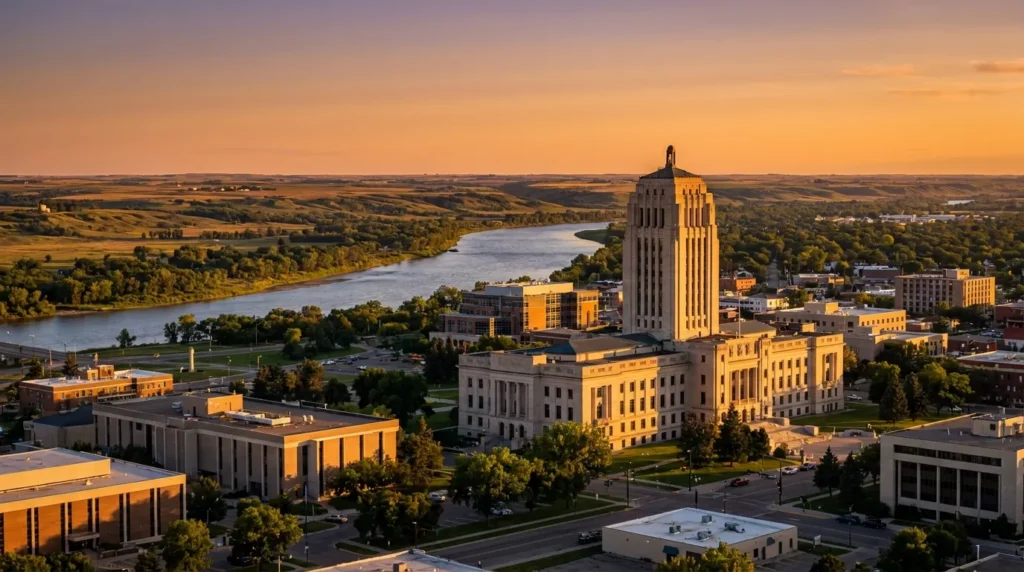
The North Dakota State Capitol, a 19-story Art Deco structure nicknamed the Skyscraper on the Prairie, dominates the skyline. The North Dakota Heritage Center, located alongside it, is the state's most comprehensive history museum, covering everything from dinosaurs to the Bakken oil era.

Fort Abraham Lincoln State Park, in neighboring Mandan, preserves General Custer's home and a reconstruction of the Mandan On-A-Slant Village. The Lewis and Clark Riverboat offers cruises on the Missouri. The Dakota Zoo and the Gateway to Science Center are popular family stops.

Downtown Bismarck, centered around Main Avenue, has been revitalized with cafes, brewpubs (Laughing Sun, Stonehome), and the Bismarck Art and Galleries Association. In summer, festivals such as the United Tribes International Powwow bring Lakota and Dakota cultures from nearby reservations into the city.

  1. 1["North Dakota State Capitol"
  2. 2"North Dakota Heritage Center and State Museum"
  3. 3"Dakota Zoo"
  4. 4"Camp Hancock State Historic Site"
  5. 5"Former Governors' Mansion State Historic Site"
  6. 6"Lewis and Clark Riverboat"
Nightlife3.0 / 10
Parks & green spaces
  • ["Sertoma Park"
  • "Pioneer Park"
  • "Cottonwood Park"
  • "Keelboat Park"
  • "Hillside Park"
  • +1 more

Latest posts

Posts about North Dakota

Coverage and updates related to this destination.

Showing content from North Dakota, as there is no specific data for Bismarck yet.