Visto n' Visa
Blog
Notícias e artigos
Destinations
Careers
Immigrants

Want to live and work in Passaic?

Personalized immigration plan with eligible visas, costs, and next steps for your goal!

If you are not eligible, you will know exactly why and what to do to improve your approval chances.

Save up to 12 hours in meetings

No pointless assessments.

Save up to 90%

Save money on vague or unfocused consultations

Avoid Fraud and Mistakes

One mistake can cost you your visa

Total Impartiality

Zero commercial bias

Decide with peace of mind

No toxic urgency

Fast and Accurate

Answers in minutes, no guesswork

Majority Hispanic population with a strong Arab and Jewish presence

Approximately 70% of residents are of Hispanic origin, led by Dominicans, Mexicans, and Central Americans, alongside established Arab and Orthodox Jewish communities that have been present for decades.

Passaic has approximately 70,000 residents in just over 3 square miles, placing it among the most densely populated cities in the state. Spanish is the primary home language for the majority, and along streets like Main Avenue and Passaic Street, businesses are almost entirely bilingual.

Beyond the Hispanic community, the city is home to one of the largest Arab communities in New Jersey, concentrated mainly around South Main Street, with mosques, bakeries, and markets serving families from Lebanon, Syria, Egypt, and Palestine. There is also a growing Orthodox Jewish community in the Passaic Park neighborhood, with synagogues, schools, and kosher markets.

The median age is low, with many young families and school-age children. Public schools serve students who speak dozens of languages at home, and the district offers bilingual programs and English as a Second Language instruction.

Languages spoken
  • English
  • Spanish
  • Arabic
  • Yiddish
  • Hebrew
  • +1 more
Main religions
  • Roman Catholic
  • Orthodox Judaism
  • Sunni Islam
  • Evangelical Protestantism
  • Pentecostalism

Moderate cost by New York metropolitan area standards

Passaic is well below Manhattan and Hoboken in rental and grocery costs, though property taxes and car insurance rank among the highest in the country.

Compared to other cities a half hour from New York, Passaic is clearly more affordable. One-bedroom apartment rents are well below what is paid in Jersey City or Hoboken, and markets such as C-Town, Compare Foods, and Arab bakeries offer fresh food at competitive prices.

The major budget burdens are property tax, which in New Jersey ranks among the highest in the country, and car insurance, which is expensive in Passaic due to traffic density and claims rates. Renters do not face property tax directly, but it is typically embedded in the rent.

Dining out is accessible, with lunch specials at Dominican, Mexican, and Arab counters available at low prices. Public transit is a practical alternative to a car, particularly for those commuting to New York or Newark.

108Cost index (US = 100)8% above US average
CategorySingleCoupleFamily (2 + 2)
iHousing$1,414$1,632$2,067
iFood$414$827$1,501
iTransport$544$924$1,196
iHealthcare$304$609$1,142
iChildcare$1,980
iOther$924$1,664$2,339
Monthly total$3,600$5,656$10,225

Source: U.S. BLS Consumer Expenditure Survey 2023 + BEA Regional Price Parities 2023 · Estimates in USD, monthly.

Three-story brick buildings, multi-family homes, and few high-rises

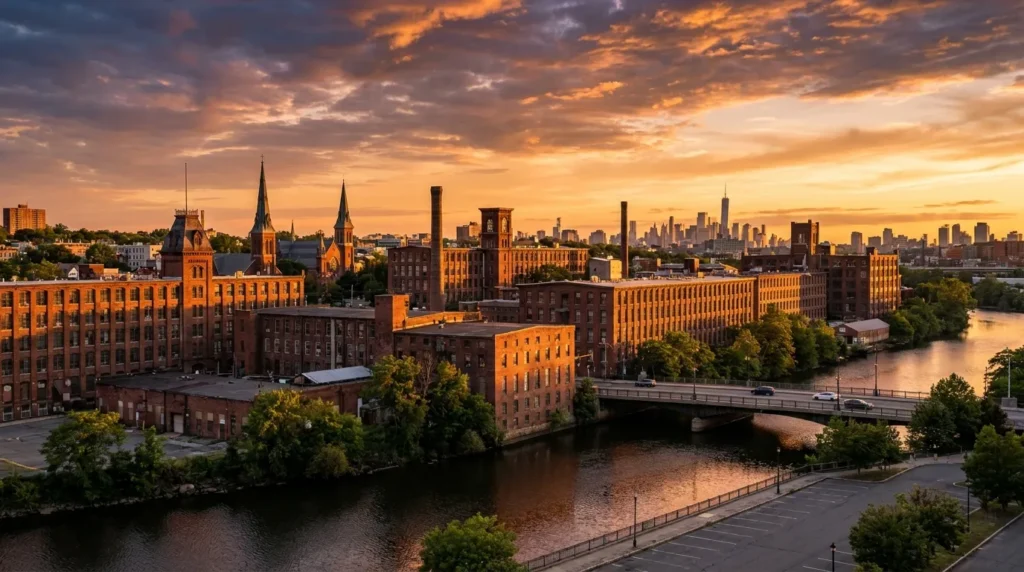
Passaic's housing stock is dominated by three- to six-story brick buildings and older multi-family homes, with little new construction and limited availability of large units.

The majority of residents rent. The most common housing types are brick apartment buildings from the early 20th century, two- and three-family row houses, and some residential towers along the main avenues. Detached single-family homes are a minority and are concentrated in Passaic Park.

Passaic Park is the most sought-after neighborhood for families, with tree-lined streets, religious schools, and a greater suburban feel. The downtown and the area around Main Avenue offer the most affordable inventory and the most commercial activity. Neighborhoods like Dundee and Third Ward are popular, with a strong Latino presence.

Those arriving from Europe or Latin America may find prices high at first, but the cost per square foot is well below Manhattan or Brooklyn. A personal visit is strongly recommended, as building conditions vary considerably from block to block.

Recommended neighborhoods
  • Passaic Park
  • Eastside
  • Dundee
  • Third Ward
  • Lower Main

Retail, healthcare, and logistics drive local employment

Passaic's economy depends on retail, light manufacturing, hospitals, and logistics, with many residents commuting daily to Newark, Jersey City, and New York.

Commerce on Main Avenue and Passaic Street employs thousands in stores, restaurants, and ethnic markets. St. Mary's General Hospital is one of the city's largest permanent employers and draws healthcare professionals from throughout the region.

Light manufacturing and warehouses along the Passaic River remain active, with facilities producing food products, textiles, and packaging. Logistics has grown in recent years due to proximity to airports, seaports, and major highways.

For better-paying jobs, most skilled professionals commute by train from Clifton or by bus to Newark, Jersey City, and Manhattan. Finance, technology, and media sectors are almost entirely located outside the city, but transit access is reasonable.

Dominant sectors
  • Retail
  • Light Manufacturing
  • Healthcare
  • Logistics and Warehousing
  • Food Services
  • +1 more
Major employers
  • St. Mary's General Hospital
  • Passaic Public Schools
  • Goya Foods (Jersey City, regional)
  • Shulton/Procter & Gamble (historical, neighboring)
  • C-Town Supermarkets
  • +1 more

Large public school system and several private religious schools

Passaic Public Schools serves tens of thousands of students with bilingual programs, and the city has a strong network of Orthodox Jewish and private Catholic schools.

The public school system is one of the largest in northern New Jersey, with bilingual programs in Spanish and Arabic, English instruction for newcomers, and vocational high schools. The district serves students from immigrant families representing more than one hundred countries.

The Passaic Park neighborhood is home to Orthodox Jewish schools, including men's yeshivas and Bais Yaakov schools for girls, which draw families from throughout the New York metropolitan area. There are also traditional Catholic schools and some Islamic schools.

For higher education, most young adults study at nearby institutions such as Passaic County Community College in Paterson, William Paterson University in Wayne, Montclair State University, and Rutgers in Newark and New Brunswick.

Notable universities
  • Passaic County Community College (Paterson)
  • William Paterson University (Wayne)
  • Montclair State University
  • Rutgers University-Newark
  • Berkeley College (Woodland Park campus)

Local hospital complemented by an extensive metropolitan network

St. Mary's General Hospital handles emergencies and general care in Passaic, while residents access top-tier hospitals in Newark and New York for complex treatments.

St. Mary's General Hospital in Passaic provides emergency care, obstetrics, surgery, and specialized clinics. It is the city's main hospital and serves many low-income residents through Medicaid and community programs. Community clinics and federally qualified health centers supplement primary care access.

For more serious or specialized cases, patients are referred to St. Joseph's University Medical Center in Paterson, Hackensack University Medical Center, and university hospitals in Newark and New York. Proximity to Manhattan facilitates access to leading centers in oncology, cardiology, and transplant medicine.

Healthcare costs in the United States are a significant burden without insurance. Immigrants who obtain work visas typically receive employer-sponsored coverage; those outside that path may seek marketplace plans, Medicaid if eligible, or community clinics with income-based fees.

Passaic

An urban city with quieter pockets and areas requiring caution at night

Passaic has crime rates above the state average, but daily life in neighborhoods like Passaic Park is calm, with greater caution warranted in commercial zones after dark.

Passaic is an urban city with typical challenges: car theft, occasional robberies, and altercations near bar areas. Crime statistics are above the New Jersey state average but below those of Newark and Paterson. Police presence on central streets is consistent.

Passaic Park is generally perceived as the quietest neighborhood, in part due to its organized community life. Residential areas on the Eastside and around Passaic Park are generally safe during the day and at night. The downtown and some blocks near the industrial corridors along the river warrant more caution after dark.

Practical recommendations include not leaving valuables visible in a car, avoiding poorly lit streets when walking alone late at night, and remaining alert in isolated parking areas. Women report feeling comfortable in residential neighborhoods and busy commercial areas.

Safer neighborhoods
  • Passaic Park
  • Eastside
  • Dundee residential area
  • Area around St. Mary's Hospital
Areas to avoid
  • Industrial areas along the Passaic River at night
  • Isolated blocks of Third Ward late at night
  • Empty parking lots on Lower Main after businesses close

Frequent buses to New York and heavy reliance on NJ Transit

Passaic has no active rail station but is served by direct buses to Manhattan, easy connections to Newark, and proximity to Newark, LaGuardia, and JFK airports.

The rail line that once passed through Passaic has been decommissioned, so public transit relies heavily on NJ Transit Bus service. Routes 190, 191, 192, and 197 reach Port Authority in Manhattan in approximately 30 to 45 minutes outside peak hours. Local lines also connect to Paterson, Newark, and Hackensack.

For rail access, residents typically walk or take a bus to the Clifton, Garfield, or Delawanna station to connect to the NJ Transit Main Line. Drivers use Route 21, Route 3, and the Garden State Parkway to access the rest of the metropolitan area.

Newark Liberty International Airport is less than 30 minutes by car and is the primary arrival point for immigrants. LaGuardia and JFK are approximately 45 to 60 minutes away, depending on traffic. Bike lanes are limited, and cycling within the city remains uncommon.

Airports
  • EWR — Newark Liberty International (nearby)
  • LGA — LaGuardia (nearby)
  • JFK — John F. Kennedy International (nearby)
  • TEB — Teterboro (executive aviation, nearby)

Climate

Passaic

A blend of Latin, Arab, and Jewish cuisine within a few city blocks

Culture in Passaic plays out in the streets, with Dominican restaurants, Arab bakeries, kosher markets, and religious celebrations that share the calendar.

Everyday cultural life unfolds on the sidewalks of Main Avenue, Passaic Street, and Lexington Avenue. Dominican restaurants serve mangu and mofongo, Mexican counters offer tacos al pastor, and Arab bakeries sell manakish, pita bread, and pistachio sweets. The kosher retail scene in Passaic Park is a regional reference for Orthodox Jews throughout the area.

Catholic religious festivals with processions are organized by Latin communities, Ramadan and Eid celebrations are concentrated around the mosques, and the Jewish calendar sets the rhythm of Passaic Park, with shops closing for Shabbat on Friday afternoons.

There is no significant arts scene or museums within the city, but popular culture is vibrant and accessible. For theater, concerts, and museums, New York is a short bus ride away.

Notable dishes
  • Dominican mangu
  • Mofongo
  • Pollo a la brasa
  • Za'atar manakish
  • Lamb shawarma
  • +3 more
Annual events
  • Passaic County Fair (regional)
  • Dominican Independence Day Parade
  • Ramadan and Eid al-Fitr celebrations
  • Religious events in Passaic Park (Sukkot, Passover)
  • Our Lady of Guadalupe Festival

Limited tourist appeal, with neighborhood parks and proximity to New York

Passaic is not a tourist destination, but offers municipal parks, ethnic commerce, and easy access to Greater New York attractions.

The city has no large museums or major landmarks. What draws residents and visitors are the commercial streets, with Arab markets, Jewish bakeries, and Latin restaurants side by side. A walk along Main Avenue in the afternoon offers a vivid portrait of northern New Jersey's diversity.

Third Ward Park, along the banks of the Passaic River, offers sports courts, a playground, and a picnic area. Pulaski Park, downtown, hosts events and community games. For larger natural spaces, Garret Mountain Reservation in Paterson is just minutes away and features trails, a lake, and a scenic overlook.

The location is a significant advantage: in under an hour, one can reach museums in Manhattan, Sandy Hook Beach, Liberty State Park, or the historic Paterson Great Falls.

  1. 1Third Ward Park
  2. 2Pulaski Park
  3. 3Main Avenue (ethnic commerce)
  4. 4Passaic Park (historic neighborhood)
  5. 5Garret Mountain Reservation (nearby, Paterson)
  6. 6Paterson Great Falls (nearby)
Parks & green spaces
  • Third Ward Park
  • Pulaski Park
  • Eastside Park
  • Passaic River Park (riverside)
  • Garret Mountain Reservation (nearby)

A city built by successive waves of immigration since the 19th century

Passaic was shaped by European immigrants in the 19th century and is now dominated by Latin American, Arab, and Orthodox Jewish communities, with active religious and commercial networks.

Passaic's history is a history of immigration. In the late 19th and early 20th centuries, Polish, Italian, German, Slovak, and Eastern European Jewish workers arrived to work in the textile factories. Many of the old churches and buildings still bear traces of those communities.

From the 1970s and 1980s onward, Dominicans, Mexicans, Central Americans, and South Americans arrived, today forming the majority of the population. In parallel, Arab families from Lebanon, Syria, Egypt, Palestine, and Iraq established a commercial and religious corridor on South Main Street. Since the 1990s, Orthodox Jews from Brooklyn and New York State have consolidated Passaic Park as a religious neighborhood.

Newcomers find markets, churches, mosques, synagogues, and community organizations well acquainted with the immigration process: apartments available without a credit score, schools with bilingual programs, immigration attorneys on Main Avenue, and community clinics with income-based fees. The informal support network is strong and provides significant assistance during the first months.

31,000
Foreign-born residents
estimated
Top countries of origin
  • Dominican Republic
  • Mexico
  • Ecuador
  • Peru
  • Lebanon
  • Syria
  • Poland
  • Egypt
Foreign consulates
  • Dominican Republic Consulate General (New York)
  • Mexican Consulate General (New York)
  • Ecuadorian Consulate General (Newark)
  • Peruvian Consulate General (Paterson)
  • Lebanese Consulate General (New York)
  • +2 more
Community organizations
  • Catholic Charities of the Archdiocese of Newark
  • Hispanic Multi-Purpose Service Center
  • Arab American Civic Organization
  • Jewish Family Service of Clifton-Passaic
  • International Rescue Committee (Elizabeth, regional)
  • Center for Hope and Safety

Latest posts

Posts about New Jersey

Coverage and updates related to this destination.

Showing content from New Jersey, as there is no specific data for Passaic yet.