Visto n' Visa
Blog
Notícias e artigos
Destinations
Careers
Immigrants

Want to live and work in St. Louis?

Personalized immigration plan with eligible visas, costs, and next steps for your goal!

If you are not eligible, you will know exactly why and what to do to improve your approval chances.

Save up to 12 hours in meetings

No pointless assessments.

Save up to 90%

Save money on vague or unfocused consultations

Avoid Fraud and Mistakes

One mistake can cost you your visa

Total Impartiality

Zero commercial bias

Decide with peace of mind

No toxic urgency

Fast and Accurate

Answers in minutes, no guesswork

Diverse population with growing Bosnian, Hispanic, and African communities

St. Louis has a large African American population, one of the largest Bosnian communities outside Europe, and a growing presence of Hispanics, Vietnamese, and East African immigrants.

The city's core population has declined over recent decades, but the metropolitan area remains stable. White and African American residents form the majority, with a strong historic Black presence in neighborhoods like The Ville, birthplace of musicians such as Chuck Berry. The city is nearly evenly split between the two communities, and this demographic reality shapes much of cultural life.

The Bosnian community is one of the most notable. Refugees arrived in the 1990s fleeing the Balkan Wars, and the Bevo Mill neighborhood became a Bosnian enclave with restaurants, markets, and a mosque. It is one of the largest Bosnian communities outside Europe. Hispanics are growing in neighborhoods like Cherokee Street, with Mexican, Salvadoran, and Cuban populations.

Religiously, Catholics and Protestants predominate. The Catholic heritage is strong, particularly among families of German, Irish, and Italian descent. The Hill neighborhood is a reference point for Italian culture, with old parishes and culinary traditions. Islam is growing with the Bosnian and African communities, and historic synagogues serve the Jewish community in Clayton and University City.

Languages spoken
  • English
  • Bosnian
  • Spanish
  • Vietnamese
  • Arabic
  • +1 more
Main religions
  • Christianity (Catholic and Protestant)
  • Islam
  • Judaism
  • Buddhism
  • No religion

One of the lowest costs of living among major US cities

St. Louis offers affordable housing, accessible food options, and taxes at Missouri's standard rates. Healthcare and insurance costs are near average. The city income tax catches many newcomers off guard.

Buying a home in St. Louis is still feasible for those coming from expensive markets. Central neighborhoods like Tower Grove and Lafayette Square feature historic homes at prices that would surprise residents of coastal cities. Renting is also affordable, with one-bedroom apartments in desirable neighborhoods costing a fraction of what similar units fetch in Chicago.

Food is inexpensive, with grocery chains such as Schnucks, Dierbergs, Aldi, and Asian markets like Jay International covering all price ranges. Ethnic restaurants in The Hill, Cherokee Street, and South Grand serve complete meals at reasonable prices. Local cuisine has its own identity, with toasted ravioli, gooey butter cake, and Imo's thin-crust St. Louis-style pizza.

The city's 1 percent income tax on wages catches many newcomers off guard. Those who live outside the city but work within it also pay. Missouri's state income tax adds to the total. Consulting an accountant in the first year is worthwhile, particularly for those with income from multiple sources or remote workers employed by out-of-state companies.

82Cost index (US = 100)18% below US average
CategorySingleCoupleFamily (2 + 2)
iHousing$1,061$1,225$1,551
iFood$311$620$1,127
iTransport$409$694$898
iHealthcare$229$457$857
iChildcare$1,486
iOther$694$1,249$1,755
Monthly total$2,704$4,245$7,674

Source: U.S. BLS Consumer Expenditure Survey 2023 + BEA Regional Price Parities 2023 · Estimates in USD, monthly.

Affordable historic brick homes downtown and varied suburbs surrounding the city

St. Louis is known for its brick-construction homes, especially in the central areas. Suburbs range from upscale neighborhoods in Clayton and Ladue to more modest areas in the western and southern parts of the county.

The central housing stock is dominated by brick houses and buildings, many dating from the late 19th and early 20th centuries. Neighborhoods like Tower Grove South, Shaw, and Compton Heights feature beautifully restored examples. Some areas require renovation work, and there is an active market of house flippers buying and renovating properties for resale.

For families with children, suburbs like Kirkwood, Webster Groves, Clayton, and Brentwood are popular for their well-rated public schools. Clayton also serves as a business hub, with corporate buildings and upscale restaurants. Those seeking new construction with large yards typically look toward Chesterfield, O'Fallon, or St. Charles.

Renters will find options at every price point. Central West End is the most vibrant central neighborhood, with restored historic buildings and new developments. The Cortex Innovation Community and Midtown also attract young professionals. Avoiding the vacant areas of the city's north side is advisable, where housing prices are very low but infrastructure is deteriorated and crime rates are high.

Recommended neighborhoods
  • Central West End
  • Tower Grove South
  • The Hill
  • Shaw
  • Clayton
  • +3 more

Diverse job market with strength in healthcare and biotechnology

St. Louis has strong sectors in healthcare, biotechnology, manufacturing, and logistics. Legacy companies like Anheuser-Busch and Boeing coexist with biotech startups in the Cortex district.

The healthcare sector is the largest employer, with BJC HealthCare, SSM Health, and Mercy operating hospitals and clinics throughout the region. Washington University School of Medicine, affiliated with Barnes-Jewish Hospital, is one of the most respected medical centers in the country. Research in cancer and infectious diseases attracts scientists from around the world.

Manufacturing still carries weight. Boeing maintains a large operation in St. Louis County, producing military aircraft. Anheuser-Busch, maker of Budweiser, has its historic headquarters downtown. Emerson Electric and Edward Jones, a financial services giant, round out the roster of major employers. Logistics is growing due to the city's central position on the American map.

Biotechnology gained momentum with the Cortex Innovation District, a hub hosting startups, laboratories, and research centers around Washington University and Saint Louis University. For immigrants, professions in medicine, engineering, computer science, and logistics offer strong prospects. Networking through universities and tech meetups is particularly helpful for breaking into the market.

Dominant sectors
  • Healthcare and biotechnology
  • Aerospace manufacturing
  • Financial services
  • Logistics
  • Education
Major employers
  • BJC HealthCare
  • SSM Health
  • Boeing
  • Anheuser-Busch
  • Edward Jones
  • +2 more

Elite universities and uneven quality in public K-12 education

Washington University and Saint Louis University place St. Louis on the academic map. However, K-12 schools within the city vary widely, and families typically prefer suburban districts.

Washington University in St. Louis is one of the most respected institutions in the United States, particularly in medicine, law, and business. Saint Louis University, a Jesuit institution, is strong in healthcare, law, and sciences. The University of Missouri-St. Louis (UMSL) is the public option, with affordable tuition. Other options include Webster University and Maryville University.

Public elementary and secondary education within the City of St. Louis faces long-standing challenges. Parents often explore charter, magnet, or private schools as alternatives. In suburbs like Clayton, Ladue, Kirkwood, Webster Groves, and Rockwood, however, public schools are highly rated, attracting families willing to pay more for a home in exchange for educational quality.

For technical and professional training, the St. Louis Community College system has multiple campuses offering short-term programs in healthcare, manufacturing, and technology. ESL programs for adult immigrants are available through the community college as well as through churches and organizations like the International Institute of St. Louis.

Notable universities
  • Washington University in St. Louis
  • Saint Louis University
  • University of Missouri-St. Louis
  • Webster University
  • Maryville University
  • St. Louis Community College

A nationally recognized medical center, particularly in oncology and pediatrics

St. Louis is home to elite hospitals such as Barnes-Jewish and St. Louis Children's, affiliated with Washington University. SSM Health and Mercy complete the network with broad regional coverage.

Barnes-Jewish Hospital, part of BJC HealthCare, is one of the largest teaching hospitals in the country and the clinical partner of Washington University School of Medicine. Its reputation draws patients from across the nation, especially in oncology, cardiology, and transplant medicine. St. Louis Children's Hospital, located next door, is a national pediatric reference center.

SSM Health, a Catholic healthcare system, operates SSM Health Saint Louis University Hospital, affiliated with Saint Louis University, with a robust emergency department and multiple specialties. Mercy has locations in Creve Coeur and Washington, and maintains primary care clinics throughout the region. For the Hispanic community, Casa de Salud offers accessible care with a bilingual staff.

As throughout the United States, health insurance is essential. ACA marketplace plans, employer-sponsored coverage, or Medicaid in some cases cover legal residents. Without coverage, even routine appointments are expensive, and emergencies can result in significant debt. Comparing plans, understanding deductibles, and confirming that preferred providers are in-network before scheduling appointments is strongly advisable.

Healthcare index74.0 / 100
  • Life expectancyyears at birth
    78.4yrs
  • Doctors per 1kpracticing physicians
    3.7
  • Health spendper capita, per year
    $13,473
  • Public systemoverall quality rating
    Good

A difficult statistical reputation, but reality depends heavily on the neighborhood

St. Louis appears on negative rankings due to certain northern neighborhoods, but most residential areas are calm. Researching before choosing where to live makes a significant difference.

The city frequently appears on high-crime rankings in the United States. The numbers are driven by neighborhoods in the north of the City of St. Louis, which face longstanding issues with poverty, urban abandonment, and violence linked to drug activity. These problems rarely spread to Central West End, The Hill, Tower Grove, or the suburbs.

Well-established central neighborhoods and suburbs like Clayton, Kirkwood, and Webster Groves are considered safe. Opportunistic crimes such as car theft and break-ins are the most common complaints. There has been an increase in thefts of Kia and Hyundai vehicles due to a security vulnerability exploited by juveniles. Additional cameras and security measures are recommended.

Local police maintain a visible presence in commercial and tourist areas. Tornadoes are a real concern between March and June, with public sirens sounding when there is a threat. Knowing where the shelter is in a building or home is worthwhile. Localized flooding along the Mississippi also affects some low-lying areas in spring, particularly after heavy snowfall to the north.

5.8
Homicides per 100k
per year
Safety index
30.0
Crime index
70.0
Safer neighborhoods
  • Central West End
  • The Hill (Italian neighborhood)
  • Soulard (during the day)
  • Clayton (neighboring municipality)
  • Lafayette Square
  • Tower Grove South
  • Shaw
Areas to avoid
  • North St. Louis (especially around Wells-Goodfellow and JeffVanderLou) at night
  • Parts of East St. Louis (on the Illinois side)
  • Isolated stretches of Gravois Avenue late at night
  • Industrial areas along the Mississippi River in the early morning hours

A car-centric city with MetroLink connecting key destinations

St. Louis requires a car for most activities, but the MetroLink light rail system connects the airport, downtown, universities, and stadiums in a practical way.

The road network is extensive, with interstates I-44, I-64, I-70, and I-270 crossing the region. Traffic exists during peak hours but is light compared to cities like Chicago. Parking is generally easy and inexpensive outside of downtown. Most families own two cars, especially those living in distant suburbs.

MetroLink is the light rail system, with two lines connecting Lambert Airport to downtown, Washington University, and Busch Stadium. It is useful for those living near stations and working at served locations. Metro Transit buses complement the system but offer limited coverage and low frequency on many routes.

Lambert St. Louis International Airport offers direct flights to major American cities and some international connections. Greyhound and Amtrak operate from the Gateway Multimodal Transportation Center. For short trips in the central areas, bike rentals and electric scooters are a practical option on good days.

2
Metro lines
38
Metro stations
24 min
Avg commute
65
Walkability
Airports
  • STL — St. Louis Lambert International Airport
  • International airport
  • Bike infrastructure

What the climate is like living in St. Louis

A major Midwestern city with a humid continental climate: hot and humid summers around 90 degrees Fahrenheit, and moderately cold winters with occasional snowfall.

Summers in St. Louis are hot and quite humid, with highs between 88 and 91 degrees Fahrenheit in July. Severe thunderstorms and occasional tornado risk are common, and air conditioning is standard in all homes.

Winters are cold but manageable, with lows between 21 and 28 degrees Fahrenheit in January and seasonal snowfall totaling around 18 inches. A mid-weight coat and natural gas heating are standard.

Spring is unsettled, with frequent tornado watches, while fall is the most pleasant season. Annual rainfall totals around 39 inches, peaking in summer, and the Mississippi River marks the eastern boundary of the city.

Sunny days / year213 days
Avg high (°F)
  • 60°J
  • 66°F
  • 74°M
  • 80°A
  • 86°M
  • 93°J
  • 97°J
  • 96°A
  • 93°S
  • 88°O
  • 75°N
  • 66°D
Avg low (°F)
  • J
  • F
  • 18°M
  • 27°A
  • 41°M
  • 52°J
  • 61°J
  • 58°A
  • 48°S
  • 30°O
  • 20°N
  • 13°D
Rainfall (")
  • 4"J
  • 3"F
  • 5"M
  • 4"A
  • 5"M
  • 3"J
  • 6"J
  • 4"A
  • 2"S
  • 4"O
  • 2"N
  • 2"D

Birthplace of the blues, home to free cultural institutions and a unique culinary scene

St. Louis has a surprisingly rich cultural scene for its size, with free museums in Forest Park, a historic blues tradition, regional cuisine, and ethnic festivals throughout the year.

Forest Park is the cultural heart. Larger than New York's Central Park, it houses the Saint Louis Art Museum, the Missouri History Museum, the Saint Louis Science Center, and the zoo, all with free admission. It is rare in the United States to find so much culture at no cost, and this significantly enhances quality of life.

Music has deep roots. Blues and ragtime originated here, and clubs like BB's Jazz, Blues and Soups keep the tradition alive. Gershwin concerts at Powell Hall are presented by the Saint Louis Symphony Orchestra, one of the oldest in the country. Theater lovers can enjoy The Muny in Forest Park, which presents outdoor musicals in the summer.

Regional cuisine is distinctive. Toasted ravioli was invented in The Hill neighborhood, gooey butter cake is a local sweet, and St. Louis-style pizza features a cracker-thin crust with Provel cheese. The Cardinals baseball team has a passionate following, and the Blues hockey team brings another devoted fan base. The Festival of Nations celebrates the city's diversity.

St. Louis

Attractions in St. Louis, from the Gateway Arch to its neighborhoods

A Mississippi River city known for the Gateway Arch, recognized as the national birthplace of early blues, once the fourth-largest city in the United States, with free cultural institutions and ethnically distinct neighborhoods.

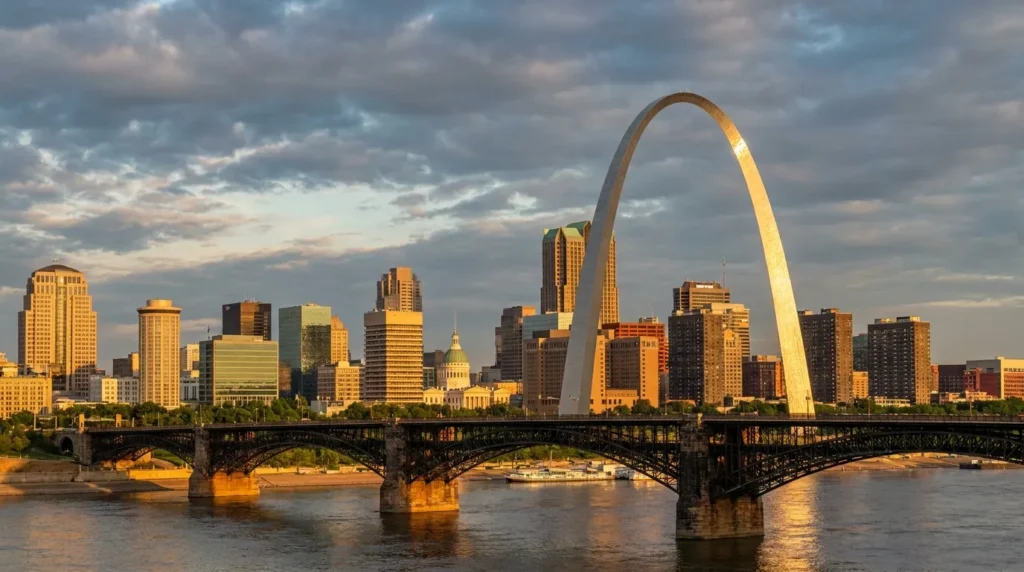
The Gateway Arch, a 630-foot stainless steel structure designed by Eero Saarinen, defines the skyline and anchors Gateway Arch National Park, which includes a museum on westward expansion. Forest Park, larger than Central Park, is home to the Saint Louis Art Museum, Missouri History Museum, Saint Louis Zoo, and Saint Louis Science Center, all free to visit.

The Hill is the Italian-American neighborhood, featuring markets like DiGregorio's and long-established restaurants. Soulard offers the Soulard Farmers Market, dating to 1779, and is located near the Anheuser-Busch Brewery. Cherokee Street, on the south side, serves as the Hispanic and Mexican corridor, with taquerias and antique shops.

Citygarden, a downtown sculpture park, and the City Museum, an interactive museum-playground built from industrial salvage by Bob Cassilly, are essential family destinations. Powell Hall, home of the Saint Louis Symphony, and the Fox Theatre round out the cultural corridor.

  1. 1["Gateway Arch and Gateway Arch National Park"
  2. 2"Saint Louis Art Museum"
  3. 3"Saint Louis Zoo (free admission)"
  4. 4"Missouri Botanical Garden (one of the best in the world)"
  5. 5"City Museum"
  6. 6"Forest Park"
Nightlife7.0 / 10
Parks & green spaces
  • ["Forest Park (larger than Central Park)"
  • "Tower Grove Park"
  • "Missouri Botanical Garden"
  • "Citygarden"
  • "Carondelet Park"
  • +1 more

Latest posts

Posts about Missouri

Coverage and updates related to this destination.

Showing content from Missouri, as there is no specific data for St. Louis yet.