Visto n' Visa
Blog
Notícias e artigos
Destinations
Careers
Immigrants

Want to live and work in St. Joseph?

Personalized immigration plan with eligible visas, costs, and next steps for your goal!

If you are not eligible, you will know exactly why and what to do to improve your approval chances.

Save up to 12 hours in meetings

No pointless assessments.

Save up to 90%

Save money on vague or unfocused consultations

Avoid Fraud and Mistakes

One mistake can cost you your visa

Total Impartiality

Zero commercial bias

Decide with peace of mind

No toxic urgency

Fast and Accurate

Answers in minutes, no guesswork

A traditional Midwestern city with a growing Hispanic community

St. Joseph is predominantly white, with a historically established African American presence and a rapidly growing Hispanic community drawn by food manufacturing jobs.

The demographic profile is typical of the rural Midwest. Most residents trace their ancestry to Europe, primarily German, Irish, English, and Polish backgrounds. The African American community has a well-established historical presence, tied to the Great Migration northward in the early 20th century, with traditional neighborhoods in the central and eastern parts of the city.

The Hispanic community is the fastest-growing segment. Mexicans, Guatemalans, and Hondurans make up the bulk, drawn by jobs at the Triumph Foods pork processing plant and other food industry operations. Along commercial corridors and in the South Side neighborhood, Latin markets, authentic taquerias, and Mexican bakeries have taken root. Entire families have settled, with children enrolled in local schools.

Religiously, Protestant and Catholic Christian denominations predominate, with historic Catholic parishes such as Co-Cathedral of St. Joseph. Evangelical and Baptist churches are common. A small mosque serves Iraqi, Syrian, and Afghan refugees who have arrived in recent years. The Reorganized Mormon Conference community also has a historically significant regional presence.

Languages spoken
  • English
  • Spanish
  • Arabic
  • Sudanese
Main religions
  • Christianity (Protestant and Catholic)
  • Islam
  • No religion

One of Missouri's lowest costs of living, attractive to retirees

St. Joseph offers very affordable housing, cheap food, and services well below the national average. It is a popular choice for retirees and those seeking extreme value for money.

Housing in St. Joseph is inexpensive by American standards. Older properties, including restored Victorian homes, carry prices that seem unreal to those arriving from coastal markets. Rents are also very accessible, and one-bedroom apartments in complexes can cost a fraction of what is paid in Kansas City or St. Louis. For remote workers, the purchasing power gain is significant.

Food and services fall below the national average. Hy-Vee, Walmart, Aldi, and local markets cover the basics. Latin markets such as El Maguey serve the growing Hispanic community. Local restaurants include classic barbecue, traditional American fare, authentic Mexican options, and casual chains. For a wider range of dining, residents typically make the trip to Kansas City.

Missouri state taxes apply, with state income tax and sales tax combining to roughly 8 percent on purchases. There is no additional municipal income tax. Energy, natural gas, and car insurance costs fall near the state average. The overall cost of living ranks among the lowest for cities above 70,000 residents in the Midwest, which attracts remote workers and retirees.

87Cost index (US = 100)13% below US average
CategorySingleCoupleFamily (2 + 2)
iHousing$1,132$1,307$1,654
iFood$331$661$1,202
iTransport$436$740$958
iHealthcare$244$488$914
iChildcare$1,585
iOther$740$1,332$1,872
Monthly total$2,883$4,528$8,185

Source: U.S. BLS Consumer Expenditure Survey 2023 + BEA Regional Price Parities 2023 · Estimates in USD, monthly.

Affordable historic homes, a mix of established older neighborhoods and suburban expansion

St. Joseph has a strong supply of historic homes in established neighborhoods at very accessible prices. Recent expansion is happening in the south and east of the city.

Central neighborhoods feature Victorian homes, early 20th-century bungalows, and Queen Anne-style residences. Areas such as Hall Street and Krug Park are well-established, with homes in need of renovation selling at low prices. An active market of buyers purchasing, restoring, and reselling these properties exists. For those who appreciate older homes, it is a rare opportunity.

For families with children, recent expansion is occurring to the south, around Pickett Road and toward the Country Club neighborhood, and to the east, near I-29. Newer homes with the classic suburban footprint, double garages, and large backyards are found in these areas. St. Joseph school districts cover most of the city, and neighborhoods such as North End and Country Club tend to have stronger academic reputations.

Renters will find apartments in complexes spread throughout the city, particularly along Belt Highway and near shopping centers. Houses for rent also appear in the older neighborhoods. Platforms such as Zillow and Realtor display current inventory. It is advisable to avoid some areas in the central-eastern part of the city that face urban decline, with abandoned properties and deteriorating infrastructure.

Recommended neighborhoods
  • Hall Street historic district
  • Country Club area
  • Krug Park area
  • near Pickett Road
  • Saxton-Lovers Lane

Market dominated by food manufacturing, healthcare, and logistics

St. Joseph has an economy based on food manufacturing (especially pork processing), healthcare through Mosaic Life Care, and logistics benefiting from its central Midwestern location.

Triumph Foods operates one of the largest pork processing plants in the United States in St. Joseph, employing thousands of workers. Boehringer Ingelheim Vetmedica produces veterinary pharmaceuticals, and Nestlé Purina maintains a significant operation. This food and animal medicine manufacturing sector is the backbone of the local economy, with steady demand for workers.

Healthcare is the other pillar, with Mosaic Life Care (formerly Heartland Regional Medical Center) serving as the largest hospital employer in northwest Missouri. The network serves patients from several neighboring cities and includes an emergency room, medical specialties, and clinics throughout the area. American Family Insurance also has a major operation in St. Joseph, with offices employing hundreds in financial services.

For immigrants, food manufacturing is a common entry point, with companies that have historically hired Hispanic workers and refugees. Working conditions are demanding, but wages above the federal minimum and health benefits make a real difference. Healthcare, retail, construction, and services round out the picture. Networking through churches and community centers helps newcomers get established.

Dominant sectors
  • Food manufacturing
  • Healthcare
  • Veterinary manufacturing
  • Insurance
  • Logistics
Major employers
  • Triumph Foods
  • Mosaic Life Care
  • Boehringer Ingelheim Vetmedica
  • Nestlé Purina
  • American Family Insurance
  • +1 more

A local school district and a regional public university

St. Joseph has its own school district with average performance, Missouri Western State University as the regional public university, and Hillyard Technical Center for vocational training.

The St. Joseph School District serves most of the city, with three main high schools: Lafayette, Central, and Benton. Quality is considered average, with AP programs, sports, and regular extracurricular activities. Some families prefer Catholic private schools such as Bishop LeBlond or charter school options as alternatives.

For higher education, Missouri Western State University is the local public option, offering programs in education, business, health, nursing, sciences, and the arts. It provides accessible undergraduate programs and serves students from northwest Missouri and neighboring states such as Kansas and Nebraska. For larger universities, Kansas City and its options such as UMKC and Rockhurst are about an hour's drive away.

For technical and professional training, Hillyard Technical Center offers short-term programs in healthcare, manufacturing, welding, automotive mechanics, and information technology. Programs have solid regional employment outcomes, accessible tuition, and work well for those seeking quick career transitions. For immigrant adults, ESL programs operate through the community college, community schools, and local churches.

Notable universities
  • Missouri Western State University
  • Hillyard Technical Center
  • University of Missouri (Columbia)
  • Northwest Missouri State University (Maryville)

Regional medical hub for northwest Missouri

St. Joseph serves as the medical hub for northwest Missouri, with Mosaic Life Care as the main hospital system. For complex cases, Kansas City offers additional options about an hour away.

Mosaic Life Care is the largest regional hospital system, with its main hospital in St. Joseph offering a full emergency department, maternity services, oncology, cardiology, and numerous other specialties. It serves patients from northwest Missouri, northeast Kansas, and southwest Iowa. The network includes outpatient clinics throughout the city, with primary care, specialists, and urgent care facilities.

For more complex cases, particularly advanced pediatric and oncological care, residents often travel to Kansas City. Children's Mercy Hospital, the University of Kansas Health System, and Saint Luke's are about an hour away via I-29. Mental health resources are limited locally, with a growing number of private clinics and hospital-based programs. Wait times for specialists can be long.

Health insurance in the United States is expensive and essential. Legally residing immigrants can access the ACA marketplace, Medicaid where eligible, or employer-sponsored coverage. For workers at food processing plants, employer plans are generally available. For the Hispanic community, community health clinics with income-based sliding-scale fees and bilingual staff provide accessible care.

Healthcare index68.0 / 100
  • Life expectancyyears at birth
    78.4yrs
  • Doctors per 1kpracticing physicians
    3.7
  • Health spendper capita, per year
    $13,473
  • Public systemoverall quality rating
    Good

Crime above the national average, but established residential neighborhoods are safe

St. Joseph has crime rates above the national average, with property crime and drug-related issues weighing on the statistics. Residential neighborhoods such as Country Club and Hall Street are considered safe.

Crime figures appear high when compared to the national average, with property crime and issues related to methamphetamine and opioids present in certain areas. The reputation is not as peaceful as planned suburbs like Lee's Summit, but most of the city functions as a typical mid-sized Midwestern city, without major problems for residents who choose their neighborhood carefully.

Established residential neighborhoods such as Country Club, the historic Hall Street area, and the vicinity of Krug Park are considered safe for daily life. Opportunistic crimes, such as thefts from unlocked cars and break-ins to garages left open, are the most common complaints. The central-eastern part of the city and some older areas with abandoned properties warrant more caution, particularly at night.

The greatest regional risk is not crime but tornadoes and severe storms. Between March and June, the season demands attention. Public sirens sound when a confirmed threat exists, and most homes have a basement or designated shelter. Missouri River flooding also periodically affects low-lying areas. Apps such as NOAA Weather Radio and cell phone emergency alerts help residents stay prepared.

5.8
Homicides per 100k
per year
Safety index
48.0
Crime index
52.0
Safer neighborhoods
  • Hyde Park Historic District
  • Museum Hill
  • Cathedral Hill
  • Country Club (Eastside)
  • Krug Park area
  • South Park
Areas to avoid
  • Sections of downtown along Frederick Avenue at night
  • Industrial areas around the Missouri River late at night
  • Isolated parts of Midtown in the early morning hours

A car-dependent city with a small airport and easy access to I-29

St. Joseph requires a car for virtually everything. I-29 provides quick access to Kansas City. The St. Joseph Transit system operates local bus routes with limited coverage. The regional airport offers flights to Chicago.

A car is absolutely necessary for daily life. I-29 runs north-south through the city, connecting northward toward Omaha and southward toward Kansas City. US-36 crosses east-west. Belt Highway, US-169, is the main commercial corridor. Traffic is light by American standards, and parking is abundant and free throughout virtually the entire city.

St. Joseph Transit operates local bus routes with radial lines covering parts of the city. Useful for non-drivers, but low frequency limits practical use. Uber and Lyft operate in the area but with limited availability outside peak hours. For regional travel, Greyhound bus service passes through the city. For Amtrak train service, travelers must drive to Kansas City and board at Union Station.

Rosecrans Memorial Airport in Saint Joseph offers direct flights to Chicago via United Express, useful for connections. For more options, residents drive to Kansas City International Airport (MCI), roughly an hour away. For getting around within the city, cycling is feasible on certain trails such as the Riverwalk, but dedicated bicycle infrastructure is limited.

18 min
Avg commute
40
Walkability
Airports
  • STJ, Rosecrans Memorial Airport (general aviation)
  • MCI, Kansas City International Airport (about 100 km away)
  • Bike infrastructure

What the climate is like living in St. Joseph

St. Joseph sits in northwest Missouri with a humid continental climate: hot summers averaging around 31 degrees Celsius, and moderately cold winters with regular snowfall.

Summers in St. Joseph are hot and humid, with highs between 30 and 32 degrees Celsius in July. Severe thunderstorms and occasional tornado risk are part of the season, and air conditioning is standard in all homes.

Winters are cold with prairie winds, with lows between -8 and -4 degrees Celsius in January and seasonal snowfall totaling around 22 inches. A mid-weight coat and natural gas heating are standard.

Spring is unsettled and fall is the most pleasant season. Annual rainfall totals roughly 950 mm, peaking in summer, and the Missouri River defines the city's western boundary.

Sunny days / year215 days
Avg high (°F)
  • 54°J
  • 61°F
  • 73°M
  • 82°A
  • 86°M
  • 94°J
  • 98°J
  • 98°A
  • 94°S
  • 87°O
  • 72°N
  • 63°D
Avg low (°F)
  • J
  • -1°F
  • 12°M
  • 24°A
  • 37°M
  • 51°J
  • 60°J
  • 57°A
  • 47°S
  • 25°O
  • 18°N
  • 11°D
Rainfall (")
  • 1"J
  • 1"F
  • 3"M
  • 3"A
  • 6"M
  • 5"J
  • 5"J
  • 4"A
  • 2"S
  • 2"O
  • 2"N
  • 1"D

A city defined by the Pony Express, Jesse James, and Midwestern traditions

St. Joseph has a strong cultural identity tied to the history of the American Old West. Museums, festivals, and the slower pace of a mid-sized Midwestern city define the cultural rhythm.

The Pony Express National Museum tells the story of the horse-relay postal service that departed from here toward California in 1860. It is a must-visit for anyone interested in American history. The Jesse James Home Museum, where the famous outlaw was killed in 1882, is another significant historical site. The Patee House Museum completes the circuit, housed in the hotel building where Jesse James stayed.

Cultural life is typical of a mid-sized Midwestern city. The Saint Joseph Performing Arts Association brings plays and concerts to the area. There is a multiplex cinema, municipal parks, and seasonal festivals such as the Trails West Festival in summer. For a broader cultural calendar, residents travel to Kansas City. The dining scene is modest, with solid examples of classic barbecue, authentic Tex-Mex (driven by the Mexican community), and rural American cuisine.

College sports carry little weight locally, but Kansas City professional teams (Chiefs, Royals, Sporting KC) have a loyal following. Fishing on the Missouri River and at lakes such as Smithville Lake is a common hobby. Hunting is also part of local culture, especially outside the city. Social life revolves around families, churches, schools, and weekend outdoor activities.

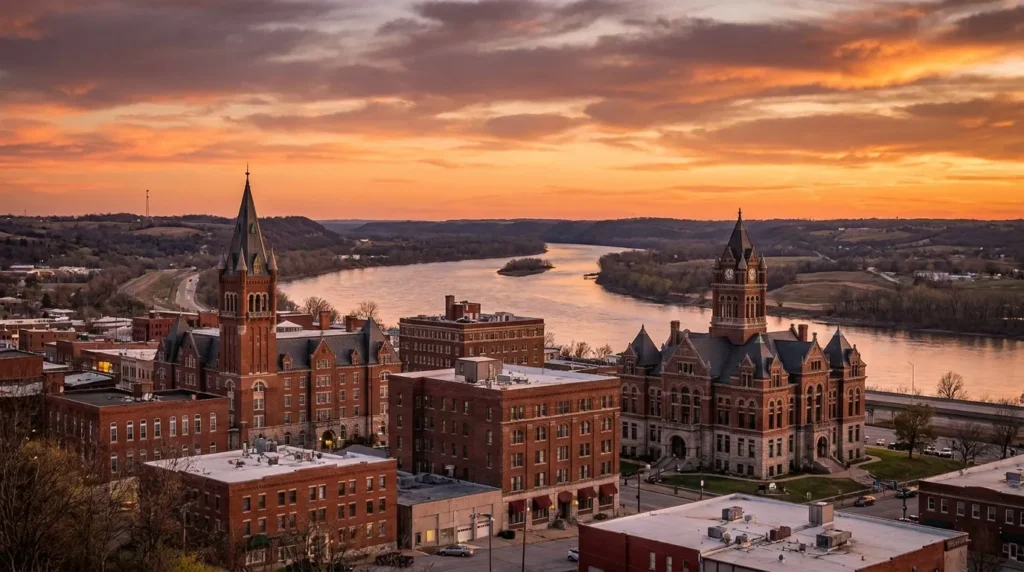
St. Joseph

St. Joseph, starting point of the Pony Express on the banks of the Missouri

A historic city in northwest Missouri, St. Joseph was the eastern terminus of the Pony Express in 1860 and the site where Jesse James was killed. Today its economy is anchored by healthcare, agribusiness, and historical tourism.

The Pony Express National Museum, housed in the original Pikes Peak Stables from which riders departed for California, is the city's foremost historical landmark. The Jesse James Home, where the outlaw was killed in 1882, stands nearby. The Patee House Museum, a former frontier luxury hotel, rounds out the Old West history circuit.

The Albrecht-Kemper Museum of Art, with its American art collection, and the St. Joseph Museum, covering the Sac and Fox peoples and local history, occupy Victorian mansions on Hall Street, one of the most distinguished boulevards in the state. The art deco Missouri Theater, built in 1927, hosts concerts and the St. Joseph Symphony. The Glore Psychiatric Museum traces the history of American psychiatry.

Krug Park, with its stone castle and the annual Krug Park Christmas Lights festival, is the city's most visited park. The Missouri River Trail and Riverfront Park provide access to the river. The Trails West! Festival at the Civic Arena, held each August, celebrates regional music. Kansas City is about an hour south via I-29, offering the Country Club Plaza and Chiefs games.

  1. 1["Pony Express National Museum"
  2. 2"Jesse James Home Museum (site where Jesse James was killed)"
  3. 3"Patee House Museum"
  4. 4"Glore Psychiatric Museum"
  5. 5"St. Joseph Museums Inc."
  6. 6"Albrecht-Kemper Museum of Art"
Nightlife3.0 / 10
Parks & green spaces
  • ["Krug Park"
  • "Hyde Park"
  • "Parkway System (historic park corridor)"
  • "Bode Sports Complex grounds"
  • "Bartlett Park"
  • +1 more

Latest posts

Posts about Missouri

Coverage and updates related to this destination.

Showing content from Missouri, as there is no specific data for St. Joseph yet.