Visto n' Visa
Blog
Notícias e artigos
Destinations
Careers
Immigrants

Want to live and work in Rochester?

Personalized immigration plan with eligible visas, costs, and next steps for your goal!

If you are not eligible, you will know exactly why and what to do to improve your approval chances.

Save up to 12 hours in meetings

No pointless assessments.

Save up to 90%

Save money on vague or unfocused consultations

Avoid Fraud and Mistakes

One mistake can cost you your visa

Total Impartiality

Zero commercial bias

Decide with peace of mind

No toxic urgency

Fast and Accurate

Answers in minutes, no guesswork

Demographic composition and international diversity in Rochester

A historical white base of German, Norwegian, and Irish descent, layered with a large international community of physicians, researchers, and refugees. A significant Somali community, alongside South Asian, Hispanic, and Southeast Asian populations.

Rochester's historical demographic base resembles the rest of southeastern Minnesota, with a strong German, Norwegian, Irish, and Lutheran heritage. Over recent decades, however, Mayo Clinic has overlaid a cosmopolitan character that is rare for a Midwest city of this size.

A Somali community has been established since the 1990s, with mosques, businesses, and community schools. Indians, Pakistanis, and Filipinos came primarily as physicians, nurses, and researchers. Vietnamese residents arrived in the 1970s and 1980s and maintain restaurants and Buddhist temples. Mexican Hispanics have grown in construction and service industries. Brazilians are few, generally visiting physicians at Mayo or research fellows.

The age distribution is more varied than other mid-sized Minnesota cities because Mayo continuously attracts young professionals. Per capita income is high for the state, with a strong medical and administrative middle class, though a pocket of service workers earns considerably more modest wages.

Languages spoken
  • English
  • Somali
  • Spanish
  • Hindi
  • Arabic
  • +2 more
Main religions
  • Lutheran Protestantism
  • Roman Catholicism
  • Sunni Islam
  • Hinduism
  • Buddhism
  • +1 more

Cost of living in Rochester compared to the Twin Cities

Cost of living is slightly higher than other mid-sized Minnesota cities due to Mayo's pressure on the housing market, but services, food, and car insurance are more affordable than in Minneapolis.

Rochester presents an anomaly for an inland city: high average wages driven by Mayo Clinic, paired with a cost of living that follows a mid-sized city pattern. The result is strong purchasing power for physicians and skilled professionals, and a tight budget for those working in services, hospitality, or construction. Rent is the most sensitive line item, with growing upward pressure.

For groceries, Hy-Vee is the dominant chain, with several large stores that double as community gathering points. Aldi, Walmart, and Costco round out the base. Ethnic markets such as World Bazaar (Somali) and Latin markets along North Broadway cover specialty items. Dining out ranges from American chains to Asian options of uncommon quality for a city this size.

Natural gas heating through CenterPoint Energy weighs on budgets from November through April. Electricity through Rochester Public Utilities is municipally operated and cheaper than the national average. Car insurance in Minnesota is reasonable. Property taxes in Olmsted County are moderate. Medical households live comfortably, while others need careful budgeting in the early years.

98Cost index (US = 100)2% below US average
CategorySingleCoupleFamily (2 + 2)
iHousing$1,279$1,476$1,870
iFood$374$748$1,358
iTransport$492$836$1,082
iHealthcare$276$551$1,033
iChildcare$1,791
iOther$836$1,506$2,116
Monthly total$3,257$5,117$9,250

Source: U.S. BLS Consumer Expenditure Survey 2023 + BEA Regional Price Parities 2023 · Estimates in USD, monthly.

Housing market and neighborhoods in Rochester

A mixed stock with premium neighborhoods around Soldiers Field Golf Course, newer suburbs to the southwest, pockets of affordable rentals in the northeast, and a growing supply of new downtown apartments serving Mayo residents.

Rochester grew outward with well-defined neighborhoods. Pill Hill, near the hospital, is the historic medical district, with Tudor and colonial brick homes from the 1920s through 1950s. Soldiers Field and Folwell are traditional, tree-lined areas. The southwest, around 40th Street SW, concentrates newer subdivisions for young families with well-rated schools.

For renters, newer downtown complexes such as Berkman and The Maven serve medical residents and professionals without families. North Broadway and the northeast, near Civic Center, offer more affordable options and are where several immigrant communities have settled. Townhomes around Eastwood and Cascade Lake provide a middle ground.

Homeownership is a realistic goal for professionals at the median salary. Neighborhoods such as Meadow Park, Sunset Terrace, and Country Club Manor offer strong value. Property taxes are reasonable, and Mayo sometimes assists new physicians through housing support programs. Monthly rents have risen in recent years due to internal migration.

Recommended neighborhoods
  • Pill Hill
  • Soldiers Field
  • Folwell
  • Meadow Park
  • Country Club Manor
  • +3 more

Jobs and key sectors sustaining Rochester's economy

An economy heavily dependent on Mayo Clinic, the state's largest private employer. IBM, Olmsted Medical Center, retail, construction, and services round out the picture. Healthcare job openings are virtually unlimited.

Mayo Clinic employs more than 40,000 people in Rochester, more than any other private employer in Minnesota. Physicians, residents, nurses, laboratory technicians, administrative staff, researchers, interpreters, and medical translators form the core. Internationally trained medical professionals find here one of the best environments in the United States for credential recognition and residency programs.

IBM maintains a large research and development campus on the north side of the city, part of its mainframe-era legacy. Olmsted Medical Center, a smaller independent hospital, provides a secondary option in healthcare. Charter Communications has a significant local operation. Construction is robust due to the constant expansion of Mayo facilities and the hotels that accommodate long-stay patients and their families.

Hospitality and food service are significant because of the volume of international patients who stay for weeks or months of treatment. For recently arrived immigrants with limited English fluency, positions in hospital housekeeping, industrial laundry, hospitality, restaurants, and transportation are the most common entry points. Certified translators in Arabic, Somali, and Spanish are in steady demand.

Dominant sectors
  • Healthcare and medical research
  • Information technology
  • Hospitality and medical tourism
  • Construction
  • Education
  • +1 more
Major employers
  • Mayo Clinic
  • IBM Rochester
  • Olmsted Medical Center
  • Rochester Public Schools
  • Charter Communications
  • +3 more

K-12 and higher education in Rochester

A well-rated public school system for the city's size, with bilingual programs. Higher education includes Mayo Clinic College of Medicine, University of Minnesota Rochester, and two notable community colleges.

Rochester Public Schools operates three main high schools, Mayo, John Marshall, and Century, all with strong IB and AP programs. Public school quality here tends to exceed the state average, driven by the elevated socioeconomic profile of the city. Charter options such as Rochester STEM Academy and private Catholic schools such as Lourdes High School round out the landscape.

Mayo Clinic Alix School of Medicine is one of the top medical schools in the United States, affiliated directly with Mayo. The University of Minnesota Rochester (UMR), located downtown, focuses exclusively on health and biosciences through an innovative curriculum model. Crossroads College is a small Christian liberal arts institution within the city.

For community college and ESL instruction, Rochester Community and Technical College (RCTC) is the main entry point for immigrants who need formal English language training, short-term technical certificates in nursing or manufacturing, or a pathway to a public university. Winona State University Rochester and Saint Mary's University operate satellite campuses in the city.

Notable universities
  • Mayo Clinic Alix School of Medicine
  • University of Minnesota Rochester
  • Rochester Community and Technical College
  • Winona State University Rochester
  • Saint Mary's University of Minnesota
  • Crossroads College

Healthcare system in Rochester

A city with arguably the best per-capita healthcare system in the United States, anchored by Mayo Clinic. Access to specialists in virtually any field is straightforward, and wait times are incomparably shorter than in other cities.

Mayo Clinic in Rochester operates Saint Marys Hospital and Methodist Hospital, together forming one of the largest and most distinguished medical complexes in the world. Patients arrive from more than 130 countries each year. For residents, this means direct access to specialists in virtually any medical field without the need to travel.

Olmsted Medical Center is the independent local alternative, with its own hospital and clinics distributed across the city. For primary care, both networks offer clinics with reasonable wait times. For immigrants without insurance, Hawthorne Education Center and Salvation Army Good Samaritan Clinic provide services on a voluntary basis.

Health coverage, as throughout the United States, is generally tied to employment. Mayo offers an employee health plan considered among the best in the country. MNsure covers self-employed individuals. CVS, Walgreens, Hy-Vee Pharmacy, and Mayo's internal pharmacy provide strong citywide coverage. Olmsted County Public Health offers childhood vaccination and tuberculosis services.

Healthcare index85.0 / 100
  • Life expectancyyears at birth
    78.4yrs
  • Doctors per 1kpracticing physicians
    3.7
  • Health spendper capita, per year
    $13,473
  • Public systemoverall quality rating
    Excellent

Public safety and daily life in Rochester

One of the safest mid-sized cities in the United States, with a violent crime rate well below the national average and a strong community sense of security. Property crime occurs occasionally but is less frequent than in the Twin Cities.

Rochester is consistently ranked among the safest cities in the Midwest. Mayo's permanent institutional presence, high levels of formal employment, strong public investment in parks and streets, and low concentrations of extreme poverty all contribute to this profile. Violent crime is rare and almost always connected to known interpersonal situations rather than street encounters with strangers.

What appears most often in local statistics is vehicle break-ins with valuables left visible in hotel parking lots, occasional daytime residential burglaries in unoccupied homes, and retail theft. Catalytic converter theft has also increased in recent years, though at a smaller scale than in the Twin Cities. Municipal police are well trained and response times are short.

For an immigrant family arriving in the city, the sense of safety is generally high. Children ride bikes in residential neighborhoods, parks are used without significant concern, and downtown is walkable during business hours. At night, downtown quiets considerably, and the bars along Historic Third Street concentrate nightlife without recurring incidents. Standard urban awareness is sufficient.

5.8
Homicides per 100k
per year
Safety index
72.0
Crime index
28.0
Safer neighborhoods
  • Pill Hill (near Mayo Clinic)
  • Country Club Manor
  • Folwell
  • Northern Heights
  • Quarry Hill area
  • Slatterly Park
Areas to avoid
  • Isolated stretches around 6th Street SE at night
  • Industrial areas in the southeast after business hours

Transportation and mobility in Rochester

A car-dependent city outside the core, with a limited municipal bus system, direct highway access to Minneapolis via US-52, and a regional airport (RST) with flights to major hubs.

Rochester is structurally a mid-sized Midwest city, with infrastructure built around the automobile. US-52, running north toward the Twin Cities, and US-14, running east-west, are the two main arteries. Minneapolis-St. Paul is about 90 minutes by car, and MSP Airport is the international gateway used by most arriving immigrants.

Rochester International Airport (RST) operates direct flights to Atlanta (Delta), Chicago O'Hare (American), and Denver, sufficient for the Mayo patient base traveling from a distance. Flights to other cities typically connect through MSP. Rochester City Lines operates the urban bus network, with reasonable coverage downtown and thin service at the edges.

Within downtown, Mayo's network of underground tunnels and skyways allows movement between the hospital, hotels, restaurants, and parking without stepping outside in winter. This matters in January, when temperatures regularly fall below -4°F (-20°C). For most families relocating to the area, owning a car is essentially required.

18 min
Avg commute
50
Walkability
Airports
  • RST — Rochester International Airport
  • International airport
  • Bike infrastructure

What the climate is like in Rochester

Located in southeastern Minnesota and home to the Mayo Clinic, Rochester has a cold humid continental climate: warm summers around 28 degrees Celsius and long, harsh winters.

Summer in Rochester is warm and brief, with highs between 27 and 29 degrees Celsius in July. Occasional severe storms are common, and air conditioning is standard in homes.

Winter is long and severe, with lows between -18 and -14 degrees Celsius in January and snowfall totaling around 130 cm per season. Natural gas heating, snow tires, and clothing rated for wind chills below -30 are essential.

Spring arrives late, and autumn is brief but striking. Total precipitation reaches around 850 mm annually, with a rainy summer and a drier winter.

Sunny days / year200 days
Avg high (°F)
  • 39°J
  • 44°F
  • 63°M
  • 76°A
  • 82°M
  • 89°J
  • 91°J
  • 92°A
  • 88°S
  • 78°O
  • 63°N
  • 47°D
Avg low (°F)
  • -18°J
  • -22°F
  • M
  • 20°A
  • 32°M
  • 46°J
  • 54°J
  • 51°A
  • 40°S
  • 22°O
  • N
  • -4°D
Rainfall (")
  • 1"J
  • 1"F
  • 2"M
  • 3"A
  • 5"M
  • 4"J
  • 4"J
  • 4"A
  • 3"S
  • 3"O
  • 2"N
  • 1"D

Cultural life and daily living in Rochester

A cultural scene shaped by Mayo's international audience, with more dining variety than comparable cities, community festivals, small museums, and well-maintained parks. Not a nightlife city.

Rochester offers cultural depth above its size because of the constant international flow. Arabic, Indian, Somali, Ethiopian, Mexican, and Vietnamese restaurants coexist with traditional steakhouses and barbecue spots. Pasquale's Neighborhood Pizzeria, Bleu Duck Kitchen, Pescara, Newt's, and Victoria's are frequent local favorites.

The Mayo Clinic Heritage Hall and the Plummer Building are cultural attractions in their own right. Mayo Civic Center hosts concerts, conferences, and sporting events. The Rochester Art Center functions well for a city of this scale. In June, Rochesterfest brings the entire community together in a municipal park. SocialICE, held in winter, transforms downtown into an outdoor ice sculpture gallery.

Professional sports are based in Minneapolis (Vikings, Twins, Wild). Locally, the Rochester Honkers baseball team (collegiate league) and high school athletics at the city's three high schools drive community sports interest. For outdoor recreation, Quarry Hill Nature Center, Soldiers Field Park, and the trail network along the Zumbro River are the centers of weekend leisure.

Rochester

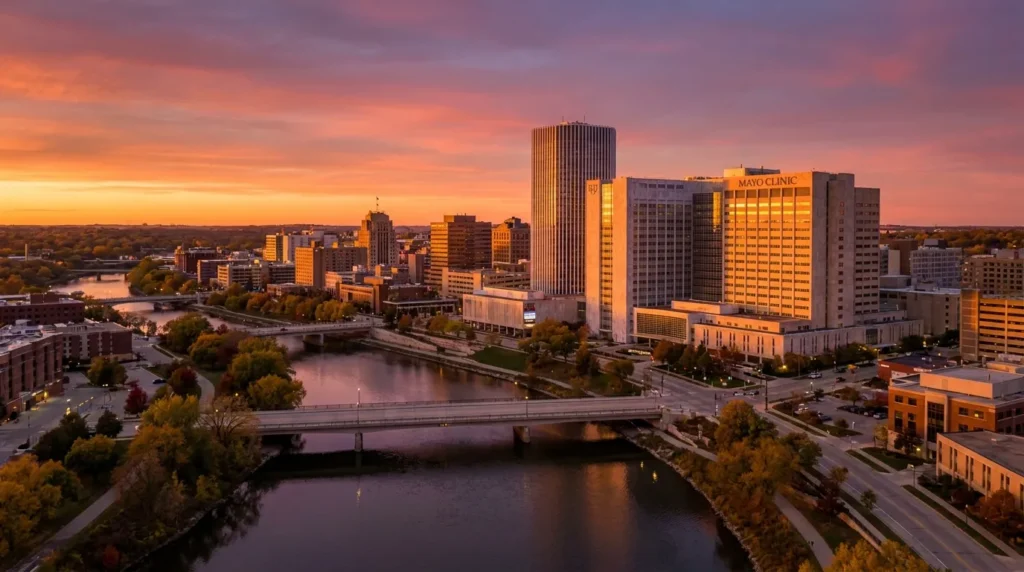
Rochester, home of the Mayo Clinic and the Midwest's medical hub

A city dominated by the Mayo Clinic, Rochester combines world-class medical infrastructure, cultural life tied to the Rochester Civic Theatre, and parks along the Zumbro River.

The Mayo Clinic occupies much of downtown with iconic buildings such as the Plummer Building and the Gonda Building, and features a subway system (underground corridor) connecting hospitals and hotels for patients on cold days. Guided tours through Heritage Hall showcase the Mayo family's history since the 19th century.

Mayowood Mansion, the former Mayo family home, is now a museum and garden. The Rochester Art Center, across from the Mayo Civic Center, features contemporary art. The Plummer House of the Arts, Henry Plummer's residence set on 65 acres of gardens and arboretum, opens for tours in summer. Quarry Hill Nature Center offers trails, a lake, and an education center.

Silver Lake Park, with its central lake and bike paths, is located in the heart of the city. Events such as Thursdays on First Market and Music in summer, along with the Rochester Honkers (Northwoods League baseball), bring life to the local calendar. Whitewater State Park, about an hour away, offers trails and waterfalls in the Driftless Area.

  1. 1["Mayo Clinic and Plummer Building"
  2. 2"Mayo Clinic Heritage Hall"
  3. 3"Mayowood Mansion"
  4. 4"Rochester Art Center"
  5. 5"Quarry Hill Nature Center"
  6. 6"Plummer House of the Arts"
Nightlife4.0 / 10
Parks & green spaces
  • ["Silver Lake Park"
  • "Quarry Hill Park"
  • "Soldiers Field Park"
  • "Mayo Park (downtown
  • along the Zumbro River)"
  • +2 more

Latest posts

Posts about Minnesota

Coverage and updates related to this destination.

Showing content from Minnesota, as there is no specific data for Rochester yet.