Visto n' Visa
Blog
Notícias e artigos
Destinations
Careers
Immigrants

Want to live and work in Louisville?

Personalized immigration plan with eligible visas, costs, and next steps for your goal!

If you are not eligible, you will know exactly why and what to do to improve your approval chances.

Save up to 12 hours in meetings

No pointless assessments.

Save up to 90%

Save money on vague or unfocused consultations

Avoid Fraud and Mistakes

One mistake can cost you your visa

Total Impartiality

Zero commercial bias

Decide with peace of mind

No toxic urgency

Fast and Accurate

Answers in minutes, no guesswork

Louisville's population composition and communities

Louisville has a majority white population, along with Kentucky's largest Black community, growing Hispanic populations, African refugees, and Bosnians. The city is religiously diverse, with strong Catholic and Baptist traditions.

Roughly two-thirds of the population is white, largely descended from German, Irish, and English settlers. Black residents make up around one-quarter of the city and are concentrated primarily in the West End. The Hispanic population has grown substantially in recent decades, with Mexican, Cuban, and Central American communities concentrated in the South End and areas such as Iroquois.

Louisville is one of the United States' official refugee resettlement destination cities. Large communities of Bosnians who arrived in the 1990s, as well as Somalis, Congolese, post-Mariel Cubans, Eritreans, and Iraqis, have settled here. Churches, mosques, and community centers serve these populations, and neighborhoods such as Iroquois, Beechmont, and Americana are informally known as the International District.

The religious profile is diverse by Southern standards. There is a strong Catholic presence (the Archdiocese of Louisville is one of the oldest), alongside Southern Baptists, Methodists, and growing Muslim and Orthodox Christian communities brought by successive waves of refugees. The median age is close to the national figure, with a healthy mix of young professionals, families, and retirees.

Languages spoken
  • English
  • Spanish
  • Bosnian / Serbo-Croatian
  • Somali
  • Swahili
  • +2 more
Main religions
  • Catholicism
  • Protestantism (Baptist, Methodist, Presbyterian)
  • Islam
  • Orthodox Christianity
  • No religion

Cost of living in Louisville: affordable for a large city

Louisville is cheaper than the American average and considerably more affordable than cities like Nashville or Indianapolis. Rent, groceries, and services are reasonable, and property taxes are moderate.

The cost of living in Louisville falls below the national average, particularly when it comes to housing. One-bedroom apartments in central neighborhoods like NuLu or the Highlands rent for amounts that would be significantly higher in Nashville. Homes for purchase remain accessible by American metropolitan standards, especially in southern and eastern neighborhoods.

Grocery chains such as Kroger, Meijer, Walmart, Aldi, and ValuMarket cover everyday needs, and ethnic markets, including ValuMarket near Iroquois Manor and various Latin American grocery stores, are scattered throughout the city. Restaurants are moderately priced, with affordable lunches at local diners and higher tabs at bourbon bars. Gas and energy costs hover near the national average.

Kentucky levies both a state income tax and a county-level occupational tax, which reduces take-home pay somewhat. Property taxes are moderate, and auto insurance is reasonable outside the highest-risk neighborhoods. Employer-sponsored health insurance works well; without coverage, healthcare costs are high, as in any American city.

82Cost index (US = 100)18% below US average
CategorySingleCoupleFamily (2 + 2)
iHousing$1,068$1,233$1,561
iFood$312$625$1,133
iTransport$411$698$903
iHealthcare$230$460$863
iChildcare$1,495
iOther$698$1,257$1,766
Monthly total$2,719$4,273$7,721

Source: U.S. BLS Consumer Expenditure Survey 2023 + BEA Regional Price Parities 2023 · Estimates in USD, monthly.

Where to live in Louisville: neighborhoods and housing profiles

Louisville offers a wide variety of neighborhoods, from historic urban areas to family suburbs. The Highlands, NuLu, St. Matthews, and Crescent Hill are the most sought-after; the South End and Okolona offer lower costs.

The Highlands, along Bardstown Road, is the best-known neighborhood for young professionals, with restaurants, bars, Victorian homes, and shotgun houses. NuLu (New Louisville), centered on East Market Street, is the more contemporary counterpart, featuring galleries, acclaimed restaurants, and lofts. Crescent Hill and Clifton, near Frankfort Avenue, are charming and family-friendly.

St. Matthews, to the east, is a well-maintained inner suburb with good restaurants, solid schools, and easy access to downtown. Further east, areas like Anchorage and Prospect have larger, more expensive homes. The South End, including Iroquois, Beechmont, and Pleasure Ridge Park, is more affordable and diverse, with a strong Latin and refugee presence and notably lower costs.

The West End is historically a predominantly African American area, with neighborhoods such as Russell, Shawnee, and Portland at various stages of gentrification and revitalization. Real estate there is priced lower, but street-by-street research is advisable before purchasing. Firms like Lenihan Sotheby's, Semonin Realtors, and Berkshire Hathaway dominate the local market.

Recommended neighborhoods
  • The Highlands
  • NuLu
  • Crescent Hill
  • St. Matthews
  • Clifton
  • +3 more

Louisville's job market: logistics, healthcare, and bourbon

The economy revolves around UPS Worldport, healthcare, manufacturing (Ford, GE Appliances), bourbon, and financial services (Humana). Regular openings exist in logistics and overnight shifts at the airport.

UPS Worldport, at Louisville Muhammad Ali International Airport, is UPS's largest air hub in the world and employs thousands on overnight shifts. It is the most common entry point for newly arrived immigrants, offering above-minimum-wage positions, benefits, and tuition assistance through the Metropolitan College partnership with the University of Louisville and JCTC.

Ford Motor Company operates two large plants (the Kentucky Truck Plant and the Louisville Assembly Plant), providing thousands of unionized jobs through the UAW. GE Appliances runs Appliance Park, one of the largest home-appliance manufacturing complexes in the country. Humana, the health insurance giant, is headquartered downtown, with openings in technology, actuarial science, and customer service.

Healthcare is a major pillar: Norton Healthcare, Baptist Health, University of Louisville Health, and the VA all contribute significantly to the sector. Bourbon producers, including Brown-Forman (Jack Daniel's, Woodford Reserve, Old Forester) and Heaven Hill, generate jobs in production, marketing, and tourism. The Kentucky Derby in May also mobilizes hospitality and service employment.

Dominant sectors
  • Logistics and aviation
  • Healthcare
  • Manufacturing (automotive and appliances)
  • Bourbon and beverages
  • Financial services and insurance
  • +1 more
Major employers
  • UPS Worldport
  • Ford Motor Company
  • GE Appliances
  • Humana
  • Norton Healthcare
  • +3 more

Education in Louisville: from K-12 to universities

The public school system (Jefferson County Public Schools) is Kentucky's largest, with quality varying by school. Good private and Catholic options exist, and two major universities are located in the city.

Jefferson County Public Schools (JCPS) serves the entire city-county with roughly 100,000 students. Quality varies considerably by school, and the system uses a student assignment model that allows families to choose among several schools within designated zones. Magnet schools such as duPont Manual High, Male High, and Brown School are considered the top public options. Many families research individual schools before deciding where to enroll.

Private and Catholic options are plentiful: Saint Xavier, Trinity, Sacred Heart Academy, Assumption, and Christian Academy of Louisville, with tuition ranging from moderate to high. For immigrant students, JCPS operates well-developed ESL programs and the Newcomer Academy, designed specifically for recent arrivals with limited English proficiency.

The University of Louisville is the city's largest public university, with strong programs in medicine, law, engineering, and business. Spalding University and Bellarmine University are smaller, Catholic, private institutions offering programs in nursing, education, and the arts. Jefferson Community and Technical College (JCTC) provides two-year degrees and vocational training, popular among working adults pursuing education alongside employment.

Notable universities
  • University of Louisville
  • Bellarmine University
  • Spalding University
  • Jefferson Community and Technical College
  • Sullivan University

Healthcare in Louisville: strong hospital networks and an academic center

Louisville is one of the South-Midwest's leading healthcare hubs, with three major hospital networks, a university hospital, and a tradition in transplant medicine. Insured patients have access to excellent care.

Norton Healthcare is the largest private network, operating multiple hospitals (Norton Hospital, Norton Audubon, Norton Brownsboro, Norton Women's and Children's) and dozens of clinics. Baptist Health Louisville is the second major system, with a general hospital in St. Matthews. UofL Health, affiliated with the University of Louisville School of Medicine, operates Jewish Hospital, University of Louisville Hospital, and several specialized centers.

Norton Children's Hospital, in partnership with the University of Louisville, is Kentucky's primary pediatric facility. Louisville was a pioneer in hand transplantation, a procedure performed at Jewish Hospital. Several VA clinics serve veterans in the region. For uninsured immigrants, Family Health Centers and Park DuValle Community Health Center offer care on a sliding-fee scale.

Organizations such as Kentucky Refugee Ministries and Catholic Charities help refugees navigate the healthcare system, and interpreters are available at major hospitals. Dentists and specialists are plentiful. Wait times for specialist appointments can reach several weeks, which is standard in the United States. Emergency departments are well-staffed, with multiple ERs accessible across the city.

Healthcare index65.0 / 100
  • Life expectancyyears at birth
    78.4yrs
  • Doctors per 1kpracticing physicians
    3.7
  • Health spendper capita, per year
    $13,473
  • Public systemoverall quality rating
    Good

Safety in Louisville: neighborhood by neighborhood, with precautions

Louisville has uneven crime rates, with homicide figures above the national average concentrated in parts of the West End. Central and eastern neighborhoods are generally quiet.

Crime in Louisville is geographically uneven. West End neighborhoods, particularly Russell, Shawnee, California, and parts of Portland, have higher rates of violent crime, linked in part to drug trafficking and concentrated poverty. Those moving to the city tend to avoid these areas at night or conduct street-level research before renting or purchasing property there.

The Highlands, NuLu, St. Matthews, Crescent Hill, Clifton, Germantown, and eastern suburbs such as Anchorage, Prospect, and J-Town are considered safe for daily life, with standard precautions around vehicles (keeping valuables out of sight) and home security. The South End includes both calm areas and some with higher incident rates; research before committing to a specific address is advisable.

Natural hazards include tornadoes (Louisville sits on the southern edge of Tornado Alley), severe summer thunderstorms, and occasional flooding near the Ohio River. Winter brings periodic ice storms that can damage trees and power lines. Louisville Metro Police Department patrols the city, and emergency response via 911 is generally reliable.

5.8
Homicides per 100k
per year
Safety index
48.0
Crime index
52.0
Safer neighborhoods
  • Highlands (bohemian and residential neighborhoods)
  • St. Matthews
  • Crescent Hill
  • Old Louisville (historic district with Victorian mansions)
  • Clifton
  • Anchorage and Prospect (affluent suburbs)
Areas to avoid
  • Russell and Portland after dark
  • Parts of the West End with a history of gun violence
  • Park Hill and Shawnee at night
  • Isolated stretches near Dixie Highway

Getting around Louisville: car, bus, and airport

Louisville is a car-dependent city. The TARC bus system exists but has limited coverage. The international airport offers direct flights to major US cities. Traffic is present but lighter than in larger metros.

Most residents drive. Interstates I-64, I-65, and I-71 cross the city, complemented by inner-loop routes such as the Watterson Expressway (I-264) and the Gene Snyder Freeway (I-265). Traffic congestion occurs during peak hours near the Ohio River bridges toward Indiana and around downtown, but it remains manageable.

TARC (Transit Authority of River City) operates bus routes throughout the city, with the most useful lines for those who live or work near downtown, the Highlands, or along Bardstown Road. It does not replace a car for suburban residents, but it serves urban commuters well, particularly those who prefer not to drive. Cycling is viable in central neighborhoods, with some dedicated bike lanes available.

Louisville Muhammad Ali International Airport (SDF) offers direct flights to major cities including Chicago, Atlanta, Dallas, New York, and Denver, served by Delta, American, Southwest, and United. Travelers needing international connections typically route through Atlanta, Charlotte, or Chicago. Greyhound connects Louisville to Indianapolis, Nashville, and Cincinnati by road.

23 min
Avg commute
36
Walkability
Airports
  • SDF — Louisville Muhammad Ali International Airport
  • LOU — Bowman Field
  • International airport
  • Bike infrastructure

What the climate is like living in Louisville

Louisville has a humid subtropical climate with continental influences, featuring hot and humid summers, mild winters with occasional snow, and four distinct seasons.

Summer in Louisville runs from June through September, with highs between 30 and 33 degrees Celsius and very high humidity. Frequent thunderstorms occur in July and August, while nights cool to around 20 to 22 degrees. The Ohio River adds to local humidity levels. Air conditioning is essential.

Winters are cold but short. Lows range from -4 to 2 degrees Celsius from December through February, with Arctic outbreaks occasionally pushing temperatures to -15 degrees. Snowfall accumulates roughly 30 to 45 centimeters per year and melts quickly in most cases. Central heating is standard, and utility bills are modest compared to northern cities.

For daily life, a strong central air conditioning system is necessary for summer, along with reliable heating for the short winter. Fall foliage peaks in October, and spring brings wet conditions with a real tornado risk in April and May, as Louisville sits in the extended Tornado Alley. The city is the largest in Kentucky, home to the Kentucky Derby and the bourbon industry, and offers a vibrant, culturally rich environment.

Sunny days / year189 days
Avg high (°F)
  • 45°J
  • 49°F
  • 59°M
  • 66°A
  • 76°M
  • 84°J
  • 88°J
  • 86°A
  • 82°S
  • 70°O
  • 56°N
  • 50°D
Avg low (°F)
  • 30°J
  • 31°F
  • 39°M
  • 46°A
  • 56°M
  • 65°J
  • 71°J
  • 68°A
  • 63°S
  • 52°O
  • 38°N
  • 34°D
Rainfall (")
  • 4"J
  • 5"F
  • 5"M
  • 5"A
  • 4"M
  • 5"J
  • 5"J
  • 4"A
  • 2"S
  • 4"O
  • 3"N
  • 3"D

Culture in Louisville: bourbon, the Derby, and a creative scene

The city has a rich culture rooted in bourbon, horse racing, college sports, music, and gastronomy. The Kentucky Derby is the signature event, but museums, festivals, and a creative community thrive throughout the year.

The Kentucky Derby, held on the first Saturday of May at Churchill Downs, is the defining event of the city. It is preceded by two weeks of festivities (the Kentucky Derby Festival), including Thunder Over Louisville, one of the largest fireworks displays in the country. The Muhammad Ali Center downtown honors the boxer who was born here, and the Louisville Slugger Museum showcases the factory behind the most famous baseball bat brand.

The urban Bourbon Trail includes distilleries such as Evan Williams, Angel's Envy, Michter's, Old Forester, and Rabbit Hole, all offering tours and tastings. The culinary scene features Southern classics, including the Hot Brown sandwich, mint julep, and Derby pie, at restaurants like The Brown Hotel, Jack Fry's, Proof on Main, and the expanding restaurant cluster in NuLu.

Sports culture centers on the University of Louisville Cardinals basketball team (KFC Yum! Center) and their traditional rival, the Kentucky Wildcats in Lexington. Independent scenes thrive in music (the Forecastle Festival drew large crowds for years), theater (Actors Theatre of Louisville, home of the Humana Festival of New American Plays), and visual arts (the Speed Art Museum and 21c Museum Hotel).

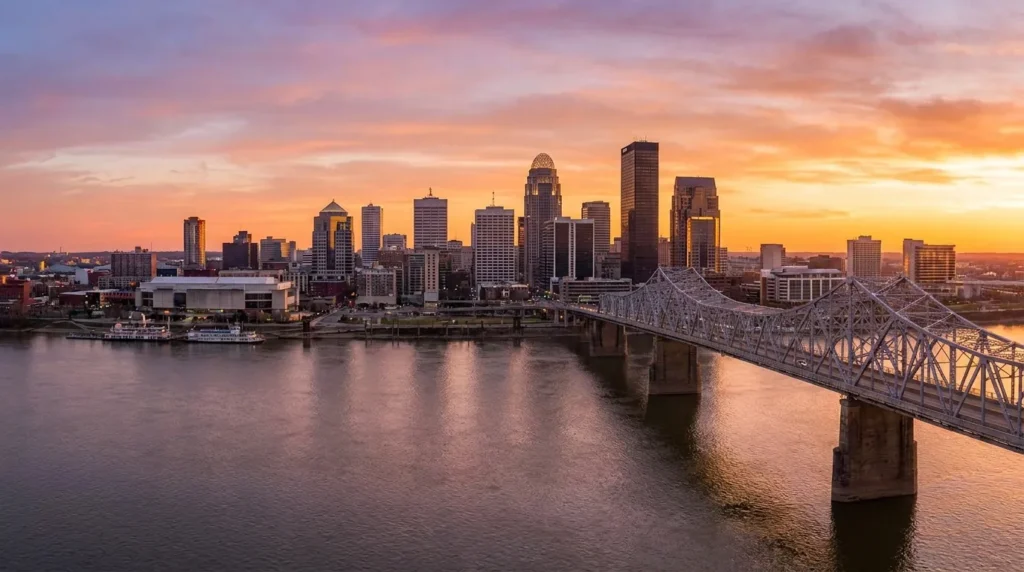
Louisville

Louisville: bourbon, horse racing, and riverside culture

Louisville blends world-famous horse racing, bourbon distilleries, iconic museums, and Olmsted-designed parks along the banks of the Ohio River.

Churchill Downs has hosted the Kentucky Derby since 1875, and its on-site museum is open year-round. The Urban Bourbon Trail winds through dozens of downtown distilleries and bars, including the Evan Williams Bourbon Experience, Angel's Envy, and Old Forester Distilling Co. The Muhammad Ali Center honors the boxing legend born in the city.

The Louisville Slugger Museum and Factory displays the baseball bats manufactured there, while the Frazier History Museum holds rare pieces of American history. The 21c Museum Hotel operates as both a hotel and a contemporary art gallery. The Speed Art Museum, near the University of Louisville, is the oldest art museum in the state.

The Olmsted park system, including Cherokee Park, Iroquois Park, and Shawnee Park, provides generous green space throughout the city. Waterfront Park along the Ohio River and the Big Four Bridge, a pedestrian span connecting Louisville to Jeffersonville, Indiana, are popular spots for walks. The nearby Bernheim Arboretum offers wooded trails just a short drive away.

  1. 1["Churchill Downs and Kentucky Derby Museum"
  2. 2"Louisville Slugger Museum & Factory"
  3. 3"Muhammad Ali Center"
  4. 4"Frazier History Museum"
  5. 5"Kentucky Science Center"
  6. 6"Speed Art Museum"
Nightlife7.0 / 10
Parks & green spaces
  • ["Waterfront Park (along the Ohio River)"
  • "Cherokee Park (designed by Frederick Law Olmsted)"
  • "Iroquois Park"
  • "Shawnee Park"
  • "Seneca Park"
  • +1 more

Latest posts

Posts about Kentucky

Coverage and updates related to this destination.

Showing content from Kentucky, as there is no specific data for Louisville yet.