Visto n' Visa
Blog
Notícias e artigos
Destinations
Careers
Immigrants

Want to live and work in Manhattan?

Personalized immigration plan with eligible visas, costs, and next steps for your goal!

If you are not eligible, you will know exactly why and what to do to improve your approval chances.

Save up to 12 hours in meetings

No pointless assessments.

Save up to 90%

Save money on vague or unfocused consultations

Avoid Fraud and Mistakes

One mistake can cost you your visa

Total Impartiality

Zero commercial bias

Decide with peace of mind

No toxic urgency

Fast and Accurate

Answers in minutes, no guesswork

A young, diverse, and internationally connected population shaped by KSU and Fort Riley

Manhattan has an atypical demographic profile for Kansas. The presence of Kansas State University and the nearby Fort Riley military base brings students and military families from all states and more than a hundred countries. The city is younger and more diverse than the state average.

The majority of the population is white, but Hispanic, Black, and Asian communities have a consistent presence. International students at KSU come in significant numbers from China, India, South Korea, Middle Eastern countries, and Africa. Graduate programs in engineering and agriculture concentrate a large share of this population.

Fort Riley, located in Junction City twenty minutes away, is home to the 1st Infantry Division. Military families live in Manhattan and surrounding areas, bringing additional diversity with service members and dependents from across the country and abroad. Hispanic and African American military communities are especially visible.

Brazilians are few in number, primarily connected to KSU graduate programs in agricultural sciences, veterinary medicine, and engineering. Portuguese-language evangelical churches operate in Kansas City and occasionally serve families from Manhattan. Community life is cordial, and the city has a reputation for welcoming international families connected to the university.

Languages spoken
  • English
  • Spanish
  • Mandarin
  • Korean
  • Hindi
  • +1 more
Main religions
  • Protestant Christianity
  • Catholicism
  • Hinduism
  • Islam
  • Buddhism

Low cost of living, with occasional pressure on rent near campus

Manhattan has a cost of living below the national average. Real estate and rent are affordable, except near the KSU campus at the start of the academic year. Food, transportation, and services are well below those of large cities, increasing monthly purchasing power.

Rent in Manhattan is low compared to larger college towns. Apartments near campus, in neighborhoods like Aggieville, are competitively priced and tend to rise in late summer. Family homes in neighborhoods such as College Hill and Northview cost a fraction of what comparable properties would in markets like Denver or Chicago.

Grocery chains including Hy-Vee, Dillons, Walmart, and Aldi cover everyday needs. International markets such as the Asian Market and taquerias can be found in the Aggieville area and along commercial corridors. Restaurants in Aggieville range from student-oriented fast food to more refined dining options.

Property taxes in Riley County are moderate. Health insurance typically comes through an employer or through KSU for students. Fuel, car insurance, and utility bills are at low levels by American standards. For professionals earning a median income, Manhattan offers a comfortable and quiet lifestyle.

87Cost index (US = 100)13% below US average
CategorySingleCoupleFamily (2 + 2)
iHousing$1,130$1,304$1,651
iFood$330$660$1,199
iTransport$435$738$956
iHealthcare$243$487$912
iChildcare$1,581
iOther$738$1,330$1,868
Monthly total$2,876$4,519$8,167

Source: U.S. BLS Consumer Expenditure Survey 2023 + BEA Regional Price Parities 2023 · Estimates in USD, monthly.

Quiet neighborhoods, apartments near KSU, and family homes in the west

Manhattan's housing market is segmented by proximity to campus and resident profile. Students concentrate in apartments near Aggieville; families prefer the west and northwest; military personnel typically live outside the city, toward Fort Riley.

Neighborhoods close to campus, such as Aggieville and the area around Anderson Avenue, are dominated by students in shared houses and apartments. Rent rises in late summer, and supply is plentiful year-round. For those comfortable with student life, it is the most practical option for reaching KSU.

The west and northwest of Manhattan, in neighborhoods such as Northview, College Hill, and Miller Ranch, feature spacious family homes, tree-lined streets, and proximity to the top public schools. Prices are moderate by American standards. This area is preferred by KSU faculty, professionals, and middle-income families.

The south has newer developments with modern homes and planned communities in neighborhoods such as Grand Mere. The east and the area near Tuttle Creek Lake have older homes and affordable rents. For military families, Junction City and the surrounding area offer low rents and easy access to Fort Riley.

Recommended neighborhoods
  • Northview
  • College Hill
  • Miller Ranch
  • Grand Mere
  • Aggieville (for students)
  • +1 more

University, military, agriculture, and veterinary medicine drive employment

Manhattan's job market is dominated by Kansas State University, the nearby Fort Riley military base, and the agri-veterinary sector, with a strong research presence. There is also a robust independent retail scene in Aggieville and jobs in regional healthcare.

Kansas State University (KSU) is the region's largest employer, with thousands of positions in teaching, research, administration, and healthcare. KSU is a national leader in veterinary medicine, agronomy, and engineering, and its research ecosystem generates skilled jobs in animal science, agricultural sciences, and biotechnology.

Fort Riley, located in Junction City twenty minutes away, is home to the 1st Infantry Division and employs thousands of civilians in services, maintenance, healthcare, and administration. For immigrants holding a green card, civilian positions on military bases are available with stable federal benefits. Ascension Via Christi operates the regional hospital.

Independent businesses in Aggieville offer positions in restaurants, shops, and cafes, with a more flexible profile suited to students. For technical professionals, KSU and its spin-offs serve as a primary entry point. For corporate-scale positions, most opportunities require looking toward Kansas City, two hours away, or Lincoln and Omaha in Nebraska.

Dominant sectors
  • Education and research
  • Military and defense
  • Agriculture and veterinary medicine
  • Healthcare
  • Independent retail
Major employers
  • Kansas State University
  • Fort Riley (US Army)
  • Ascension Via Christi Hospital
  • USD 383 Manhattan-Ogden Schools
  • GTM Sportswear
  • +1 more

Kansas State University anchors higher education, with a solid public school system

Kansas State University is the city's educational reference point, with nationally recognized programs in veterinary medicine, agriculture, and engineering. Local public schools perform acceptably, and private options are available for families seeking alternatives.

Kansas State University (KSU) is one of the leading public universities in the United States in veterinary medicine, agronomy, engineering, and business administration. The College of Veterinary Medicine is a national benchmark. The university receives a significant volume of international students and offers an academic English program for newcomers.

The Manhattan-Ogden School District (USD 383) serves most children and performs acceptably for Kansas. Manhattan High School is the main secondary school, with advanced programs in science and broad extracurricular offerings. Private options include Manhattan Catholic Schools and Flint Hills Christian School.

For alternative higher education, Manhattan Area Technical College offers accessible professional technical programs for adults in career transitions. Highland Community College has campuses in nearby cities. Military families have access to Army-specific educational programs, including schools on Fort Riley.

Notable universities
  • Kansas State University
  • Manhattan Area Technical College
  • Manhattan Christian College

Regional hospital covers everyday needs, with Kansas City as the referral center

Manhattan has healthcare coverage adequate for a city of its size. Ascension Via Christi Hospital is the main local facility. For complex procedures, Kansas City is two hours away. Military families have access to the Army network at Fort Riley.

Ascension Via Christi Hospital Manhattan is the city's main hospital, offering an emergency department, maternity, surgery, and various specialties. For more complex procedures, patients are referred to Kansas City or Topeka, two hours away. KSU maintains a partnership with the hospital for academic health programs.

Urgent care clinics such as Konza Prairie Community Health Center and Manhattan Urgent Care are available for quick appointments that do not require an emergency room visit. For mental health, private services are available alongside Pawnee Mental Health Services, which offers community programs and care for low-income families.

Military families have access to the Army network, with Irwin Army Community Hospital at Fort Riley providing full care for service members and dependents. For immigrants without coverage, community clinics offer income-adjusted rates and partnerships with KSU to extend student health services to family members.

Healthcare index60.0 / 100
  • Life expectancyyears at birth
    78.4yrs
  • Doctors per 1kpracticing physicians
    3.7
  • Health spendper capita, per year
    $13,473
  • Public systemoverall quality rating
    Good

A safe city, with active nightlife in Aggieville requiring some precautions

Manhattan is considered safe by American standards. Violent crime is low, with isolated issues tied to nightlife in Aggieville and parking lot thefts. Residential neighborhoods are quiet, and the military presence adds a sense of stability.

Violent crime rates in Manhattan are below the national average. Petty theft, car break-ins, and alcohol-related incidents on weekends occur mainly near Aggieville and the campus. The Riley County Police Department maintains a visible presence and fast response times.

Residential neighborhoods such as Northview, College Hill, and Miller Ranch are considered very quiet. Families let children ride bikes in the streets, and nighttime in residential areas is peaceful. The military presence from Fort Riley adds a sense of stability and order to the city's daily environment.

Tornadoes occur in spring, and the city has sirens, community shelters in schools, and clear university protocols. KSU has its own alert system. Occasional Kansas River flooding is monitored. Winter ice storms can cancel classes and close roads, but rarely paralyze the city for extended periods.

5.8
Homicides per 100k
per year
Safety index
70.0
Crime index
30.0
Safer neighborhoods
  • College Heights
  • Northview
  • Westside neighborhoods
  • Stagg Hill
  • Miller Ranch
  • Northwoods
Areas to avoid
  • Some areas near Aggieville late at night (college bar district)
  • Sectors near the eastern industrial boundary at night

A compact city with everything within short reach, but a car remains the norm

Manhattan is compact by American standards, with short internal distances. Local public transit is limited but functional. K-177 and I-70 connect the city to the rest of Kansas. A car remains the most practical means of transportation for most residents.

ATA Bus operates routes throughout the city with connections to the KSU campus. For students and those living near the center, it is workable, and for the university community it is feasible to live without a car. For daily life in outlying neighborhoods or routes to Junction City, a car remains essential.

K-177 heads north to Tuttle Creek Lake and south to I-70, providing quick access to Topeka (1 hour), Kansas City (2 hours), and Wichita (2.5 hours). Manhattan Regional Airport offers direct flights to Dallas and Chicago, with connections to the rest of the country. For international travel, KCI in Kansas City is the preferred option.

Internal traffic is calm, with congestion only on certain stretches near campus during class hours. There are bike paths along the Kansas River and in parks such as the Linear Trail, well suited for recreation. Walking through Aggieville and Downtown is pleasant; in other neighborhoods, walking is uncommon.

15 min
Avg commute
44
Walkability
Airports
  • MHK - Manhattan Regional Airport
  • MCI - Kansas City International Airport (2h)
  • Bike infrastructure

What the Climate Is Like Living in Manhattan

Manhattan, in eastern Kansas, has a humid continental climate with hot, dry summers, cold and windy winters, and severe spring weather typical of Tornado Alley.

Summer in Manhattan runs from June through September, with highs between 86°F and 93°F (30°C and 34°C) and moderate humidity. Frequent thunderstorms occur in June. Nights drop to around 64°F to 68°F (18°C to 20°C). Wind is a constant presence on the plains, which helps in summer but intensifies the chill in winter. Air conditioning is essential.

Winters are cold. Lows range from 15°F to 28°F (-9°C to -2°C) from December through February, with Arctic fronts driving temperatures down to -4°F (-20°C). Snowfall accumulates between 14 and 18 inches (35 to 45 cm) per year. Central heating is standard. Spring brings a real tornado risk, peaking in May, as Manhattan sits in the heart of Tornado Alley.

For residents, a strong air conditioning system, central heating, a tornado shelter (basement), and wind-appropriate clothing are practical necessities. As home to Kansas State University, the city has a strong university-town atmosphere. Fall is the most pleasant season, with autumn colors in October and stable weather.

Sunny days / year218 days
Avg high (°F)
  • 42°J
  • 43°F
  • 57°M
  • 69°A
  • 75°M
  • 88°J
  • 91°J
  • 90°A
  • 85°S
  • 68°O
  • 56°N
  • 48°D
Avg low (°F)
  • 25°J
  • 22°F
  • 36°M
  • 45°A
  • 56°M
  • 68°J
  • 72°J
  • 71°A
  • 65°S
  • 49°O
  • 38°N
  • 30°D
Rainfall (")
  • 2"J
  • 1"F
  • 3"M
  • 3"A
  • 7"M
  • 3"J
  • 4"J
  • 2"A
  • 2"S
  • 2"O
  • 2"N
  • 2"D

University culture, KSU sports, and the Flint Hills landscape

Manhattan has a strong culture tied to KSU, with a sports calendar that energizes the city, a nightlife scene in Aggieville, seasonal festivals, and the Flint Hills landscape as a natural attraction. The dining scene is modest but varied.

Kansas State Wildcats football and basketball games move the city. Bill Snyder Family Stadium and Bramlage Coliseum fill to capacity, bars in Aggieville pack out, and part of the local economy depends on these fall and winter weekends. The rivalry with KU in Lawrence heats up the calendar.

Aggieville is the nightlife hub, with historic bars such as Auntie Mae's Parlor and Kite's Bar and Grille, restaurants, cafes, and the nearby Anneberg Park. Downtown has the Wareham Opera House, the Manhattan Arts Center, and independent coffee shops. Festivals such as Country Stampede in summer and the Tallgrass Heritage Festival draw the community together.

The Flint Hills, a formation of native prairie, offer trails, scenic views, and Konza Prairie as a KSU research preserve. Tuttle Creek Lake to the north is a destination for fishing, kayaking, and sailing. The dining scene reflects KSU's diversity, with Asian restaurants, Mexican eateries, and American steakhouses spread throughout the city.

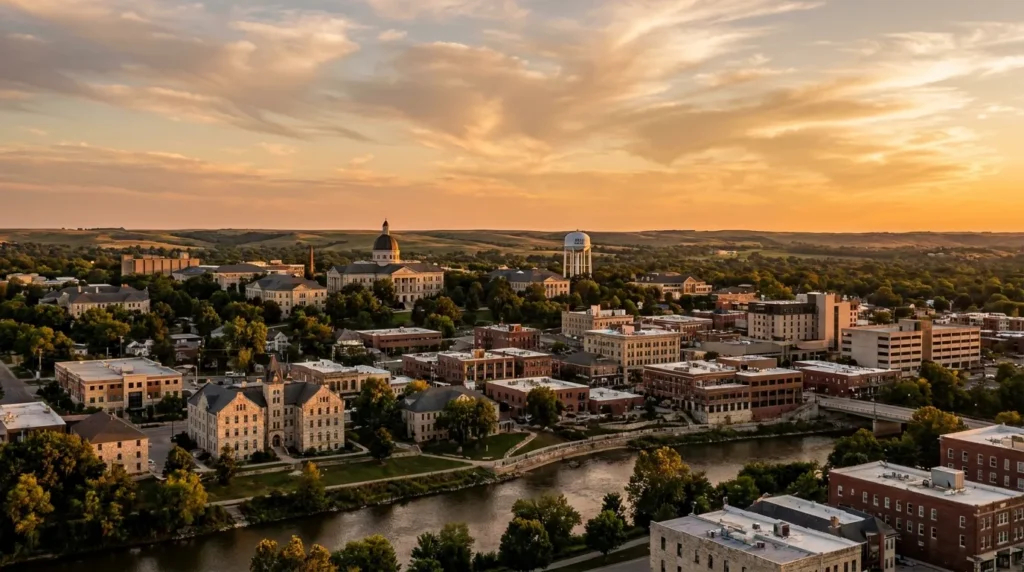
Manhattan

What It's Like to Live in Manhattan, the Little Apple of Kansas

Manhattan is defined by Kansas State University, with Aggieville as its bohemian district, Fort Riley just miles away, and the Flint Hills tallgrass prairie opening on the horizon.

The city's young heart is Aggieville, a commercial district founded in 1889 and often called the Greenwich Village of Kansas, featuring bars like Auntie Mae's Parlor, Manhattan Brewing Company, and venues such as The Hat. Bill Snyder Family Stadium and Bramlage Coliseum host K-State Wildcats football and basketball games.

The Sunset Zoo and the Marianna Kistler Beach Museum of Art on the K-State campus are frequent cultural stops. The Flint Hills Discovery Center at Blue Earth Plaza explains the tallgrass prairie ecosystem, one of the last remaining biomes of its kind in the United States.

For outdoor recreation, Tuttle Creek State Park to the north offers a 12,000-acre lake for sailing, fishing, and the popular Country Stampede festival. The Konza Prairie Biological Station, managed by K-State and the Nature Conservancy, opens public trails in select sections with panoramic views of the Flint Hills.

  1. 1["Kansas State University campus and Bill Snyder Family Stadium"
  2. 2"Sunset Zoo"
  3. 3"Flint Hills Discovery Center"
  4. 4"Aggieville district (shops and bars)"
  5. 5"Marianna Kistler Beach Museum of Art"
  6. 6"Tuttle Creek State Park"
Nightlife5.0 / 10
Parks & green spaces
  • ["Tuttle Creek State Park"
  • "Konza Prairie"
  • "Linear Park (Manhattan Linear Trail)"
  • "City Park"
  • "CiCo Park"
  • +1 more

Latest posts

Posts about Kansas

Coverage and updates related to this destination.

Showing content from Kansas, as there is no specific data for Manhattan yet.