Visto n' Visa
Blog
Notícias e artigos
Destinations
Careers
Immigrants

Want to live and work in Orlando?

Personalized immigration plan with eligible visas, costs, and next steps for your goal!

If you are not eligible, you will know exactly why and what to do to improve your approval chances.

Save up to 12 hours in meetings

No pointless assessments.

Save up to 90%

Save money on vague or unfocused consultations

Avoid Fraud and Mistakes

One mistake can cost you your visa

Total Impartiality

Zero commercial bias

Decide with peace of mind

No toxic urgency

Fast and Accurate

Answers in minutes, no guesswork

Orlando demographics: strong Puerto Rican presence and Florida's largest Brazilian community

Orlando has a majority white population, the largest concentration of Puerto Ricans outside Puerto Rico, a significant Haitian community, and the state's largest Brazilian community.

Over the past twenty years, the Orlando metro area became the second-largest destination for Puerto Ricans in the United States, behind only New York. Neighborhoods like Buenaventura Lakes and Kissimmee concentrate families from the island, particularly following Hurricane Maria in 2017.

Venezuelan, Colombian, Mexican, and Dominican communities are also present, alongside large Haitian, Vietnamese (in Mills 50), and Indian populations. The Brazilian community is the largest in Florida, spread across Kissimmee, Davenport, Celebration, Doctor Phillips, and central Orlando.

The demographic profile is young, with many people working in parks, hospitals, and technology. English dominates, but Spanish and Portuguese are part of daily life in many areas. Retirees from the Northeast and Midwest also relocate to the region.

Languages spoken
  • English
  • Spanish
  • Portuguese
  • Haitian Creole
  • Vietnamese
Main religions
  • Protestantism
  • Catholicism
  • Pentecostalism
  • Spiritism/Afro-Caribbean religions
  • No religion

Cost of living in Orlando: it has risen, but remains accessible by Florida standards

The cost of living in Orlando climbed significantly since 2020, but remains below Miami and even Tampa. With no state income tax, paychecks go further.

The cost of living in Orlando has risen considerably in recent years. A two-bedroom apartment near downtown or the parks is substantially more expensive than before the pandemic, though the average still falls below Miami and Tampa.

Florida has no state income tax. Sales tax in Orange County runs around six and a half percent. Electric bills weigh heavily in summer. Homeowner's insurance has increased sharply due to hurricane risk. Fuel is relatively affordable.

Publix, Walmart, Aldi, Whole Foods, and Trader Joe's serve general grocery needs. For ethnic products, Latin markets in Buenaventura Lakes and Kissimmee, Asian markets in Mills 50, and Brazilian stores in central Orlando (such as International Food Club) cover the essentials.

99Cost index (US = 100)1% below US average
CategorySingleCoupleFamily (2 + 2)
iHousing$1,288$1,487$1,883
iFood$376$753$1,367
iTransport$496$842$1,090
iHealthcare$277$555$1,041
iChildcare$1,803
iOther$842$1,516$2,131
Monthly total$3,279$5,153$9,315

Source: U.S. BLS Consumer Expenditure Survey 2023 + BEA Regional Price Parities 2023 · Estimates in USD, monthly.

Housing in Orlando: suburban communities, historic neighborhoods, and Lake Nona's modern corridor

Orlando's market offers spacious homes in gated suburban communities, historic neighborhoods downtown, and the modern Lake Nona corridor, with a strong Brazilian presence.

Newcomers to Orlando typically choose among three profiles. Historic neighborhoods near downtown (College Park, Audubon Park, Thornton Park, Mills 50) feature homes from the 1920s to 1950s with a walkable, residential feel. Winter Park, to the north, is traditional and pricier.

Gated suburban communities are widespread: Lake Nona (a planned area with hospitals and the USTA), Hunters Creek, Doctor Phillips, Windermere, Celebration (Disney's planned community), Kissimmee, and Davenport. These areas offer three- to five-bedroom homes with pools and yards, highly sought after by Brazilian families.

Quick rentals without a credit score history are often possible at large apartment complexes with a higher deposit. Home purchases require homeowner's insurance and, in some areas, flood insurance. Davenport and Kissimmee have a robust short-term rental industry.

Recommended neighborhoods
  • Lake Nona
  • Doctor Phillips
  • Winter Park
  • College Park
  • Hunters Creek
  • +3 more

Job market in Orlando: tourism, healthcare, military simulation, and technology

Orlando is anchored by tourism (Disney, Universal, SeaWorld), but also has a military simulation and training cluster, a healthcare complex in Lake Nona, and an expanding technology sector.

Walt Disney World is the state's single largest employer, with more than 70,000 workers. Universal Studios and SeaWorld also employ tens of thousands. Hotels, restaurants, and surrounding services multiply that base. The Orange County Convention Center drives conventions year-round.

Healthcare is a major sector, with AdventHealth (headquartered in Orlando), Orlando Health, Nemours Children's, and the University of Central Florida (UCF) College of Medicine in Lake Nona. Military simulation and training form their own cluster at Research Park, with Lockheed Martin, Northrop Grumman, and the Army's STRICOM/PEO STRI.

Technology is growing, driven by companies like Electronic Arts (Tiburon) and startups around UCF, the country's second-largest university by enrollment. Wages in tourism are low; in healthcare, technology, and defense, they are competitive.

Dominant sectors
  • Tourism and hospitality
  • Healthcare
  • Military simulation and defense
  • Technology
  • Conventions and events
  • +1 more
Major employers
  • Walt Disney World
  • Universal Orlando Resort
  • AdventHealth
  • Orlando Health
  • Lockheed Martin
  • +3 more

Education in Orlando: a large public school system, UCF, and respected private options

Orange County Public Schools serves most of the city. The University of Central Florida (UCF) is the second-largest university in the U.S. by enrollment. Private and charter schools offer additional options.

Orange County Public Schools is one of the largest districts in the country. Magnet schools like Winter Park High School (IB), Edgewater High, and Boone High have strong reputations. Well-known private schools include The First Academy, Lake Highland Preparatory, Bishop Moore Catholic, and Trinity Preparatory.

In higher education, the University of Central Florida (UCF) is enormous, with strong programs in engineering, simulation, hospitality, and computer science. Rollins College, in Winter Park, is a traditional private liberal arts college. Valencia College is a highly regarded community college with excellent transfer pathways.

Lake Nona is home to the UCF College of Medicine, the Burnett School of Biomedical Sciences, and the Sanford-Burnham Medical Research Institute. Families often seek highly rated charter schools or suburbs with A/B-rated schools (Lake Nona, Windermere, Winter Park).

Notable universities
  • University of Central Florida (UCF)
  • Rollins College (Winter Park)
  • Valencia College
  • Full Sail University
  • AdventHealth University

Healthcare in Orlando: AdventHealth and Orlando Health lead, with a growing Lake Nona medical hub

Orlando has two major healthcare networks, AdventHealth and Orlando Health, each operating multiple hospitals. Lake Nona Medical City is an emerging research and hospital cluster.

AdventHealth is headquartered in Orlando and operates dozens of hospitals throughout Central Florida, including AdventHealth Orlando, a regional referral hospital. Orlando Health's Orlando Regional Medical Center is a Level 1 trauma center and houses Arnold Palmer Hospital for Children and Winnie Palmer Hospital for Women and Babies.

Lake Nona Medical City is home to Nemours Children's Hospital, the UCF College of Medicine, the Orlando VA Medical Center, and Sanford-Burnham. It is a growing research hub. Coverage is widely available through private insurance plans, Medicare, and the ACA Marketplace.

Portuguese-speaking physicians can be found at numerous practices, particularly in Doctor Phillips and Lake Nona. Community health clinics serve uninsured populations. CVS, Walgreens, and Publix Pharmacy locations are present throughout every neighborhood.

Healthcare index67.0 / 100
  • Life expectancyyears at birth
    78.4yrs
  • Doctors per 1kpracticing physicians
    3.7
  • Health spendper capita, per year
    $13,473
  • Public systemoverall quality rating
    Good

Safety in Orlando: distinct neighborhood variation, with hurricanes as the primary natural risk

Safety in Orlando varies by neighborhood. Tourist areas and planned suburbs are calm; areas west of downtown have higher crime rates. Hurricanes are a real risk.

Overall crime is slightly above the national average, driven by specific neighborhoods west of Downtown. Suburbs like Lake Nona, Windermere, Winter Park, Celebration, and Doctor Phillips are consistently calm. Tourist areas have a strong police presence.

Vehicle theft and car break-ins are the most frequent crimes. The Orlando Police Department patrols the city, with the Orange County Sheriff's Office covering unincorporated areas. The Osceola County Sheriff's Office operates in Kissimmee.

The most significant natural risk is hurricanes, with season running from June through November. Although Orlando is inland, strong storms can bring intense winds and flooding. There are no storm-surge evacuation zones, but flood evacuation zones exist. Tornadoes occur but are generally weak.

5.8
Homicides per 100k
per year
Safety index
46.0
Crime index
54.0
Safer neighborhoods
  • Lake Nona
  • Baldwin Park
  • College Park
  • Winter Park (neighboring city)
  • Thornton Park
  • Dr. Phillips
  • Audubon Park
Areas to avoid
  • Pine Hills
  • Mercy Drive area
  • Stretches of Orange Blossom Trail (OBT) at night
  • Parramore during late hours
  • Isolated areas near International Drive after dark

Transportation in Orlando: a sprawling car-dependent city, with Brightline service to Miami

Orlando is car-dependent. SunRail and LYNX exist but serve limited niches. Brightline has connected Orlando to Miami since 2023.

A car is necessary for daily life in Orlando. LYNX operates bus routes, and SunRail is a north-south commuter rail (DeBary to Poinciana) useful for occasional trips downtown but insufficient for general daily commuting. Ride-share apps like Uber and Lyft work well.

The main highways are I-4 (running east-west through the city, connecting Tampa to Daytona), Florida's Turnpike (north-south, tolled), the 408 (East-West Expressway, tolled), and the 417. Rush-hour traffic has worsened with population growth and tourist volume.

Orlando International Airport (MCO) is Florida's busiest, with flights worldwide, including to Brazil (LATAM, Azul) and Europe. Brightline began operating high-speed trains to Miami in 2023, covering the distance in roughly three and a half hours.

1
Metro lines
5
Metro stations
28 min
Avg commute
42
Walkability
Airports
  • MCO — Orlando International Airport
  • SFB — Orlando Sanford International Airport
  • ORL — Orlando Executive Airport
  • International airport
  • Bike infrastructure

What the Climate Is Like Living in Orlando

An inland city in central Florida with very hot and rainy summers, mild and sunny winters, and a stable climate that supports year-round tourism.

Summer in Orlando is long, hot, and quite humid. From May through October, high temperatures range between 90 and 93 degrees Fahrenheit, with nearly daily afternoon thunderstorms and brief but intense rain showers. Central air conditioning is an essential feature of any residence, and electricity costs weigh heavily on summer budgets.

Winter is the most pleasant season for residents. From December through February, highs range between 72 and 77 degrees Fahrenheit, with lows around 50. Heating is only needed during occasional cold snaps. Low humidity makes this the ideal season for visiting theme parks and regional attractions.

Hurricane season runs from June through November. The city sits inland and faces less direct impact than coastal areas, though it still receives heavy rainfall from storms. The climate is broadly familiar to those accustomed to subtropical conditions, and Orlando is home to one of the largest immigrant communities in the country.

Sunny days / year233 days
Avg high (°F)
  • 71°J
  • 77°F
  • 81°M
  • 83°A
  • 87°M
  • 89°J
  • 89°J
  • 89°A
  • 86°S
  • 83°O
  • 76°N
  • 72°D
Avg low (°F)
  • 53°J
  • 58°F
  • 60°M
  • 64°A
  • 68°M
  • 73°J
  • 75°J
  • 75°A
  • 73°S
  • 68°O
  • 62°N
  • 56°D
Rainfall (")
  • 2"J
  • 2"F
  • 2"M
  • 4"A
  • 5"M
  • 9"J
  • 10"J
  • 12"A
  • 12"S
  • 4"O
  • 4"N
  • 4"D

Culture in Orlando: theme parks, Latin festivals, downtown arts, and sports

Orlando's culture blends the major theme parks with a downtown arts scene, a strong Latin events calendar, professional sports, and a growing craft brewery presence.

Theme parks define the landscape: Walt Disney World (Magic Kingdom, EPCOT, Hollywood Studios, Animal Kingdom), Universal Studios and Islands of Adventure, Volcano Bay, and SeaWorld. Residents can purchase annual passes at discounted local rates.

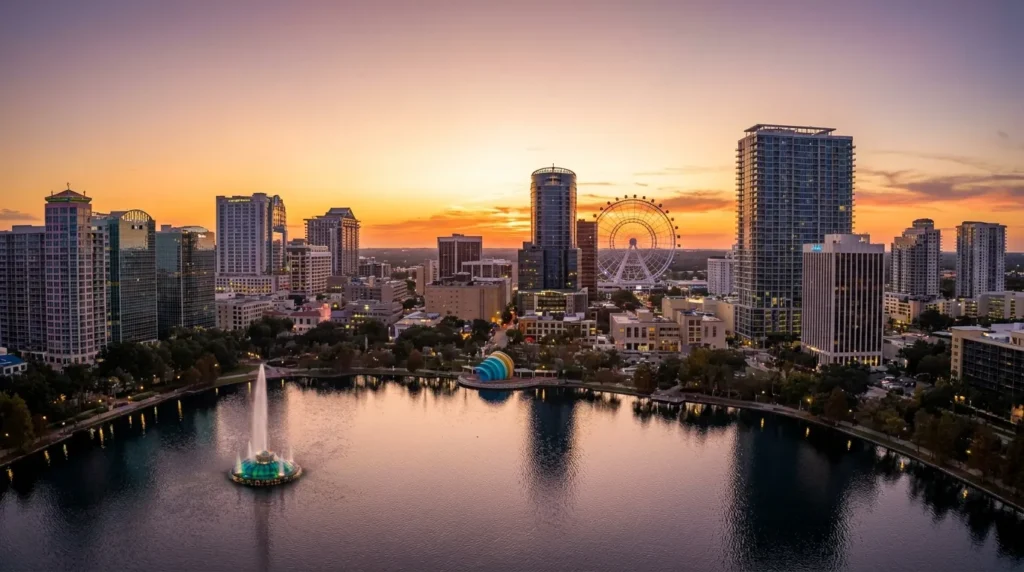
In Downtown, the Dr. Phillips Center for the Performing Arts hosts Broadway touring productions, opera, and concerts. The Orlando Museum of Art and the Mennello Museum serve the local arts scene. Lake Eola Park, known for its iconic swan paddle boats, hosts a Sunday farmer's market and community gatherings.

Sports: the Orlando Magic (NBA) play at Kia Center, while Orlando City SC and Orlando Pride (MLS/NWSL) compete at Inter&Co Stadium. Latin festivals such as Calle Orange and the Florida Puerto Rican Parade take place downtown. Mills 50 centers the Vietnamese cultural scene, and Doctor Phillips features Brazilian and international dining.

Orlando

Far Beyond the Theme Parks

Orlando offers much more than theme parks: Lake Eola, Winter Park, Mills 50, Thornton Park, Dr. Phillips Center, and Kennedy Space Center all shape daily life for residents.

Those who live in Orlando quickly discover that life extends well beyond Walt Disney World, Universal, and SeaWorld. Downtown revolves around Lake Eola Park, with its swans, amphitheater, and Sunday farmers market, as well as the Dr. Phillips Center for the Performing Arts. Neighborhoods like Thornton Park, Mills 50 (with its Vietnamese community), and Audubon Park are home to independent restaurants and cafes.

Neighboring Winter Park features Park Avenue, the Morse Museum housing the world's largest Tiffany collection, and Charles Hosmer Morse Park. Lake Nona has emerged as a hub for medicine and technology, while ICON Park on International Drive concentrates entertainment options. For nature, Wekiwa Springs and Blue Spring State Park make for ideal weekend outings, and Cocoa Beach and Kennedy Space Center are about an hour east.

The calendar includes the Orlando International Fringe Festival, the Florida Film Festival, Come Out With Pride, and Orlando Magic games in the NBA. For residents, theme parks become occasional visits while daily life revolves around brewpubs, parks, and the ever-accessible MCO airport.

  1. 1["Walt Disney World Resort"
  2. 2"Universal Orlando Resort"
  3. 3"SeaWorld Orlando"
  4. 4"ICON Park and The Wheel"
  5. 5"Lake Eola Park"
  6. 6"Orlando Science Center"
Nightlife7.0 / 10
Parks & green spaces
  • ["Lake Eola Park"
  • "Harry P. Leu Gardens"
  • "Bill Frederick Park at Turkey Lake"
  • "Wekiwa Springs State Park"
  • "Lake Underhill Park"
  • +1 more

Latest posts

Posts about Florida

Coverage and updates related to this destination.

Showing content from Florida, as there is no specific data for Orlando yet.