English
 Português
 Español


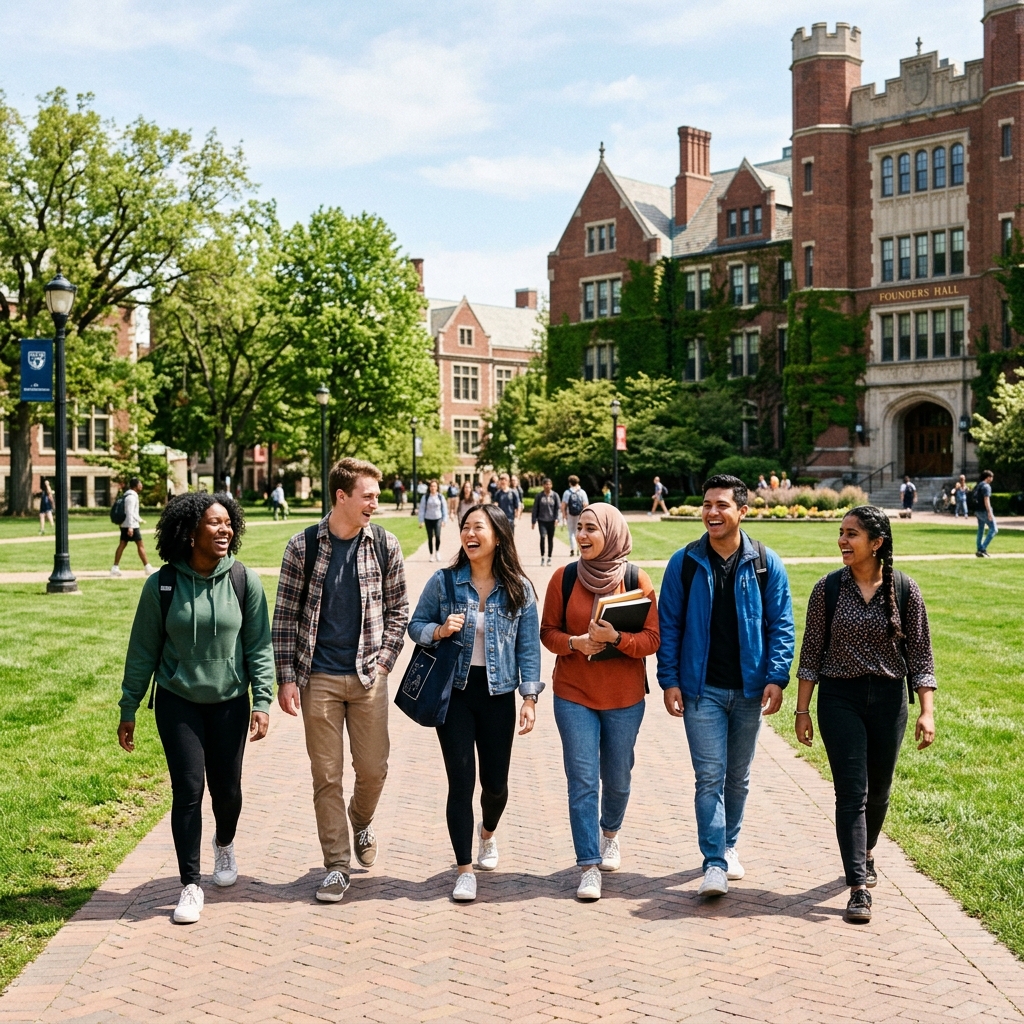
The J-1 visa is one of the most versatile entryways for Brazilians who wish to have a professional or academic experience in the United States. Unlike visas focused exclusively on work or study, the J-1 covers 15 categories of exchange programs ranging from au pair and corporate internships to scientific research and medical residency. With government fees totaling US$ 405 in 2026 and a recent regulatory change that directly benefits Brazilian citizens, now is the right time to understand how the process works in practice.
What is the J-1 Visa
The J-1 visa, officially called the Exchange Visitor Visa, is a non-immigrant visa administered by the U.S. Department of State under the authority of the Mutual Educational and Cultural Exchange Act of 1961. Its stated goal is to promote the exchange of knowledge and cultural experiences between the United States and other countries.
The J-1 is distinct from other visas because it requires participation in a program approved and supervised by a sponsor organization designated by the Department of State. This organization issues the DS-2019 form, an essential document that proves acceptance into the program and defines the category, duration, and conditions of participation.
Program Categories
The J-1 visa covers 15 distinct categories, each with specific eligibility rules and duration. The most sought-after by Brazilians include the Au Pair program, lasting 12 to 24 months for childcare providers in American families; the Intern program, limited to 12 months for recent graduates or university students seeking practical experience; and the Trainee program, up to 18 months for professionals with at least one year of experience in the field.
The Summer Work Travel (SWT), lasting up to 4 months, allows university students to work during summer vacation. The Camp Counselor program is aimed at camp monitors. Other categories include Professor, Research Scholar, Short-Term Scholar, Specialist, Government Visitor, Alien Physician, and Teacher, each with its own requirements and deadlines.
For students in STEM fields (science, technology, engineering, and mathematics), there is an academic training extension available until June 30, 2026, for undergraduate and pre-doctoral students. Standard academic training allows up to 18 months of professional practice after the program, extended to 36 months for doctoral students.
Fees and Costs in 2026
The government costs of the J-1 visa in 2026 are divided into two main fees. The SEVIS I-901 fee is US$ 220 for most exchange participants, except for au pairs, camp counselors, and Summer Work Travel participants, who pay a reduced fee of US$ 35. Payment must be made on the official website at least three business days before the consular interview.
The MRV (Machine Readable Visa) fee, charged when scheduling the consular interview, is US$ 185. The total government fees for most participants are therefore US$ 405. J-2 dependents (spouse and children under 21) pay their own MRV fee of US$ 185, but are covered by the principal’s SEVIS fee.
Additionally, the One Big Beautiful Bill Act, enacted on July 4, 2025, created a new US$ 250 fee called the Visa Integrity and Border Security Fee, applicable to the J-1 and most non-immigrant visas. As of April 2026, implementation guidelines for this fee had not yet been issued to embassies, but applicants should consider this additional cost when planning their total budget.
Two-Year Rule
Section 212(e) of the INA (Immigration and Nationality Act) establishes the two-year home-country physical presence requirement, which requires certain J-1 holders to return to their home country for at least two years before applying for H, L, K visas or permanent residency in the U.S. This requirement historically applies to participants funded by governments or whose skills are listed on the Department of State’s Skills List.
A significant change occurred on December 9, 2024, when the Skills List was updated and Brazil was removed from the list of countries subject to the skills-based requirement. In practice, this means that most Brazilians with a J-1 visa are no longer subject to the two-year residency obligation, unless they have received direct government funding. This change substantially alters post-exchange career planning for Brazilians.
For those still subject to the rule, a waiver can be requested through the DS-3035 form, with processing taking 4 to 12 months.
J-2 Dependents
Spouses and children under 21 of the J-1 holder may accompany them to the U.S. with the J-2 visa. J-2 dependents may apply for work authorization through the I-765 form (Employment Authorization Document), which in 2026 must be submitted exclusively on paper, with no electronic submission option. Typical processing takes 2 to 3 months, but may extend up to 5 months.
An important restriction: J-2 dependent employment cannot have as its main purpose the financial support of the J-1 holder. This explicit limitation is often unknown. The duration of J-2 work authorization is valid until the DS-2019 end date or for 4 years, whichever comes first.
Step-by-Step Application Process
- Choose the program and category: Identify which of the 15 J-1 categories applies to your profile and find a sponsor organization designated by the Department of State.
- Obtain the DS-2019: After acceptance into the program, the sponsor issues the DS-2019 form, which contains your SEVIS ID and program details.
- Pay the SEVIS I-901 fee: Make the payment of US$ 220 (or US$ 35, depending on the category) at least 3 business days before the interview.
- Fill out the DS-160: Complete the online non-immigrant visa application on the Department of State website.
- Pay the MRV fee: Make the payment of US$ 185 and schedule your interview at the American consulate.
- Attend the interview: Bring the DS-2019, SEVIS payment receipt, DS-160 confirmation page, valid passport, financial proof, and documents demonstrating ties to Brazil.
Errors That Compromise Approval
The most critical error in applying for the J-1 is not demonstrating sufficient ties to Brazil. The consular officer needs to be convinced that you intend to return after the program ends. Property, stable employment, family ties, and enrollment in an educational institution are relevant evidence. The absence of such proof increases the risk of refusal under Section 214(b) of the INA.
Other common mistakes include using sponsor organizations not recognized by the Department of State, presenting inconsistent or insufficient financial documentation, confusing program categories at the time of application, and being unaware of the specific work restrictions of each category. Participants who understand the program rules before applying have significantly higher approval rates and a more productive exchange experience.
Learn more about J-1
- Type
- Cultural exchange
- Duration
- Program duration
- 2-year rule
- Applies in some cases
- Processing
- 2-6 weeks
About the author

Victoria Harper
Editor-in-Chief
As a journalist and lead editor at Visto n’ Visa, Victoria helps ensure that immigration topics are covered in a clear, trustworthy, and easy-to-understand way. Her focus is on delivering useful, human, and relevant content for people exploring new paths abroad.