English
 Português
 Español


Who lives in Gjoa Haven: an Inuit majority and a small rotation of professionals from the south
Over 85 percent of the population is Inuit, with Inuktitut spoken in daily life alongside English. The remainder are teachers, nurses, police officers, and technicians who come from other Canadian provinces on temporary contracts.
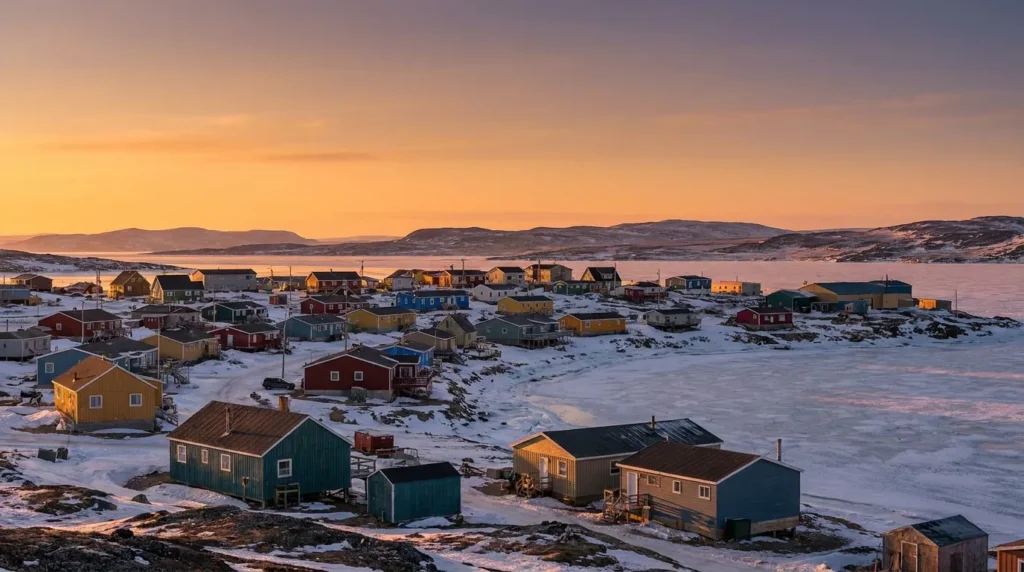
Gjoa Haven is a small community, with just over a thousand residents in a narrow strip of prefabricated houses facing the bay. The overwhelming majority is Inuit, part of the Netsilik group, with extended families who historically lived a nomadic life across the region and were sedentarized starting in the 1960s. The age profile is young: the median age is below thirty, much lower than the Canadian average.
The predominant mother tongue is Inuktitut, written in its own syllabary, and it is normal to hear it at home, at school, and on local radio. English comes in as a second language and dominates administrative, medical, and school life from the later grades onward. Almost no one speaks French in daily life, even though Canada is officially bilingual.
The non-Inuit minority tends to be transient. They are qallunaat professionals, the Inuit term for non-Inuit, hired by the government of Nunavut, the school, the health center, the mounted police, or regional mining companies. Many stay two or three years and return to the south. Religiously, Christian denominations brought by Anglican and Catholic missions predominate, layered over older Inuit spiritual practices.
- Inuktitut
- English
- Inuinnaqtun
- Anglicanism
- Catholicism
- Pentecostalism
- Traditional Inuit spirituality