Visto n' Visa
Blog
Notícias e artigos
Destinations
Careers
Immigrants

Want to live and work in Huron?

Personalized immigration plan with eligible visas, costs, and next steps for your goal!

If you are not eligible, you will know exactly why and what to do to improve your approval chances.

Save up to 12 hours in meetings

No pointless assessments.

Save up to 90%

Save money on vague or unfocused consultations

Avoid Fraud and Mistakes

One mistake can cost you your visa

Total Impartiality

Zero commercial bias

Decide with peace of mind

No toxic urgency

Fast and Accurate

Answers in minutes, no guesswork

Who lives in Huron

Traditionally white, with one of the largest Karen communities in the United States and recent Hispanic growth, creating rare diversity in a small city.

Huron's permanent population has traditionally been white, with German, Scandinavian, and Czech heritage. The major development of the past two decades is the Karen community, refugees from Myanmar who settled in the city from the mid-2000s onward, drawn by jobs at Dakota Provisions. Today more than 2,500 Karen residents live in Huron, with churches, Buddhist temples, stores, restaurants, and schools offering Karen-language programs.

Smaller Hispanic communities (Mexican, Guatemalan, Salvadoran), as well as Karenni, Ethiopian, and Somali residents, also work in the factories. The diversity is so pronounced that Huron School District serves students who speak more than 30 languages at home, a remarkable figure for a city of 14,000. There is no established Brazilian community.

English is the official and dominant language in commerce, but Karen and Spanish appear in schools, churches, and markets. Religiously, Lutherans, Catholics, Methodists, and Baptists predominate, with a strong Karen Buddhist presence (Karen Buddhist Society temple) and Karen Baptist churches, reflecting the religious diversity among Myanmar refugees.

Languages spoken
  • English
  • Karen
  • Spanish
  • Karenni
  • Burmese
  • +1 more
Main religions
  • Lutheranism
  • Catholicism
  • Karen Buddhism
  • Karen Baptist Churches
  • Pentecostalism
  • +2 more

Cost of living in Huron

One of the lowest costs of living in the United States, with affordable rent, accessible homeownership, and no state income tax.

Huron ranks among the most affordable cities in the United States. Two-bedroom apartment rents come in at very low figures. Homeownership is within reach even for factory workers on median incomes, and three-bedroom houses with yards in residential neighborhoods sell at prices considered negligible by urban American standards.

South Dakota levies no state income tax, a significant advantage for skilled professionals. State and local sales tax rates are higher than average and apply to groceries. Energy and gas costs rise above average in winter due to the extended cold, but fuel and basic food items remain below the national average.

Healthcare through Huron Regional Medical Center depends heavily on employer-provided insurance. For Dakota Provisions workers, the benefits package covers a substantial portion. Workers without benefits can use the Community Health Center. Karen and Mexican markets offer affordable, fresh ethnic groceries.

Huron

Housing in Huron

A city of single-story homes with yards, abundant supply, and low rents, with neighborhoods near Dakota Provisions popular among Karen workers.

Huron is defined by single-family homes with full basements and attached garages, spread across residential neighborhoods with wide streets. The most sought-after areas for traditional American families are in the south and east, near well-rated schools. Neighborhoods close to Dakota Provisions in the east and north concentrate Karen and Hispanic families, with even lower rents.

Downtown features older homes, some renovated buildings, and proximity to Dakota Avenue, the main commercial corridor. Historic structures from the era when Huron was a candidate for the territorial capital remain visible. Student apartments near Huron University are available on a small scale.

New apartment complexes with pools and fitness centers are virtually nonexistent. The supply consists largely of duplexes, houses in varying condition, and a few small apartment buildings. For those working at Dakota Provisions, areas such as Lincoln Park and the east-central district offer a good price-to-distance ratio. Rents are among the lowest in the state.

Recommended neighborhoods
  • South Huron
  • East Huron (near Dakota Provisions)
  • Historic Downtown
  • North Huron
  • West Huron
  • +1 more

Job market in Huron

Dakota Provisions dominates the local economy, with healthcare, retail, and the public sector rounding it out.

The largest employer in Huron is Dakota Provisions, a cooperative turkey processing plant with more than 1,500 employees. It forms the backbone of the city's economy and serves as the primary entry point for Karen, Hispanic, and African immigrant workers. The plant offers training, employee shuttle service from several neighborhoods, and maintains continuous high-volume hiring.

Huron Regional Medical Center is the second-largest employer, with openings in nursing, technical, and administrative roles. Huron School District, Huron University, and the public sector (city, county, state) round out the picture. The agricultural sector underpins much of the surrounding rural area, with cooperatives and grain processing operations.

For newly arrived immigrants, Dakota Provisions is the near-universal path, offering above-minimum wages and health benefits. Construction and service industries (hotels, restaurants) also hire regularly. Qualified professionals in healthcare, education, or administration are in shorter supply and find placement quickly. Seasonal jobs are available during the State Fair.

Dominant sectors
  • Agroindustry (turkey processing)
  • Healthcare
  • Agriculture
  • Education
  • Retail
  • +1 more
Major employers
  • Dakota Provisions
  • Huron Regional Medical Center
  • Huron School District
  • Huron University
  • Dakotaland Federal Credit Union
  • +2 more

Education in Huron

Huron University is a small local college, with a solid K-12 public system and strong ESL programming for the Karen community.

Huron University is a small private college with about 300 students, offering programs in business, education, health, and technology, with both in-person and online coursework available. The college has faced financial challenges in recent decades but continues operating as a local higher education option.

For public university attendance, students typically travel to SDSU in Brookings (one hour east), Northern State University in Aberdeen (one hour north), USD in Vermillion, or Dakota State University in Madison. Mitchell Technical College and Lake Area Tech are about an hour away.

The Huron School District's K-12 public system is particularly notable, serving students who speak more than 30 languages at home, with robust ESL programs for Karen, Spanish, Karenni, and Somali speakers. Huron High School offers both technical and academic tracks. Catholic private schools (Holy Trinity School) serve as a traditional alternative. Adult ESL programs are available at the Huron Adult Education Center.

Notable universities
  • Huron University
  • South Dakota State University (in Brookings, nearby)
  • Northern State University (in Aberdeen, nearby)
  • Mitchell Technical College (in Mitchell, nearby)

Healthcare in Huron

Huron Regional Medical Center serves as the local hospital, with complex cases transferred to Sioux Falls.

Huron Regional Medical Center is the city's main hospital, with an emergency department, maternity ward, general surgery, oncology, and specialty clinics. It serves Huron and smaller surrounding communities across east-central South Dakota, operating as a nonprofit institution with strong community ties.

For highly complex cases such as transplants, severe trauma, or advanced pediatric oncology, patients are transferred to Sanford or Avera in Sioux Falls. Both systems maintain affiliated clinics in Huron, providing specialist access in select areas.

Private American insurance plans are widely accepted. For uninsured immigrants, the Community Health Center provides care on a sliding-scale basis. The Karen community has significant interpreter needs. The hospital works with Karen, Karenni, and Spanish translators by phone. Mental health services carry long wait times statewide, compounded by language barriers for refugee populations.

Healthcare index60.0 / 100
  • Life expectancyyears at birth
    78.4yrs
  • Doctors per 1kpracticing physicians
    3.7
  • Health spendper capita, per year
    $13,473
  • Public systemoverall quality rating
    Fair

Safety in Huron

A quiet city by American standards, with low crime concentrated in a few specific areas.

Huron has crime rates among the lowest for cities of its size in the United States. Violent crime is rare. Property crime, such as vehicle break-ins and vandalism, is the most common type, concentrated near motels along US-14 and bar parking lots at night.

Residential neighborhoods such as South Huron, Historic Downtown, East Huron (where much of the Karen community lives), and Lincoln Park are quiet, with very low incidence of crime of any kind. Families leave children playing in the street, and the sense of community is strong. The local police department works with Karen community leaders.

Basic precautions apply: lock cars and homes, stay alert in bar parking lots after 10 PM, and exercise care on icy ground in winter. Extreme cold, with temperatures dropping to negative 30 degrees Celsius, represents the most significant real personal safety risk.

Safer neighborhoods
  • South Huron
  • East Huron
  • Historic Downtown
  • North Huron
  • West Huron
  • Lincoln Park area
Areas to avoid
  • US-14 corridor (motel area)
  • Bar parking lots after 10 PM

Getting around Huron

A small, car-dependent city with a regional airport, no interstate passing through, and minimal public transit.

Huron is a car-dependent city, but its small size means crossing from one side to the other takes under fifteen minutes. US-14 runs east-west and SD-37 runs north-south. I-29 is about two hours to the east, and I-90 is about an hour and a half to the south. Main internal roads include Dakota Avenue, Frank Avenue, and Lincoln Avenue.

Public transit is operated by Huron Public Transit, with Dial-a-Ride service and a few fixed routes during business hours, useful for seniors and nearby residents. Dakota Provisions provides employee shuttles from several neighborhoods, which is important for the Karen community, many of whom do not own vehicles. Urban bike infrastructure is limited.

Huron Regional Airport (HON) offers limited commercial flights via SkyWest, occasionally to Pierre. For regular flights, most residents drive two hours to Sioux Falls (FSD) or three hours to Aberdeen or Watertown. There is no passenger rail service. Greyhound no longer serves the city directly.

Airports
  • HON — Huron Regional Airport
  • FSD — Sioux Falls Regional Airport (about 200 km away)

What the Climate Is Like Living in Huron

Huron has a dry continental climate typical of the Great Plains. Summers are short and hot, winters are long and extremely cold, with wide annual temperature swings.

Summer is short and hot, with highs near 86°F in July and moderate humidity. Convective storms and hail occur in May and June, making air conditioning essential in both homes and vehicles.

Winter is severe. From December through February, lows drop below -13°F, and the city receives around 31 inches of snow per year. Plains winds drive wind chills below -22°F. Extreme cold-weather coats, boots, hats, and robust central heating are necessities.

Spring and autumn are brief. Annual rainfall totals around 22 inches, concentrated between May and September. Tornadoes are a real risk from May through July.

Sunny days / year220 days
Avg high (°F)
  • 40°J
  • 51°F
  • 67°M
  • 82°A
  • 86°M
  • 99°J
  • 98°J
  • 99°A
  • 94°S
  • 81°O
  • 65°N
  • 48°D
Avg low (°F)
  • -14°J
  • -15°F
  • M
  • 19°A
  • 30°M
  • 49°J
  • 55°J
  • 54°A
  • 42°S
  • 19°O
  • 11°N
  • -6°D
Rainfall (")
  • 1"J
  • 1"F
  • 1"M
  • 2"A
  • 3"M
  • 3"J
  • 4"J
  • 3"A
  • 2"S
  • 3"O
  • 1"N
  • 1"D

Huron's culture: state fair, agriculture, and Karen diversity

Local culture blends Midwestern agricultural traditions, the late-summer State Fair, and the Karen presence, which brought temples, festivals, and Southeast Asian cuisine.

The defining cultural landmark of Huron is the South Dakota State Fair, hosted in the city since 1905, with 10 days of rodeo events, national concerts, livestock exhibitions, food, and carnival attractions in late August and early September. The fair draws hundreds of thousands of visitors from across the state and energizes hotels, restaurants, and retail.

The Karen presence has transformed the cultural landscape. Buddhist temples such as the Karen Buddhist Society hold Karen New Year festivals featuring dance, food, and traditional dress. Markets such as New Asian Market and Burma Asian Market carry Southeast Asian products. Karen and Mexican restaurants are a welcome discovery in a small city.

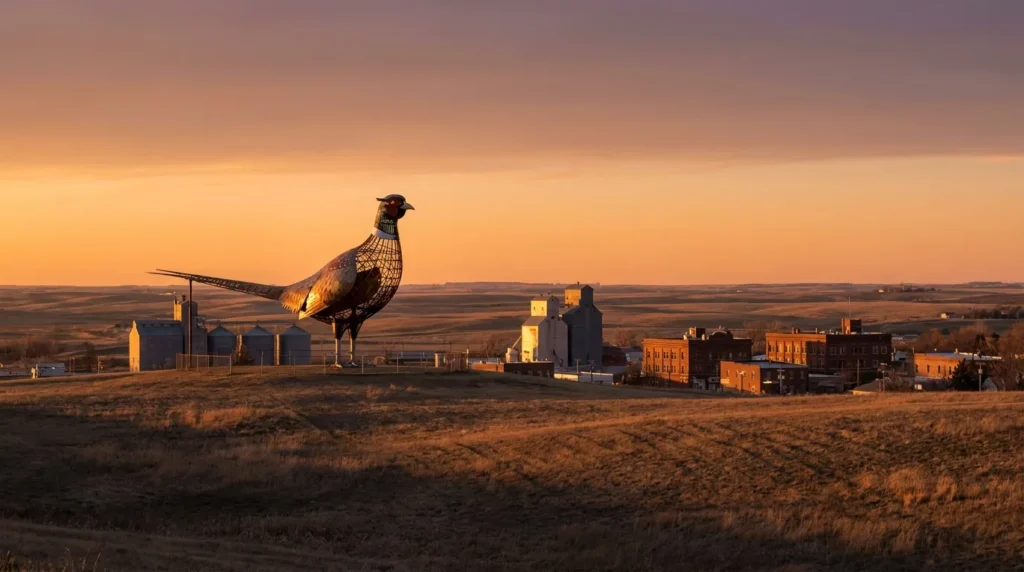
Dakotaland Museum and Trinity Episcopal Church (1881) preserve pioneer history. The World's Largest Pheasant, an 8-meter sculpture, is a notable roadside landmark. Traditional local cuisine includes chislic, kuchen, fried walleye, and pheasant. Karen cooking has added mohinga, hkale thoke (ginger salad), and curries to the local palate.

Notable dishes
  • Mohinga (Karen fish soup)
  • Hkale thoke (Karen ginger salad)
  • Chislic
  • Kuchen
  • Fried walleye
  • +2 more
Annual events
  • South Dakota State Fair
  • Karen New Year Festival
  • Huron Volga German Festival
  • Beadle County Fair
  • Huron Independence Day Parade
  • +1 more

What to see in Huron

South Dakota State Fairgrounds, the World's Largest Pheasant, local museums, and the James River define recreation in the area.

The main attraction in Huron is the South Dakota State Fairgrounds, host of the State Fair in late August, with 10 days of programming. Outside of fair season, the grounds host year-round events, livestock shows, and the Beadle County Fair. The World's Largest Pheasant, a giant sculpture at the city entrance, is a popular stop for photos.

Dakotaland Museum holds pioneer history collections, including the Hubert Humphrey Drug Store (Humphrey, former U.S. Vice President, grew up in nearby Doland) and the Pioneer Mall. Trinity Episcopal Church (1881) and the Beadle County Courthouse are historic late-19th-century structures. The Karen Buddhist Society temple is a rarity in the American Midwest.

For outdoor recreation, the James River runs through the city with fishing and canoeing opportunities. Memorial Park and Riverside Park have playgrounds and walking paths. Lake Byron, about 30 minutes to the east, offers fishing and camping. Sioux Falls is two hours away, and Mitchell, home to the Corn Palace, is one hour.

  1. 1South Dakota State Fairgrounds
  2. 2World's Largest Pheasant
  3. 3Dakotaland Museum
  4. 4Trinity Episcopal Church
  5. 5Karen Buddhist Society Temple
  6. 6Beadle County Courthouse
Parks & green spaces
  • Memorial Park
  • Riverside Park (James River)
  • Splash Central Aquatic Center
  • Lake Byron Recreation Area (nearby)
  • James River pathway
  • +1 more

Latest posts

Posts about South Dakota

Coverage and updates related to this destination.

Showing content from South Dakota, as there is no specific data for Huron yet.