Visto n' Visa
Blog
Notícias e artigos
Destinations
Careers
Immigrants

Want to live and work in Myrtle Beach?

Personalized immigration plan with eligible visas, costs, and next steps for your goal!

If you are not eligible, you will know exactly why and what to do to improve your approval chances.

Save up to 12 hours in meetings

No pointless assessments.

Save up to 90%

Save money on vague or unfocused consultations

Avoid Fraud and Mistakes

One mistake can cost you your visa

Total Impartiality

Zero commercial bias

Decide with peace of mind

No toxic urgency

Fast and Accurate

Answers in minutes, no guesswork

Diverse and growing population, with a strong retiree presence

Myrtle Beach blends South Carolina natives, retirees from the Northern US, Latino tourism workers, and a growing Eastern European immigrant community.

The city's resident population hovers around 38,000, but the Myrtle Beach-Conway-North Myrtle Beach metropolitan area exceeds 500,000 residents and is one of the fastest-growing in the United States. The white majority lives alongside significant Hispanic and African American communities, as well as pockets of immigrants from Ukraine, Russia, Moldova, and Romania who arrived over the past two decades drawn by work in the tourism sector.

The median age is higher than the national average, reflecting the steady flow of retirees from states like New York, New Jersey, Pennsylvania, and Ohio. At the same time, tourism employs thousands of young people in hotels, restaurants, and water parks, many of them coming through the J-1 Summer Work Travel visa program, which brings students from Eastern Europe and Latin America every summer.

English is the dominant language, but Spanish is widely spoken in restaurant kitchens, construction sites, and cleaning services. In neighborhoods like Socastee and parts of Conway, Russian and Ukrainian can be heard in markets and Orthodox churches. Religious diversity follows the Southern pattern: a Baptist and Methodist Protestant majority, with Catholics, Orthodox Christians, and some Hispanic evangelical congregations.

Languages spoken
  • English
  • Spanish
  • Russian
  • Ukrainian
  • Romanian
Main religions
  • Baptist Protestantism
  • Methodist Protestantism
  • Roman Catholicism
  • Orthodox Christianity
  • Pentecostal Evangelicalism

Cost of living below the American national average, but rising fast

Rent, food, and services are still affordable compared to the US Northeast, but high demand has pushed up real estate prices in recent years.

Myrtle Beach is historically one of the cheapest cities to live in on the American East Coast. Rent for a one-bedroom apartment outside the tourist zone typically falls between 1,100 and 1,500 dollars, while three-bedroom homes in residential neighborhoods like Carolina Forest range from 1,800 to 2,400 dollars in monthly rent. Buying a home is still feasible for the middle class, with median prices historically below the national average.

Grocery shopping follows Southern patterns: chains like Food Lion, Publix, and Walmart offer competitive prices, and Latino markets on Socastee Boulevard serve the Hispanic community with fresh products at lower prices. Eating out varies widely, from seafood buffets for under 25 dollars in winter to tourist oceanfront restaurants charging 60 to 80 dollars per person in summer.

What weighs on the budget is home insurance, made more expensive by hurricane risk, and the electric bill between June and September, when the air conditioning runs nonstop. South Carolina does not charge state tax on Social Security retirement income, which helps those who move here after 65. Fuel and property taxes are below the American average.

Myrtle Beach

Hot real estate market, with options from oceanfront condos to inland family homes

Carolina Forest and Market Common dominate for families, while the oceanfront concentrates seasonal rental condos. Surfside and North Myrtle offer quieter alternatives.

The Myrtle Beach real estate market is unusual because it splits supply between full-time residents and vacation rental investors. Condos on Ocean Boulevard, from Sand Dunes to Caribbean Resort, are mostly purchased as investments and rented out via Airbnb, VRBO, and local companies. Those who live here year-round prefer to stay far from this area, where summer traffic is unbearable.

Carolina Forest, west of Highway 17 Bypass, is the most sought-after neighborhood for families. It has well-rated schools, homes from the 2000s onward, gated communities with pools, and easy access to Coastal Grand Mall. Market Common, a former air base converted into a planned community, has tree-lined streets, shops, restaurants, and apartments above retail, popular with young professionals and active retirees.

Surfside Beach, just to the south, keeps the feel of a small beach town and attracts families wanting proximity to the ocean without the tourist chaos. Conway, further inland, is the most affordable option, with historic homes near the Waccamaw River and a college-town atmosphere thanks to Coastal Carolina University. North Myrtle Beach is more upscale and expensive, with neighborhoods like Cherry Grove and Ocean Drive.

Recommended neighborhoods
  • Carolina Forest
  • Market Common
  • Surfside Beach
  • Murrells Inlet
  • North Myrtle Beach
  • +2 more

Job market dominated by tourism, healthcare, and construction

Hospitality, golf, and medical services drive jobs year-round, with a seasonal summer peak. Skilled professionals find opportunities in healthcare and education.

Myrtle Beach's economy is driven by tourism, which directly supports about one third of the region's jobs. Hotels, restaurants, water parks like Family Kingdom, and attractions like Broadway at the Beach hire year-round, with starting wages generally near the state minimum plus tips. In summer, demand surges and there are openings on nearly every corner.

Outside of tourism, the healthcare sector is the second-largest employer, anchored by Grand Strand Medical Center, Conway Medical Center, and the Tidelands Health network. Nurses, technicians, and physical therapists find good placement, especially given the aging profile of the population. Construction also employs many people, serving the continuous growth of condos and homes in Carolina Forest and the surrounding area.

For newly arrived immigrants without full documentation, it is common to start in restaurant kitchens, landscaping, condo cleaning, and construction. Those arriving with technical skills in hospitality, golf, or refrigeration tend to settle in quickly. Remote jobs are a growing reality, with many people working from home for companies in other states and taking advantage of the lower cost of living.

Dominant sectors
  • Tourism and hospitality
  • Healthcare
  • Construction
  • Retail
  • Food services
  • +1 more
Major employers
  • Grand Strand Medical Center
  • Horry County Schools
  • Conway Medical Center
  • Tidelands Health
  • Coastal Carolina University
  • +3 more

Broad public system, with higher education at Coastal Carolina University

Horry County Schools serve the entire region with schools of varying quality. Coastal Carolina University in Conway is the main academic anchor.

The public system is run by Horry County Schools, one of the largest districts in South Carolina. School quality varies considerably by neighborhood, and families often choose where to live based on assigned schools. Carolina Forest, St. James, and Socastee have schools with strong academic reputations. There are also private options, with Christian Academy of Myrtle Beach and Saint Andrew Catholic School among the most sought-after.

For higher education, Coastal Carolina University in Conway is the region's academic center, with about 10,000 students and strong programs in business, marine biology, hospitality, and education. Horry-Georgetown Technical College offers technical and associate programs in fields like nursing, culinary arts, and technology, with affordable tuition and a focus on those who want to enter the workforce quickly.

For adult immigrants, there are English as a second language programs at community schools, churches, and the Myrtle Beach public library. GED preparation and professional certification courses are offered by Horry-Georgetown Tech at low cost. Access to public early childhood education is limited, and private daycares dominate the market, with prices between 800 and 1,400 dollars per month per child.

Notable universities
  • Coastal Carolina University
  • Horry-Georgetown Technical College
  • Webster University Myrtle Beach
  • Miller-Motte College

Solid hospital network anchored by two large medical complexes

Grand Strand Medical Center and Tidelands Health cover most of the demand. Access is reasonable, but uninsured costs are high, as throughout the country.

The region has healthcare infrastructure above average for a city of this size, precisely because it serves an aging population and millions of tourists per year. Grand Strand Medical Center, affiliated with HCA, is the main hospital, with a Level III trauma emergency room, advanced cardiology, and a cancer center. Conway Medical Center serves the western region and has a strong reputation in maternity and orthopedics.

The Tidelands Health network operates two regional hospitals, in Murrells Inlet and Georgetown, plus clinics throughout the area. For minor emergencies, urgent care clinics like Doctors Care and CareNow are everywhere and take walk-ins, with costs between 150 and 300 dollars without insurance. Specialty doctors exist in reasonable numbers, especially cardiologists, orthopedists, and oncologists.

The big challenge for immigrants is the insurance system. South Carolina did not expand Medicaid, so low-income childless adults generally do not qualify. Those with formal employment typically have a plan through their employer, and the federal Marketplace is the route for the self-employed. Without insurance, a basic doctor visit costs between 200 and 350 dollars, and an emergency room visit can easily exceed 2,000. Some community clinics, like HopeHealth, offer sliding-scale fees based on income.

Myrtle Beach

Safer in winter than in summer, with large variation by neighborhood

Residential neighborhoods like Carolina Forest and Market Common are safe. The tourist oceanfront has more minor incidents, especially in high season.

Myrtle Beach has crime statistics higher than the national average because of the enormous volume of tourists. Most crimes are small thefts from cars, bar fights, and alcohol-related incidents, concentrated in the strip between Ocean Boulevard and Highway 17 in the warm months. Violent crimes are less common and usually involve disputes between acquaintances, not random attacks.

Residential neighborhoods are well removed from tourist areas and are notably quiet. Carolina Forest, Market Common, Pawleys Island, and North Myrtle Beach have crime rates comparable to American Midwest suburbs. Children ride bikes, neighbors know each other, and home break-ins are rare. Small gated planned communities, common in the region, add extra security.

Areas to avoid include isolated stretches of Highway 501 outside business hours and some older sections near downtown, mainly at night. For women, walking alone along the oceanfront after 11 PM is not recommended during the summer months. In general, using common sense, locking the car, and avoiding leaving valuables in sight resolves most issues.

Safer neighborhoods
  • Carolina Forest
  • Market Common
  • Pawleys Island
  • Murrells Inlet
  • Cherry Grove
  • Surfside Beach
Areas to avoid
  • Isolated stretches of Highway 501 at night
  • Industrial areas around Mr. Joe White Avenue
  • Empty oceanfront parking lots after midnight

Car-oriented city with a busy regional airport

A car is practically required. Public transit exists but is limited. The international airport connects the city to dozens of destinations across the United States.

Myrtle Beach was built around the car, and residents depend on it for everything. Highway 17, which runs parallel to the ocean, is the city's backbone and gets congested every summer. Highway 31, known as the Carolina Bays Parkway, helps bypass oceanfront traffic and connects Carolina Forest to North Myrtle Beach smoothly. Highway 501 links Myrtle Beach to Conway and the state's interior.

Coast RTA operates the public bus lines, serving mainly tourism workers and students. The routes are useful for reaching the mall and the oceanfront, but low frequency and limited hours make the service impractical for those working outside business hours. Biking is feasible in some planned neighborhoods like Market Common and on bike paths in North Myrtle.

Myrtle Beach International Airport, MYR, sits next to downtown and operates direct flights to more than 50 cities in the United States, served by carriers like Spirit, Allegiant, American, Delta, and United. There are no regular international flights, but connections via Charlotte, Atlanta, or Philadelphia are short. Uber and Lyft work well year-round.

Airports
  • MYR, Myrtle Beach International Airport
  • International airport
  • Bike infrastructure

Climate

Myrtle Beach

Beach culture, golf, seafood, and country music

The local identity blends Southern tradition, beach resort culture, artisanal fishing heritage, and influences from American Northeast tourism.

Myrtle Beach culture is a curious blend of deep Southern tradition with the colorful aesthetic of American beach towns. The region has roots in fishing, colonial rice farming, and the Gullah Geechee culture of African American communities that have lived along the coast for generations. These elements show up in cuisine, music, and the architecture of older homes.

Live music is central to social life. House of Blues at Barefoot Landing, The Bowery on Ocean Boulevard, and dozens of smaller bars play country, blues, classic rock, and shag, a regional dance declared South Carolina's official state dance. Food means seafood above all: local shrimp, oysters from Murrells Inlet, bluefish, and the famous low country boil served on newspaper across the table.

The calendar has events that shape local life. Carolina Country Music Fest in June packs the beach, the Sun Fun Festival celebrates the start of summer, and Brookgreen Gardens hosts cultural festivals and exhibits year-round. In fall, motorcycle events like Myrtle Beach Bike Week draw tens of thousands of visitors. Christmas is taken seriously, with light festivals at Broadway at the Beach.

Notable dishes
  • Low country boil
  • Shrimp and grits
  • Calabash-style fried seafood
  • She-crab soup
  • Carolina-style pulled pork barbecue
  • +2 more
Annual events
  • Carolina Country Music Fest
  • Sun Fun Festival
  • Myrtle Beach Bike Week
  • Coastal Uncorked Food & Wine Festival
  • Mayfest on Main
  • +1 more

Beach, amusement parks, golf, and family attractions everywhere

Beyond 60 miles of beach, the city offers theme attractions, botanical gardens, aquariums, and more than 80 golf courses across the Grand Strand region.

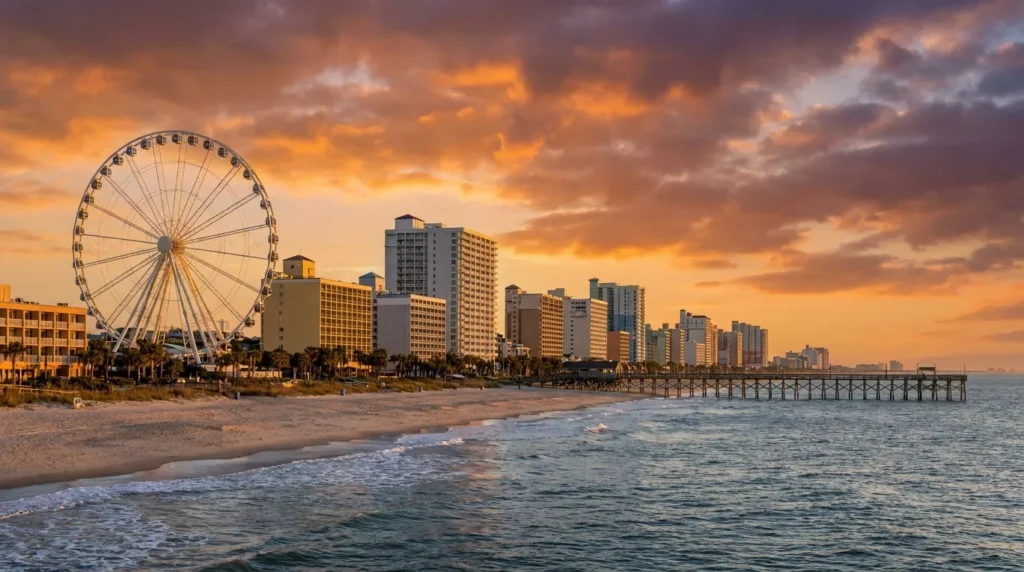
The beach is the star and stretches for miles of firm white sand, with a wooden boardwalk in the center. The Myrtle Beach Boardwalk runs from the 14th Avenue Pier to the 2nd Avenue Pier and concentrates restaurants, shops, and the SkyWheel, a 187-foot Ferris wheel with ocean views. Broadway at the Beach is a giant entertainment complex with Ripley's Aquarium, cinemas, House of Blues, and dozens of restaurants.

For families with children, Family Kingdom Amusement Park offers oceanfront roller coasters at affordable prices, and water parks like Myrtle Waves provide relief in summer. Ripley's Aquarium is one of the most visited attractions, with a shark tunnel and interactive shows. Brookgreen Gardens, in Pawleys Island, combines botanical gardens, bronze sculptures, and a mini-zoo in an impressive space of more than 9,000 acres.

Those who enjoy nature find trails and bird watching at Huntington Beach State Park, with Atalaya Castle and a preserved beach. Myrtle Beach State Park preserves rare maritime forest in the American Southeast. For golfers, the region has more than 80 courses, some designed by names like Arnold Palmer and Jack Nicklaus, with lower rates in fall and spring.

  1. 1Myrtle Beach Boardwalk
  2. 2SkyWheel Myrtle Beach
  3. 3Broadway at the Beach
  4. 4Ripley's Aquarium
  5. 5Family Kingdom Amusement Park
  6. 6Brookgreen Gardens
Parks & green spaces
  • Myrtle Beach State Park
  • Huntington Beach State Park
  • Brookgreen Gardens
  • Market Common Grand Park
  • Withers Swash Park
  • +1 more

Diverse immigrant community, with a strong Eastern European presence

Hispanics from Mexico and Central America dominate the service sector, while Ukrainians, Russians, and Moldovans have formed a visible community since the 2000s.

The immigrant community in Myrtle Beach reflects the city's tourism economy. Hispanic workers, mainly from Mexico, Honduras, Guatemala, and El Salvador, form the largest group and drive kitchens, landscaping, condo cleaning, and construction. Their presence is strongest in Socastee and parts of Conway, with Spanish-language markets, restaurants, and churches spread along Highway 544 and Socastee Boulevard.

An Eastern European community has established itself since the 2000s, primarily coming from Ukraine, Russia, Moldova, and Romania. Many initially arrived through the J-1 visa program and later secured sponsorship to stay. In Forestbrook and some Carolina Forest neighborhoods, one can find Russian markets, Orthodox churches like Holy Trinity Russian Orthodox Church, and self-employed professionals serving the community.

Immigrants from the United Kingdom, Canada, and the Philippines are also a visible presence, generally working in healthcare, hospitality management, or as retirees. There are smaller communities of Brazilians, Indians, and Venezuelans growing in recent years. For newcomers, organizations like New Directions of Horry County, Catholic Charities of South Carolina, and the public library's ESL program offer initial guidance, English classes, and help with documents.

18,000
Foreign-born residents
estimated
Top countries of origin
  • Mexico
  • Ukraine
  • Honduras
  • Russia
  • Moldova
  • Guatemala
  • Philippines
  • United Kingdom
Foreign consulates
  • Honorary Consulate of Mexico in Charleston
  • Consulate General of Mexico in Raleigh
  • Consulate General of the United Kingdom in Atlanta
  • Consulate General of Ukraine in New York
Community organizations
  • New Directions of Horry County
  • Catholic Charities of South Carolina
  • Hispanic Outreach Center
  • Horry County Literacy Council
  • Eastern Carolina Community Foundation

Latest posts

Posts about South Carolina

Coverage and updates related to this destination.

Showing content from South Carolina, as there is no specific data for Myrtle Beach yet.