Visto n' Visa
Blog
Notícias e artigos
Destinations
Careers
Immigrants

Want to live and work in Florence?

Personalized immigration plan with eligible visas, costs, and next steps for your goal!

If you are not eligible, you will know exactly why and what to do to improve your approval chances.

Save up to 12 hours in meetings

No pointless assessments.

Save up to 90%

Save money on vague or unfocused consultations

Avoid Fraud and Mistakes

One mistake can cost you your visa

Total Impartiality

Zero commercial bias

Decide with peace of mind

No toxic urgency

Fast and Accurate

Answers in minutes, no guesswork

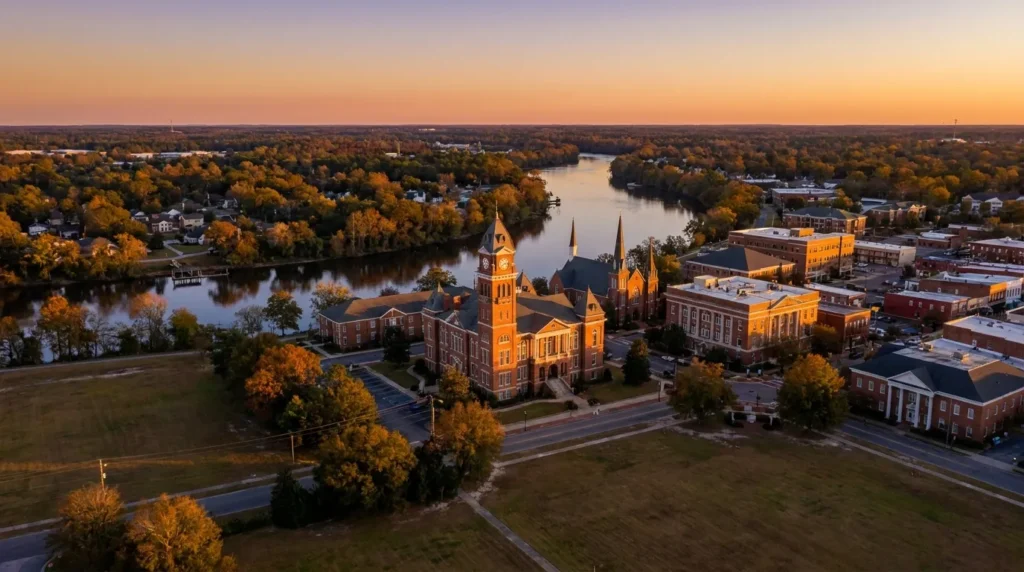
Who lives in Florence, South Carolina

A city of about 40,000 residents, with a strong African American presence, a traditional white Southern community, and recent growth in Hispanic immigrants.

Florence is a racially mixed city, with a population nearly split between white and African American residents, a legacy of the agricultural and railroad history of the Pee Dee. The Black community is longstanding and organized around traditional churches such as Trinity Baptist and Mt. Zion AME, with strong local cultural and political influence.

Over the past two decades the city has received Hispanic immigrants, mainly Mexicans and Central Americans drawn by construction, food processing, and service jobs. There is also a small South Asian community tied to the medical sector, centered around the hospitals. The Brazilian presence is discreet, generally comprising healthcare professionals and construction workers.

English dominates daily life, but Spanish has begun appearing in commercial signage, Pentecostal churches, and public schools, which offer ESL programs. The age profile is balanced, mixing young families, college students, and retirees who choose Florence for its low cost of living and access to hospitals.

Languages spoken
  • English
  • Spanish
Main religions
  • Protestantism (Southern Baptist)
  • Methodism
  • Catholicism
  • African American churches (AME, Baptist)
  • Pentecostalism

Cost of living in Florence: affordable by American standards

Florence is one of the most affordable cities in South Carolina for housing, food, and services, with wages below the national average but genuine budget flexibility.

The cost of living in Florence falls well below the United States average. Rent is the biggest differentiator: two-bedroom apartments in newer buildings cost far less than in Charleston or Greenville, and entire houses for rent are common in residential neighborhoods such as West Florence and Forest Hills.

Everyday groceries are affordable at chains like Walmart, Food Lion, Aldi, and the local Piggly Wiggly. Mid-range restaurants charge modest prices, and the region's classic pecan logs, traditional bars, and Carolina barbecue spots keep dining out inexpensive. Fuel, vehicle registration fees, and car insurance are also lower than in the northeastern United States.

The tradeoff is wages: the economy depends heavily on healthcare, retail, and logistics, so professional incomes fall below those in Charlotte or Atlanta. For remote workers or those in the medical field, Florence offers quality of life with little financial pressure.

Florence

Housing in Florence: single-family homes and affordable rent

The city has more single-story homes than apartment buildings, low rents, and well-defined traditional neighborhoods, with recent expansion to the west and south.

The housing supply in Florence is dominated by single-family homes with yards, typical of the American South. The most sought-after neighborhoods are west of downtown, such as West Florence, Country Club, Forest Hills, and Hoffmeyer, with three- to four-bedroom houses and tree-lined streets. Rents are far lower than in coastal South Carolina cities.

Those who prefer apartments will find modern complexes near I-95 and Hoffmeyer Road, with pools and fitness centers. Downtown has been gaining lofts and renovated buildings around Dargan Street, though this remains a niche market. For families with young children, areas such as Magnolia Mall and South Cashua are often recommended for their schools and safety.

Buying a home in Florence is feasible for middle-class professionals, with prices that still allow single-income households. New construction is concentrated in West Florence, near the Francis Marion campus. Maintenance costs run higher due to storms and humid heat, which take a toll on roofs and air conditioning systems.

Recommended neighborhoods
  • West Florence
  • Forest Hills
  • Country Club
  • Hoffmeyer
  • South Cashua
  • +1 more

Job market in Florence: healthcare, logistics, and manufacturing

The local economy revolves around two major hospitals, distribution near I-95, and plants such as Honda and Otis, rounded out by universities and government.

The largest employer in Florence is the healthcare sector. McLeod Regional Medical Center and MUSC Health Florence (formerly Carolinas Hospital) together account for thousands of positions in nursing, technical, administrative, and medical roles, drawing professionals from across the region. Demand is steady, and those with American healthcare credentials find placement quickly.

Logistics and manufacturing are the second engine. The city's position on I-95, the main artery of the East Coast, has attracted distribution centers from Honda (motorcycles and ATVs), Ruiz Foods, ACS, GE, and Otis Elevator. Florence Regional Airport and the CSX railroad complete the logistics profile.

The public sector carries weight due to the federal courthouse, city hall, and the Florence School District One system. Francis Marion University and Florence-Darlington Technical College generate academic jobs and train the technical workforce. Opportunities for immigrants tend to appear most in construction, food processing, and services.

Dominant sectors
  • Healthcare
  • Logistics and distribution
  • Light manufacturing
  • Education
  • Retail
  • +1 more
Major employers
  • McLeod Regional Medical Center
  • MUSC Health Florence
  • Honda of South Carolina
  • Ruiz Foods
  • Otis Elevator
  • +2 more

Education in Florence: strong public university and technical college

The city has a public state university, a robust technical college, and public and private schools serving the metropolitan area.

Higher education in Florence centers on Francis Marion University, a public state university with about 3,500 students, known for nursing, education, and business programs. Florence-Darlington Technical College offers short-term technical programs and associate degrees in areas such as industrial technology, healthcare, and mechatronics, with strong ties to the local Honda plant.

The presence of the MUSC regional campus brought health research and graduate medical programs to the city, expanding the university ecosystem. Those seeking larger universities will find the University of South Carolina in Columbia and the College of Charleston within a two-hour drive.

The public K-12 system is divided between Florence School District One and neighboring districts. Schools such as West Florence High and South Florence High are among the most sought after. Traditional private options include Florence Christian School and Trinity-Byrnes Collegiate, both with a Christian-oriented curriculum.

Notable universities
  • Francis Marion University
  • Florence-Darlington Technical College
  • MUSC Health Education Center (campus regional)

Healthcare in Florence: two major hospitals serving the entire region

Florence concentrates the hospital infrastructure of northeastern South Carolina, with two large systems and specialized clinics.

McLeod Regional Medical Center is the city's largest employer and functions as the regional referral hospital, with a trauma center, oncology, cardiology, neurology, and maternity services. The McLeod system also includes McLeod Children's Hospital and clinics spread throughout the Pee Dee.

The second anchor is MUSC Health Florence Medical Center (formerly Carolinas Hospital), part of the Medical University of South Carolina's academic system, with a general hospital, emergency department, and medical residencies integrated with academic training. The connection to Charleston provides access to advanced procedures.

Those moving to Florence typically have greater access to specialists than in smaller interior cities. Private American insurance plans (Blue Cross Blue Shield, UnitedHealthcare) are widely accepted. For uninsured immigrants, community clinics such as HopeHealth offer care on a sliding-fee scale, including mental health and dental services.

Healthcare index62.0 / 100
  • Life expectancyyears at birth
    78.4yrs
  • Doctors per 1kpracticing physicians
    3.7
  • Health spendper capita, per year
    $13,473
  • Public systemoverall quality rating
    Fair

Safety in Florence: quiet neighborhoods, some areas to avoid

The city is considered safe in newer residential areas, but with pockets of crime in parts of the east-central area and nighttime commercial zones.

Florence has crime rates above the average for small American cities, particularly for property crimes, but most incidents are concentrated in a limited number of areas. Residential neighborhoods such as West Florence, Forest Hills, and Country Club are considered safe for families.

Areas warranting greater caution are found in the east and northeast of downtown, along corridors such as East Palmetto Street and East Pine Street, with higher rates of theft and drug-related crime. Twenty-four-hour gas stations near I-95 also see a concentration of minor incidents.

In general, the recommendation for newcomers is the same as for any mid-sized American city: live west or south of downtown, avoid walking at night in isolated commercial areas, and keep cars and homes locked. Local police are responsive, and the 911 emergency line covers the entire metropolitan area.

Safer neighborhoods
  • West Florence
  • Forest Hills
  • Country Club
  • Hoffmeyer
  • South Cashua
Areas to avoid
  • East Palmetto Street at night
  • East Pine Street
  • Isolated areas near I-95

Getting around Florence: a car is essential

A car-centric city, with I-95 and I-20 cutting through the region, a small regional airport, and minimal public transit via PDRTA.

Florence is a car-dependent city. The intersection of I-95 and I-20 sits just outside the city, making Florence a near-mandatory stop for travelers heading between New York and Miami along the East Coast. For daily use, the main routes are US-76 (David McLeod Boulevard), Palmetto Street, and Second Loop Road.

Public transit exists but is limited: the Pee Dee Regional Transportation Authority operates local lines and routes to nearby cities such as Lake City and Darlington, useful primarily for those working in retail and at the hospitals. There is no subway or urban rail.

Florence Regional Airport (FLO) has direct flights to Charlotte, connecting to the American Airlines network. For international flights, most travelers use Myrtle Beach (MYR), Charleston (CHS), or Raleigh-Durham (RDU). Cycling is possible in quieter neighborhoods, but the city lacks a structured bike lane network.

Airports
  • FLO — Florence Regional Airport
  • MYR — Myrtle Beach International (about 68 miles away)
  • CHS — Charleston International (about 124 miles away)

What the Climate Is Like Living in Florence

Florence has a humid subtropical climate with long, hot summers and short, mild winters. High humidity and summer thunderstorms are regular features of the seasonal calendar.

Summers are long and hot, with highs near 91°F between June and September and consistently high humidity. Brief afternoon thunderstorms are common, and powerful air conditioning is an essential part of residential comfort.

Winters are short and mild, with highs around 57°F in January and lows rarely dropping below freezing. Snow is a rare occurrence. A medium-weight coat handles most cold days between December and February.

Spring and fall are pleasant, with temperatures ranging between 64°F and 79°F. Annual rainfall averages around 45 inches, peaking in summer. Tropical storms can reach the area in late summer but typically arrive significantly weakened by the time they reach this inland part of the state.

Sunny days / year220 days
Avg high (°F)
  • 74°J
  • 78°F
  • 80°M
  • 84°A
  • 94°M
  • 96°J
  • 98°J
  • 99°A
  • 96°S
  • 89°O
  • 81°N
  • 76°D
Avg low (°F)
  • 23°J
  • 26°F
  • 26°M
  • 35°A
  • 46°M
  • 59°J
  • 68°J
  • 67°A
  • 54°S
  • 42°O
  • 28°N
  • 24°D
Rainfall (")
  • 4"J
  • 4"F
  • 3"M
  • 3"A
  • 4"M
  • 5"J
  • 5"J
  • 6"A
  • 4"S
  • 2"O
  • 3"N
  • 4"D

Florence culture: barbecue, railroads, and the Pee Dee

Local culture blends rural Southern tradition, railroad heritage, and Pee Dee identity, with museums, theater, and a growing food scene.

Florence's cultural identity is that of the Carolina Lowcountry interior: pulled pork barbecue with yellow mustard sauce, sweet tea, peach cobbler, and fish fry. Restaurants such as Schoolhouse BBQ and downtown bars keep the tradition alive, while younger chefs bring updated Southern cuisine to Dargan Street and West Evans Street.

Cultural life centers on the Florence County Museum, the Florence Little Theatre (one of the oldest community theaters in the state), the Hyman Fine Arts Center at Francis Marion, and events such as the Florence Pecan Festival and the South Carolina Pecan Music and Food Festival. Historic churches and Florence National Cemetery, linked to the Civil War, reinforce the Southern character.

Sports unite the city around the Francis Marion Patriots, minor league baseball in the region, and high school football on Friday nights. Despite its modest size, Florence maintains an annual calendar of festivals, parades, and community events that help newcomers feel at home quickly.

Notable dishes
  • Carolina barbecue with mustard sauce
  • Southern fried chicken
  • Shrimp and grits
  • Peach cobbler
  • Pecan pie
  • +1 more
Annual events
  • South Carolina Pecan Music and Food Festival
  • Florence After Five
  • Florence Veterans Day Parade
  • Florence Little Theatre season
  • Taste of Florence

What to see in Florence: museums, parks, and the coast nearby

Local attractions include museums, regional parks, and proximity to the coast, which draws most residents for weekend outings.

The cultural heart of Florence is the Florence County Museum, downtown, with a collection of Southern art, Civil War artifacts, and Pee Dee history. Nearby are the Florence Little Theatre, the War Between the States Museum, and Florence National Cemetery, which helps visitors understand the city's role in the American Civil War.

For nature, Lynches River County Park offers hiking, canoeing, and camping in one of the few preserved wild areas in the state. Jeffries Creek Park, inside the city, has short trails, and Timrod Park is the classic urban park, with a lake and courts.

The main draw of Florence, however, is its location: Myrtle Beach is an hour and a half away, with Grand Strand beaches, and Charleston is two hours away, with colonial culture, dining, and Lowcountry beaches. For Florence residents, weekend trips are part of the lifestyle.

  1. 1Florence County Museum
  2. 2Florence Little Theatre
  3. 3War Between the States Museum
  4. 4Florence National Cemetery
  5. 5Drs. Bruce and Lee Foundation Library
  6. 6Magnolia Mall
Parks & green spaces
  • Lynches River County Park
  • Jeffries Creek Park
  • Timrod Park
  • Maple Park
  • Levy Park

Latest posts

Posts about South Carolina

Coverage and updates related to this destination.

Showing content from South Carolina, as there is no specific data for Florence yet.