Visto n' Visa
Blog
Notícias e artigos
Destinations
Careers
Immigrants

Want to live and work in West Fargo?

Personalized immigration plan with eligible visas, costs, and next steps for your goal!

If you are not eligible, you will know exactly why and what to do to improve your approval chances.

Save up to 12 hours in meetings

No pointless assessments.

Save up to 90%

Save money on vague or unfocused consultations

Avoid Fraud and Mistakes

One mistake can cost you your visa

Total Impartiality

Zero commercial bias

Decide with peace of mind

No toxic urgency

Fast and Accurate

Answers in minutes, no guesswork

Who lives in West Fargo: young families and some immigrant communities

A predominantly white population of Scandinavian and German descent, with growth driven by young families from Fargo, military personnel, technology professionals, and immigrants seeking good schools.

West Fargo's profile is that of a young, middle-class American family. Norwegian, German, and Swedish heritage remains strong, with surnames ending in -son and -sen appearing on any school roster. Growth is driven by families relocating from Fargo, neighboring Minnesota, and other parts of the Midwest in search of new homes and better schools.

The Latino community has grown in recent years, predominantly Mexican and Venezuelan, drawn by jobs in construction, healthcare, and food processing in Fargo. Bhutanese, Somali, and Nepali refugees resettled in the metropolitan area are also present, though most live within Fargo proper. International students from NDSU sometimes reside in West Fargo, in apartments near I-94.

The Brazilian community is small and dispersed. The median age skews young, driven by families with school-age children. Couples in their thirties with young children, relocating from the American Northeast or other parts of the region in search of more space, better schools, and a quieter environment, are a common sight.

Languages spoken
  • English
  • Spanish
  • Somali
  • Nepali
  • Bosnian
Main religions
  • Lutheranism
  • Catholicism
  • No religion
  • Various evangelical denominations
  • Islam

Cost of living in West Fargo: low, with rent pushed up by growth

Even with rapid growth, West Fargo maintains a cost of living below the American average. Rent has risen with demand, but homes for purchase remain accessible. Winter heating costs add up.

Cost of living is one of the city's main attractions. New homes for purchase are priced well below what comparable properties cost in major metro areas or Sun Belt suburbs. Modern apartments with heating included are plentiful along the 13th Avenue corridor. North Dakota has a low state income tax, which helps households save at the end of the month.

The major expense is heating from November through April. New homes with proper insulation and double-pane windows soften the impact. Electricity is supplied by Xcel Energy and local cooperatives, with rates in a mid-range tier. Combined sales tax runs around 7.5 percent.

For everyday needs, supermarkets such as Hornbacher's, Cashwise, Walmart, and Costco cover most shopping. Restaurants along 13th Avenue offer solid variety, including chains like Texas Roadhouse, Olive Garden, and Buffalo Wild Wings, alongside Asian and Mexican options. Fuel costs less than in most of the U.S., and property taxes remain in a moderate range.

West Fargo

Housing in West Fargo: new homes in modern developments and family neighborhoods

West Fargo is dominated by new residential construction. Developments such as Eagle Run, Brooks Harbor, and Shadow Wood offer large homes in quiet neighborhoods. Apartments are growing along 13th Avenue.

Most of the housing supply comes from new developments on the south and west sides of the city. Eagle Run, Brooks Harbor, Shadow Wood, and Wild Rice Estates are planned neighborhoods with large homes, parks, community pools, and internal bike paths. Homes typically feature three to five bedrooms, a two-car garage, and a generous backyard. Young families make up the primary market.

Modern apartments with pools, fitness centers, and heating included are concentrated along 13th Avenue, Sheyenne Street, and around the Sheyenne 17 corridor. These are common options for newcomers not yet ready to buy. The east side, closer to Fargo, has older homes and more established neighborhoods such as Independence and Sunnyside.

Purchasing property is feasible even for families on median incomes. Local real estate agencies such as Park Co. and Berkshire Hathaway HomeServices dominate the market. American credit history is required for conventional financing, though state first-time buyer programs are available. Winter makes a heated garage and streets maintained by the neighborhood association important priorities.

Recommended neighborhoods
  • Eagle Run
  • Brooks Harbor
  • Shadow Wood
  • Wild Rice Estates
  • Sheyenne 17 corridor
  • +2 more

Job market in West Fargo: business parks and a commute to Fargo

West Fargo is absorbing industrial and logistics companies relocating from Fargo. Most residents work in Fargo, in healthcare, technology, or services, with a short commute along I-94.

West Fargo has developed its own business park corridor with industrial and logistics companies, particularly along Sheyenne 17 and the I-94 frontage. The West Fargo Industrial Park hosts distributors, small manufacturers, and processing facilities. Cardinal Health and companies tied to agricultural equipment have significant operations in the city.

Most residents, however, commute to Fargo, with an average travel time of 15 to 25 minutes. The region's major employers are all in Fargo: Sanford Health, Essentia Health, Microsoft, Bell Bank, NDSU, and RDO Equipment Co. West Fargo Public Schools is also a major local employer, with thousands of staff across its campus system.

For newcomers without fluent English, restaurants, construction, cleaning, and food processing offer rapid entry points, with wages above the rural American average. Low regional unemployment eases access to the job market, and commuting between West Fargo and Fargo is straightforward, though it relies almost entirely on personal transportation.

Dominant sectors
  • Public education
  • Logistics and distribution
  • Agricultural equipment
  • Construction
  • Healthcare (via Fargo)
  • +1 more
Major employers
  • West Fargo Public Schools
  • Cardinal Health
  • Cass County (administration)
  • RDO Equipment (nearby)
  • Walmart Distribution
  • +1 more

Education in West Fargo: award-winning public schools and a family focus

West Fargo Public Schools is considered one of the best public school systems in North Dakota and the primary reason many families relocate here. Universities are in Fargo, just a few minutes away.

West Fargo Public Schools is a statewide reference for quality and management. Schools such as Sheyenne High and West Fargo High have high college acceptance rates and offer a wide range of advanced programs, sports, and extracurricular activities. The district invests in new infrastructure, with modern schools built to accommodate population growth.

An English as a Second Language program serves immigrant students, with ESL teachers and translators in multiple languages, primarily Spanish, Somali, and Nepali. Families can choose among several elementary, middle, and high schools depending on their neighborhood. The academic calendar follows the American standard, beginning in August with summer break in June and July.

For higher education, NDSU and MSUM are just a few minutes away in Fargo and Moorhead. Concordia College in Moorhead offers a liberal arts education. For technical training, North Dakota State College of Science and Rasmussen University provide flexible options. Private religious schools are located mainly in Fargo.

Notable universities
  • NDSU (in Fargo, nearby)
  • Minnesota State University Moorhead (nearby)
  • Concordia College (nearby)
  • Rasmussen University

Healthcare in West Fargo: local clinics and major hospitals in Fargo

West Fargo has its own Sanford and Essentia clinics. The major hospitals are in Fargo, just a short drive away. The standard American system applies, with health insurance as the central factor.

West Fargo has Sanford Health and Essentia Health clinics offering routine visits, pediatrics, gynecology, and outpatient care. The large hospitals, with emergency departments, maternity wards, and complex specialties, are in Fargo, 10 to 15 minutes away. Sanford Medical Center Fargo is the largest hospital in the state, covering trauma, cardiology, oncology, and transplants.

As in any American city, health insurance is essential. Employees of Sanford, Essentia, West Fargo Public Schools, and local companies typically have negotiated plans. North Dakota Medicaid covers children, pregnant women, eligible refugees, and some low-income categories. Those without coverage turn to community clinics with income-based sliding-scale fees.

In an emergency, ERs in Fargo treat anyone, but bills arrive afterward and can be substantial without insurance. Specialists typically have wait times of several weeks. Mental health services have good availability in the metropolitan area, with therapists in multiple languages. Dental care is separate, and costs can be high without a dental plan.

Healthcare index65.0 / 100
  • Life expectancyyears at birth
    78.4yrs
  • Doctors per 1kpracticing physicians
    3.7
  • Health spendper capita, per year
    $13,473
  • Public systemoverall quality rating
    Good

Safety in West Fargo: one of the safest cities in the United States

West Fargo frequently appears in rankings of the safest cities in the U.S. Violent crime is very rare, neighborhoods are quiet, and family suburban life defines the local experience.

Crime rates in West Fargo are among the lowest in the country for cities of comparable size. Residential neighborhoods are extremely quiet, with very few incidents of violent crime. Police reports typically involve isolated thefts from unlocked vehicles, break-ins at open garages, and traffic violations. Families walk at night with a complete sense of security.

The West Fargo Police Department has a strong local reputation and invests in community programs. School resource officers are assigned to schools and maintain close relationships with students. Events such as National Night Out bring residents together in parks and strengthen ties with law enforcement. Domestic disputes occur as they do anywhere.

The greater risk remains the winter. Snowstorms, wind chills below -40°F in January, cutting winds, and icy roads require caution. Hypothermia cases appear every year, and those arriving from tropical climates need to invest in a thermal coat, insulated boots, and gloves before stepping outside on a cold day.

5.8
Homicides per 100k
per year
Safety index
70.0
Crime index
30.0
Safer neighborhoods
  • The Preserve
  • Eagle Run
  • Berkeley Square
  • Brooks Harbor
  • Charleswood
  • Westport Beach
Areas to avoid
  • Commercial stretches along 13th Avenue, empty at night
  • Industrial areas near Sheyenne Street late at night

Transportation in West Fargo: I-94, integrated bus service, and car dependence

West Fargo relies almost entirely on the car. I-94 cuts through the city and connects to Fargo in minutes. The MATBUS system links to downtown Fargo. Hector Regional Airport is nearby.

I-94 runs east-west through West Fargo, connecting to I-29 and Fargo in just a few minutes. Most destinations within the city are close together and traffic is light, with only occasional congestion during peak hours. For longer trips, Hector International Airport in Fargo is 15 minutes away and operates direct flights to Minneapolis, Chicago, Denver, and Florida cities.

MATBUS is the integrated bus system serving Fargo, West Fargo, and Moorhead, with routes covering 13th Avenue, the West Acres Mall, and major commercial corridors. Service runs during business hours, with limited schedules on weekends. Uber and Lyft cover the city with reasonable wait times.

The Amtrak Empire Builder passenger train stops in Fargo, with a station in the neighboring downtown. A car is essentially required for those working outside the main commercial corridors. Obtaining a North Dakota driver's license is straightforward. In winter, appropriate tires, a stronger battery, and an emergency kit are essential.

18 min
Avg commute
28
Walkability
Airports
  • FAR — Hector International Airport (nearby, in Fargo)
  • Bike infrastructure

What the climate is like living in West Fargo

West Fargo has an extreme humid continental climate, with very long, frigid winters, short hot summers, and strong winds across the open plains.

Winters are severe and prolonged, with lows frequently dropping below -22 degrees Celsius (around -8°F). Blizzards are a regular occurrence, and wind across the plains drives wind chill to extreme levels.

Summer is short, sunny, and warm, with highs between 28 and 31 degrees Celsius in July, moderate humidity, and afternoon thunderstorms. Occasional tornadoes occur in spring and early summer.

Residents need robust heating systems, extreme-weather winter coats, a heated garage, and snow tires. Air conditioning helps during summer, and winter preparation typically begins in October.

Sunny days / year200 days
Avg high (°F)
  • 20°J
  • 20°F
  • 37°M
  • 50°A
  • 68°M
  • 83°J
  • 84°J
  • 81°A
  • 73°S
  • 55°O
  • 40°N
  • 27°D
Avg low (°F)
  • J
  • F
  • 18°M
  • 31°A
  • 46°M
  • 61°J
  • 64°J
  • 62°A
  • 55°S
  • 39°O
  • 25°N
  • 12°D
Rainfall (")
  • 1"J
  • 1"F
  • 1"M
  • 3"A
  • 3"M
  • 3"J
  • 3"J
  • 3"A
  • 3"S
  • 2"O
  • 1"N
  • 2"D

Culture in West Fargo: family suburban life and community events

The culture is typically American suburban: school sports, neighborhood gatherings, active churches, and community events at Lions Conservancy Park. Neighboring Fargo offers the region's larger cultural scene.

West Fargo has the culture of a Midwest family city. Bonanzaville USA is the signature cultural landmark, with a reconstructed historic village and museums covering the railroad, agriculture, and 19th-century frontier life. The Red River Valley Fair takes place every summer, drawing thousands of visitors with a rodeo, concerts, amusement rides, and agricultural exhibitions.

Lions Conservancy Park and Veterans Memorial Park anchor outdoor life in summer, with pools, trails, and community events. Public schools such as West Fargo High and Sheyenne High have strong sports traditions, with hockey, football, and track filling stands on weekends. Lutheran and Catholic churches play a significant social role in the community.

For a broader cultural scene, Fargo is right next door, offering the Fargo Theatre, Plains Art Museum, festivals, and quality dining. West Fargo's food scene is dominated by national chains like Olive Garden, Texas Roadhouse, and Buffalo Wild Wings, though Mexican and Asian options and craft breweries are growing along 13th Avenue.

West Fargo

What to do in West Fargo, North Dakota's fast-growing suburb

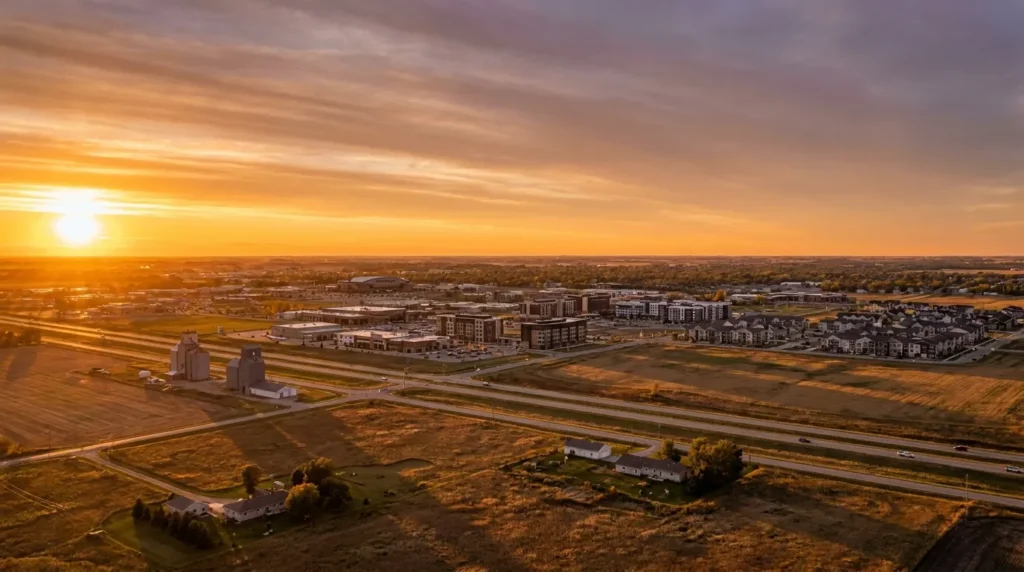
West Fargo expanded rapidly over recent decades as a residential suburb of Fargo. It features new neighborhoods, highly rated schools, and plays a central role in the state's agricultural and technology economy.

The standout attraction is Bonanzaville USA, a living history museum featuring more than 40 restored historic buildings — including a railroad depot, church, schoolhouse, farmstead, and village — that portray the Scandinavian and German immigrant experience of the late 19th century. Events such as Pioneer Days in summer draw thousands of visitors from across the Red River Valley region.

For everyday recreation, Lights Out Trampoline Park, Rustad Recreation Center, and West Fargo Sports Arena anchor family activities. Veterans Memorial Arena hosts West Fargo High School sporting events, and the Sheyenne Diversion Trail offers a paved path for cycling and walking used year-round (with caution in winter). West Fest serves as the annual community festival.

On weekends, Downtown Fargo is a five-minute drive away, with the Fargo Theatre, Plains Art Museum, and the Hjemkomst Center in Moorhead — home to a full-scale Viking ship replica. Lake Sakakawea and Theodore Roosevelt National Park, four to five hours out, are classic destinations for longer getaways. Minneapolis is 3.5 hours east via I-94 for concerts and professional sports.

  1. 1["Bonanzaville USA"
  2. 2"Red River Valley Fairgrounds"
  3. 3"Veterans Memorial Arena"
  4. 4"Lights of the North (seasonal)"
  5. 5"Sheyenne Street historic district"
  6. 6"Cass County Historical Society Museum"
Nightlife3.0 / 10
Parks & green spaces
  • ["Rendezvous Park"
  • "Veterans Memorial Park"
  • "Elmwood Park"
  • "Lions Park"
  • "Eagle Run Park"
  • +1 more

Latest posts

Posts about North Dakota

Coverage and updates related to this destination.

Showing content from North Dakota, as there is no specific data for West Fargo yet.