Visto n' Visa
Blog
Notícias e artigos
Destinations
Careers
Immigrants

Want to live and work in Wahpeton?

Personalized immigration plan with eligible visas, costs, and next steps for your goal!

If you are not eligible, you will know exactly why and what to do to improve your approval chances.

Save up to 12 hours in meetings

No pointless assessments.

Save up to 90%

Save money on vague or unfocused consultations

Avoid Fraud and Mistakes

One mistake can cost you your visa

Total Impartiality

Zero commercial bias

Decide with peace of mind

No toxic urgency

Fast and Accurate

Answers in minutes, no guesswork

Who lives in Wahpeton

A predominantly white population of German and Scandinavian descent, with a small Latino and Native American presence. A predominantly Christian religious community, particularly Lutheran and Catholic.

Wahpeton's population is predominantly white, with German, Norwegian, and Swedish roots. This is a historical characteristic of the entire region, settled by European immigrants in the late 19th century. Surnames such as Johnson, Anderson, and Schmidt are common.

There is also a Latino presence, linked primarily to farm work and the animal protein industry in the region. The Sisseton Wahpeton Oyate reservation is located a few kilometers away, on the South Dakota side, and brings Native American cultural activity to the area.

English is the dominant language. Spanish appears in some work environments. Religious life revolves around Lutheran (ELCA) and Catholic churches, with some evangelical congregations and a historically present smaller Bahá'í community.

Languages spoken
  • English
  • Spanish
Main religions
  • Lutheranism (ELCA)
  • Catholicism
  • Evangelical churches
  • Bahá'í

Low cost of living, typical of the American interior

Rent, groceries, and utilities well below the U.S. national average. Homeownership is within reach for those with stable income. A car is an unavoidable expense.

Wahpeton ranks among the most affordable American cities. A one- or two-bedroom apartment rents for a fraction of what is paid in any coastal U.S. city. Buying a home is also feasible for those with stable employment, with three-bedroom houses and yards available at accessible price points.

The energy bill is heavier in winter due to heating costs. Internet is reliable and inexpensive. Local stores including Hugo's and Walmart Supercenter cover the basics, and grocery prices are competitive. Restaurants are few and simple, so those who cook at home save considerably.

The main budget burden is the car. Without real public transportation, owning a vehicle is mandatory, meaning insurance, fuel, maintenance, and snow tires. Even so, on balance, living in Wahpeton costs considerably less than in almost any major American city.

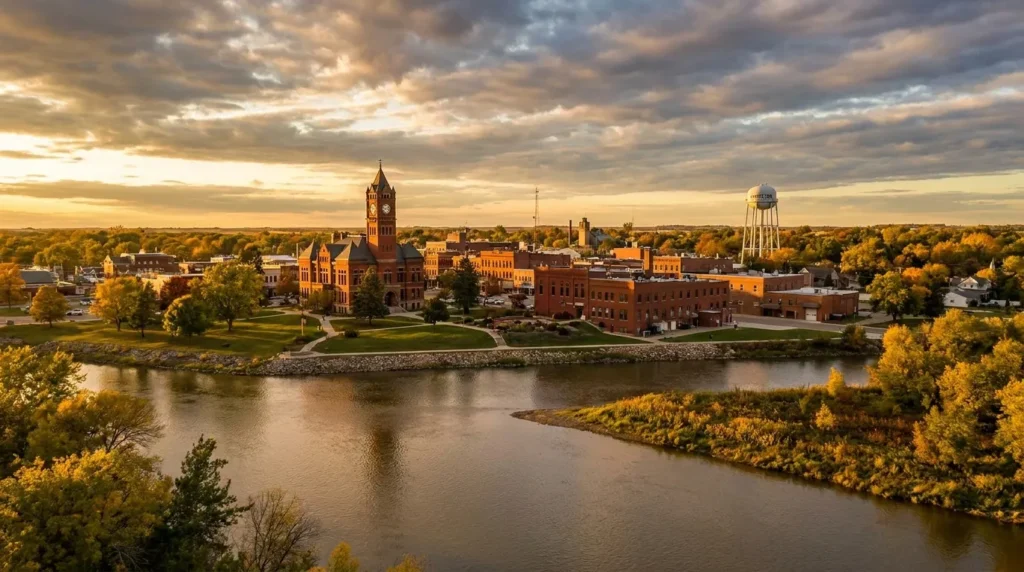
Wahpeton

Houses with yards and affordable rents

A market dominated by single-family homes with basements and garages. Older neighborhoods near downtown and newer developments to the north and west of the city.

Wahpeton's housing stock is dominated by single-family homes, many built between the 1950s and 1980s, with finished basements and one- or two-car garages. Areas near the historic downtown feature older, charming, tree-lined houses.

For those seeking newer construction, subdivisions to the west and north of the city have homes from the 2000s onward, with better insulation, double garages, and open kitchens. Apartments exist but are less common than houses. Demand typically comes from NDSCS students and professionals new to the city.

It is worth checking the condition of the roof, furnace, and insulation before closing. Poorly insulated houses become a burden in winter and drive up the gas bill. A local agent can help clarify property tax rates, which in North Dakota are moderate.

Recommended neighborhoods
  • Historic Downtown Wahpeton
  • Northside
  • Westside (near NDSCS)
  • Chahinkapa Park area

Industry, agriculture, and public services

An economy sustained by manufacturers such as ComDel and WCCO Belting, agriculture, the NDSCS technical college, and local healthcare services. Historically low unemployment.

Wahpeton has a stronger industrial economy than its size would suggest. ComDel Innovation manufactures equipment and WCCO Belting is a world reference in agricultural conveyor belts. Cargill maintains operations in the region, tied to grains and animal protein.

The North Dakota State College of Science (NDSCS) is a major employer and center for technical training, attracting instructors, technicians, and administrative staff. CHI St. Francis Health is the local hospital and employs nurses, technicians, and administrative workers. Public employment at the city, county, and school district levels is also available.

For newly arrived immigrants, positions on factory floors, in logistics, maintenance, cleaning, and food services are the most common entry points. Those with technical training in welding, industrial maintenance, or logistics will find genuine and stable demand.

Dominant sectors
  • Industrial manufacturing
  • Agriculture and agribusiness
  • Technical education
  • Healthcare
  • Public services
Major employers
  • WCCO Belting
  • ComDel Innovation
  • Cargill
  • North Dakota State College of Science (NDSCS)
  • CHI St. Francis Health
  • +1 more

Strong technical training for a city of this size

NDSCS offers technical programs and associate degrees that are highly sought after in the region. Public schools maintain good standards and there are private Christian options.

The standout name in education in Wahpeton is the North Dakota State College of Science (NDSCS), one of the best technical community colleges in the United States. It offers programs in welding, industrial maintenance, nursing, diesel mechanics, precision agriculture, and information technology, with very high employment placement rates.

Elementary and secondary education is handled by Wahpeton Public Schools, with schools such as Wahpeton High School and Central Elementary. St. John's Catholic School is a private option for Catholic families. Schools offer ESL support for non-native English speakers.

For those seeking a four-year university, North Dakota State University (NDSU) in Fargo and Minnesota State University Moorhead are about an hour away. Many NDSCS students transfer after two years to pursue a bachelor's degree.

Notable universities
  • North Dakota State College of Science (NDSCS)
  • North Dakota State University (NDSU), Fargo
  • Minnesota State University Moorhead

Local hospital and referrals to Fargo

Primary care and emergency services covered by CHI St. Francis Health. For complex cases, Fargo hospitals serve as the regional referral centers, with Sanford and Essentia.

Healthcare in Wahpeton relies on CHI St. Francis Health, a local hospital with an emergency department, basic maternity services, imaging, and affiliated clinics. For day-to-day needs, including consultations, exams, and minor procedures, it serves the majority of the population's needs.

When a case requires complex specialty care such as oncology, advanced cardiology, neurosurgery, or serious trauma, patients are referred to Fargo. There, Sanford Medical Center and Essentia Health are two large hospitals with advanced technology and regional referral status.

The American healthcare system operates with private insurance, generally provided by employers. Those arriving as immigrants should confirm their coverage, in-network provider list, and deductible amount before seeking care. Emergency care is provided regardless of insurance status, but generates a bill.

Healthcare index60.0 / 100
  • Life expectancyyears at birth
    78.4yrs
  • Doctors per 1kpracticing physicians
    3.7
  • Health spendper capita, per year
    $13,473
  • Public systemoverall quality rating
    Fair

A quiet city with low crime rates

Wahpeton has very low violent crime rates, typical of the rural Midwest. The most common issues are petty theft and traffic violations.

By American standards, Wahpeton is a safe city. Violent crimes are rare and tend to occur in domestic contexts or related to alcohol and drug use, not random attacks. Walking at night downtown or in residential neighborhoods is generally not a cause for concern.

The most common incidents are petty theft, vandalism, drunk driving, and traffic violations. Accidents on snow and ice during winter are a real concern and require appropriate tires and more cautious driving.

As in any small city, community and neighborhood ties function as an informal safety network. Locking the car and home, and exercising common sense near bars at night, addresses 99 percent of risks. Tornadoes and severe summer storms also merit attention: the city has a siren system and shelters.

Safer neighborhoods
  • Residential neighborhoods west of NDSCS
  • Northside
  • Historic downtown during the day
  • Chahinkapa Park area
Areas to avoid
  • Isolated industrial zones at night
  • Rural roads during winter storms

A car-dependent city with no commercial airport of its own

No regular public transportation. A car is essential. The nearest commercial airport is Fargo (FAR), about 47 miles north, with flights to major hubs.

Wahpeton is built for the car. Streets are wide, parking is available almost everywhere, and traffic is virtually nonexistent. There is no meaningful urban bus network; on-demand transportation programs serve elderly residents and those with reduced mobility.

For air travel, the most commonly used airport is Hector International (FAR) in Fargo, about an hour's drive north via US-81. Direct flights depart from there to Minneapolis (MSP), Denver, Chicago, and other hubs. No passenger rail service passes through the city; the nearest Amtrak station is in Fargo (Empire Builder line).

Cycling is viable in summer for short trips downtown and to parks, but cycling infrastructure is limited. In winter, snow and ice make biking impractical for months at a time. US-75 and I-29 connect the city quickly to Fargo, Sioux Falls, and Minneapolis.

Airports
  • FAR — Hector International (Fargo, ~47 mi)
  • Harry Stern Airport (general aviation, no commercial flights)

What the Climate Is Like Living in Wahpeton

Wahpeton has an extreme humid continental climate, with long and severe winters, short and warm summers, and abundant mosquitoes along the Red River banks.

Winters are long and severe, with lows frequently dropping below -8 degrees Fahrenheit and regular blizzards. Wind across the plains drives wind chills to dangerous levels.

Summer is short, sunny, and warm, with highs between 82 and 88 degrees Fahrenheit in July, moderate humidity, and abundant mosquitoes. Severe storms with occasional tornadoes are common in July.

Residents need robust heating, extreme winter outerwear, snow tires, and a heated garage. Air conditioning helps in summer, and insect repellent is essential during the humid months.

Sunny days / year200 days
Avg high (°F)
  • 21°J
  • 21°F
  • 38°M
  • 51°A
  • 69°M
  • 84°J
  • 84°J
  • 81°A
  • 74°S
  • 56°O
  • 41°N
  • 29°D
Avg low (°F)
  • J
  • F
  • 20°M
  • 32°A
  • 47°M
  • 62°J
  • 64°J
  • 62°A
  • 55°S
  • 40°O
  • 27°N
  • 14°D
Rainfall (")
  • 1"J
  • 1"F
  • 1"M
  • 3"A
  • 3"M
  • 2"J
  • 2"J
  • 3"A
  • 2"S
  • 3"O
  • 1"N
  • 2"D

Small-town culture of the northern plains

Cultural life revolves around community events, NDSCS sports, the Chahinkapa Zoo, and seasonal festivals. Signature foods include hot dish, walleye, and knoephla soup.

Wahpeton's cultural life is that of a small city in the northern United States: understated, organized, and tied to the seasons. NDSCS events, especially collegiate games, bring entire families together. Concerts and community theater take place at Hughes Memorial Auditorium.

Chahinkapa Park is the heart of local recreation: zoo, water park, historic carousel, trails, and the point where the Red River originates. Bagg Bonanza Farm, a short distance outside the city, tells the story of the late-19th-century mega wheat farms and opens for visits in summer.

In the kitchen, Midwestern and Scandinavian-German heritage dishes dominate: hot dish (an American casserole with noodles, meat, and cream of mushroom sauce), river fish such as walleye, knoephla soup, lutefisk at Lutheran festivals, and German kuchen for dessert.

Notable dishes
  • Hot dish
  • Grilled walleye
  • Knoephla soup
  • Norwegian lefse
  • Lutefisk
  • +1 more
Annual events
  • Chahinkapa Park Summerfest
  • NDSCS Homecoming
  • Bagg Bonanza Farm Open House
  • Holiday Lights at Chahinkapa
  • Wahpeton-Breckenridge Riverfest

Parks, river, and agricultural history

Wahpeton's attractions revolve around Chahinkapa Park, the Red River, the zoo, and historical museums. Everything on a small-city scale, but accessible.

The main attraction is Chahinkapa Park, along the banks of the Red River. There, visitors find the Chahinkapa Zoo, Chahinkapa Aquatic Park, the Prairie Rose Carousel (restored from the 1920s), and walking trails. It is the gathering place of the city on any summer weekend.

The Richland County Historical Museum chronicles the history of the region's settlement, the arrival of the railroad, and mechanized agriculture. Bagg Bonanza Farm, a short distance outside the city, is a national historic site preserving one of the late-19th-century mega wheat farms.

For those who enjoy fishing and canoeing, the Red River and Bois de Sioux are accessible year-round. In winter, ice fishing, cross-country skiing, and snowmobiling are on the menu. The Wahpeton Civic Center skating rink opens during the cold season.

  1. 1Chahinkapa Park
  2. 2Chahinkapa Zoo
  3. 3Prairie Rose Carousel
  4. 4Chahinkapa Aquatic Park
  5. 5Bagg Bonanza Farm Historic Site
  6. 6Richland County Historical Museum
Parks & green spaces
  • Chahinkapa Park
  • Kidder Recreation Area
  • Island Park (Breckenridge, MN)
  • Bois de Sioux River Trail

Latest posts

Posts about North Dakota

Coverage and updates related to this destination.

Showing content from North Dakota, as there is no specific data for Wahpeton yet.